
Denon DL-110 High Output Moving Coil Cartridge
4.1Editor score
1.6 mV high output
Works with MM phono inputs
Elliptical solid diamond stylus
Japanese handspun construction
Our High Output Mc Cartridge guide compares ten moving-coil models from Sumiko, Hana, Denon, Ortofon, and Audio-Technica for vinyl systems.
A high output moving-coil cartridge translates fine vinyl grooves into a musical signal while offering the detail and tracking associated with MC designs. The right choice depends on your phono stage, tonearm, system, and musical priorities, making cartridge specifications and compatibility at least as important as appearance.
This guide compares ten cartridges using their stated output classifications, construction details, stylus and cantilever choices, electrical requirements, and supplied product information. It includes genuine high-output models as well as several low-output alternatives that require more demanding amplification, because those differences are essential when building a compatible system.
Each review explains the cartridge's strongest qualities, practical trade-offs, and ideal pairing situation. The top selections cover a convenient entry point, a refined high-output option, and a premium model. Product availability and prices can change, so confirm the current specifications, condition, and return terms before purchasing.
4.1Editor score

4.6Editor score

5.0Editor score
The comparison below places the ten cartridges by output type, generator design, stylus arrangement, and practical system requirements. It is especially useful for identifying which options can work with a conventional MM phono input and which need a dedicated moving-coil stage or step-up device.





The Sumiko Blue Point No. 3 High Output MC Moving Coil Phono Cartridge earns a 4.6 rating and stands out as a refined option for listeners who specifically want a genuine high-output moving-coil model. Its defining appeal is the combination of an open-body Reference-style presentation, copper generator coils, and high-output operation, giving it a more specialized identity than a generic cartridge upgrade.
We may earn a commission when you buy through this link, at no additional cost to you.
Sumiko describes the cartridge as part of its latest Reference open-body moving-coil family and emphasizes refinement of an existing MC system. The open construction makes the generator assembly visually prominent while potentially helping the design communicate its technical purpose. High-purity copper coils are the most concrete material specification supplied, offering a clear point of difference in the electrical generator.
There are practical constraints to consider. Although this is the high-output version, it remains a moving-coil cartridge rather than a universal MM cartridge, so the associated phono stage must be selected carefully. The supplied data does not state output voltage, compliance, tracking force, or load resistance, making direct electrical comparison with models that publish full specifications impossible without consulting the manufacturer's current documentation.
This cartridge makes the most sense for an owner with an MC-capable phono stage who values refinement and recognizable Sumiko construction. It is less suitable as a blind drop-in upgrade for a receiver limited to MM input. Overall, it is the most balanced editorial selection because it directly addresses the high-output request while adding meaningful design and material credentials.
Sumiko explicitly identifies this as the high-output edition, which narrows the main compatibility concern compared with a low-output moving-coil cartridge. It still deserves confirmation against the cartridge's published electrical data and the gain of the intended phono stage.
The open-body Reference format and high-purity copper coils are the cartridge's most visible engineering distinctions. They make it attractive to buyers who prefer a visually purposeful generator and a cartridge with a clearly defined coil material.
We may earn a commission when you buy through this link, at no additional cost to you.
The Sumiko Songbird High Output MC Phono Cartridge has a 5.0 rating and is the premium high-output choice in this guide. It combines high-output moving-coil operation with a long 7-micron stylus face, an open-architecture body, and membership in Sumiko's prestigious Reference Series.
We may earn a commission when you buy through this link, at no additional cost to you.
The long stylus face is the most immediately useful feature for comparison. A longer contact area can support stable playback across the record, while the high-output generator reduces the amplification burden relative to many low-output MC designs. Sumiko specifically says the cartridge is intended to add excitement to otherwise anemic classical system setups, suggesting a more assertive musical intent.
The trade-off is that premium positioning does not remove the need for sensible system matching. A high-output cartridge may work with more conventional gain, but its published output, impedance, tracking force, and load requirements should still be checked before installation. A capable phono stage also gives the Songbird a better chance of realizing its intended detail and dynamic character.
The Songbird is best for an established system that can accommodate a high-output MC cartridge and wants a more sophisticated upgrade than a conventional plug-and-play model. With a perfect user rating and a clearly defined high-output specification, it is the strongest premium recommendation here for listeners who value musical energy as much as refinement.
The specified 7-micron stylus face distinguishes the Songbird from many entry-oriented cartridges. It is one of the clearest reasons to consider this model when stable, confident groove tracking is a priority.
Sumiko's stated goal is to bring excitement to classical systems that may sound restrained. Buyers who prioritize presence, articulation, and musical momentum should find that intent more relevant than purely technical specification lists.
We may earn a commission when you buy through this link, at no additional cost to you.
The Hana EL Series Moving Coil Cartridges carry a 4.8 rating and offer a strong combination of customer reception and specialist-brand identity. The Hana name is closely associated with hand-built moving-coil cartridges, making this a relevant selection for a listener seeking something more considered than a general-purpose replacement.
We may earn a commission when you buy through this link, at no additional cost to you.
The supplied product information is unusually limited, identifying the product simply as Hana EL Series Moving Coil Cartridges. It does not provide the output voltage, stylus form, cantilever material, compliance, or recommended load. As a result, the listing should be treated as a series-level entry rather than a model with every technical parameter defined.
Compatibility is the chief uncertainty. EL is commonly associated with a particular family, but the product title itself does not explicitly call this listing a high-output version. A buyer should verify the exact variant, output voltage, and recommended load against the phono stage before ordering. That diligence is especially important if the intended amplifier has only a standard MM input.
Hana's 4.8 rating and specialist construction make this an appealing option for a system already designed around quality moving-coil cartridges. It may provide a more distinctive upgrade path than the simpler DL-110 alternatives. Nevertheless, incomplete published specifications make it a less transparent choice for a first-time MC buyer than the clearly labeled high-output models in this guide.
Hana is a specialist analog brand, and the EL Series listing connects buyers with a cartridge family designed for serious moving-coil listening. Its appeal lies in the design pedigree as much as any single published specification.
Because the supplied title does not disclose output voltage or load requirements, confirm the precise cartridge version and its electrical compatibility before making a purchase.
We may earn a commission when you buy through this link, at no additional cost to you.
The Hana MC Moving-Coil Stereo Cartridge with Nude Microline Tip – MH (High Output) has a 5.0 rating. Its title clearly identifies the MH model as the high-output member of a closely related pair, giving it a more direct fit for the search term than listings that omit the output classification.
We may earn a commission when you buy through this link, at no additional cost to you.
Its nude Microline tip is the principal technical attraction in the supplied information. The design implies a fine contact geometry intended to retrieve detailed information from record grooves. Hana's focus on moving-coil construction also distinguishes it from the broad category of replaceable magnetic cartridges, potentially appealing to listeners who want a more deliberate analog upgrade.
A high-output designation does not mean it can drive every integrated amplifier's phono section. Moving-coil cartridges still require compatible input impedance and sufficient gain, and the absence of detailed electrical figures in the listing makes prior verification important. The relationship between the MH and ML versions is especially relevant: they share a closely related name but are intended to suit different output categories.
This is a compelling pick for a serious system with a dedicated MC phono stage or a suitable step-up solution. The perfect rating is encouraging, while the explicit high-output specification and Microline tip give it a clearer identity than the broader EL Series listing. Confirm the published load and tracking specifications before installation.
A nude Microline tip provides a clear technical identity and is the central reason to consider the MH over a generic high-output moving-coil cartridge.
The MH and ML versions use closely related names but differ in output level. Listeners with a more capable phono stage should consult each model's electrical data rather than assuming they are interchangeable.
We may earn a commission when you buy through this link, at no additional cost to you.
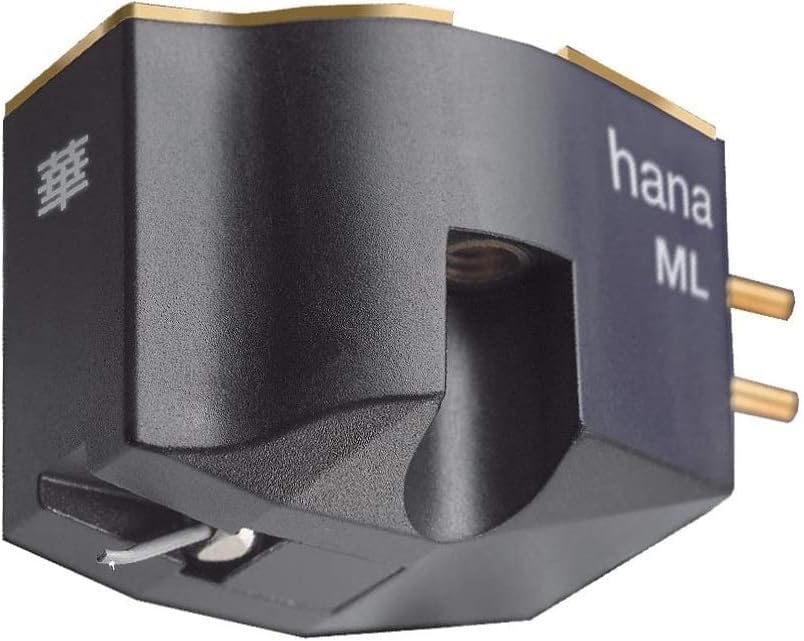
The Hana MC Moving-Coil Stereo Cartridge with Nude Microline Tip – ML (Low Output) receives a 5.0 rating and shares the desirable fine-stylus concept of the MH version. Its explicit low-output status makes it better suited to listeners with a high-quality moving-coil phono stage than those shopping strictly for an MM-compatible cartridge.
We may earn a commission when you buy through this link, at no additional cost to you.
The nude Microline tip remains the defining feature. Combined with Hana's moving-coil construction, it places this model in the category of enthusiast components where careful installation and appropriate electronics can be as important as the cartridge itself. The 5.0 rating indicates a particularly positive reception among listed buyers.
The decisive limitation is output. A low-output moving-coil cartridge needs a phono stage with enough gain and the correct loading, or a suitable step-up transformer. Connecting it to a conventional MM input without appropriate conversion may produce insufficient level or an unfavorable match. A capable preamplifier with a selectable MC stage is therefore essential.
The ML is worth considering when the goal is a refined MC system rather than the shortest route to high output. It may be the better match for a dedicated analog chain, while the MH is the more logical relative for this guide's intended audience. It is included because understanding the distinction prevents buyers from accidentally choosing a low-output model for an MM-only system.
The low-output specification makes this cartridge most appropriate for a dedicated MC phono stage or carefully selected step-up transformer. It is not intended to behave like a conventional high-output model.
The ML shares the nude Microline identity of the MH version, offering the same broad cartridge philosophy in a different output category. The main decision is electrical matching rather than basic construction alone.
We may earn a commission when you buy through this link, at no additional cost to you.
The Denon DL-110 High Output Moving Coil Cartridge [Electronics] has a 4.6 rating and is the most approachable high-output option in this guide. Its stated plug-and-play readiness and high-output moving-coil construction reduce the complexity normally associated with upgrading to an MC cartridge.
We may earn a commission when you buy through this link, at no additional cost to you.
Litz wire is a notable construction detail because it is intended to support the generator's electrical behavior. More importantly for system matching, the high-output classification makes the DL-110 a more practical bridge for listeners who want MC character without immediately adding a dedicated step-up transformer. The related Denon listing also identifies the cartridge as compatible with standard MM phono inputs.
As with many long-running audiophile components, the visual simplicity can hide a potentially refined upgrade path. The trade-off is that the available product information is brief and does not provide a full specification sheet. Buyers should still confirm tracking force, stylus details, and the exact output impedance of the version they receive, particularly when comparing different DL-110 listings.
This cartridge suits someone with a conventional amplifier or receiver who wants to move beyond an entry-level magnetic cartridge and try a moving-coil design. It is also a logical recommendation for a budget-conscious build because compatibility is prioritized. The clear high-output specification, Litz wire construction, and 4.6 rating support its position as the value-focused pick.
The high-output generator and plug-and-play positioning make this an accessible way to add moving-coil performance to a system without starting with a more demanding low-output cartridge.
Litz wire provides a concrete construction distinction within the budget category. It supports the cartridge's technical credibility without requiring the buyer to navigate a much more complicated feature list.
We may earn a commission when you buy through this link, at no additional cost to you.
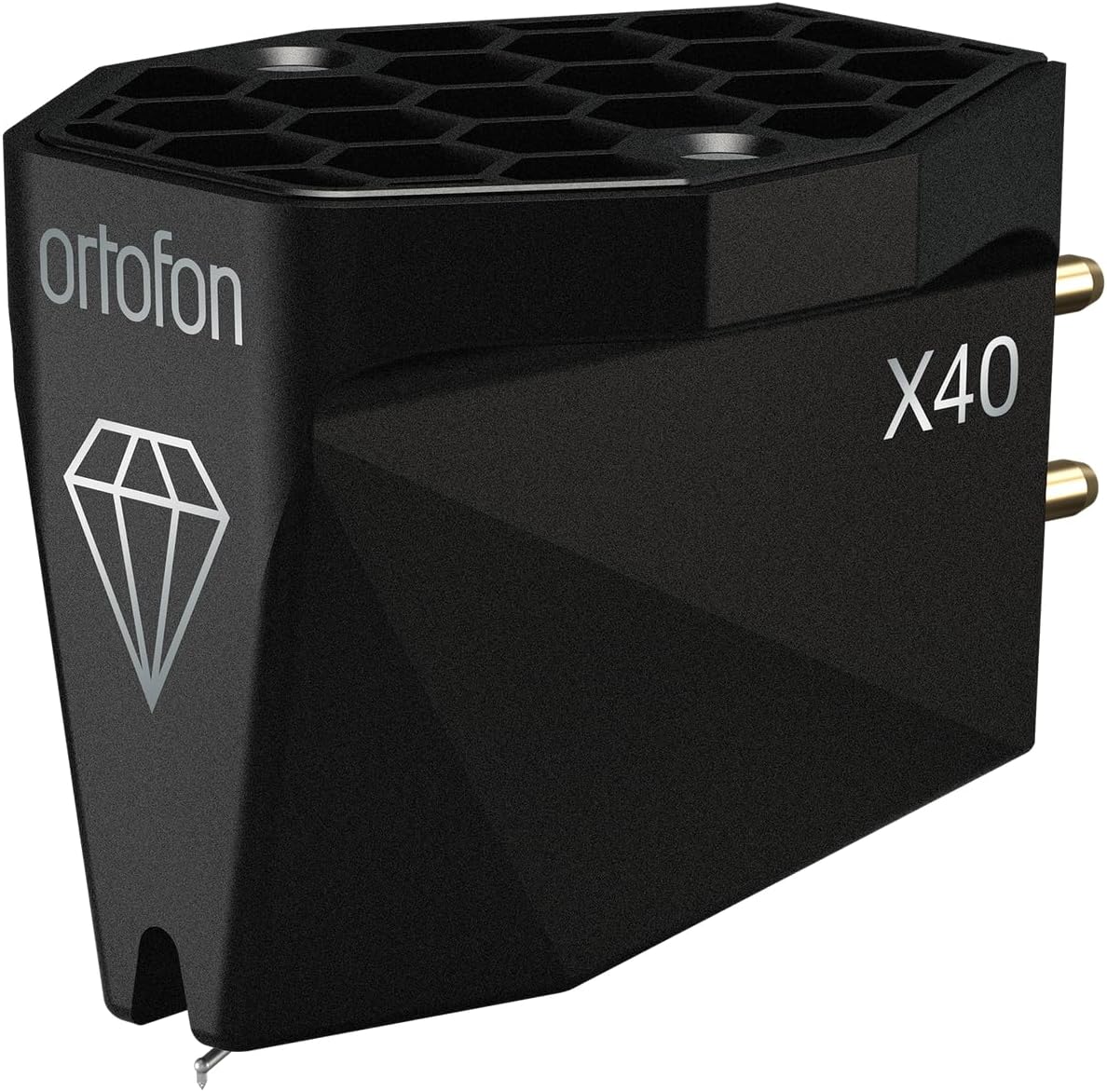
The Ortofon MC X40 Moving Coil Phono Cartridge with Nude Shibata Stylus and Boron Cantilever (Black) has a 4.4 rating. Although its 0.4 mV output places it outside the strict high-output group, it is included because its unusually complete specifications make it an informative and technically compelling MC alternative.
We may earn a commission when you buy through this link, at no additional cost to you.
The cartridge combines a nude Shibata diamond stylus with a rigid, lightweight boron cantilever. Ortofon also describes a one-piece pole cylinder, a rear magnet yoke, high-purity silver coil wire, and custom rubber damping designed to control physical coil movement. The combination targets transparency, speed, responsiveness, stability, and reduced distortion.
The specifications are unusually transparent: output voltage is 0.4 mV, frequency response extends from 20 Hz to 20 kHz within stated limits, channel separation is 26 dB, compliance is 15 micrometers per millinewton, recommended tracking force is 2.0 grams, and the recommended load is above 50 ohms. These details simplify matching to a suitable phono stage.
This is not the cartridge to choose merely because the listing resembles a high-out model; it is a low-output alternative with a premium specification set. It is most appropriate for someone who already has a capable MC input and values detailed specifications, damping engineering, and a well-defined stylus-and-cantilever combination.
The pairing of a nude Shibata stylus with a rigid boron cantilever gives the MC X40 a coherent high-resolution design. It is aimed at listeners who understand and can optimize the moving-coil chain.
Ortofon's in-house rubber compounds are used to control coil movement and unwanted vibration. The stated goals are improved tracking, reduced distortion, and more stable musical accuracy.
We may earn a commission when you buy through this link, at no additional cost to you.
The Denon DL-110 High Output Moving Coil Cartridge has a 4.1 rating and presents one of the clearest upgrade paths in the guide. Its 1.6 mV output allows it to connect to standard MM phono inputs without a step-up transformer, head amplifier, or pre-preamp.
We may earn a commission when you buy through this link, at no additional cost to you.
Denon gives unusually thorough construction details for this model. It includes a traditional cross-shaped armature, weight-balance plate, dual-construction cantilever, and vibration center with two-way damping. The stylus is a solid elliptical diamond with a stated rectangular section of 0.1 by 0.2 millimeters, and the cartridge is handspun in Japan.
Its main technical qualification is the 160-ohm output impedance. Even though the voltage level is sufficient for many MM inputs, not every phono stage presents an ideal load for that impedance. The cartridge also claims a wide frequency range, crisp highs, detailed midrange, and rich bass, though individual system results will depend on the turntable, arm, phono stage, and record.
The DL-110 is an excellent choice for a first serious cartridge upgrade when replacing a basic magnetic model. It avoids the largest cost and complexity barrier associated with low-output MC cartridges. Its 4.1 rating is the lowest in this list, so it may not be the automatic choice for every enthusiast, but its compatibility-focused engineering remains compelling.
A 1.6 mV output is high enough for standard MM phono inputs in many systems. That removes the need for a separate transformer or head unit, making the upgrade considerably more approachable.
The stated 160-ohm output impedance deserves attention. Consult the phono stage's loading guidance to ensure the cartridge and electronics form a suitable electrical pairing.
We may earn a commission when you buy through this link, at no additional cost to you.
The Audio-Technica AT-ART9XA Dual Moving Coil Cartridge has a 5.0 rating and a technically focused design. Its 0.2 mV output is clearly low, meaning it requires a high-gain moving-coil stage or appropriate step-up device, but that output also makes it suitable for more demanding and adjustable analog chains.
We may earn a commission when you buy through this link, at no additional cost to you.
The dual generator coils are aligned in an inverted V shape, which Audio-Technica says provides high separation, a wide response, clear sound localization, and minimal distortion. A Shibata stylus supports high and mid-low range reproduction, while a boron cantilever contributes responsive behavior. The redesigned armature increases generator-coil cross-sectional area by 20 percent.
PCOCC, or Pure Copper Ohno Continuous Cast, wire is used for the coils. The cartridge's specialized magnetic circuit is designed to optimize energy in the gap where the generator coils sit. These choices show that the AT-ART9XA is not simply a basic MC cartridge with a higher output; it is a carefully engineered low-output model for a serious chain.
The product is best suited to owners with a flexible, high-gain phono stage and the patience to optimize loading and gain. Its 5.0 rating is impressive, but it does not belong in a guide to strict high-output alternatives without qualification. It is included as a useful contrast: if your electronics can handle it, the low output can provide a very clean and controlled starting point.
The symmetrical inverted-V coil arrangement is designed to improve separation and spatial information. Audio-Technica links it directly to clear localization and minimal distortion.
At 0.2 mV, the AT-ART9XA demands a phono stage with meaningful gain. Attempting to use it with a basic MM input without conversion can result in a low signal level.
We may earn a commission when you buy through this link, at no additional cost to you.
The Denon DL-110 Moving Coil Cartridge has a 4.8 rating and a straightforward high-output specification. At 1.6 mV, it can be used with a compatible MM phono input, making it one of the most convenient ways to introduce a moving-coil cartridge into a conventional system.
We may earn a commission when you buy through this link, at no additional cost to you.
The published figures are simple but useful. Its frequency response is listed as 20 Hz to 45 kHz, output voltage as 1.6 mV, channel separation as 25 dB at 1 kHz, and channel balance as 1 dB at 1 kHz. Those numbers make direct comparison with the more extensively documented Denon listing straightforward.
The limitation is that the description does not reveal as much about the physical design as the other DL-110 entry. It does not discuss stylus shape, cantilever construction, output impedance, or damping. That makes it a less compelling choice when shopping strictly for a new design, but it remains a proven and highly rated route to a compatible moving-coil upgrade.
This cartridge is best for someone who prioritizes easy installation, recognizable specifications, and strong customer feedback over an elaborate feature list. It is also a useful benchmark for judging other MC upgrades. If the system has a flexible phono input, the combination of high output, low quoted channel imbalance, and a 4.8 rating makes this a persuasive practical choice.
The output voltage, frequency response, channel separation, and balance values are easy to compare with other cartridges. That transparency helps when checking basic system compatibility.
The 1.6 mV output removes the need for a step-up device in many installations. The cartridge is therefore particularly attractive for a straightforward upgrade of an existing MM-capable system.
We may earn a commission when you buy through this link, at no additional cost to you.
Choosing a high-output moving-coil cartridge requires balancing electrical compatibility, stylus design, tracking demands, and system goals. The most important first step is identifying what your phono stage can actually accommodate, because a cartridge designation alone does not guarantee a successful installation.
A phono stage determines whether a moving-coil cartridge can be used directly or needs a step-up transformer or head amplifier. Check the available input labels, required gain, supported cartridge impedance, and load settings before selecting a model. The Denon DL-110 listings explicitly describe 1.6 mV output as compatible with standard MM inputs, making them among the simplest options for conventional amplifiers.
Choose the cartridge around the electronics you already own, not around a generic compatibility promise. High output can broaden the range of usable stages, but it does not make loading irrelevant.
Output voltage indicates how much signal the cartridge generates. Higher output generally makes amplification easier, while lower output can suit stages designed for a quiet, clean signal. The listed examples span 1.6 mV for the DL-110, 0.4 mV for the Ortofon MC X40, and 0.2 mV for the Audio-Technica AT-ART9XA.
Match the cartridge's output to the available gain. Do not expect a low-output cartridge to work well merely because the phono input is labeled moving coil; the stage must provide enough voltage gain and the right load.
Stylus shape affects contact, tracking, and the balance between detail and durability. The Sumiko Songbird uses a long 7-micron stylus face, the Hana MH and ML use nude Microline tips, and the MC X40 and AT-ART9XA use Shibata designs. The Denon DL-110 description identifies a solid elliptical diamond with a 0.1 by 0.2 millimeter rectangular section.
Look for a geometry that suits both your records and your cleaning habits. Fine high-resolution designs can demand careful setup, while an elliptical tip may offer a more conventional balance of tracking and maintenance tolerance.
The cantilever carries the stylus through the groove, so its material and rigidity affect signal behavior. The MC X40 and AT-ART9XA both use boron, while the DL-110 description highlights a dual-construction cantilever. In the generator, the Sumiko Blue Point No. 3 uses high-purity copper coils, the Ortofon uses high-purity silver wire, and the AT-ART9XA uses PCOCC wire.
Read the generator and cantilever descriptions as a complete design package. A sophisticated material cannot compensate for poor installation or an unsuitable phono stage.
A cartridge generator must move precisely while resisting unwanted vibration. The Ortofon MC X40 uses custom-developed rubber compounds to damp physical coil movement, while the Denon DL-110 listing describes a vibration center with two-way damping. These features are intended to improve tracking, reduce distortion, and maintain stable signal generation.
Treat damping as a refinement rather than a substitute for setup. A clean stylus, correct alignment, secure mounting, and a stable turntable remain the foundation of good playback.
The cartridge must fit within the tonearm's effective mass, length, and tracking-force range. The MC X40 specifies a recommended tracking force of 2.0 grams and compliance of 15 micrometers per millinewton, while the AT-ART9XA supplies no complete tracking figures in the provided information. The more published data a manufacturer provides, the easier this matching task becomes.
Check the cartridge's weight, dimensions, mounting hardware, recommended force, and stylus clearance. An arm that can handle the specified force may still be unsuitable if its effective mass does not suit the cartridge's compliance.
Stereo imaging depends on consistent behavior between the left and right channels. The Denon DL-110 specification lists 25 dB channel separation and 1 dB channel balance at 1 kHz, while the Ortofon MC X40 lists 26 dB separation and 0.5 dB balance. These are useful points of comparison but do not describe the entire frequency range.
Consider published measurements alongside the manufacturer's engineering goals. A well-matched cartridge should contribute to stable placement rather than drawing attention to one side or one portion of the spectrum.
Some listeners seek refinement and transparency, while others want energy, articulation, or a strong connection to the performance. Sumiko says the Songbird can add excitement to anemic classical setups, while the Ortofon emphasizes transparency, speed, and responsiveness. Those stated goals can help narrow the list before technical details are considered.
Prioritize the presentation you want rather than a single headline specification. The most convincing cartridge is the one whose construction, loading requirements, and musical focus suit your turntable, phono stage, room, and records.
Install the cartridge only after switching off and unplugging the turntable, then confirm the tonearm's tracking-force range and mounting requirements. Remove the old cartridge carefully, note the orientation of the leads, and fit the new body squarely. Follow the manufacturer's alignment procedure for overhang, azimuth, and anti-skate rather than assuming a generic adjustment applies to every model.
Set the phono stage for the cartridge's stated output and impedance, then begin with a conservative tracking force. Check that the tonearm is floating freely before lowering the arm, and never force a cantilever sideways. After installation, play a familiar record, make small alignment and tracking adjustments, and listen for stable image placement rather than judging only immediate loudness or treble.
Care for the cartridge by keeping the stylus protected with its guard and using a soft, lint-free cleaning method appropriate for the stylus. Never use alcohol on the body or a wet cleaning fluid near the generator. Remove the cartridge safely for transport, store it in its protective case, and revisit alignment if you change the tonearm, arm base, or phono-stage loading.
A high output moving-coil cartridge is a moving-coil generator that produces a relatively high signal voltage for its category. That output can make it easier to use with some conventional phono inputs, although input impedance and gain requirements still matter. It should not be confused with a moving-magnet cartridge, even if both can sometimes work with the same input.
Often, yes, because a high-output MC model produces enough voltage for many MM phono stages. The Denon DL-110 is specifically described as 1.6 mV and compatible with MM input, without a step-up transformer or head amplifier. Before connecting any cartridge, verify the output voltage, impedance, and recommended loading for both the cartridge and phono stage.
The primary difference is signal voltage. High-output models place a greater demand on the available amplifier gain, while low-output models generally require a high-gain MC stage or a step-up device. The Hana MH and ML versions illustrate this difference directly, as do the Denon DL-110 at 1.6 mV and the Audio-Technica AT-ART9XA at 0.2 mV.
It depends on the cartridge and phono stage. The listed Denon DL-110 high-output version is designed to connect to standard MM inputs without a step-up transformer, while the MC X40 at 0.4 mV and AT-ART9XA at 0.2 mV are more likely to need a capable MC input. Check the amplifier or preamplifier manual before choosing additional hardware.
Check the cartridge's recommended tracking force, weight, dimensions, compliance, and mounting requirements against your tonearm specification. The MC X40, for example, lists a 2.0-gram recommended tracking force and 15-micrometer-per-millinewton dynamic lateral compliance. The correct force must also fall within the arm's adjustment range, while its effective mass must suit the cartridge.
No. A fine or advanced stylus can improve detail retrieval, but performance still depends on groove condition, alignment, tracking force, tonearm compatibility, and the rest of the system. The long Songbird stylus face, nude Microline tips, and Shibata designs each offer different characteristics. Choose the geometry that suits your records and maintenance routine.
Not necessarily. A well-matched high-output moving-coil model can be a substantial upgrade, but the cartridge must be electrically compatible with the existing phono stage. Confirm loading and gain first. A dedicated MC phono stage may also provide useful adjustment, so it is worth comparing the complete upgrade path before buying.
Use a soft, lint-free cleaning method and protect the stylus whenever it is not in use. Do not flood the cartridge body with fluid or use alcohol on its housing, since the suspension and generator can be damaged. Keep the cartridge installed correctly, handle it by the body, and store it in a protected case whenever the turntable is moved.
The Denon DL-110 stands out as the most budget-conscious and straightforward option because its 1.6 mV output can work with standard MM phono inputs. The Sumiko Blue Point No. 3 offers a more refined high-output proposition with open-body construction and copper coils, while the Sumiko Songbird takes the premium position with its long stylus face and Reference Series positioning.
Prioritize compatibility before fine differences in stylus or generator design. Check output voltage, input impedance, tracking force, tonearm requirements, and available gain. The Hana ML, Ortofon MC X40, and Audio-Technica AT-ART9XA may be excellent choices for dedicated MC systems, but they are not interchangeable with genuinely high-output models.
Finally, confirm the current listing, manufacturer specifications, package contents, condition, return policy, and price at the time of purchase. Cartridge listings can contain version differences or incomplete technical details, and the best choice is the one that integrates cleanly with your existing turntable, tonearm, phono stage, and musical priorities.