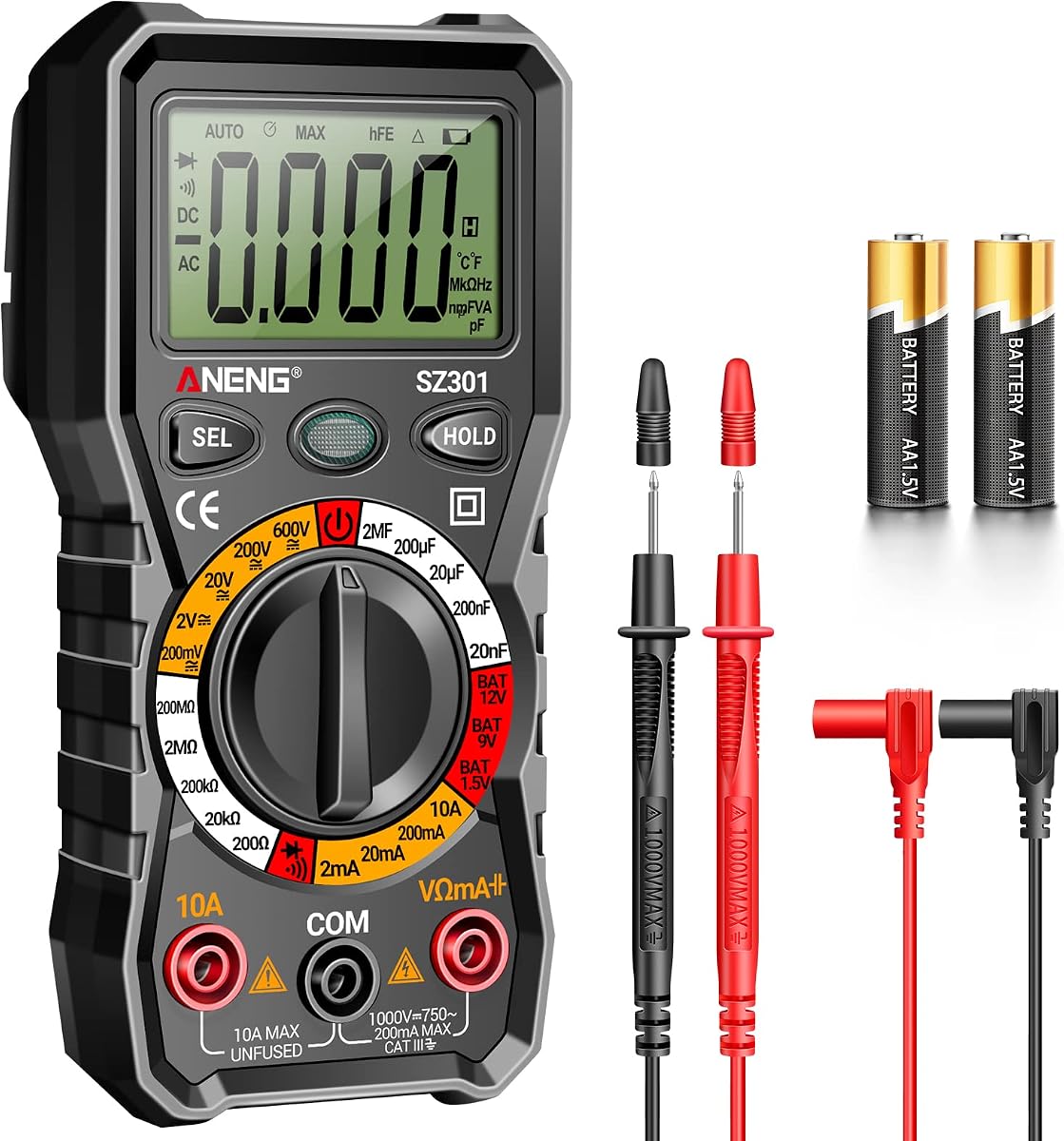
ANENG Digital Multimeter with Case
4.4Editor score
0 to 200MΩ resistance range
Double-fuse overload protection
Includes protective carrying case
Discover the best Ohm Meter options for home, automotive, and professional work, with side-by-side comparisons of accuracy, safety, range, and features for
An ohm meter measures electrical resistance, helping you identify open circuits, damaged components, continuity issues, and unexpected resistance values. A useful model should combine an understandable display, suitable measurement ranges, dependable safety features, and controls that make routine diagnostics less error-prone. The right instrument depends on the circuits you regularly work with.
This guide compares ten digital and analog multimeters with ohm-meter functions, evaluating resistance limits, voltage and current capabilities, ranging behavior, backlighting, test-lead alerts, temperature testing, and safety features. The selections range from compact general-purpose meters for household troubleshooting to professional instruments with True RMS measurement, auto-ranging, and insulation-resistance capability.
Each review identifies the most useful qualities, practical limitations, and likely owner based on the available product information. The top picks highlight the strongest options for different priorities, including value, balanced versatility, and professional capability. Product availability and pricing can change, so readers should confirm current specifications and offers before purchasing.
4.4Editor score

4.8Editor score

4.8Editor score
The table below compares the selected ohm meters by measurement range, electrical testing functions, display and ranging design, and practical features. It includes general-purpose digital meters, a true-RMS professional model, an analog option, and an insulation tester for high-resistance diagnostics.


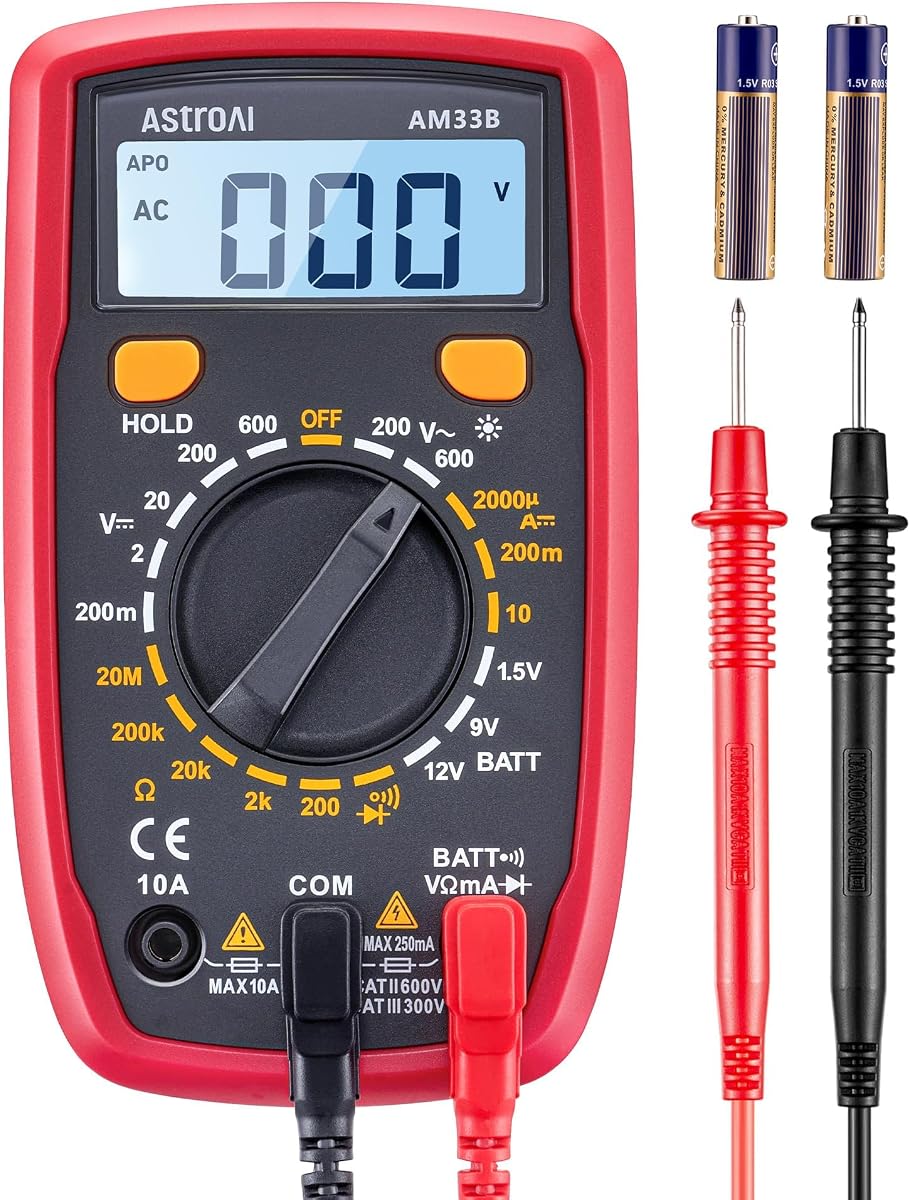


The Fluke 15B+ combines resistance testing with the core electrical measurements expected from a dependable professional multimeter. Its 4.8 customer rating reflects a strong reception, while the combination of AC and DC voltage, AC and DC current, continuity, diode, and capacitance functions makes it more than a basic resistance tester. It is a strong all-around choice for technicians and serious DIY users.
We may earn a commission when you buy through this link, at no additional cost to you.
A primary strength is measurement versatility. The meter measures voltage up to 1000V and current up to 10A, giving it useful reach across residential, commercial, automotive, and equipment-diagnostic tasks. Resistance, continuity, diode, and capacitance measurements expand that coverage, while the CAT III 600V safety rating provides a clearly stated protection category for common electrical environments.
The main trade-off is the premium nature of the product compared with general-purpose meters. Buyers who only need occasional continuity checks may find a smaller model more proportionate. However, the broad measurement set, high rating, and professional safety positioning justify the premium for users who want one instrument across many electrical tasks rather than a narrow ohmmeter.
Choose the Fluke 15B+ when reliability, measurement breadth, and electrical safety matter. It is particularly attractive to electricians, facilities personnel, advanced electronics hobbyists, and vehicle technicians. For resistance-focused users who also expect voltage, current, capacitance, and diode testing, this is a confident overall recommendation.
Resistance sits within a much broader diagnostic toolkit. The 15B+ can also evaluate voltage, current, continuity, diodes, and capacitance, helping one meter cover more suspected faults without relying on separate instruments.
Measurement capability reaches 1000V for voltage and 10A for current. Those limits make the meter suitable for demanding diagnostic work, provided the leads are installed in the correct terminals and the safety rating is appropriate for the circuit.
We may earn a commission when you buy through this link, at no additional cost to you.
The Klein Tools ET600 stands apart because it is designed for high-resistance and insulation testing rather than only ordinary continuity checks. It carries a 4.8 customer rating and measures insulation resistance up to 4000MΩ at 125V, 250V, 500V, and 1000V DC. That makes it the specialist choice in this group for cable, wiring, and equipment insulation diagnostics.
We may earn a commission when you buy through this link, at no additional cost to you.
Its purpose-built test controls simplify a demanding job. Test and lock buttons support straightforward insulation testing, while a warning alarm and high-voltage icon help indicate voltage presence. The backlit display includes a bar graph, plus icons for auto power-off, high voltage, maximum and minimum readings, and hold, giving users clear visual feedback during longer tests.
This is a specialized instrument, so not every owner needs it. Its insulation-testing emphasis makes it less economical for someone who only checks small electronic components. However, the resistance capacity, multiple test voltages, True RMS auto-ranging, and standard voltage, resistance, and continuity measurements justify the investment when insulation condition is central to the work.
Select the ET600 for electricians, facilities teams, industrial maintenance personnel, and advanced users diagnosing degraded insulation. It is the pick for high-value diagnostic work where ordinary resistance range and a continuity beep are not enough. For general household checks, one of the smaller digital meters will be easier to use.
The ET600 offers test voltages of 125V, 250V, 500V, and 1000V DC, allowing users to evaluate insulation across multiple test levels. Its range reaches 4000MΩ, substantially broadening the scope of resistance assessment beyond typical component checks.
Voltage detection is supported by a warning alarm and high-voltage icon, while the lock button can support sustained testing. These visible cues are useful when working around equipment that may still carry an unexpected voltage.
We may earn a commission when you buy through this link, at no additional cost to you.
The ANENG Digital Multimeter with Case offers substantial measurement capability at the value-focused end of this list. It provides resistance testing from 0Ω to 200MΩ, AC and DC voltage measurement, AC and DC current measurement, continuity, diode, capacitance, and live-wire functions. Its 4.4 rating reflects a generally positive user reception.
We may earn a commission when you buy through this link, at no additional cost to you.
The broad 200MΩ resistance range is especially relevant to the keyword because it exceeds the limits of many entry-level meters. Users can check low-resistance paths, test components, and inspect higher-value resistive loads without immediately moving to an insulation tester. A clear display, insulated probes, and double-fuse overload protection add practical value for everyday diagnostics.
Trade-offs include a lower customer rating than the category leaders and the need to select ranges manually. The stated accuracy varies by function, with resistance accuracy listed as ±4.0% plus 10 digits. That makes it best suited to general diagnosis rather than precision laboratory work, but the included case and broad function set improve practicality.
The ANENG model is a strong choice for students, hobbyists, homeowners, and technicians who want one inexpensive meter for many tasks. It is particularly compelling when resistance range and accessory value matter. Buyers needing calibrated precision, automatic ranging, or professional safety certifications should consider a more specialized option.
A resistance range beginning at 0Ω and extending to 200MΩ supports many diagnostic tasks, from continuity checks to higher-value resistor testing. This broader reach makes the meter more versatile than a basic low-cost tester.
Two AA batteries, test leads, and a silicone protective case are included. The case helps protect the meter during storage or transport, while the preinstalled batteries reduce the setup required before first use.
We may earn a commission when you buy through this link, at no additional cost to you.
The Klein Tools MM420 is a strong all-around digital multimeter for users who want auto-ranging convenience and accurate resistance readings. Its 4.7 rating places it among the better-reviewed products in the group. Resistance extends to 50MΩ, while True RMS technology supports more dependable AC voltage and current measurements.
We may earn a commission when you buy through this link, at no additional cost to you.
The feature set is unusually complete for a portable multimeter. It measures AC and DC voltage up to 600V, AC and DC current up to 10A, resistance, continuity, temperature, capacitance, frequency, duty cycle, and diodes. Lead-alert LEDs illuminate to show proper test-lead placement, adding a practical safeguard against a common setup mistake.
Some users may find the advanced feature set excessive, particularly if they only need occasional continuity and resistance checks. The model also costs more than basic meters. In return, it offers auto-ranging, a backlit display, test-lead storage, a kickstand, compatibility with an optional magnetic hanger, and construction designed to withstand a 6.6-foot drop.
The MM420 suits electricians, HVAC technicians, electronics hobbyists, and serious DIY users who regularly switch among diagnostic functions. It is a particularly good match for anyone tired of manually choosing resistance ranges. With its balanced feature set and job-site-oriented design, it is one of the strongest professional choices here.
Automatic range selection reduces the need to estimate a component's resistance before taking a reading. This saves time and reduces errors when working with unknown values, making the MM420 convenient for both routine and irregular troubleshooting.
The stated 6.6-foot drop resistance, backlit screen, lead holders, and kickstand support use in homes, businesses, HVAC environments, and light-industrial settings. An optional magnetic hanger adds another option for hands-free work.
We may earn a commission when you buy through this link, at no additional cost to you.
The AstroAI 6000-Count True RMS combines a high-resolution display with one of the broadest function sets among conventional digital multimeters. It carries a 4.6 rating and supports resistance, AC and DC voltage, AC and DC current, continuity, capacitance, frequency, duty cycle, diode, and temperature measurements.
We may earn a commission when you buy through this link, at no additional cost to you.
Auto-ranging simplifies operation, while True RMS is intended to improve accuracy on AC voltage and current, especially with complex waveforms. A large backlit LCD, data hold, auto shutoff, and integrated kickstand make the meter practical for extended troubleshooting. Double ceramic fuses provide overload protection for the meter and circuitry.
The broad menu can feel crowded to a first-time owner, and the product instructions specifically note that the cap should be removed before using the test leads. Manual range selection for some functions may also slow certain tasks compared with a simpler auto-ranging meter. However, these are reasonable compromises for the extensive diagnostic capability.
This AstroAI model is best for automotive technicians, electronics learners, makers, and homeowners who appreciate a capable all-in-one instrument. Its combination of 6000 counts, True RMS, temperature, capacitance, and frequency measurements goes well beyond basic ohm-meter use. It is a compelling feature-rich choice for broad diagnostic work.
True RMS measurement can provide a more representative reading than a simplified average-based method, particularly on non-sinusoidal AC signals. That makes the meter relevant to modern electronics and equipment where waveform shape affects diagnostic accuracy.
Frequency, duty cycle, capacitance, temperature, diode, and continuity functions expand the meter beyond resistance and voltage. Users can move from component checks to broader circuit troubleshooting without changing instruments.
We may earn a commission when you buy through this link, at no additional cost to you.
The Westinghouse 600V True RMS is a capable general-purpose meter aimed at commercial and residential electrical work. Its 4.7 rating indicates strong customer reception. Resistance, continuity, diode, frequency, temperature, capacitance, AC/DC voltage, and 10A current measurements cover many common diagnostic needs.
We may earn a commission when you buy through this link, at no additional cost to you.
Auto-ranging and True RMS measurement are the most valuable technical features for everyday work. The 4000-count backlit LCD provides a readable display, while MAX/MIN mode captures fluctuating readings. Certification to UL 61010-1, CSA C22.2, and UL/CSA 61010-2-033 adds a clear safety framework for users who need documented standards.
The product information does not specify the maximum resistance value, so buyers focused specifically on high-resistance or insulation work should not assume it meets those needs. It also lacks the dedicated high-voltage insulation-test features of the Klein ET600. For general circuit diagnosis, however, its broad measurement set and auto-ranging behavior are strong advantages.
Choose the Westinghouse meter for electricians, facilities personnel, installers, and advanced DIY users who value durability and certification. Its stated 6.5-foot drop resistance, two-year warranty, and 24/7 customer service add confidence for regular field use. It is a well-rounded choice for standard resistance and electrical troubleshooting.
Certification to UL 61010-1, CSA C22.2, and UL/CSA 61010-2-033 gives buyers recognized safety standards to consider. That is particularly relevant when the meter will be used in residential, commercial, or light-industrial environments.
MAX/MIN mode holds the highest and lowest observed values, making intermittent behavior easier to investigate. The backlit 4000-count display also supports clearer readings in dim workspaces.
We may earn a commission when you buy through this link, at no additional cost to you.
The Klein Tools MM325 is a dependable manual-ranging multimeter with a 4.7 customer rating. It supports resistance up to 2MΩ alongside AC and DC voltage to 600V, 10A DC current, continuity, diode testing, and battery testing. That combination makes it appropriate for common residential, maintenance, and electronics tasks.
We may earn a commission when you buy through this link, at no additional cost to you.
Lead-alert LEDs are a standout usability feature because they illuminate to indicate whether the test leads are placed correctly. A backlit LCD improves visibility in low-light areas, while test-lead holders on the back and a kickstand make the instrument easier to position. It can also work with an optional magnetic hanger for hands-free operation.
The 2MΩ resistance limit is modest compared with several other products here, and the 10A current function covers DC only. Manual range selection also asks the user to choose the appropriate range before measuring. These limitations make it less attractive for insulation testing or users who regularly handle unknown, very high-resistance values.
The MM325 is a good match for electricians, technicians, students, and homeowners who prefer direct manual control. Its battery-test function is convenient for checking common cells, while the lead alerts reduce setup mistakes. Choose it for dependable general-purpose measurements rather than specialized high-resistance work.
The integrated LEDs indicate proper test-lead placement, helping users avoid incorrect terminal selection. This is a simple feature with meaningful value because inserting a lead into the wrong socket can invalidate a measurement or create an avoidable hazard.
Rear test-lead storage and an integrated kickstand support organized, stable use. The optional magnetic hanger extends those options for technicians who need the meter visible while working with both hands.
We may earn a commission when you buy through this link, at no additional cost to you.
The blue AstroAI 2000-Count is a straightforward digital multimeter for household electronics, batteries, fuses, vehicles, and basic electrical troubleshooting. It has a 4.5 rating and covers AC/DC voltage, DC current, resistance, continuity, and diode testing. The 1999-count display provides enough resolution for common diagnostic readings.
We may earn a commission when you buy through this link, at no additional cost to you.
User-friendly features include a backlit LCD for dim environments, data hold for stabilizing a reading, and a continuity buzzer. Double-fuse protection helps guard against overload, while the silicone cover adds physical protection and insulation. Batteries, test leads, and a user manual are included, making it ready for basic use after setup.
There are two explicit limitations: it cannot measure AC current, and it does not support AC voltage below 100mV. The manual rotary switch requires correct range and function selection, and the listed sampling speed is twice per second. These constraints mean it is better for routine checks than specialized or rapidly changing measurements.
Buy the blue AstroAI for homeowners, students, electronics beginners, and vehicle-maintenance users who need resistance, voltage, and continuity in one device. It is especially useful for checking fuses, batteries, charging systems, and basic automotive circuits. Users needing AC current or automatic ranging should look elsewhere.
Data hold helps retain a value while the user adjusts probes or examines a circuit. A backlit screen and audible continuity indicator make results easier to interpret in dark spaces or without constant visual focus on the display.
Knowing that AC current is unsupported and AC voltage below 100mV is outside the range prevents avoidable frustration. This meter is better aligned with batteries, household circuits, fuses, and many automotive diagnostics than specialized AC analysis.
We may earn a commission when you buy through this link, at no additional cost to you.
The black AstroAI 2000-Count is a general-purpose digital meter that stands out for its dedicated battery testing. It carries a 4.6 rating and includes 1.5V, 9V, and 12V battery-test modes. The 1.5V and 9V modes automatically detect and display battery status, reducing the need to interpret a raw voltage result manually.
We may earn a commission when you buy through this link, at no additional cost to you.
For everyday electrical work, it measures AC and DC voltage, DC current, resistance, continuity, and diode. A backlit 1999-count LCD, data hold, and auto shutoff improve everyday usability, while double-fuse protection and the silicone cover support safer handling. Batteries, test leads, and a manual are included.
It cannot measure AC current, and the rotary control requires the user to select the correct mode and range. The 2000-count display is less detailed than the 4000-count and 6000-count options in this list. As a result, it is better for familiar component values and routine fault-finding than precision readings across unusually broad ranges.
Choose the black AstroAI for DIYers, motorists, and household troubleshooters who frequently test batteries. The dedicated battery modes make it a practical choice for maintaining toys, household electronics, remote controls, and vehicle batteries. It is less suitable for AC current work or advanced laboratory measurements.
Separate modes for 1.5V, 9V, and 12V cells make common battery checks more accessible. Automatic status detection for 1.5V and 9V batteries adds convenience for users who may not know how to interpret load behavior or raw readings.
Automatic shutoff helps preserve the installed batteries when the meter is left unattended. Combined with the low-battery indicator, it provides a practical way to manage power during intermittent troubleshooting sessions.
We may earn a commission when you buy through this link, at no additional cost to you.
The Gardner Bender GMT-318 offers an alternative to digital instruments with a color-coded analog display. It has a 4.4 rating and provides six functions, 14 ranges, AC/DC voltage measurement, and a 500V maximum voltage. The 15-position rotary dial makes its operating model visually direct.
We may earn a commission when you buy through this link, at no additional cost to you.
The analog meter can be easier to interpret for users who already understand needle scales and find digital displays less intuitive. Color coding supports quick reference, while replaceable test leads and included instructions help with maintenance and setup. Fuse overload protection circuitry adds a layer of safety for the instrument.
Manual range selection requires care, and an analog needle generally offers less exact resolution than a modern digital display. This model does not provide the auto-ranging, data hold, True RMS, or specialized insulation-testing features found elsewhere in the comparison. Those limitations make it less versatile for advanced electronics work.
Choose the GMT-318 for beginners, students, educators, or electricians who prefer a simple mechanical display and want to learn fundamental multimeter operation. It can also suit users who value replaceable leads and straightforward controls. For precise resistance work, automated range selection, and broad digital functions, a modern digital meter is the better choice.
The color-coded analog scale and 15-position rotary dial provide a visible, mechanical approach to taking readings. That can make the meter approachable for learners who are building familiarity with ranges, probes, and circuit fundamentals.
Replaceable test leads allow worn accessories to be renewed rather than requiring the entire meter to be replaced. Agency-approved fuse overload protection circuitry helps protect the instrument during demanding measurements.
We may earn a commission when you buy through this link, at no additional cost to you.
The best ohm meter depends on the resistance range, circuit types, safety requirements, and level of experience you need to support. Consider how you will use the instrument before comparing displays, ranging methods, accessories, and specialized test functions.
Resistance range defines the broadest values the meter can measure and is a central consideration for anyone searching specifically for an ohm meter. The ANENG model extends to 200MΩ, the Klein MM420 reaches 50MΩ, and the Klein ET600 supports insulation measurements up to 4000MΩ. Other products either state different resistance capacities or do not provide a maximum value in the available information. Compare the highest resistance you expect to encounter rather than focusing only on the lowest selectable range.
Choose a range that covers your likely components and wiring without exceeding the needs of your work. A higher maximum can be useful for isolating insulation and leakage paths, but it does not automatically make the meter more accurate for small everyday resistor values.
Manual-ranging meters require the user to select the correct range before taking a reading. This can provide direct control and may appeal to learners who want to understand measurement ranges, but it also creates room for range errors. Auto-ranging models automatically select an appropriate scale, which is faster and especially useful when component values are unknown.
For frequent troubleshooting, auto-ranging is generally more convenient. A manual meter can still be highly capable, but choose it when deliberate range control is part of your preferred workflow or when the task is limited to familiar circuits.
A useful ohm meter should also support the measurements needed to diagnose why a resistance value is unexpected. Common additions include AC/DC voltage, DC or AC current, continuity, diode testing, and capacitance. The Fluke 15B+ measures voltage up to 1000V and current up to 10A, while several Klein and AstroAI models cover 600V.
Match the upper limits to the circuits you service. A higher voltage rating may be essential for panels and equipment, while a meter with only 200mV-to-600V ranges may be less useful for low-voltage electronics. Check current type as well, because some meters support only DC current.
True RMS measurement is valuable when measuring AC voltage or current, particularly on non-sinusoidal waveforms. The Klein MM420, Westinghouse 600V, AstroAI 6000-Count, and Klein ET600 list True RMS capability. True RMS meters are better suited to modern electronics, variable-frequency equipment, and power systems where an averaged reading can be misleading.
True RMS is most relevant for AC diagnostics. If resistance and basic DC testing are the main priorities, the additional feature may matter less, but it can make a meter more future-proof for mixed electrical work.
Safety features help reduce mistakes around energized equipment. Look for a stated safety category, fuse protection, insulated probes, voltage warning indicators, and lead-placement alerts. The Fluke 15B+ carries a CAT III 600V rating, while the Westinghouse model lists UL and CSA certification to applicable standards.
A safety rating is not a substitute for correct procedures. Always de-energize circuits when appropriate, use the correct test leads and settings, and verify the meter with a known source before working. Choose protection features appropriate to the environment and the voltage class of the equipment.
A clear display improves accuracy, especially in dim workspaces or when reading values that change. Backlighting is included on the AstroAI models, Klein MM325 and MM420, and Westinghouse. Display resolution also matters: the 2000-count meters use a 1999-count format, while the Klein MM420 and related products offer higher-resolution options elsewhere in the category.
Data hold, MAX/MIN modes, and large screens can make it easier to capture fluctuating or intermittent readings. Choose a display that shows units and range information clearly, and avoid choosing based only on screen size if it reduces precision or readability.
Some meters include functions that extend well beyond basic resistance. Temperature measurement can help evaluate appliances, HVAC systems, and components; capacitance testing supports capacitor checks; frequency and duty cycle broaden power-system diagnostics. The Klein ET600 goes further with dedicated insulation resistance testing at four DC test voltages.
Specialized functions should match the intended work. They can add value without making a meter essential for every owner. If insulation condition, component capacitance, or temperature is central to your diagnostics, prioritize a model that measures it rather than relying on a general-purpose meter.
Included leads, batteries, cases, kickstands, and lead storage can materially affect daily convenience. The ANENG package includes a silicone protective case, batteries, and leads. The Klein MM420 includes safety-capped leads, a thermocouple, instructions, and batteries, while the Gardner Bender model provides replaceable test leads. Kickstands, magnetic hanger compatibility, and stated drop resistance are useful for field work.
Look for accessories that reduce setup time and protect the instrument during storage or transport. Warranty and customer support are also worth confirming. These practical considerations can matter as much as headline specifications for a tool intended for regular use.
Before measuring resistance, disconnect power from the circuit and discharge any capacitors that could retain energy. Remove components from the circuit when their readings would be affected by parallel paths. Inspect the test leads and meter, confirm that the battery is adequately charged, and select the resistance function before touching the probes to the component.
Turn the power off and remove at least one lead from each side of the component being tested. Place the probes across the two component terminals and wait for the reading to stabilize. A near-zero result may indicate continuity, while an open or very high reading can point to a broken path. Always compare the measured value with the expected value and account for component tolerance rather than treating every small difference as a fault.
Care for the meter by storing it in a protective case, avoiding extreme heat or moisture, and replacing damaged leads promptly. Keep the dial in an off position when the meter is not in use, especially if the product supports auto shutoff. Before each task, confirm the correct mode, range, and lead sockets. When measuring voltage or current rather than resistance, follow the manufacturer's instructions and use the appropriate input rating.
An ohm meter measures electrical resistance, usually expressed in ohms. It can reveal whether a component has the expected value, whether a conductive path is open, or whether resistance is high enough to indicate damaged insulation. For reliable results, test a de-energized circuit and isolate components when parallel paths could distort the reading.
A multimeter is usually more useful because it combines resistance testing with voltage, current, continuity, and often diode or capacitance functions. A dedicated insulation tester is different: it applies controlled high test voltages to evaluate insulation condition. Most household and electronics tasks are better served by a versatile digital multimeter with an adequate resistance range.
Changing readings can result from a circuit still carrying power, a capacitor charging or discharging, an unstable connection, or parallel resistance paths in the circuit. Temperature can also affect some components. Disconnect power, discharge capacitors, remove one side of the component from the circuit, and clean or secure the probe contacts before repeating the test.
A meter that covers common low and mid-range resistor values is usually sufficient for household electronics, batteries, fuses, and many wiring checks. A range extending to 50MΩ or 200MΩ provides more flexibility for high-value resistors and leakage checks. Insulation or cable testing may require a megohmmeter rather than an ordinary digital multimeter.
A higher display count can make small changes easier to see, but resolution alone does not guarantee accuracy. Overall instrument specification, selected range, component tolerance, contact quality, and proper technique all affect the result. A high-resolution meter remains dependent on correct setup and appropriate test conditions.
True RMS is most important for AC voltage and current measurements, especially when waveforms are complex or distorted. It is less directly relevant to ordinary resistance checks, which are based on applied voltage and current. If the meter will also be used for modern electronics, power equipment, or variable-frequency drives, True RMS offers a worthwhile advantage.
No. Resistance measurements should be performed on a de-energized, discharged circuit. Applying a multimeter to a live circuit can produce incorrect readings, damage the instrument, and create a serious safety hazard. Verify that power is disconnected and discharge stored energy before testing.
Continuity testing uses an audible signal to indicate a low-resistance path, which is fast for checking wires, switches, fuses, and possible shorts. Resistance testing displays the numeric value and is more useful for evaluating components whose resistance should fall within a specified range. Many multimeters include both functions.
The Fluke 15B+ stands out as the strongest overall option because it combines resistance measurement with voltage, current, continuity, diode, and capacitance functions under a CAT III 600V safety rating. The ANENG Digital Multimeter with Case is the most convincing budget choice, particularly because it reaches 200MΩ and includes a protective case, while the Klein ET600 is the premium specialist for insulation testing up to 4000MΩ.
Prioritize resistance range, correct measurement types, and the ability to diagnose the surrounding circuit. Auto-ranging is valuable for unknown values, True RMS improves AC diagnostics, and lead-placement warnings or high-voltage indicators make field use safer. For cable and insulation work, select a true megohmmeter rather than assuming a standard multimeter can perform the same test.
Finally, check the current specifications, category ratings, accessories, and offers before buying. Product designs and availability can change, and only the manufacturer or current product documentation should be used to confirm operating limits. Compare the meter against the circuits you actually need to diagnose, then choose the model that offers the safest practical fit for your work.