
Jackery Explorer 1000 v2
4.8Editor score
1,070Wh capacity
1,500W continuous output
Compact 23.8-pound design
Compare the best power stations for refrigerators, including capacity, output, runtime, UPS support, charging options, and portability.
A refrigerator should not be one of the first appliances to lose power during an outage. Portable power stations can keep refrigeration running, preserve food, and support medical or commercial cooling, but choosing the right unit requires comparing usable capacity, continuous output, transfer speed, and recharging flexibility rather than relying on headline wattage alone.
This guide compares ten portable power stations for refrigerators using the supplied specifications, customer ratings, port layouts, battery technologies, expansion options, and stated backup capabilities. It covers models suited to apartments, houses, camping trips, RVs, clinics, and small businesses, while distinguishing basic backup from higher-capacity systems designed to run several essential appliances.
Each review explains where the product stands out, where trade-offs appear, and which type of refrigerator user may benefit most. Runtime figures remain estimates because compressor size, ambient temperature, door openings, and battery age affect results, and current prices and configurations can change, so shoppers should verify the latest listing details before purchasing.
4.8Editor score
4.4Editor score

4.6Editor score
The table below compares all ten options across the factors that most directly affect refrigerator backup: energy capacity, continuous output, UPS behavior, and physical scale.


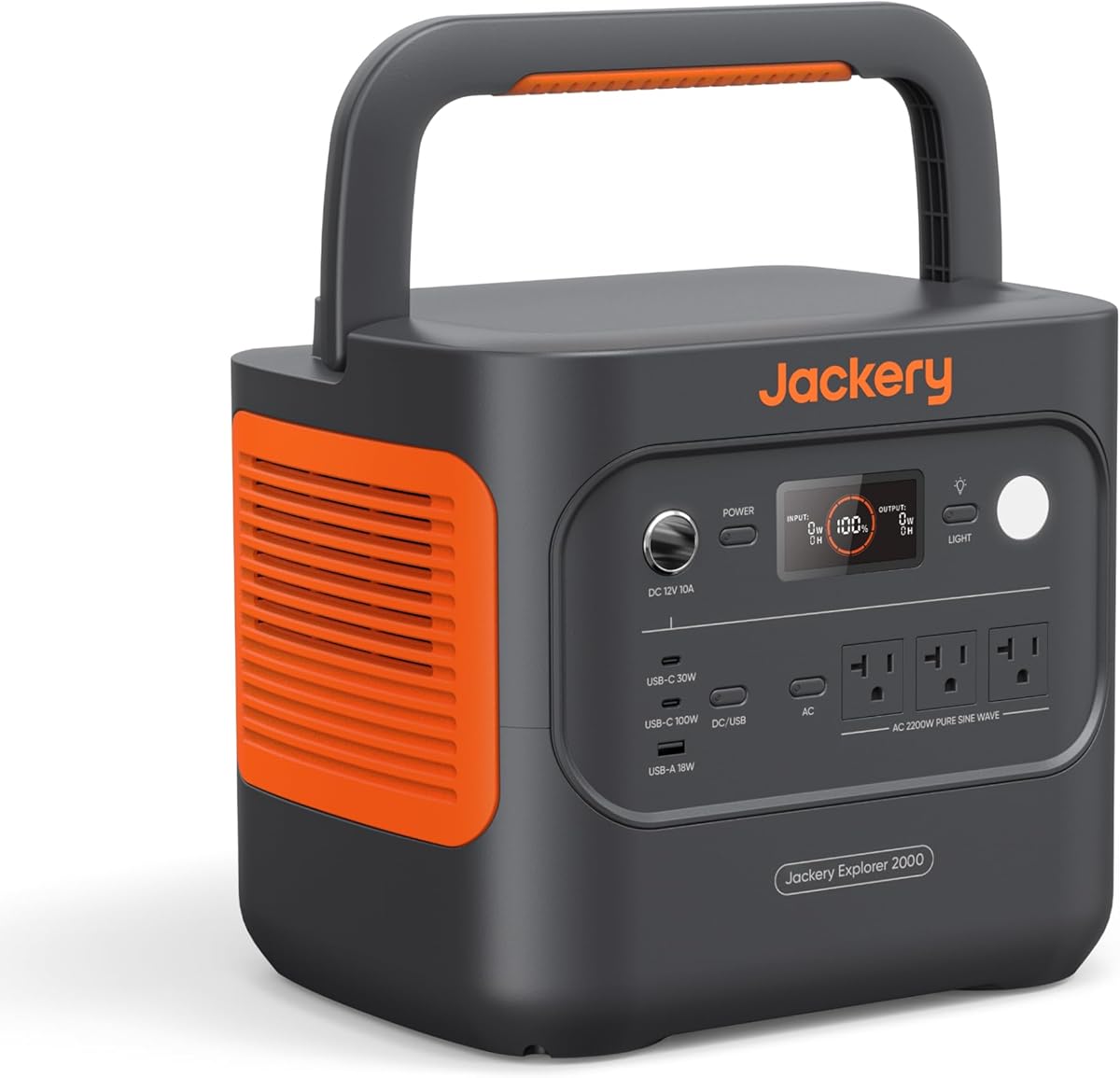
The Jackery Explorer 2000 v2 combines 2,042Wh of capacity with 2,200W of continuous AC output, giving it enough flexibility for a refrigerator and several smaller essentials. Its 4.4 rating reflects a generally capable package, and the particularly attractive feature is its 20ms UPS transfer, which is better suited to sensitive electronics than a basic manual switchover.
We may earn a commission when you buy through this link, at no additional cost to you.
The unit is unusually manageable for a two-kilowatt-hour system. At 39.5 pounds, it is substantially easier to reposition than many similarly powerful competitors, while three AC outlets, a 100W USB-C port, and other connections let users avoid bringing a separate adapter for common devices. Its LiFePO4 battery is rated for up to 10,000 cycles, and the product is UL1778 test-certified as an uninterruptible power system.
Refrigerators rarely operate at their rated maximum continuously, but a compressor can still create a meaningful surge when starting. The 2,200W output provides ample headroom for a standard household refrigerator, and the stated 20ms switching helps protect electronics connected through the UPS. The main limitation is that a refrigerator can consume a meaningful portion of the battery over an extended outage, so extended or frequent outages still call for careful charge management.
This is the strongest all-around recommendation for households wanting useful runtime without moving to a wheeled home-system format. It suits users who need more capacity than a compact camping station but do not need a full home installation. Buyers should verify their refrigerator’s startup requirements, keep the unit partly charged, and confirm that they understand the difference between normal charging and the faster emergency charging mode.
The 2,200W continuous output leaves generous room for a refrigerator compressor and commonly used backup appliances. The three AC ports also make it practical to keep essential electronics connected without relying exclusively on USB power.
AC fast charging can take the station from zero to 80% in 66 minutes, while the app-controlled emergency mode can complete a charge in 102 minutes. Compatible 400W solar panels can also provide a useful off-grid replenishment option.
We may earn a commission when you buy through this link, at no additional cost to you.
The Jackery HomePower 3600 Plus is the most home-scaled option in the group, with 3,584Wh of base capacity and 3,600W of continuous output. Its 4.6 rating and dual-voltage capability position it as a premium option for users who expect to operate a refrigerator and other household essentials during sustained outages.
We may earn a commission when you buy through this link, at no additional cost to you.
Expansion is the central attraction. The stated capacity can reach 21kWh with one unit and 43kWh with multiple units, creating a path from portable backup to a much larger home energy system. The plug-and-play design also simplifies adoption because users can connect the power station to the HomePower transfer system rather than install a complex dedicated system.
The 3600 Plus is not a lightweight camping companion, but its wheels and telescopic handle acknowledge that larger batteries are difficult to reposition. It can be moved from a kitchen to a garage, yet its design communicates that it is intended primarily for stationary backup. Its claimed 6,000-cycle life and ceramic-membrane battery cells add long-term appeal for users planning regular emergency readiness rather than occasional weekend use.
Choose this model when refrigerator preservation is only one part of a broader home-resilience plan. It is especially relevant for households expecting multi-day outages, families running medical refrigeration, or small workplaces that cannot tolerate frequent interruptions. Smaller users can obtain more capability and portability from a mid-sized station, while those wanting a turnkey home system will find the high capacity and transfer-system compatibility particularly useful.
The base 3,584Wh capacity offers meaningful refrigerator runtime, and expansion to 21kWh per unit provides much greater endurance. This scalability is valuable for outages long enough that recharging from a wall outlet is not dependable.
A 3,600W output can support demanding household equipment, while the rolling luggage design makes the high capacity easier to manage. The telescopic handle is particularly useful when moving the unit between rooms or toward a prepared emergency location.
We may earn a commission when you buy through this link, at no additional cost to you.
The Jackery Explorer 1000 v2 pairs 1,070Wh of capacity with 1,500W of continuous output and a 3,000W surge peak. Its 4.8 rating is the highest among the listed products, and its stated ability to power fridges makes it a natural fit for apartment residents, campers, and travelers who need focused refrigerator backup.
We may earn a commission when you buy through this link, at no additional cost to you.
At 23.8 pounds, it is one of the easiest full-size options to carry. Three pure sine wave AC outlets reduce compatibility concerns with sensitive electronics, while two USB-C ports, one USB-A port, a car outlet, and LED lighting cover common needs. App control adds one-hour emergency charging, a 30dB quiet mode, and an energy-efficiency mode, making the unit adaptable to different operating conditions.
Capacity is the trade-off. A standard refrigerator can consume a large share of a 1,070Wh reserve, particularly if the household also needs to power a freezer, router, lights, or medical cooler. The 1,500W output is suitable for a typical refrigerator, but the 3,000W surge figure should not be confused with sustained power. Users should avoid interpreting the fast charging mode as a reason to leave the battery routinely at zero.
This model is the most practical option for a smaller refrigerator or temporary outage, especially where portability matters. It is a strong choice for an apartment, van, vacation home, or camping setup where modest but reliable capacity is enough. Buyers seeking overnight backup for a full-size refrigerator with additional appliances should step up to a larger model.
The 1,500W output and 3,000W surge capacity are well matched to a typical household refrigerator. Its lower 23.8-pound weight makes temporary positioning around the kitchen considerably easier than with larger power stations.
Jackery’s app provides fast emergency charging, quiet overnight charging, and energy-efficiency controls. The default 1.7-hour charging mode is designed to balance speed with battery health, while emergency mode is available when preparation time is limited.
We may earn a commission when you buy through this link, at no additional cost to you.
The EcoFlow Delta 3 combines a 1,024Wh battery with 1,800W of continuous output and a 4.7 rating. Its interface density is one of its strongest refrigerator-focused features because it can power up to 13 appliances simultaneously, giving users room to protect a refrigerator while maintaining communications, lighting, and small household necessities.
We may earn a commission when you buy through this link, at no additional cost to you.
Charging speed is a major advantage. The unit supports up to 1,500W of AC input and 500W of solar input, allowing a full charge in 56 minutes and an 80% charge in 30 minutes under the stated conditions. Its LiFePO4 cells are rated for 4,000 cycles to 80% capacity, and the product includes a five-year customer service period.
The 1,024Wh starting capacity is modest for prolonged home refrigeration, and X-Boost output above the normal 1,800W rating requires appropriate resistive loads. It is a mistake to assume the higher boost figure behaves like continuously available inverter power. Nevertheless, the expansion system can grow to 5kWh using compatible EcoFlow battery packs, allowing buyers to add endurance later.
The Delta 3 is most convincing for users who need many low- to moderate-power devices alongside a refrigerator. It is also a good fit for buyers who want rapid recovery after an outage and already use EcoFlow solar equipment. Those requiring multi-day runtime from the first purchase should account for the smaller base capacity or plan to expand the system.
A stated 56-minute full charge and 30-minute 80% charge reduce downtime between utility restoration and the next outage. This speed is useful for users who recharge the station whenever grid power returns rather than storing it permanently at full charge.
The ability to support 13 appliances at once is useful for a refrigerator surrounded by essential low-power equipment. Check each device’s startup requirement and avoid combining several high-surge loads on a single outlet.
We may earn a commission when you buy through this link, at no additional cost to you.
The Anker SOLIX C2000 Gen 2 is one of the most refrigerator-focused products in this guide. Its listed 2,048Wh capacity, 2,400W rated output, and 4,000W peak output are backed by a specific claim of up to 32 hours for a dual-door refrigerator, making it easier to compare with other models for this use case.
We may earn a commission when you buy through this link, at no additional cost to you.
Low standby consumption of 9W is valuable because a power station that constantly consumes its own stored energy is less useful during long outages. Adding an expansion battery raises capacity to 4kWh and the stated dual-door refrigerator runtime to 64 hours. That is a compelling route for users who want more endurance without replacing the main unit.
Recharging is flexible through AC, solar, car charging, and an 800W alternator option that can recharge the unit in three hours. The 4,000W peak output should only be treated as short-duration headroom, while the 2,400W rated figure is the safer basis for sustained loads. At 41.7 pounds, it is compact relative to its power but remains a two-person carry.
This is an excellent choice for households, campers, and RV travelers who want a clearly stated refrigerator-runtime figure. It particularly appeals to those planning to add an expansion battery later. Users who need ultra-fast transfer behavior for highly sensitive medical equipment should investigate the product’s UPS specifications and test their exact setup before relying on it in a critical application.
The stated 32-hour runtime for a dual-door refrigerator gives buyers a practical baseline. Because compressor behavior and ambient heat affect consumption, treat the figure as a planning estimate rather than a guarantee for every refrigerator.
The 9W standby draw reduces unnecessary drain while the unit waits for an outage. For travelers, the 800W alternator charging method offers a substantially faster replenishment route than a basic cigarette-lighter socket.
We may earn a commission when you buy through this link, at no additional cost to you.
The Jackery HomePower 3000 delivers 3,072Wh of capacity and 3,600W of continuous output, with a stated refrigerator runtime of one to two days. Its 4.5 rating and UL-certified UPS rated to switch within 20ms make it a credible choice for keeping refrigeration and electronics running through short or extended outages.
We may earn a commission when you buy through this link, at no additional cost to you.
The product supports a refrigerator, fan, Wi-Fi router, lights, security cameras, medical refrigerators, and other essentials. Dual 100W USB-C PD ports, USB-A, AC, DC, and an RV connection broaden its usefulness. The UPS feature is especially relevant for users who cannot tolerate resets in network equipment, although every connected device must still be compatible with the transfer behavior.
Recharging is one of the strongest elements. A full charge takes 1.7 hours through hybrid AC and DC charging or 2.2 hours through AC alone, while two compatible 200W solar panels can take the unit to 80% in nine hours. Its LiFePO4 battery is rated for 4,000 cycles while retaining 70% capacity, supporting long-term planning.
The HomePower 3000 is ideal for households that want a refrigerator, internet access, lighting, and a few powered devices running together. It also makes sense for users maintaining medical refrigeration or wanting a general-purpose home outage kit. Its size and weight are less attractive for travel, but the capacity-to-volume design makes it more practical than many similarly powerful systems.
The UL-certified 20ms transfer is designed to minimize interruption to security systems, routers, computers, and medical refrigerators. Keep essential equipment connected to the appropriate outputs and test the system before an emergency.
The hybrid charging path can restore the full battery in 1.7 hours under the stated conditions. That makes the unit practical for households that recharge whenever utility service returns instead of leaving it at full capacity for months.
We may earn a commission when you buy through this link, at no additional cost to you.
The EBL 2400W power station combines 1,843.2Wh of capacity with 2,400W of maximum output, giving it more continuous power than many similarly sized competitors. Its 4.4 rating reflects a broad feature set, including support for 12 devices, four AC outlets, USB-A, USB-C, DC, car, and wireless charging connections.
We may earn a commission when you buy through this link, at no additional cost to you.
The emergency power mode switches to backup in 0.1 seconds. That is quick enough for many household electronics, though it is not as close to instantaneous as the sub-10ms or sub-0.01-second transfer claims made by some rivals. A clear display shows remaining battery and operating status, while the four-mode LED light can provide useful emergency illumination.
The outdoor-specific LiFePO4 battery is rated for more than 3,500 charge-discharge cycles and a service life exceeding 10 years. Its protection system covers overcharging, over-discharging, short circuits, and high temperatures. At 55 pounds and 16.9 by 11.8 by 11 inches, however, it is physically demanding to transport despite its dual-side handles.
This station makes the most sense for users who need high output for a refrigerator alongside a demanding appliance or tool. It can also serve as a group camping system thanks to the large number of ports. Those needing exceptionally fast UPS transfer should choose a model with a documented sub-20ms specification, while mobility-focused users should account for its substantial weight.
The 2,400W maximum output is useful when a refrigerator shares the station with kettles, power tools, or other high-wattage equipment. Start high-draw appliances separately to reduce the chance of overload during compressor startup.
Twelve-device support and a wireless charging panel are convenient for camps, tailgates, and shared emergency kits. Each port has limits, so total appliance demand must remain within the inverter’s capability.
We may earn a commission when you buy through this link, at no additional cost to you.
The UDPOWER S1200 is built around a 1,190Wh battery and a 1,800W peak output, with a 4.1 rating. Its defining feature is the claimed UPS response of less than 0.01 seconds, making it one of the strongest options in the list for refrigerators used alongside routers, CPAP equipment, computers, or other sensitive medical and electronic devices.
We may earn a commission when you buy through this link, at no additional cost to you.
Its 14-port hub includes five AC outlets, two 100W USB-C ports, four USB-A ports, a car port, and two DC5521 connections. The pure sine wave output includes voltage control and load balancing, while the emergency mode aims to prevent data loss. A 120W foldable solar panel is part of the product concept, although the station and panel are shipped separately.
The LiFePO4 battery is claimed to last more than 4,000 cycles and retain 80% capacity, and smart energy management is said to reach 90% charge after one year. Those are useful specifications, but the lower 4.1 rating warrants a more measured buying decision. Buyers should also verify the exact contents and delivery configuration for their region.
Choose the S1200 when transfer speed and broad port access matter more than maximum capacity. It is a practical option for a compact medical refrigerator, a small freezer, or a travel setup with many low-power devices. For a full-size refrigerator requiring multi-day runtime, a larger battery would be the more sensible foundation.
The stated transfer time below 0.01 second is particularly relevant to electronics that can reset or lose data during a brief interruption. Verify compatibility with critical devices and perform a planned outage test before depending on it.
The compatible 120W foldable panel can recharge the station in off-grid locations, while the adjustable stand helps optimize sun exposure. Remember that the station and panel ship separately, so plan the complete setup in advance.
We may earn a commission when you buy through this link, at no additional cost to you.
The Jackery HomePower 3000 and 2x200W Solar Panels bundle combines a 3,072Wh home backup station with two compatible solar panels. Its 4.5 rating, 3,600W output, and stated one-to-two-day refrigerator runtime make it an attractive off-grid package for homes, cabins, or RVs without a dependable charging source.
We may earn a commission when you buy through this link, at no additional cost to you.
The two 200W panels can bring the battery to 80% in nine hours under the stated conditions. The station also supports hybrid AC and DC charging, AC charging, a 12V car connection, and gas-generator charging. This range of options helps users establish a practical recharging routine based on available weather and access to vehicles or other equipment.
Its UL-certified UPS switches within 20ms, supporting refrigerators paired with routers, security cameras, pet feeders, and medical refrigeration. Dual 100W USB-C ports add useful charging flexibility. The 4,000-cycle LiFePO4 rating and CTB-focused construction make the battery package designed for repeated service rather than occasional use.
This bundle is best for buyers who already recognize a need for renewable recharging and want the panels included. It may be unnecessary for households with dependable grid access and limited storage, while users without suitable sun exposure should not assume the solar panels alone will keep the station ready. Review the storage footprint of both the station and the unfolded panels before ordering.
Including two 200W solar panels removes the need to source a separate compatible charging setup. The stated nine-hour route to 80% is most realistic when sunlight is strong, placement is correct, and the panels receive little shading.
The large battery can support a refrigerator for one to two days under the stated scenario while also serving routers, lights, fans, and electronics. Prioritize the refrigerator and medical or communication equipment if available energy becomes limited.
We may earn a commission when you buy through this link, at no additional cost to you.
The EcoFlow Delta 3 Max Plus combines 2,048Wh of base capacity with up to 3,800W of continuous X-Boost output. Its 4.6 rating and claimed transfer time below 10ms make it a strong choice for a refrigerator connected to computers, medical equipment, or network devices that are sensitive to even short interruptions.
We may earn a commission when you buy through this link, at no additional cost to you.
The X-Boost system is designed to accommodate resistive appliances that exceed the normal inverter limit, including some refrigerators, heaters, and power tools. That flexibility is useful in an emergency, although continuous output should be considered carefully and high-resistance loads should be tested. The LiFePO4 battery is specified for up to a decade of daily use and includes an extended five-year service period.
Five charging routes include an AC wall outlet, solar, car, Smart Generator, and PV plus car charging. The station can reach 80% capacity in 43 minutes, making it well suited to recovery between outages. Expansion from 2kWh to as much as 10kWh allows the system to grow for long RV journeys, extended camping, or prolonged home outages.
This is an attractive choice for buyers who want a balance of portability, transfer speed, and growth potential. It is especially useful for RVs and households that expect to add batteries later. The main caution is that the headline 3,800W figure belongs to X-Boost mode, so users with medical refrigeration should prioritize the normal rating, transfer behavior, and manufacturer guidance.
The stated sub-10ms transition helps keep sensitive electronics running when utility power fails. As with any UPS system, test your exact refrigerator controller and connected devices before an emergency.
Adding compatible EcoFlow batteries can raise total storage to 10kWh. This makes the station a flexible starting platform for users who want more capacity later without replacing the primary inverter.
We may earn a commission when you buy through this link, at no additional cost to you.
The right refrigerator power station depends on compressor demand, expected outage length, transfer sensitivity, mobility, and recharge access. These factors help narrow the field before comparing technical specifications.
Begin by identifying the refrigerator’s running and starting requirements. A household refrigerator usually cycles on and off rather than drawing maximum power continuously, but the compressor can create a brief surge. This makes sustained inverter output more important than a single startup figure. Check the appliance’s nameplate and manufacturer guidance, and avoid relying on an estimated wattage when a medical refrigerator or commercial unit is involved.
Choose continuous capacity that comfortably exceeds the refrigerator’s running draw with room for other essential devices. Do not use the station’s peak or X-Boost rating as a substitute for its normal continuous output.
Capacity is the amount of stored energy available to the inverter, but not all of it becomes usable appliance runtime. Refrigerator size, compressor efficiency, ambient temperature, door openings, and the power of accompanying devices all influence consumption. A compact 1,000Wh-class unit may suit a small cooler or short outage, while a 2,000Wh to 3,000Wh station gives a full-size refrigerator more room to breathe.
For prolonged outages, consider models with expansion batteries or home-scale transfer-system compatibility. Match the expansion path to your plans rather than buying unused capacity, and account for the time required to recharge.
If the refrigerator contains medication, vaccines, biological samples, or valuable food, a rapid transfer can be important. The ideal system changes to battery power in a few milliseconds or less, reducing the chance that a compressor controller or connected electronics will reset. A 20ms UPS is a meaningful improvement over a manual outlet switch, while a 0.1-second response should be checked carefully for medical applications.
Look for explicit UPS certification and test the installed setup. Uninterrupted at the wall does not necessarily mean uninterrupted at the appliance, particularly if the power path includes surge protectors or improperly configured extension leads.
Continuous output should cover the refrigerator’s running demand and any other essential appliance you intend to operate. Surge capability matters when the compressor starts, but surge power is temporary and should not be confused with sustained output. A unit with adequate continuous output and enough headroom will restart the compressor more reliably than a unit whose headline wattage exists only in a brief boost mode.
Avoid connecting several high-startup loads simultaneously. A useful rule is to leave comfortable headroom above the combined operating demand and to test the refrigerator and all attached equipment together.
A fast charger can restore substantial energy between outages, but the best method depends on where the station lives. Wall charging is convenient at home, solar is valuable where grid access is uncertain, car charging supports travel, and generator charging provides another emergency option. Review both the station’s input rating and the output of the chosen charging source, since a low-output adapter can make otherwise fast capabilities irrelevant.
Fast modes are useful but do not replace sound battery management. Use normal or balanced charging for long-term storage, keep the battery away from extreme heat and cold, and recharge before predicted severe weather rather than waiting for an emergency.
Pure sine wave output is generally preferable for sensitive electronics, while a wide selection of AC, USB-C, USB-A, car, and DC ports makes the station more adaptable. Count the connected devices and compare their charging protocols with the station’s specifications. A 100W USB-C port is useful for a laptop or tablet, but it does not replace the AC output needed by a refrigerator.
Choose a port layout that separates critical refrigerator power from convenient charging. If several USB devices are connected to a shared inverter, their combined draw can still affect available refrigerator power.
Capacity and portability involve a direct trade-off. A lightweight one-kilowatt-hour station can be moved by one person and used for camping or in a small apartment, while a three-kilowatt-hour system may require both hands, wheels, or a permanent location. Measure doorways, vehicle storage, and the route from the station to the refrigerator before ordering a larger model.
For home use, a rolling handle and clear placement area are often more useful than maximum portability. For travel, weight, folded dimensions, and a manageable recharge method should influence the decision more heavily.
LiFePO4 chemistry is used across this category and is generally well suited to repeated discharge and charge cycles. Cycle ratings, retention thresholds, and warranty periods still differ, so compare them rather than assuming all 4,000-cycle claims are equivalent. Battery management systems help protect against overcharging, over-discharging, short circuits, and excessive temperature.
Consider the warranty and expected service life in addition to the cycle count. A longer rated life is valuable for emergency equipment, but proper storage and charging habits remain essential to achieving that potential.
Before an outage, determine the refrigerator’s electrical requirements, identify the appropriate outlets, and perform a planned test by disconnecting wall power. Confirm that the compressor restarts normally, that connected electronics remain stable, and that the station’s display reports the expected load. This test also reveals where the unit can be stored without blocking ventilation or creating trip hazards.
During normal use, keep the power station on a stable, dry, ventilated surface away from direct heat, combustible materials, and water. Plug the refrigerator into the correct AC output rather than through an unapproved extension chain, and let the unit manage output without exceeding its continuous rating. Use the UPS and charging modes exactly as described in the product manual.
For long-term care, store the battery partially charged in a cool, dry place and recharge it periodically according to the manufacturer’s instructions. Inspect cables and connectors for damage, keep ports covered in dusty or humid locations, and test the refrigerator backup system several times a year. If the battery, casing, fan, or output behavior appears abnormal, stop using it and seek manufacturer support.
Runtime depends on the refrigerator’s power draw, battery capacity, ambient temperature, and the number of other devices connected. Small coolers may run for many hours, while a full-size refrigerator may consume a substantial portion of a compact station overnight. A larger battery, careful load management, and regular recharging extend the available runtime.
For a standard household refrigerator, look for at least 1,000Wh of capacity and continuous output comfortably above the compressor’s running requirement. A 1,500W to 2,000W inverter generally provides more room for essential electronics and startup surges. Medical or commercial refrigeration may require a larger system and a careful load test.
UPS functionality is valuable when the refrigerator also supports medication, vaccines, food monitoring, or sensitive electronics. Very fast transfer reduces resets and data loss during an outage. For food preservation alone, the capacity and energy available may matter more, but a fast-switching system remains a safer general choice.
It can if the combined continuous demand and startup surges remain within the inverter’s supported output. A larger home-scale unit is generally more appropriate because two compressors can draw heavily during startup. Connect the refrigerator first, add the freezer afterward, and avoid operating other high-wattage appliances at the same time.
A refrigerator typically cycles between a lower running draw and a brief higher demand when the compressor starts, so its average consumption is much lower than its startup requirement. Check the appliance label for rated wattage and amperage, then compare those figures with the station’s continuous output and surge capability.
It depends on the manufacturer’s instructions and whether the model has a standard charging mode or an always-on AC function. Some units are designed to remain connected as an emergency power source, while others may consume meaningful standby energy or should be stored partially charged. Follow the manual and monitor the battery during extended plugged-in periods.
Solar can be practical if the panels receive strong, unobstructed sunlight and are positioned correctly. A covered, shaded, or heavily overcast location can reduce charging performance substantially, so solar should be treated as one part of a charging plan rather than the only one. A wall, vehicle, or generator connection may recover lost energy faster.
Test the system under a controlled outage condition, confirm that the refrigerator starts normally, and check every connected device for resets. Keep essential outlets and cables organized, maintain an emergency charge, and review the setup before forecast severe weather. A written operating plan helps prevent mistakes during a real disruption.
The Jackery Explorer 2000 v2 offers the strongest general balance of capacity, output, portability, and 20ms UPS switching. The Jackery Explorer 1000 v2 is the more compact and approachable option for a single refrigerator or smaller load, while the Jackery HomePower 3600 Plus leads the premium group with its large capacity, dual-voltage support, and extensive expansion path.
The right choice depends on the scenario. Consider a mid-sized EcoFlow or Anker model for fast charging, broad port access, and expandable runtime; a Jackery HomePower 3000 configuration for substantial household backup; or a UDPOWER system when exceptionally fast transfer and numerous low-power connections are the main requirements. Match the station to the compressor, expected outage length, recharge access, and storage space.
Before ordering, verify the refrigerator’s starting and running requirements, confirm UPS behavior with important devices, and plan a routine charging schedule. Current prices, bundle contents, availability, and compatible accessories can change, so check the latest product listing and manufacturer guidance before making a final purchase.