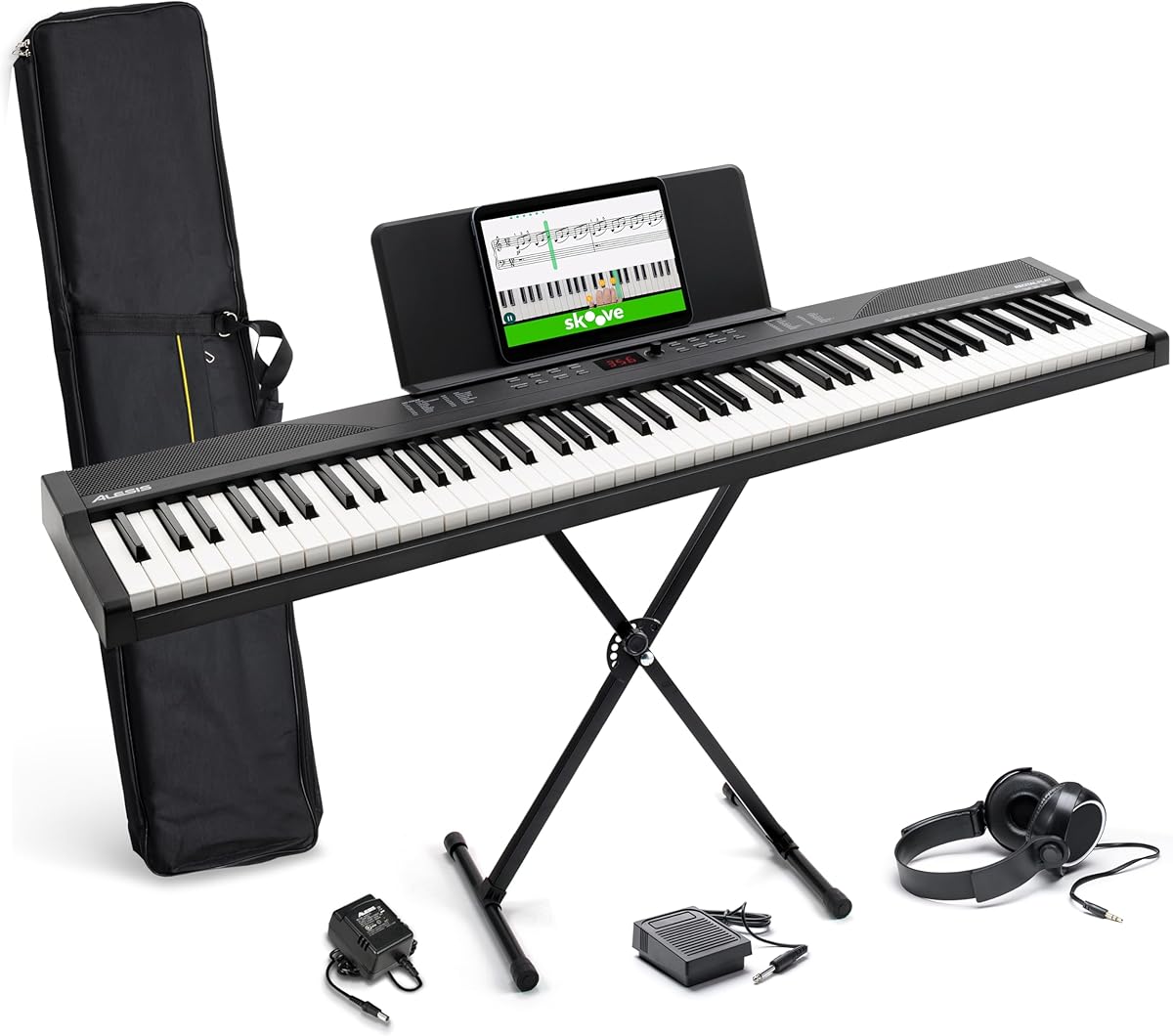
Alesis Recital Play
4.6Editor score
Touch-sensitive full-size piano keys
Four hundred eighty instrument sounds
Split lesson and record modes
Complete learning accessory bundle
Explore the best 88 key weighted keyboard options, comparing key action, sounds, connectivity, pedals, learning features, accessories, and portability.
An 88 key weighted keyboard offers a more authentic piano experience than a typical lightweight home keyboard. Full-size keys, touch-sensitive action, and properly weighted hammers can help students build technique while giving experienced players greater control over dynamics, touch, and expression.
We compared all ten instruments across the factors that most affect daily use: key action, sound library, polyphony, built-in speakers, learning tools, MIDI and USB connectivity, pedal options, included accessories, portability, and overall suitability for practice, recording, and performance.
Each review identifies the strongest reasons to consider a particular model, along with its practical limitations. The list includes traditional hammer-action pianos, compact home instruments, portable packages, and one semi-weighted starter keyboard, while current prices and availability should be checked before purchase.
4.6Editor score

4.7Editor score
4.7Editor score
This side-by-side overview compares the ten keyboards' action types, sound libraries, connectivity, and included hardware, making it easier to identify the model that matches your playing level, room, learning goals, and recording needs.


The YAMAHA P71 is an 88-key weighted-action digital piano with a 4.7 rating and a clear emphasis on acoustic-piano feel. Its touch-sensitive keys respond to changes in pressure, while the weighted action is designed to reproduce the physical resistance of an acoustic instrument. That makes it a strong all-around choice for pianists who want expressive control without navigating a complicated control panel.
We may earn a commission when you buy through this link, at no additional cost to you.
The instrument offers 10 voices, including a Yamaha grand-piano sound, and supports Dual Mode for blending two voices together. Layering a piano with strings or another compatible instrument can add depth to practice arrangements and compositions. A sustain pedal is included, giving players an immediate way to control note duration and create more nuanced performances. One-button operation keeps the workflow straightforward and allows attention to remain on the music.
The principal limitation is the compact selection of 10 voices. It is a focused piano-first instrument rather than a broad workstation for users who want dozens of timbres, extensive rhythms, or advanced recording menus. The package also lists a sustain pedal and power supply but not a stand, bench, or music rest, so pianists may need additional furniture depending on where the keyboard will be used.
This is an excellent recommendation for students, serious home pianists, and performers who value touch, simplicity, and a convincing piano sound. It is less suitable for someone seeking a large library of accompaniment sounds or a complete ready-to-play furniture package. Among the keyboards reviewed, its restrained operation and natural weighted action create one of the most convincing reasons to choose the P71.
Touch sensitivity and weighted action are the P71's defining advantages. A musician can vary volume through key pressure, then use the included sustain pedal to shape phrasing and resonance. The straightforward interface avoids unnecessary friction between listening, practicing, and performing.
Although the voice count is modest, Dual Mode adds useful creative depth. Blending piano with strings or another voice gives practice sessions and compositions a richer character without requiring a complicated arranger or a separate sound module.
We may earn a commission when you buy through this link, at no additional cost to you.
The Alesis Recital Play combines 88 full-size touch-sensitive piano-style keys with a 4.6 rating and an unusually complete package. It is designed primarily as a portable practice and learning instrument, offering a broad sound library, lesson tools, recording functions, and the accessories needed to begin playing immediately.
We may earn a commission when you buy through this link, at no additional cost to you.
Its 480 realistic sounds, adjustable reverb, 160 rhythms, and 140 demo songs make it a useful companion for practice, composition, and light ensemble work. Split, Lesson, and Record Modes allow a student to work with a teacher, divide the keyboard, or capture a performance. USB-MIDI connectivity broadens the possibilities by allowing use with compatible recording and educational software on a Mac or PC.
The important distinction is that the keys are touch-sensitive but not described as fully weighted. That means the instrument offers responsive dynamics and a familiar 88-key layout, yet does not provide the same physical key resistance as the true hammer-action models in this guide. It is therefore better suited to learners who prioritize affordability, portability, lessons, and features than to pianists specifically shopping for graded or fully weighted resistance.
The bundle includes a keyboard stand, sheet music or tablet stand, sustain pedal, headphones, carry case, and power supply. It can also run on six AA batteries, although they are not included, making it one of the few choices here that can move easily between rooms or locations. For a student or family seeking the most feature-rich portable learning package, the Recital Play is a persuasive choice.
Lesson, Split, and Record Modes turn a general-purpose keyboard into a structured practice partner. These functions support focused study, teacher-student sessions, and reviewing performances, while the metronome and transpose feature help players work with familiar material and changing keys.
The included stand, rest, headphones, carry case, pedal, and power supply reduce the number of separate purchases required at the start. Battery power adds mobility, while USB-MIDI opens the instrument to compatible lesson and recording software on a computer.
We may earn a commission when you buy through this link, at no additional cost to you.
The Bfgxuoo 88-Key Set has a 5.0 rating and presents itself as a complete starter package for beginners and adults. Its 88 full-size semi-weighted keys simulate piano touch with lighter resistance than a fully weighted hammer-action instrument, offering a middle ground between a conventional light keyboard and a heavier digital piano.
We may earn a commission when you buy through this link, at no additional cost to you.
The instrument includes 200 sounds, 200 rhythms, and 70 demo songs for practice, chord work, and arrangement. Bluetooth can connect with a smartphone for lessons, while MIDI supports compatible computers and external devices for editing or recording. Additional connections include sustain pedal, MP3, microphone, headphone, and USB, creating a broad range of possibilities for learning and home use.
Recording and playback features make it useful for checking progress, and the included headphones support quieter practice. The package contains a double-X stand, key stickers, music rest, USB power adapter, sustain pedal, and keyboard bag. This is an unusually extensive starter bundle, although the semi-weighted action and sticker-based beginner aids may not align with the priorities of an experienced classical pianist.
This model is most suitable for new players, casual adult learners, and anyone who values a ready-to-use package with broad connectivity. It should not be presented as a full substitute for a traditionally weighted acoustic-style action, because the supplied information specifically identifies the keys as semi-weighted. For those who accept that distinction, the feature and accessory density make it a compelling option.
Bluetooth, USB-MIDI, and MP3 support make the keyboard adaptable to phones, computers, and external equipment. These connections can support lesson software, music editing, recording, and playback without requiring the player to stay within the instrument's built-in library.
The double-X stand, music rest, sustain pedal, headphones, power adapter, bag, and key stickers cover the practical basics of a first home setup. New players can focus on learning while leaving room to remove the stickers as their confidence grows.
We may earn a commission when you buy through this link, at no additional cost to you.
The UISCOM 88 Key Weighted Home Digital Piano is a wooden, desk-style instrument with a 4.4 rating and a different emphasis from many portable keyboards. Its defining feature is a custom triple-pedal system for sustain, sostenuto, and soft pedal functions, closely reflecting the expressive controls found on acoustic pianos.
We may earn a commission when you buy through this link, at no additional cost to you.
Sound is generated by the listed French Dream5704 chip, with eight distinct tones and 40 demo songs. Dual-tone mode, recording, playback, reverb, chorus, and tempo controls give players several ways to shape a performance. MIDI functionality adds key-sensitivity adjustment and connection to computers or other MIDI equipment, allowing the instrument to participate in more advanced setups.
Connectivity is a major strength. Dual headphone jacks support private listening, while the built-in USB port can handle MP3 or hard-drive playback. The integrated media player provides direct control over songs, and the wooden cabinet is designed to blend into a home rather than resemble a generic stage keyboard. On the other hand, eight tones and 40 demos are modest compared with several other models in this list.
This is a compelling recommendation for pianists who care about pedal realism, a home-oriented appearance, and flexible media connections. It is less suitable for someone seeking a large collection of acoustic instrument timbres or extensive built-in teaching content. Buyers who want traditional pedal behavior and a substantial sound should examine this model closely.
Separate sustain, sostenuto, and soft pedals enable finer control than a single-pedal setup. These functions support more nuanced phrasing and make the keyboard better suited to serious practice, interpretation, and repertoire work.
The wooden desk-style cabinet is intended to sit comfortably in a home setting. At the same time, USB media playback, dual headphone outputs, and MIDI support provide useful connections for listening, recording, and computer-based work.
We may earn a commission when you buy through this link, at no additional cost to you.
The Donner DEP-20 is a portable 88-key digital piano with full-sized hammer-action keys, adjustable touch response, and a 4.6 rating. It combines a broad selection of instrumental timbres with media functions and a relatively detailed control panel, making it a strong fit for players who want weighted action without the size of furniture-style digital pianos.
We may earn a commission when you buy through this link, at no additional cost to you.
Its sound library contains 238 tones, including examples such as ukulele, drums, and bass, and the specification lists 128-note polyphony. Dual-tone mode allows two voices to be combined for layered arrangements. A backlit LCD can display chord names and notation, helping players follow songs, while recording mode, MIDI, and an MP3 player broaden the functions available for practice and creation.
Two 25-watt amplifiers are included for room-filling playback, along with audio inputs and outputs. The control panel also mentions sustain and triangle pedals, although the supplied product title identifies the package with a sustain pedal and power supply. As a portable model without listed furniture, it may be less visually integrated in a living room than a desk or stand bundle.
This DEP-20 is best for intermediate players, hobbyists, and students who want substantial sound variety along with authentic weighted resistance. Its range of tones, rhythm-adjacent accompaniment options, display, and media functions go beyond a bare practice piano. Those who prefer a simplified interface and a curated acoustic-piano sound may find other models more streamlined.
The key action provides the resistance and response expected from a serious practice instrument, while adjustable touch sensitivity lets players shape how strongly keys react. The 238-tone library and dual-mode layering make the DEP-20 useful for more than straightforward piano study.
A backlit LCD can present chords and notation, reducing the need to memorize every harmony during song practice. Recording, MIDI, MP3 playback, and dual amplifiers extend the instrument into casual composition, rehearsal, and media-listening setups.
We may earn a commission when you buy through this link, at no additional cost to you.
The Donner DEP-20 Furniture package takes the core features of the portable DEP-20 and adds a furniture stand and three-pedal unit. It is a full-size 88-key hammer-action digital piano with adjustable touch response, a 4.6 rating, and enough sound, display, and connectivity features to function as a central home instrument.
We may earn a commission when you buy through this link, at no additional cost to you.
The piano offers 238 tones and 128-note polyphony, with dual-tone support for combining sounds. Its backlit LCD displays chords and notation, while recording mode, MIDI connectivity, and an MP3 player support practice, arrangement, and media use. Two listed 25-watt amplifiers provide built-in sound, and the audio inputs and outputs can support ensembles or additional equipment.
The main difference from the portable DEP-20 is the furniture presentation and three-pedal arrangement. This is a more permanent home setup, potentially better suited to a dedicated practice room than a small studio or temporary location. Its controls also offer more options than a minimal piano, so first-time players may need time to learn the panel.
This configuration is an excellent choice for a home studio or family practice space where a stable, realistic piano station is desired. It offers the same broad tone selection and media functionality as the portable version while adding the visual and pedal completeness of a furniture digital piano. Players who need frequent transport or maximum simplicity may prefer the slimmer alternative.
The furniture stand gives the instrument a more finished appearance than a portable X-stand configuration. It is better suited to a dedicated room and creates a stable visual center for regular practice, lessons, and performance.
The included three-pedal unit supports the sustain, sostenuto, and soft-pedal functions described for this model. That wider pedal range helps pianists practice legato passages, sustain control, and other techniques associated with acoustic-piano performance.
We may earn a commission when you buy through this link, at no additional cost to you.
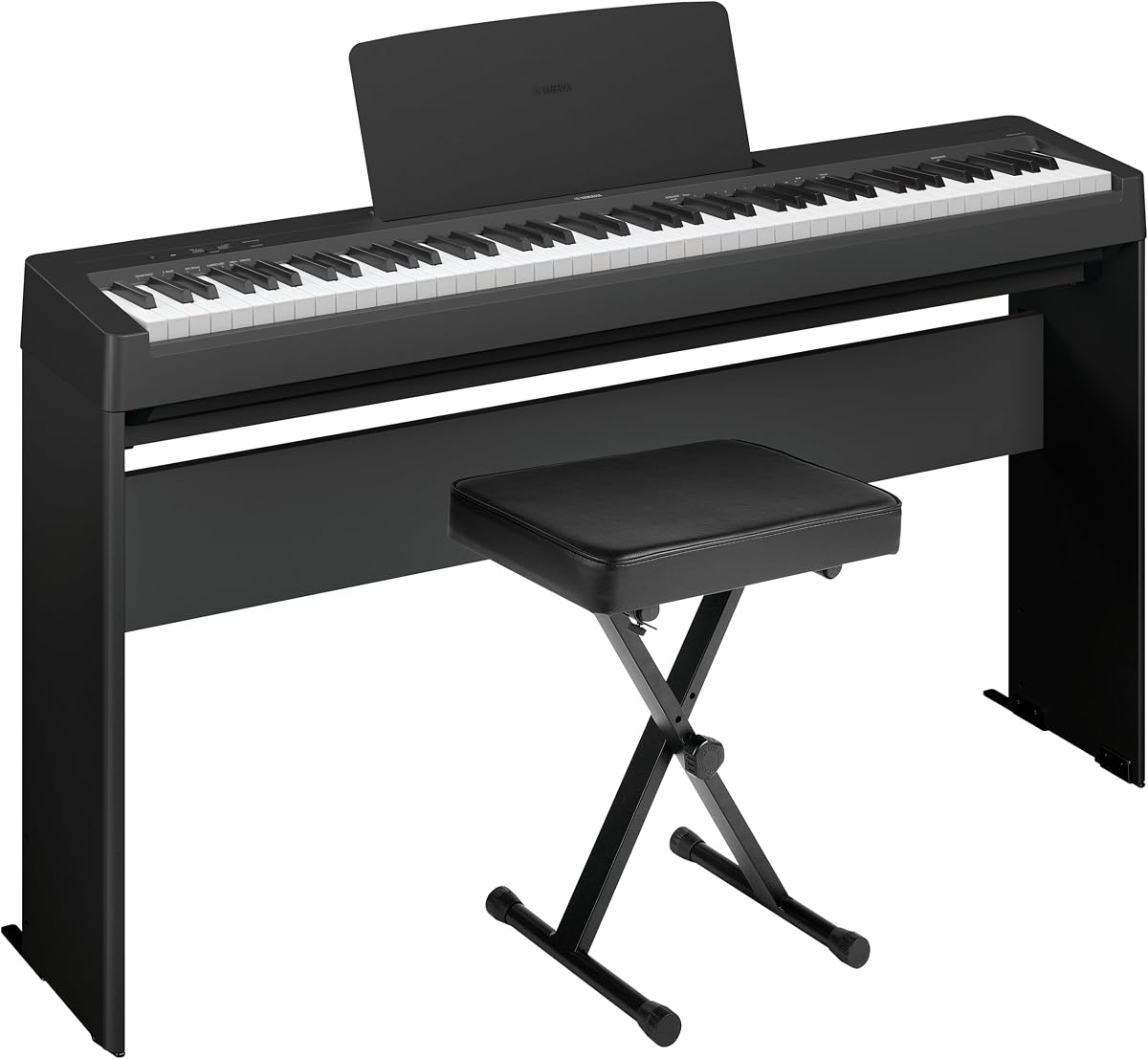
The Yamaha P-143 Bundle is a complete 88-key weighted musical keyboard package with a 4.7 rating. It is designed for pianists who want a focused, natural acoustic-piano experience together with the furniture needed for immediate use at home. The included stand, bench, music rest, sustain foot switch, and AC adapter make it a notably complete setup.
We may earn a commission when you buy through this link, at no additional cost to you.
The keyboard's weighted action is intended to reproduce the feel of an acoustic piano, while its grand-piano sound emphasizes natural resonance and rich, full tones. One-button operation and accompanying apps simplify the interface, allowing the player to spend less time navigating settings and more time concentrating on technique. A slim design keeps the instrument visually restrained in a home environment.
Its main trade-off is that the design emphasizes piano fundamentals rather than workstation breadth. There is no indication of a large multi-instrument library, rhythm bank, or extensive lesson system. Players whose priorities are weighted touch, a refined piano voice, and elegant home furniture will find that focus advantageous, while those wanting accompaniment sounds may need a more varied instrument.
For a student progressing toward serious piano study, a home performer, or a household replacing a separate keyboard and furniture purchases, this bundle is an excellent recommendation. It combines the action and sound that matter most for realistic piano practice with the practical accessories needed from day one.
The P-143 focuses on reproducing the response and character of an acoustic grand. Weighted keys support realistic technique, while the listed grand-piano voice provides a centered sound for repertoire, lessons, and personal practice.
A matching stand and bench, music rest, sustain foot switch, and power adapter eliminate several early setup purchases. The result is a coherent home instrument that can be positioned and played without separately sourcing every basic accessory.
We may earn a commission when you buy through this link, at no additional cost to you.
The Yamaha P145BT combines 88 weighted, touch-sensitive keys with a compact design and built-in speakers. Its 4.5 rating reflects a balanced package for home practice and travel, while Graded Hammer Compact action is intended to provide a natural acoustic-piano feel within a slim, relatively portable instrument.
We may earn a commission when you buy through this link, at no additional cost to you.
The sound specification centers on a premium grand piano with natural resonance and full-bodied tone. Bluetooth audio allows a player to stream favorite songs and play along, while app support includes Smart Pianist and Rec'n'Share. These features make the instrument useful for structured practice, sharing performances, and learning alongside familiar music.
The included music rest, sustain foot switch, and AC adapter support basic operation, but there is no listed stand or bench. A music rest that is part of a compact package may also be worth checking against the player's preferred angle and setup. As a Bluetooth-enabled home or travel keyboard, however, it addresses a clear need that many fixed pianos cannot.
This is a strong recommendation for pianists who want a Yamaha-style weighted action, acoustic-piano sound, and modern wireless convenience in a relatively compact format. It works well for students, home players, and musicians who practice alongside streamed music. Buyers planning to perform regularly may want to confirm that its built-in amplification and compact action suit the intended venue.
Graded Hammer Compact action gives the 88 keys a more realistic feel than a light action. The slim design reduces the visual and physical footprint, making the instrument practical for rooms where a full furniture piano would be excessive.
Bluetooth audio makes it easy to stream music and play along, while Smart Pianist and Rec'n'Share support practice, guidance, and performance sharing. These connected features complement rather than overwhelm the piano-focused controls.
We may earn a commission when you buy through this link, at no additional cost to you.
The 88-Key Weighted Desk Piano is a full-size weighted keyboard with a convertible wooden cabinet and a 4.4 rating. Its unusual selling point is the ability to convert from a hammer-action digital piano into a desk-style setup, making it particularly relevant to home offices, dorm rooms, and apartments where furniture flexibility matters.
We may earn a commission when you buy through this link, at no additional cost to you.
The sound section is unusually large for the price category, listing 800 tones and 128-note polyphony. A multi-function panel provides tone selection, recording controls, and a split function intended to assist learners. USB-MIDI integration supports connection to computers and compatible devices, while USB media functionality enables MP3 playback for practice and play-along work.
The flip key cover and portable legs are designed to protect the keys when the instrument serves as a desk. That makes it space-efficient, but it also means the user must physically change the configuration rather than simply rolling a conventional piano into place. The cabinet should be considered a home furnishing first and a portable instrument second.
This is an excellent choice for a user who wants real weighted keys, a large sound library, and a workstation that can coexist with a home office. It is less attractive for players who need a lightweight stage instrument, frequent transport, or a simple setup with no furniture conversion. Its versatility is most valuable where a second function for the keyboard is important.
The convertible design addresses limited-space problems by allowing the keyboard to become part of a work area. Portable legs and a flip key cover support the alternate use, while the 88-key layout preserves familiar piano spacing.
Eight hundred tones, 128-note polyphony, split functionality, recording, and USB-MIDI support make this keyboard practical for varied practice and creative work. It offers more timbral choice than most weighted home pianos in the list.
We may earn a commission when you buy through this link, at no additional cost to you.
The Donner DEP-20 Lite is a portable 88-key digital piano set with full-weighted hammer-action keys, adjustable touch response, and a 4.3 rating. It targets players who want traditional resistance plus modern device connectivity without moving into a large furniture-style digital piano.
We may earn a commission when you buy through this link, at no additional cost to you.
Its library includes 185 tones, 116 rhythms, and 128-note polyphony. The wireless function supports connections with iOS and Android devices as well as USB-MIDI computers, making the instrument useful for mobile learning, recording, and computer-based music work. A 1.3-inch LCD displays chord names and notation, while dual 25-watt speakers provide the main listening experience.
The package includes a stand and sustain pedal, and the product is designed to be lightweight enough for rehearsal, learning, creation, and performance. A bench is not listed, so buyers should consider whether they already have one. The smaller tone library than the standard DEP-20 also represents a deliberate step down in variety, although 185 sounds and 116 rhythms remain substantial.
This model is a good recommendation for students, teens, and portable players who prioritize wireless MIDI and full weighted action. It is less compelling for someone seeking the largest sound library or a complete furniture arrangement. Overall, it delivers a practical middle ground between traditional weighted feel and connected digital learning.
Support for iOS, Android, and USB-MIDI computers lets the keyboard work with a wider range of lesson and recording environments. Wireless connectivity is especially useful for students who practice with a phone or tablet.
The DEP-20 Lite retains full-size hammer-action keys and adjustable touch response in a portable set. Dual 25-watt speakers, an LCD, a sustain pedal, and a stand provide a practical core for home practice and rehearsal.
We may earn a commission when you buy through this link, at no additional cost to you.
The best 88-key weighted keyboard depends on how you learn, where it will live, and whether you value authentic resistance, broad sounds, connected lessons, or a complete furniture package. Compare action, sound, controls, and included accessories before deciding.
A fully weighted keyboard uses key resistance intended to feel more like an acoustic piano, while a semi-weighted model uses lighter, partial resistance. This distinction is central to the search because a touch-sensitive keyboard can still feel substantially lighter than a true weighted-action instrument. The YAMAHA P71, Donner DEP-20 models, UISCOM, Yamaha P-143, Yamaha P145BT, and 88-Key Weighted Desk Piano are described with weighted or hammer-style action, whereas the Alesis Recital Play and Bfgxuoo set fall into different action categories.
Choose full weighted action for technique, sustained practice, and classical repertoire. Consider semi-weighted keys when portability, lower weight, and a gentler starting experience matter more. Confirm the exact action description rather than assuming every 88-key piano has acoustic-like resistance.
Full-size keys preserve the spacing and dimensions players expect from an acoustic piano, which improves muscle-memory transfer and makes lessons easier to follow. Touch sensitivity adds another layer by allowing dynamics to follow how firmly a key is pressed. A keyboard that combines full-size keys with sensitivity can still teach useful dynamic control even if its resistance is lighter than a piano's.
Look for both key length and touch sensitivity in the specifications. These features improve realism and make it easier to develop balance between melody and accompaniment. If your goal is traditional piano technique, weight and grading deserve priority beyond size alone.
A focused piano voice can be more satisfying than a huge collection of unrelated sounds, but a broader library helps with lessons, accompaniment, composition, and ensemble work. The Yamaha P71 has 10 voices, the UISCOM offers 8 tones, the Bfgxuoo has 200 sounds, the Donner DEP-20 includes 238, the DEP-20 Lite has 185, and the desk piano lists 800. Polyphony indicates how many notes can sound together; several models provide 128-note polyphony.
Prioritize sound quality for repertoire and polyphony for complex passages. Choose a broad library if you need many timbres, and a refined piano sound if you mainly want realistic classical practice. Check demo songs and rhythm counts too, since they influence how useful the keyboard is without external material.
Learning tools can make a keyboard more useful for a student who does not yet have a teacher. The Alesis Recital Play includes Split, Lesson, and Record Modes, a metronome, transpose function, and access to compatible educational software. The Bfgxuoo offers recording and playback, while the UISCOM and Donner models include recording, chord displays, notation information, or MIDI operation.
Match the tools to your routine. Students may prioritize lesson modes and metronome timing, while experienced players may care more about MIDI, recording, and split functions. Useful educational software should also be compatible with the operating system and connections you intend to use.
MIDI allows an instrument to communicate with computers, mobile devices, notation programs, recording software, and compatible teaching applications. USB-MIDI appears across several models, while the Alesis supports Mac or PC use, the Bfgxuoo adds Bluetooth and MP3, and the Yamaha P145BT provides Bluetooth audio plus app support.
Check whether you want device control, file playback, or wireless play-along music. Bluetooth audio is useful for streaming songs, whereas wired or USB MIDI may be more appropriate for lesson and recording software. Confirm the required adapters and software before purchase, and review the listed connection formats carefully.
Pedal behavior has a major effect on realism. A sustain pedal allows notes to continue after the keys are released, while sostenuto and soft-pedal functions add more traditional acoustic control. The UISCOM and furniture-configured Donner DEP-20 provide a three-pedal approach, while several portable keyboards include a single sustain pedal or foot switch.
Choose three pedals when practicing repertoire that relies on expressive pedaling or when playing with a teacher who expects traditional functions. A sustain pedal is sufficient for many beginning players. Check whether pedals are included before assuming that a pictured accessory is part of the package.
Built-in speakers make an instrument convenient for everyday practice, while headphone output supports quiet study and late-night sessions. The Donner DEP-20 models list two 25-watt amplifiers, and the UISCOM includes two headphone jacks. The Alesis bundle includes headphones, while the Bfgxuoo package also includes a pair.
For a shared home, headphones and USB or audio connections may be more important than speaker volume. For rehearsals or small performances, built-in amplification deserves closer attention. Test the available outputs in advance and make sure external speakers or an audio interface match the instrument's connections.
The difference between a portable keyboard and a home-ready piano can be substantial. The Yamaha P-143 includes a stand, bench, music rest, sustain foot switch, and power adapter. The Alesis provides a stand, rest, pedal, headphones, case, and power supply, while the DEP-20 Lite includes a stand and sustain pedal. By contrast, some models require a separate furniture purchase.
Measure the intended space before choosing a furniture style. Consider weight if the instrument must move, and verify whether a bench, music rest, pedal, headphones, or stand is included. A complete package can simplify setup, but separate components may be easier to replace or reposition later.
Place the keyboard on a stable surface or stand and allow enough room for the full 88-key span, pedals, and music rest. Set the bench at a height that keeps the forearms naturally relaxed and the wrists approximately level. Connect the sustain pedal or other supplied pedals according to the manual, then choose an appropriate volume before switching on the power.
Begin with a touch-response setting that suits your current technique. Practice slowly, listening for evenness between the notes of a chord and checking that softer playing produces a clear change in volume. Use the metronome, split, lesson, recording, or notation features when they support a specific goal rather than simply cycling through menus. USB-MIDI and Bluetooth should be connected through compatible software or devices, with the correct input and output selections verified first.
Keep the instrument away from direct sunlight, moisture, extreme heat, and heavy liquids. Dust the key surfaces and cabinet with a soft, dry cloth, and avoid abrasive cleaners. Wipe the touch-sensitive keys gently because residue can affect sensitivity. Store cables and accessories together, and follow the manufacturer's transport instructions when moving a heavier furniture model. For long periods of nonuse, disconnect the power adapter and store the instrument in a stable, dry environment.
Yes, especially when the keys have full-size dimensions, touch sensitivity, and meaningful weight or grading. Adults can benefit from the same full keyboard range and technique development available on a digital piano. Beginners who need the lightest setup may choose a semi-weighted model, while students preparing for classical study should prioritize full weighted or graded hammer action.
Fully weighted keys are intended to reproduce the greater resistance of acoustic piano keys, often using hammer-style mechanisms. Semi-weighted keys provide partial resistance and are usually lighter. The Bfgxuoo model in this guide uses semi-weighted keys, while the touch-sensitive Alesis Recital Play should not be mistaken for a fully weighted action. Check each listing carefully because touch sensitivity and physical weight are separate features.
No. Touch sensitivity determines how the instrument responds to changes in key pressure, while weighting determines how much physical resistance the key provides. A keyboard can offer one, the other, or both. For the most realistic combination, look for full-size touch-sensitive keys with weighted or graded action.
Polyphony is the number of notes the instrument can sound simultaneously. It matters most for advanced repertoire, dense arrangements, and sustained chord work. Beginners can learn effectively with less polyphony, but 128-note polyphony provides more headroom and appears across several of the reviewed models. Sound quality, action, and accurate learning features may matter more during the earliest stages.
Models with USB-MIDI, wireless MIDI, or USB device support can connect to compatible recording and educational software. The Alesis Recital Play supports Mac and PC use, the Donner DEP-20 Lite lists iOS, Android, and USB-MIDI connections, and several other keyboards provide MIDI or USB playback. The receiving computer or mobile device must support the connection and the software must recognize the keyboard as a MIDI input.
A music rest improves comfort during lessons, repertoire study, and reading from sheet music. It is included with the Yamaha P-143, P145BT, Alesis Recital Play, and Bfgxuoo set, while other products may require a separate accessory. Check the package contents and the stability of any rest included with a portable setup.
A weighted keyboard is usually better for developing realistic piano technique because the key response more closely resembles an acoustic instrument. It can help players learn control, balance, and dynamic shaping. A light keyboard may still be sufficient for casual learning, children's activities, or music entertainment, so the best choice depends on the intended level and type of practice.
Test every key for consistent response, inspect the action for stiffness or sticking, and confirm that touch sensitivity works across the range. Check the speakers, headphone output, pedal connections, display, and USB or MIDI ports, along with the included power supply. Also examine the cabinet, stand, and pedals for damage, and ask for proof that all key functions and accessories are included.
The YAMAHA P71 stands out for its convincing weighted action, refined piano sound, and uncomplicated operation, making it the most balanced overall recommendation. The Alesis Recital Play is the strongest value-oriented learning bundle, while the Yamaha P-143 Bundle leads the premium category with its complete furniture setup, natural touch, and polished grand-piano sound.
Prioritize action type first if your goal is realistic piano technique. Next, choose according to the features you will actually use: a broad library and learning tools for students, wireless or MIDI connections for digital workflows, three pedals for advanced expression, and compact furniture or accessories that suit your available space and transport needs.
Finally, confirm the exact package contents, current product details, software compatibility, and present-day price before purchasing. Weighted keyboards vary considerably in weight, size, sound library, and included hardware, and prices can change. A careful comparison of those details will help you choose the model that best matches your playing goals and daily routine.