
Endoscope Camera with Light, 1920P HD Borescope Tools
4.5Editor score
1920P HD imaging
Sixteen-foot flexible probe
IP67 waterproof camera
Four-point-three-inch display
Plumbing inspection cameras make hidden pipe problems visible without immediately cutting into walls or floors. A useful camera combines a clear image, dependable lighting, a cable suited to the job, and controls that remain manageable around drains, cleanouts, and confined work areas.
The products below were compared using the supplied specifications, focusing on probe length, lens configuration, display quality, waterproofing, lighting, recording functions, battery life, and included accessories. The list covers dedicated sewer cameras as well as compact borescopes for lighter plumbing inspections.
Each review identifies the most useful capabilities and practical limitations of its featured model. Ratings and product details reflect the information available for this guide, while prices and promotions can change, so readers should verify current listings before purchasing.
4.5Editor score
4.5Editor score

5.0Editor score
As an Amazon Associate we earn from qualifying purchases.
This side-by-side comparison highlights the major differences in reach, imaging, lighting, recording, and portability across ten plumbing inspection cameras suited to everything from compact residential checks to longer drain surveys.


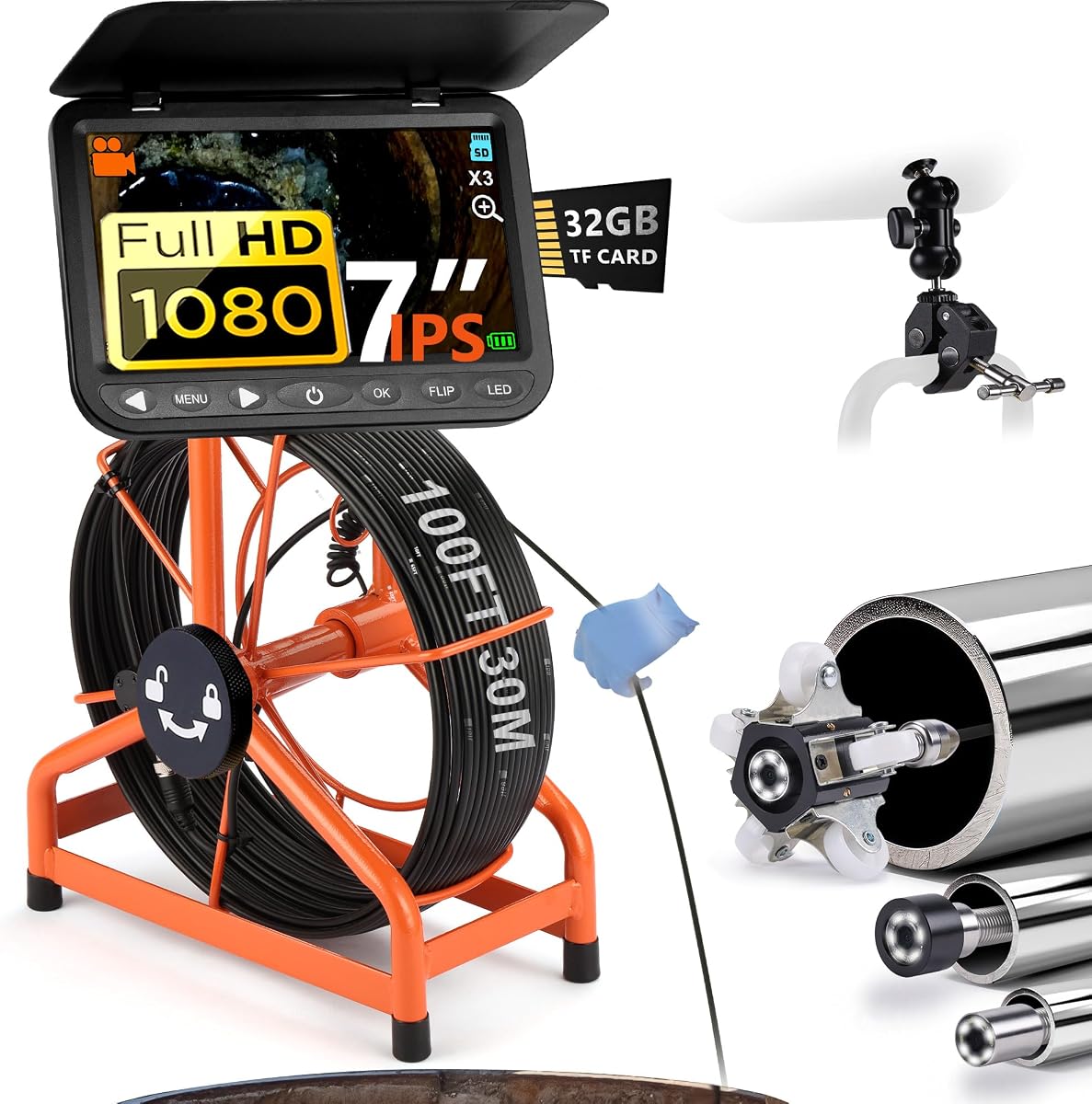
The ChoosePRO HD1080P Sewer Camera is the most complete dedicated plumbing inspection system in this group, earning a 4.5 rating for its combination of a long cable, large display, built-in recording, and practical reel design. Its 100-foot marked cable makes it better suited to deeper drain and sewer lines than most compact borescopes in the roundup.
We may earn a commission when you buy through this link, at no additional cost to you.
The camera uses an HD 1080P lens, a seven-inch IPS screen, and 16× zoom to help users identify cracks, clogs, and corrosion. Six adjustable LEDs illuminate dark pipe interiors, while the IP68-rated head is designed for wet, dirty, or flooded environments. Thirty-two gigabytes of built-in DVR storage permits recording and instant playback, and footage can also be transferred through the included SD card or USB-C connection.
Its reel is built around a twist-unlock mechanism intended to release or secure the cable quickly. The aluminum mounting hardware is also more substantial than an all-plastic setup, and the camera includes sleeves for different pipe sizes plus a spring tip intended to help negotiate bends. The trade-offs are a single-lens viewpoint, a larger overall package, and the need to supply a power bank separately if continuous operation beyond the built-in battery is required.
This camera is a strong recommendation for plumbers, property inspectors, facility teams, and serious homeowners who want one system to cover deeper lines and retain visual evidence. It is especially useful when distance marking, documentation, and a large viewing screen matter more than having multiple lens perspectives at the same time.
The 100-foot cable and feet-based markings help users relate a blockage to its position in the line. A 32GB DVR also makes this model practical for inspections that require recorded evidence, later playback, or sharing of observations with a customer.
An IP68 camera head, adjustable LEDs, interchangeable sleeves, and a spring tip provide the core protections and navigation aids needed for wet and dirty pipe environments. The seven-inch IPS screen is particularly useful when an operator needs a detailed view of the live image.
We may earn a commission when you buy through this link, at no additional cost to you.
This 5-inch 1080P dual-lens endoscope delivers useful plumbing inspection features at an approachable level, with a 4.4 rating. It combines a 16.4-foot semi-rigid probe, a 170-degree viewing angle, and switchable front and side cameras in a handheld package designed for both homeowners and working tradespeople.
We may earn a commission when you buy through this link, at no additional cost to you.
The probe is IP67 waterproof and includes eight adjustable LEDs, allowing it to handle drains, ducts, and other damp locations. A 1.2-to-four-inch focus range supports close inspection of details such as cracks and corrosion, while the wide-angle view helps operators understand the shape of a confined space. The self-contained 5-inch HD display means there is no need to connect a phone, install an application, or rely on Wi-Fi.
Its main limitation is explicit: the camera cannot take pictures or record videos. That limits its usefulness for formal documentation or sharing inspection evidence. The 2000mAh battery also provides approximately three to four hours of use, which may be adequate for household work but less convenient during a full day of repeated inspections.
Choose this model when you need an inexpensive way to examine short drain runs, pipe interiors, wall cavities, or mechanical spaces and do not need recorded documentation. The dual-lens design gives it more versatility than a basic single-camera borescope, making it a practical budget choice for occasional users.
Switching between the forward and side lenses helps an operator see forward along a pipe and then turn attention toward the wall. This is valuable when the question is not merely whether an obstruction exists, but what is causing it.
The plug-and-play format avoids app installation and phone pairing. Its portable size, one-handed handle, and IP67 probe make it straightforward to use for a sink drain, cabinet cavity, duct, or other compact inspection.
We may earn a commission when you buy through this link, at no additional cost to you.
The 1920P HD Borescope Tools is a compact inspection camera with a 4.5 rating, offering a higher stated resolution than most entry-level borescopes. Its 4.3-inch IPS display, approximately 170-degree viewing angle, color flip, and brightness shift give operators several ways to interpret a confined-space image.
We may earn a commission when you buy through this link, at no additional cost to you.
The semi-rigid cable measures 16.6 feet and ends in a short 1.29-inch lens, while the probe itself is 7.9 millimeters in diameter. That relatively slim head is designed to maneuver through narrow pipes and reach awkward angles. Eight LEDs can be adjusted for dark environments, and IP67 waterproofing supports use in wet pipe systems.
The main compromises are the absence of photo and video storage and the use of only one camera lens. A user can inspect live, but cannot rely on this unit to create a record of the work. The four-point-three-inch screen is also smaller than the five-, seven-, or larger displays offered by several more specialized models.
This is a good fit for DIY users, maintenance technicians, and inspectors who need a portable, high-resolution live view inside short drains, walls, or ducts. It is especially attractive when avoiding phone applications and driver software is important.
The stated 1920P resolution provides a high-detail live image in a small package. Color and brightness adjustments help the operator recognize surface texture and make subtle cracks or deposits easier to distinguish.
The short lens and 7.9-millimeter probe are useful in narrow lines where a longer camera head may catch on fittings. The semi-rigid cable maintains its shape yet remains flexible enough to bend around common obstacles.
We may earn a commission when you buy through this link, at no additional cost to you.
The DEPSTECH DS520 combines a 50-foot semi-rigid cable with three camera lenses and a five-inch IPS screen, earning a 4.3 rating. Its split-screen and five viewing modes provide a more flexible perspective than the single-lens cameras in the roundup, which can help distinguish blockage types and locate wall-side defects.
We may earn a commission when you buy through this link, at no additional cost to you.
The three lenses include a front view and two side views with stated focal ranges of 1.2 to 3.9 inches, 0.8 to 2.4 inches, and 0.6 to 0.9 inches. A 180-degree flip button and split-screen mode make it possible to inspect the pipe from multiple directions without constantly twisting the cable. The screen provides real-time 1080P imagery, and the IP67 probe is suitable for wet conditions.
The fifty-foot length gives the DS520 much more reach than a compact borescope, although a semi-rigid cable is not equivalent to a fully articulated sewer camera. It will work best in relatively straight runs and should not be expected to make every tight trap or elbow. Its larger display and broader accessory set also make it less convenient for delicate household work than a short handheld scope.
Plumbers, mechanics, home inspectors, and facilities teams can benefit from the combination of reach and multiple perspectives. The two-year warranty and stated 24/7 support also make it appealing for regular professional use, particularly when the ability to examine forward and side views at once reduces repeated camera repositioning.
The front lens follows the direction of travel, while the two side lenses examine the pipe wall. Split-screen viewing makes comparison easier and can reveal debris, root intrusion, or a damaged fitting that is not directly in front of the probe.
The cable provides enough distance for many residential drain and wall inspections while remaining more manageable than a full professional survey system. The included hook and magnet also add value for retrieving small objects encountered during mechanical work.
We may earn a commission when you buy through this link, at no additional cost to you.
The Teslong Dual Lens Sewer Camera is a straightforward 50-foot drain inspection system with a 4.1 rating. Its defining feature is simultaneous split-screen viewing from a forward camera and a side camera, allowing operators to see the route ahead and inspect the pipe wall without switching views.
We may earn a commission when you buy through this link, at no additional cost to you.
The forward camera uses six LEDs, while the side camera uses one. Images appear on a 4.3-inch IPS display that tilts and rotates 180 degrees, making it easier to read while standing over a manhole or crouching beneath a sink. Display brightness can be adjusted for direct sunlight, and a 3000mAh rechargeable battery is intended to support extended drain work.
The semi-rigid cable performs well in straight PVC sections but has limited ability to negotiate tight 90-degree elbows and P-traps. Visibility can also suffer in murky water, so the supplied guidance recommends flushing the line with clean water first. A compatible 32GB FAT32 TF card is not included, and users must add one if they want to save inspection files.
This camera is best for plumbers and maintenance teams that routinely inspect relatively straight drains and want a clear two-view image without relying on a phone. The lack of included storage is a minor inconvenience, while the cable limitations should be considered carefully for older, complex, or sharply curved plumbing systems.
The split-screen format is the central advantage. A forward view identifies the path of the drain, while the side view exposes cracks, root intrusion, joint separation, and debris along the wall.
The rotating and tilting monitor improves positioning in awkward work areas. Adjustable brightness helps balance visibility in sunlight against glare or reflections encountered in darker drain environments.
We may earn a commission when you buy through this link, at no additional cost to you.
The KCapyn 100FT Sewer Camera provides a 1080P image, a 100-foot semi-rigid cable, and DVR recording in a portable package, earning a 4.2 rating. Its 30-meter length and distance markings make it well suited to longer drain lines, tanks, and other hard-to-reach pipe locations.
We may earn a commission when you buy through this link, at no additional cost to you.
Six integrated LEDs illuminate the camera head, which has an IP68 dustproof and waterproof design for damp or dirty environments. The five-inch display supports real-time viewing and synchronized recording, while a built-in 32GB storage card allows the operator to save photos and videos for later analysis, reporting, or customer sharing.
One of the system's most practical features is its integrated orange toolbox. The monitor, cable, hook, and other accessories can be organized in one case, reducing missing parts and making transport between jobs easier. The limitation is that the camera uses a single lens rather than a front-and-side arrangement, so users may need to reposition the probe to inspect different aspects of a pipe wall.
This camera is a strong fit for contractors, facility maintenance teams, and advanced DIY users who want long reach and integrated documentation without carrying separate cases and storage components. Its semi-rigid cable is best on straighter routes, so it is not an ideal solution for highly convoluted plumbing.
The 100-foot cable supports deeper inspections than most compact scopes, and its marked scale helps users estimate the location of a defect. That information is valuable when discussing repair options with a property owner or maintenance supervisor.
Integrated storage, included DVR media, and a sturdy toolbox make the system easier to deploy consistently. A crew can move from one site to another without assembling a collection of loose accessories.
We may earn a commission when you buy through this link, at no additional cost to you.
The Teslong 5-inch Dual Lens Borescope is a highly rated compact inspection camera, holding a 4.6 rating in the supplied data. It is designed for walls, drains, ducts, engine compartments, and other confined spaces, combining a 16.5-foot semi-rigid cable with forward and side cameras.
We may earn a commission when you buy through this link, at no additional cost to you.
Each lens has independent LEDs, and the seven lights can be adjusted to reduce glare or improve visibility in deep, dark spaces. The five-inch IPS display provides a clear live view without requiring a phone, Wi-Fi connection, or application. Its 5000mAh rechargeable battery provides approximately 4.5 hours of continuous use, with a stated charging time of around five hours.
The IP67 probe can be used in wet environments, and the cable holds its shape while still bending enough to coil for storage. A hard case, hook, magnet, and mirror are included. The shorter cable and the absence of a stated built-in recording capacity limit its usefulness for deep sewer surveys or jobs requiring formal video evidence.
This borescope is an excellent general-purpose option for plumbers, mechanics, HVAC technicians, and homeowners who work on more than one kind of system. It is particularly appealing when the user values a large display, flexible lens positioning, and a high rating more than long reach or DVR functionality.
Independent front and side illumination lets operators avoid dark pipe sections without forcing excessive brightness onto reflective metal. The control makes the tool useful across plumbing, automotive, and building cavities.
A dual-lens borescope is useful for locating wall penetrations, examining drain interiors, checking engine cylinders, and viewing HVAC ductwork. The self-contained display also keeps the workflow simple when working around moisture, dust, or fragile surfaces.
We may earn a commission when you buy through this link, at no additional cost to you.
The Teslong Articulating Borescope is designed around maneuverability rather than distance. Its 4.6 rating reflects a strong overall reception for a compact five-foot tool with an articulating tip, a 4.5-inch IPS LCD, and no requirement for a phone or app.
We may earn a commission when you buy through this link, at no additional cost to you.
A centrally positioned joystick controls the two-way articulating probe, allowing the camera head to angle around obstructions or look behind nearby surfaces. This articulation is particularly useful in mechanical components, wall cavities, and HVAC spaces where a fixed straight camera cannot point toward the area of interest.
The color screen provides high-resolution visuals, and adjustable high-brightness LEDs illuminate dark areas. A conveniently placed photo button allows the user to capture images during an inspection, while the lightweight, compact construction helps reduce fatigue. The trade-off is a five-foot cable, which is too short for extended drain lines, plus a smaller screen than many dedicated sewer cameras.
This borescope is best for automotive, HVAC, construction, and close-access residential inspection work. It is a smart choice when precise tip direction matters more than reach. For standard pipe inspection, it can handle nearby drains and cavities, but a longer semi-rigid camera is the more sensible choice.
The articulating head can turn toward hidden or angled areas that a conventional straight probe might miss. This is useful for examining engine recesses, damaged wall sections, and internal components without repositioning the entire handle.
A centered joystick and rear photo button keep core functions within easy reach. The compact body and five-foot cable make this a convenient grab-and-go inspection tool for technicians carrying equipment from job to job.
We may earn a commission when you buy through this link, at no additional cost to you.
The Sewer Camera with Locator is the most specialized and premium-oriented model in the roundup, with a 5.0 rating. Its defining advantage is the included 512Hz locator, which complements a 100-foot marked cable and helps determine the approximate underground position of the camera head and a blockage.
We may earn a commission when you buy through this link, at no additional cost to you.
A 4.3-inch 1080P AHD monitor has a 145-degree viewing angle, adjustable LED lighting, and a sun visor for outdoor work. The 23-millimeter camera head includes 12 adjustable LEDs, while a built-in 32GB TF card supports image and video recording. Meter markers on the five-millimeter cable make distance easier to estimate during surveys.
The 8500mAh battery is rated for approximately six to eight hours of continuous work, making the system well suited to longer jobs. The trade-off is size and weight compared with compact borescopes, and the single-lens arrangement does not offer the simultaneous side view of dual- or triple-lens systems. Users also need to feed the cable through the fixed ring for smoother operation.
This camera is recommended for professional plumbing, construction, chimney, HVAC, automotive, and industrial maintenance teams that need both visual inspection and location information. It is especially appropriate when a blockage must be traced to a point along an underground line.
The locator provides information beyond what the image alone can offer. Combined with meter-marked cable, it helps an operator connect a visible defect with a location that can be marked at the surface for excavation or repair planning.
The 100-foot cable and high-capacity battery support extended inspection sessions. A 32GB card, sun visor, and multiple LEDs also make the package well suited to outdoor drain and utility work.
We may earn a commission when you buy through this link, at no additional cost to you.
The DEPSTECH DS620 is a 50-foot triple-lens inspection camera with a 4.4 rating. It combines a five-inch IPS display, 1080P imaging, switchable front and side views, and included 32GB storage, making it particularly suitable for users who want both close inspection and a permanent visual record.
We may earn a commission when you buy through this link, at no additional cost to you.
The semi-rigid cable reaches into voids, confined spaces, walls, ceilings, cylinders, and drains. Its 7.9-millimeter IP67 probe is built for damp environments, while adjustable camera lights and Bluart 3.0 technology support detailed observation. The included memory card can hold hours of video and thousands of still images, and a rechargeable battery is stated to provide up to four hours of continuous use.
The DS620 is less maneuverable in very tight spaces because the manufacturer recommends using a cable puller for enhanced control. Its battery runtime is also shorter than the six-to-eight-hour figure associated with the locator-equipped camera, although four hours remains practical for many residential and maintenance inspections. The larger display and carrying case add to its overall footprint.
This is a strong choice for plumbers, mechanics, DIY users, and homeowners who need a 50-foot reach plus multi-angle views and recorded documentation. The two-year warranty and 24/7 customer support provide added reassurance, while the included card eliminates a common extra purchase.
The included 32GB card lets operators preserve video and photographs without immediately setting up a phone or computer. That is useful for documenting a blockage, comparing findings over time, or sharing a report with a customer.
The slim 7.9-millimeter probe can access confined locations, and the triple-lens system gives operators several ways to inspect the same area. Front and side perspectives help reduce the need to pull the cable back and change the viewing angle repeatedly.
We may earn a commission when you buy through this link, at no additional cost to you.
The right plumbing inspection camera depends on the diameter and depth of the lines you examine, whether you need recorded evidence, and how frequently the equipment will be used.
Cable length determines the depth of the system you can inspect. Compact scopes with roughly 16-foot probes suit household drains, wall cavities, ducts, and automotive spaces, while 50-foot systems are better for deeper residential drain lines. Dedicated sewer cameras with 100-foot cables cover longer runs and support more serious diagnostic work. Cable flexibility matters as much as length: semi-rigid probes are easy to push through straight lines but may struggle around tight P-traps, whereas an articulating tip can steer through confined bends with less reach.
Match the cable to the plumbing, not merely to the biggest number available. A longer probe is unnecessary for a small sink line and may make a compact job less convenient.
A single forward-facing lens is useful for seeing along the route of a pipe, but it can miss cracks and defects directly beside the camera. Dual-lens systems add a side camera for examining pipe walls, and triple-lens systems offer an even wider range of viewing options. Split-screen displays are especially useful because they let the operator compare forward and side views without repeatedly changing modes.
Resolution should also be considered, but lighting, focus range, and probe diameter can affect practical clarity more than headline resolution alone. Look for a camera that can clearly render cracks, corrosion, roots, debris, and joint separation under realistic pipe conditions.
Drain interiors are often dark, dirty, or submerged, so adjustable LED lighting is essential. More than one brightness level helps reveal detail without washing out close surfaces with glare. IP67 or IP68 protection indicates resistance to dust and water, although operators should still follow the manufacturer's handling instructions and avoid submerging parts not designed for it.
For pipes with mineral deposits, grease, or reflections, lighting controls can be as important as image resolution. A camera that produces a clear image in a dry pipe may perform much less effectively in a murky line.
Built-in DVR recording and included memory are valuable when you need evidence, reports, before-and-after comparisons, or customer records. Some budget borescopes display a live image but cannot capture stills or video. Other systems provide a photo button without offering a large internal storage capacity. Verify the exact recording format, card compatibility, transfer method, and free space before relying on documentation.
Recording is less essential for a quick household check, but it is usually worth prioritizing for plumbers, property inspectors, facility managers, and contractors who create formal documentation.
A larger screen can make cracks, roots, and material boundaries easier to identify, but portability also matters. Displays between 4.3 and five inches suit most handheld inspections, while the ChoosePRO model's seven-inch screen offers a notably larger view. Rotating or tilting displays are valuable beneath sinks, inside cleanouts, and around manholes because they reduce the need to view the monitor at an awkward angle.
Buttons should be large enough to operate while wearing work gloves, and the controls should be easy to understand without a phone. Self-contained systems also keep the operator's personal device away from dirty and wet work areas.
Battery capacity indicates how long a system may operate between charges, but actual runtime depends on lighting, recording, and the workload. A 2000mAh battery may suit a brief household inspection, while 3000mAh to 8500mAh options are more comfortable for full days of work. Check charging time as well, and note whether the monitor can operate while connected to an external power source.
For jobs in locations without convenient outlets, battery runtime can determine whether one charge is sufficient. Keeping a second compatible battery or a power solution may be useful for intensive daily use, depending on the manufacturer's guidance.
A locator can be valuable when the pipe runs underground or through a structure and the image alone cannot reveal its exact position. A locator paired with distance-marked cable helps an operator estimate where a blockage or damaged section lies, enabling more accurate repair planning. The meter markings on the premium sewer camera are the most explicit example in this roundup, although several other systems also include marked cables.
These features are more important for professional surveys than for a routine household check. Buyers should confirm that the locator and camera are designed to work together and understand the learning curve involved.
Useful accessories include hooks, magnets, mirrors, protective cases, pipe sleeves, and cable pullers. A case matters when equipment is transported between jobs, while sleeves can help center the probe inside different pipe diameters. Warranty length and support availability also deserve consideration for regular professionals, particularly because cameras may be dropped, exposed to moisture, or used in dirty environments.
Finally, compare the complete package rather than evaluating the head unit alone. A longer cable, carrying case, memory card, and useful mounting hardware can add more practical value than a small increase in stated image resolution.
Begin by identifying the access point and understanding the pipe layout. Clear standing water with clean water when possible, because murky liquid can obscure the image, and remove accessible obstructions before inserting the probe. Wear appropriate personal protective equipment, secure the reel, and keep hands clear of the moving cable and reel mechanism.
Insert the camera gradually while watching the live display. Start with moderate lighting, then adjust brightness to suit reflections, darkness, and pipe material. Use marked cable depth as a reference, move the camera in short controlled increments, and rotate or articulate the head where supported. For a dual-view system, compare the forward and side images before deciding whether the cable should advance farther.
After the inspection, record and save relevant findings, then clean and dry the camera head and connector as directed. Coil the cable without sharp bends, secure accessories in the case, and store the unit away from extreme heat or moisture. Do not charge a camera that is wet, and follow the manufacturer's instructions for compatible cards, cables, batteries, and replacement parts.
A 16-foot probe is usually sufficient for household sinks, wall cavities, ducts, and other short inspections. A 50-foot camera is more appropriate for deeper residential drain lines, while a 100-foot system suits longer sewer runs and professional surveys. Consider not only depth but also whether the cable is flexible enough to reach the access point.
Some models record video and still images, while others provide only a live display. The ChoosePRO and KCapyn cameras include DVR storage, the premium locator model includes a 32GB TF card, and the DEPSTECH DS620 includes a 32GB card. By contrast, the five-inch dual-lens and 1920P compact scopes do not store photos or videos.
A dual or triple lens can help because it shows both the direction of travel and the pipe wall. A single lens is simpler and may be sufficient for locating obvious obstructions in straight lines. Multi-lens systems are more useful when diagnosing cracks, corrosion, root intrusion, leaks, or joint damage.
Semi-rigid cables generally work best in relatively straight pipe sections and may have difficulty negotiating very tight bends. Models with an articulating tip can change direction more effectively, although they usually have a shorter reach. The Teslong 50-foot product specifically notes limited flexibility through tight 90-degree elbows and P-traps.
A locator helps determine the approximate location of the camera head and the defect it has reached, which is especially useful for underground lines. Combined with meter-marked cable, it can narrow down where excavation or repair work may be required. It is most relevant to professional drain surveys rather than routine household inspections.
Several models have IP67 or IP68 camera protection and are designed for wet, dirty, or flooded environments. Nevertheless, water clarity still affects the visible image, and operators should follow the stated immersion and handling instructions. Flushing a line with clean water can often improve visibility before inspection.
No. Every camera in this roundup provides a self-contained display and does not require an app or Wi-Fi connection. Some compact models cannot save images, while DVR-equipped systems provide a built-in way to document findings and transfer files for later review.
Clean the probe and lens after each job, allow the connector and monitor to dry as directed, and avoid charging wet equipment. Store the cable without sharp kinks, keep the protective case closed when the unit is not in use, and check the battery, card, and connectors periodically. Follow the manufacturer's warranty and replacement-part instructions for damaged components.
The ChoosePRO HD1080P Sewer Camera is the strongest all-around choice because it combines a 100-foot marked cable, a large seven-inch IPS display, 32GB DVR storage, adjustable lighting, and a fast reel system. For less demanding work, the 1920P borescope provides a high-resolution and compact inspection option, while the five-inch dual-lens endoscope adds front and side views at a budget-friendly level.
Prioritize cable reach, lens perspective, and recording based on the actual work. Plumbers inspecting deep or complex drains may need a long, semi-rigid system or a locator-equipped camera, while DIY users can often get adequate results from a shorter borescope. Probe diameter, waterproof protection, display angle, lighting, and battery runtime also influence whether a tool will be comfortable on the job.
Ratings, product configurations, and promotions can change, and current prices should always be checked on the linked listing before purchase. Review the included accessories, warranty, supported memory format, and manufacturer guidance to ensure the camera is appropriate for the pipes and inspection environment you expect to encounter.