
eufy Security eufyCam S4, 4K Solar Camera, 3-Lens PTZ, 360° Coverage
4.2Editor score
Triple-lens camera system
4K fixed wide view
360-degree PTZ tracking
SolarPlus power system
Active warning lights
Compare the best AI security cameras for home security, comparing 4K video, solar power, AI detection, tracking, storage, and connectivity for your home with
AI security cameras combine machine-assisted detection, automated tracking, smart alerts, and remote monitoring in cameras designed to watch homes, driveways, yards, and entry points. The best model balances accurate recognition, dependable video, useful nighttime detail, flexible storage, and installation options that suit the property rather than merely adding AI to the feature list.
This guide compares ten AI security cameras across resolution, field of view, motion recognition, tracking behavior, solar or wired power, storage choices, connectivity, deterrence features, and smart-home compatibility. It includes single cameras, multi-camera kits, battery-powered systems, PoE equipment, and camera-and-base bundles to reflect the many ways modern properties can be monitored.
Each review explains the strongest reasons to consider the camera, along with its limitations and ideal installation environment. The top picks highlight a versatile all-rounder, a premium triple-lens system, and a flexible single-camera option, while the full comparison shows how every model differs. Prices and availability can change, so confirm current listings before buying.
4.2Editor score

4.3Editor score

4.3Editor score
The table below compares the ten cameras by resolution, coverage, power method, AI capabilities, and storage approach, making it easier to identify the right model for a porch, yard, driveway, or complete property.





The WYZE Cam v4 is an adaptable indoor and outdoor camera that combines 2.5K QHD recording with on-device AI recognition. Its 4.3 rating reflects a strong balance of useful detection, clear daytime imagery, and straightforward installation. The fixed 120-degree field of view may be less expansive than a pan-tilt design, but it provides a dependable view of doors, porches, playrooms, driveways, and other fixed observation points.
We may earn a commission when you buy through this link, at no additional cost to you.
Its most distinctive feature is the combination of a Starlight sensor and a 72-lumen spotlight, which can produce color footage in darkness rather than relying exclusively on infrared. When motion occurs, the camera can illuminate the scene, sound a 100 dB siren, and distinguish people, packages, pets, and vehicles on-device. That recognition helps reduce the irritation of irrelevant alerts while adding useful context to each event.
The camera also offers two-way audio, custom activity zones, a multi-camera dashboard, and compatibility with Alexa, Google Assistant, and IFTTT. Storage can remain local on a microSD card as large as 512GB, although the card is sold separately. Optional cloud backup is available, but no cloud plan is required for core use. The IP65 housing and stated operating range from -4°F to 113°F also make the camera more versatile than many indoor-only alternatives.
Installation is approachable: the included magnetic base can sit on a shelf or attach to metal, the freestanding stand works on flat surfaces, and a screw mount supports wall placement. Buyers seeking the strongest balance of resolution, detection, deterrence, local recording, and installation convenience will find this a compelling general-purpose choice. It is especially suited to renters, first-time owners, and households building a scalable camera network.
This is not a substitute for a panoramic camera when a homeowner wants to move the view remotely, and the 2.4GHz-only connection can be limiting in crowded wireless environments. Even so, it offers more capability than many basic indoor cameras while remaining straightforward enough for a first security installation. Its local-storage and smart-home support make it an especially balanced recommendation.
On-device recognition separates people, packages, pets, and vehicles before generating alerts. Combined with activity zones, that reduces notifications for passing traffic and movement in areas where the camera has no monitoring role.
A supported microSD card provides a subscription-free way to retain footage. Users who want an additional cloud backup layer can add an optional service, but the core camera does not depend on it.
We may earn a commission when you buy through this link, at no additional cost to you.
The eufyCam S4 is the most technically elaborate camera in this guide, using three lenses to combine a 4K fixed bullet view with a lower 2K dual-lens PTZ system. Its 4.2 rating reflects a premium design aimed at users who want extensive coverage, automatic subject tracking, and detailed zoom. Rather than forcing one lens to perform every task, it assigns broad situational awareness and close inspection to separate optical systems.
We may earn a commission when you buy through this link, at no additional cost to you.
The upper 4K lens provides a 130-degree fixed view, while the PTZ section rotates for 360-degree coverage and optical zoom. Bullet-to-PTZ tracking allows the moving lens to locate a subject detected by the bullet camera. Auto-framing can zoom out when additional subjects enter the scene, helping keep the relevant activity visible. The stated tracking distance of up to 164 feet is particularly useful for large driveways, yards, and open properties.
SolarPlus 2.0 power is supported by a detachable 5.5-watt solar panel, with approximately one hour of direct sunlight described as sufficient for daily operation. The camera can work independently with on-device human, vehicle, and pet detection, 32GB of built-in storage, and microSD expansion up to 256GB. Adding a compatible HomeBase S380 unlocks BionicMind family-versus-stranger differentiation, broader local storage, continuous recording, and snapshots without a subscription fee.
The camera also supports active deterrence through red and blue warning lights and a 105 dB siren. Radar and PIR sensors work together to improve motion accuracy and reduce false alarms. The main compromise is financial: this is a substantial investment, and some of the most advanced features require additional equipment or specific compatibility. Buyers also need to understand that other HomeBase models and eufy NVR systems are not supported for the listed HomeBase S380 functions.
For a homeowner who wants one premium camera to survey a broad outdoor area and zoom in after an alert, the S4 is difficult to match in this group. It is best suited to users willing to prioritize image quality, tracking, solar convenience, and advanced local AI over a simpler installation.
The fixed 4K lens maintains a broad reference view while the PTZ lenses follow and magnify activity. This dual approach can preserve context without relying on digital zoom alone.
The detachable solar panel gives installers more freedom than a permanently integrated design. Combined with automatic tracking, it supports unattended coverage across expansive outdoor areas.
We may earn a commission when you buy through this link, at no additional cost to you.
The eufy SoloCam E30 is a well-rounded 2K solar camera for buyers who want broad coverage and automatic tracking without moving into the camera's premium multi-lens tier. Its 4.3 rating places it among the strongest-rated options here. A 360-degree pan-and-tilt design, f/1.6 aperture, and AI tracking make it especially suitable for front porches, driveways, yards, and other areas where a fixed camera might miss movement.
We may earn a commission when you buy through this link, at no additional cost to you.
Built-in AI detects and tracks people, vehicles, and important events within view. That makes the camera more useful than one that merely announces every instance of motion. The removable solar panel is another useful feature, and two hours of daily sun are stated to keep it charged. Because the panel detaches, it can be positioned separately from the camera when the best viewing angle and strongest sunlight do not coincide.
The E30 supports microSD storage up to 128GB without a subscription. It can operate independently or connect to a HomeBase S380 or S280, depending on whether the priority is advanced AI and large local storage or group-control functionality. Users are instructed to unbind the camera before changing compatible HomeBases. The camera supports 2.4GHz Wi-Fi, providing a stable connection through many homes but limiting compatibility with 5GHz-only networks.
The central tradeoff is image resolution. At 2K, the E30 should provide a practical view of people, vehicles, and packages, but the WYZE Cam v4 and several 4K options provide more room to crop and inspect distant activity. It also lacks the multi-lens architecture of the S4, so automatic tracking and wide situational coverage occur within a single pan-tilt unit.
For buyers prioritizing ease, solar operation, and tracking over maximum resolution, the SoloCam E30 is an excellent fit. It is especially compelling for a first camera covering one important zone, or for a larger property where one rotating camera can reduce the number of units required.
The 360-degree pan-and-tilt mechanism lets users redirect the camera through the app and follow detected movement. That makes it practical for properties where a single fixed view would leave important areas uncovered.
A supported microSD card keeps recording straightforward and subscription-free. Compatible HomeBase choices provide a path toward larger storage and more advanced system management for expanding installations.
We may earn a commission when you buy through this link, at no additional cost to you.
This four-camera solar system offers broad property coverage and a 4.4 rating, the highest among the products listed. It is designed for buyers who want multiple wireless cameras without running Ethernet cables or placing outlets around a yard. Each unit combines 2K recording, a pan-tilt-zoom design, a spotlight, two-way audio, and AI-assisted human detection.
We may earn a commission when you buy through this link, at no additional cost to you.
Its dual-band Wi-Fi support differentiates it from several competing models restricted to 2.4GHz. The 2.4GHz band can provide stronger penetration through walls and farther reach, while 5GHz offers faster performance and smoother live viewing when the signal conditions are favorable. Users can therefore select the appropriate band for different parts of a home instead of being limited to one network type.
Power is handled through detachable solar panels and integrated backup batteries. Two hours of daily sunlight is stated to maintain regular operation, while the battery offers resilience during cloudy periods. The IP65 construction is designed for rain, snow, dust, and temperature changes, making the cameras suitable for exposed outdoor positions.
AI human detection works alongside PIR sensing to distinguish people from animals and moving objects. Users can pan, tilt, and zoom remotely, speak through two-way audio, and choose between local microSD recording or optional cloud storage. The storage card is not included, and higher-resolution cloud footage may require a paid plan, so the full cost of long-term retention should be considered.
This is a strong fit for first-time owners, renters, and anyone who wants four cameras positioned around a house, driveway, or yard. It gives more complete coverage than a single-camera purchase without a complex wired network. The compromises are shared 2K resolution across the set, less detail than premium 4K alternatives, and potential cloud-plan costs for users who want remote high-quality storage.
Supporting 2.4GHz and 5GHz networks gives installers more options in homes with dense wireless congestion. It can also make live viewing smoother when the 5GHz band has a clear path to the router.
A four-pack can cover a front entrance, driveway, backyard, and side area with fewer separate purchases. Solar panels and backup batteries support a wire-free layout across widely separated positions.
We may earn a commission when you buy through this link, at no additional cost to you.
The aosu T2 Ultra is a four-camera system built around 4K TrueColor night vision, local storage, and cross-camera event review. Its 4.3 rating reflects a strong feature set for homeowners who want more than independent camera feeds. The cameras can identify people and vehicles on-device, track activity automatically, and participate in a system designed to connect clips into a more complete account of an event.
We may earn a commission when you buy through this link, at no additional cost to you.
Each camera offers 360-degree pan-and-tilt coverage and real-time auto tracking. A 9200mAh battery and detachable solar panel support outdoor placement, while the aosuBase connects to the router by Ethernet and communicates wirelessly with the cameras. This architecture avoids relying on house Wi-Fi at each camera position and allows the system to support up to six cameras as coverage expands.
Multi-Camera Tracking is the standout feature. Instead of presenting disconnected snippets, the system can combine related footage from multiple cameras into one timeline, making it easier to see how an arrival or suspicious event unfolded. Smart Vehicle Guard adds another layer by monitoring parked vehicles and sending an alert when nearby movement occurs. Activity zones, light warnings, and sound warnings add active deterrence.
Storage is local by default. The base includes 32GB and can expand to 1TB, with encrypted local storage designed to keep footage under the homeowner's control. That avoids a mandatory subscription, making the system appealing for households that prefer not to depend on cloud retention. The base and four cameras form a more involved installation than a standalone camera, and Ethernet access at the base is required.
This system is best for people monitoring several exterior zones who value event reconstruction as much as raw resolution. Its 4K imagery, local capacity, vehicle awareness, and coordinated tracking provide a compelling package. Users who only need to watch one doorway may find this level of infrastructure more than necessary, but larger properties can gain considerable value from coordinated views.
Multi-Camera Tracking links related clips into a unified timeline. That reduces the need to reconstruct events by manually opening separate feeds and comparing timestamps.
The included local storage and expandable capacity make long-term recording possible without a required subscription. Ethernet at the base provides a stable central connection for the wireless cameras.
We may earn a commission when you buy through this link, at no additional cost to you.
The eufy SoloCam E42 pairs two 4K solar cameras with a HomeBase 3, giving buyers a compact two-camera system rather than a single unit or a large multi-camera bundle. Its 4.2 rating reflects solid image quality and comprehensive local-storage support. The cameras can recognize license plates from up to 33 feet, an especially useful capability for driveways, entrances, and busy street-facing properties.
We may earn a commission when you buy through this link, at no additional cost to you.
Built-in AI detects and tracks people, vehicles, and other notable events while the 360-degree rotation reduces the blind spots associated with fixed views. A motion-activated strobe and siren provide active deterrence when an event enters the monitored area. SolarPlus 2.0 technology is stated to maintain operation with two hours of direct sunlight each day, reducing routine charging and cable management.
HomeBase 3 is the central component. It includes 16GB of built-in storage, can expand to 16TB, and supports continuous recording even during network outages. Each SoloCam also supports a microSD card up to 128GB without a subscription fee, although the card is not included. Recommended performance relies on the supplied HomeBase 3, and existing owners are advised to use the specified firmware and app versions.
The principal limitation is that buyers receive only two cameras, so complete large-property coverage may require further expansion. Another consideration is the need to place each solar panel where it receives useful direct sunlight. The system's strong points are resolution, tracking, local retention, and an included base that adds resilience when internet access is interrupted.
This kit is well suited to couples, smaller homes, or users who want two high-resolution exterior cameras with a central hub. It also offers a natural upgrade path for anyone beginning with a focused entrance-and-driveway setup and later adding cameras. For buyers comparing value, the E42 delivers a more complete infrastructure package than a standalone camera while remaining smaller than four-camera systems.
True 4K recording provides enough detail for close inspection, and the stated license-plate recognition range makes the cameras more useful in vehicle-heavy areas. Tracking helps retain that detail when subjects move through the scene.
HomeBase 3 supports continuous recording even if the network goes down. Local expansion to 16TB also creates a strong retention option for households that prefer keeping recordings at home.
We may earn a commission when you buy through this link, at no additional cost to you.
The REOLINK OMVI 3i PoE is a wired triple-lens camera for installers who want stable connectivity, extensive coverage, and detailed tracking. Its 4.2 rating suits a system intended for permanent mounting. A 10MP dual-lens panoramic camera covers 180 degrees, while an 8MP PT camera handles zoomed detail, creating an 18MP combined composition for both environmental context and close inspection.
We may earn a commission when you buy through this link, at no additional cost to you.
SyncTrack technology allows the panoramic camera to identify motion and pass it to the PT camera, which locks onto the object and follows it automatically. A dual-screen display preserves the broad scene while the second view tracks the target. If the subject leaves the panoramic field, the tracked view can continue following it, while automatic zooming adds detail when appropriate.
Advanced AI recognizes people, vehicles, and animals. Virtual fences, intrusion zones, and non-motion zones allow users to shape alerts around meaningful boundaries and disregard areas where movement is routine. For nighttime deterrence, the camera can switch between infrared and motion-triggered white light. Alarms and lighting can therefore serve as a visible and audible response instead of relying only on an app notification.
PoE sends data and power through one Ethernet cable, making the connection more consistent than Wi-Fi in large properties. Storage options are unusually flexible: microSD up to 512GB, Reolink NVR, FTP, or NAS can all be used. H.264 and H.265 compression, continuous recording, multi-user access, and two-way talk round out the platform-oriented feature set.
Installation complexity is the main trade-off. Ethernet must be routed to the mounting location, and the camera does not support Wi-Fi. Users should also update the Reolink NVR firmware and use a supported current client so the complete triple-lens and PTZ views appear correctly.
For owners with an existing wired network or a willingness to add cable, the OMVI 3i PoE is a capable choice. Its combination of panoramic awareness, automated close-up tracking, multiple storage paths, and perimeter tools makes it particularly suitable for serious outdoor monitoring.
The panoramic and PT lenses operate as a coordinated system. The broad view shows where activity occurs, while the automated telephoto view follows and enlarges the relevant subject.
MicroSD, NVR, FTP, and NAS support give installers several ways to retain footage. PoE also removes the reliability problems that can arise when a distant outdoor camera depends entirely on wireless signals.
We may earn a commission when you buy through this link, at no additional cost to you.
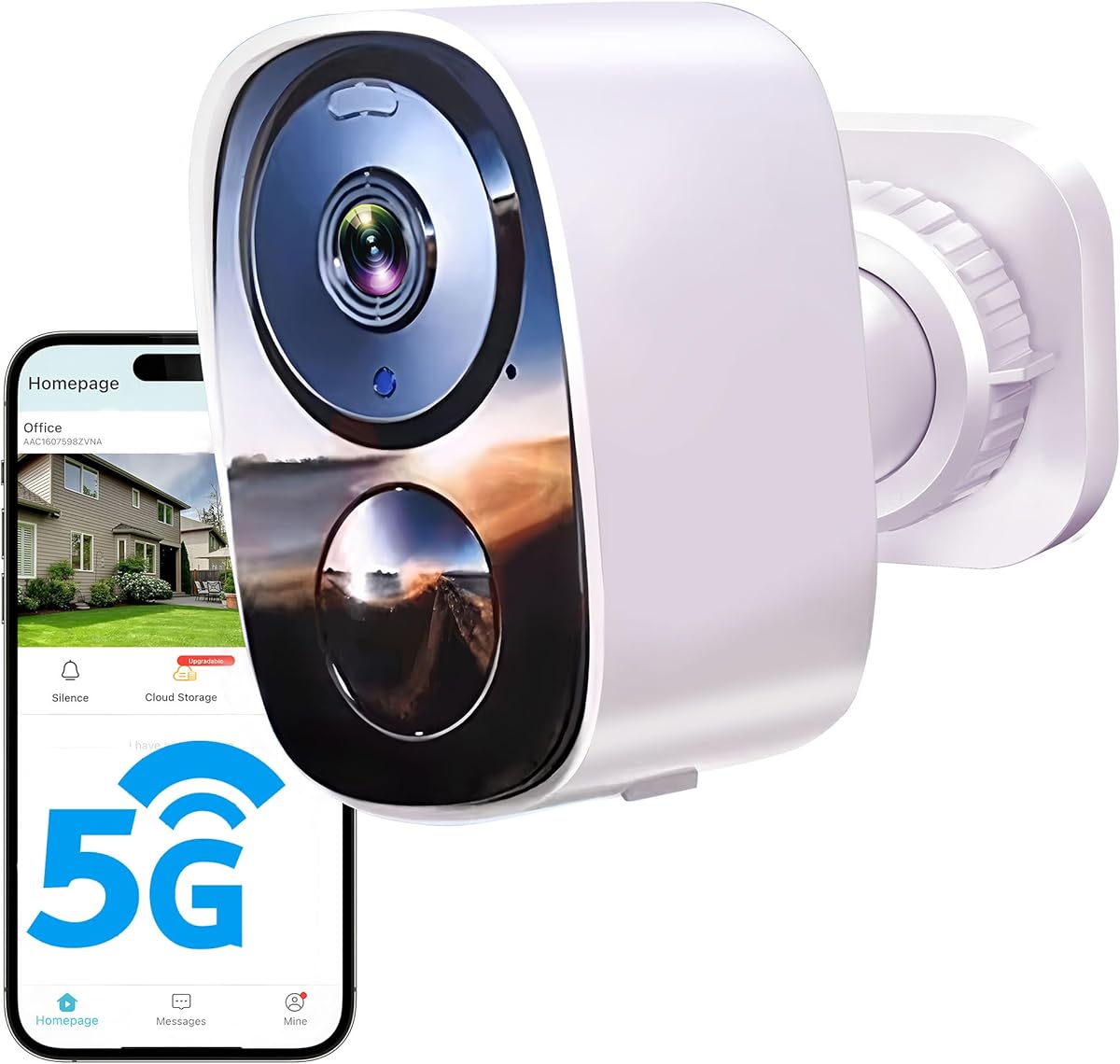
The 2026 Upgraded 2K Security Camera is a battery-powered option designed for flexible outdoor placement without solar panels or wired power. Its 4.3 rating reflects a useful combination of 2K recording, AI motion detection, dual-band Wi-Fi, and free cloud access. It also supports local microSD storage up to 256GB, giving users a choice between cloud and on-camera retention.
We may earn a commission when you buy through this link, at no additional cost to you.
The headline battery claim ranges from one to six months. Test conditions cited in the product information describe a fully charged camera running for 60 days with motion detection triggered 100 times per day, while less frequent activity could theoretically extend operation to six months. Actual performance varies with motion frequency, recording mode, temperature, and other usage conditions, making the short end of the range more relevant for busy entrances.
Night monitoring combines enhanced night vision with built-in LED illumination for full-color images in darkness. AI motion detection sends phone notifications, and the included speaker and microphone support two-way conversation. The camera also includes a spotlight and siren for deterrence. Its IP66 rating provides dust and water protection for exterior use, while dual-band 2.4GHz and 5GHz support improves connection flexibility.
The free cloud plan provides SD-quality access, whereas HD cloud video is associated with paid plans. Local SD recording can provide better control and avoids reliance on cloud availability, although the card is sold separately. The recommended motion-detection distance is five to eight meters, so users should place the camera with that range in mind.
This model is most suitable for people who want flexible, wire-free placement and understand that battery performance depends on activity. It is less ideal for extremely busy driveways where frequent triggering consumes power rapidly. For moderate traffic, low-light monitoring, and simple mobile alerts, it offers a capable feature set.
Power-saving behavior can extend runtime on quiet locations, while frequent detections reduce it. Buyers should estimate expected activity before choosing a mounting point rather than relying only on the maximum figure.
The free cloud plan and microSD support provide two different storage paths. SD-quality cloud access is free, while higher-resolution cloud retention and local high-capacity cards involve different considerations.
We may earn a commission when you buy through this link, at no additional cost to you.
The aosu Total-Watch Classic AI Suite is the most complete whole-home package in this guide. Its 4.1 rating reflects broad integration rather than a single standout specification. The system includes four 3K solar-powered outdoor cameras, a video doorbell designed for full-body visibility, and a 2K indoor camera with One-Touch Call for staying connected with family inside.
We may earn a commission when you buy through this link, at no additional cost to you.
At the center is aosuCortex, an AI-native platform designed to interpret activity across connected devices. Notifications can distinguish family arrivals, package deliveries, vehicles, and potential intrusions instead of treating every event as generic motion. The system can also link related footage across cameras, which helps users follow movement across the property and understand an event without manually comparing separate feeds.
Each outdoor camera offers full-color night vision and solar power, allowing flexible placement without household wiring. App-guided setup streamlines installation, while the included indoor camera expands monitoring beyond the perimeter. This combination is especially useful for families who want a front-door presence, exterior coverage, and interior communication within one ecosystem.
The supplied 32GB local storage keeps recordings at home, and expansion is supported to as much as 16TB for long-term retention. No subscription is required, which makes the system appealing for users focused on privacy and predictable ownership costs. The trade-offs concern compatibility: the product information explicitly states that the suite is not compatible with ONVIF or Home Assistant.
This suite is best for buyers who want one coordinated package rather than assembling cameras, a doorbell, and an indoor unit from separate ecosystems. It offers particularly strong value for full-home coverage, although its 4.1 rating is slightly lower than the leading single-camera options. Buyers should confirm that their integrations and existing smart-home environment align with its closed ecosystem.
Outdoor cameras, a front-door video unit, and an indoor camera work together in one managed suite. This simplifies monitoring for families who want coverage of both the property perimeter and household communication points.
aosuCortex aims to interpret arrivals, deliveries, vehicles, and possible intrusions rather than simply reporting pixels changing. Cross-camera linking then helps reconstruct related activity across the property.
We may earn a commission when you buy through this link, at no additional cost to you.
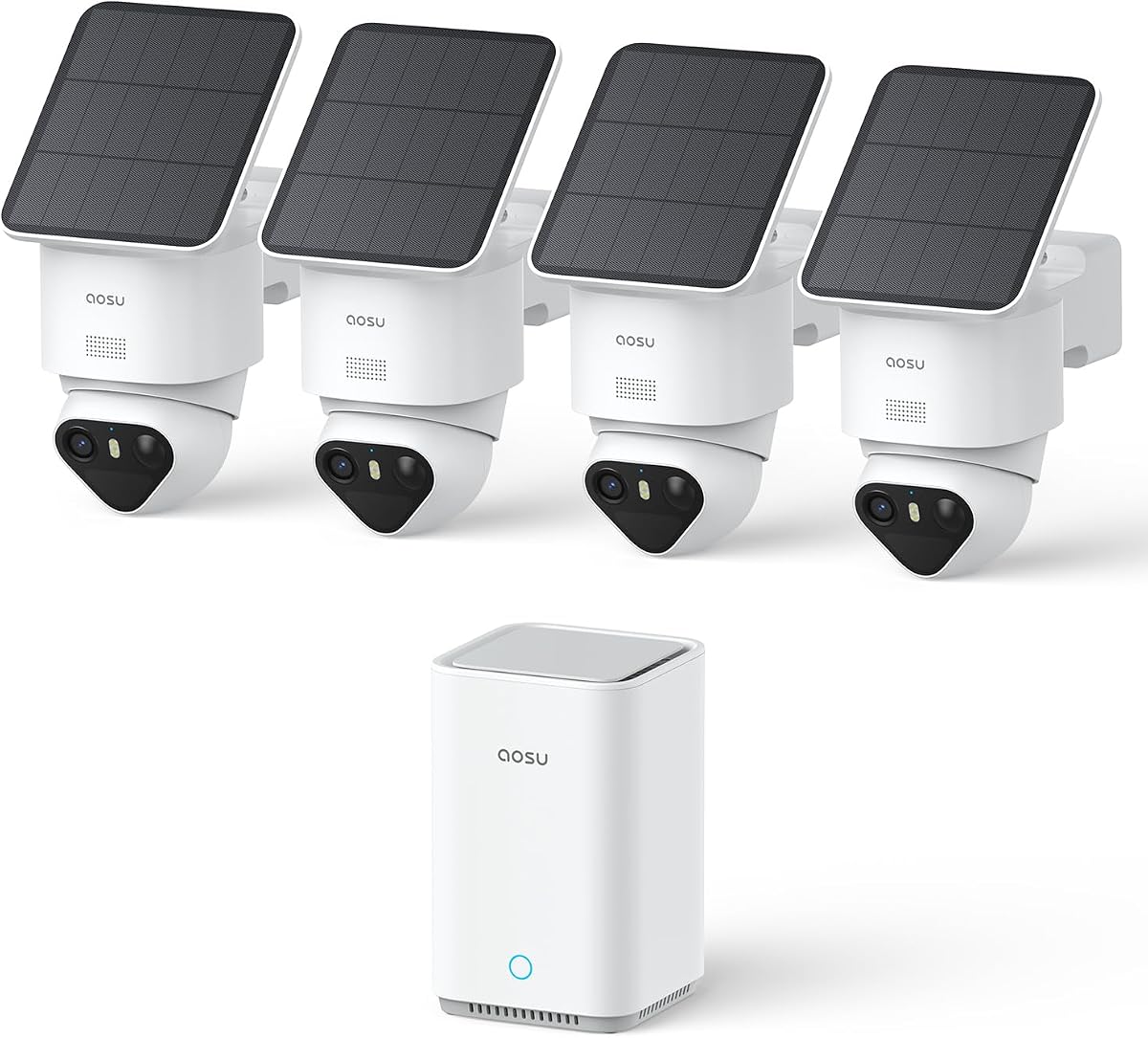
The aosu 2K Solar Security Cameras Wireless Outdoor System provides four cameras, a local base, and expandable storage in one package. Its 4.1 rating makes it a practical option for buyers who prioritize whole-property coverage and simple expansion. The four compact units are designed for outdoor placement around entrances, driveways, yards, and side passages.
We may earn a commission when you buy through this link, at no additional cost to you.
Its split solar-panel design separates the panel from the camera, allowing each camera to be mounted where the view is best while the panel is positioned where sunlight is strongest. This is useful on shaded porches or under eaves. Solar performance still depends on season, placement, exposure, and settings, so realistic expectations remain important.
The aosu app can display four cameras simultaneously, and Camera-to-Camera Tracking groups sightings of the same person across cameras into a single timeline. That reduces repeated notifications and speeds up review. PIR and AI human detection concentrate alerts on people rather than random movement, although detection quality can vary with distance, lighting, placement, and sensitivity settings.
Full-color night vision, light and sound warnings, and IP65 weatherproofing help the cameras remain useful after dark and through harsh outdoor conditions. The aosuBase delivers local video storage without a mandatory subscription and can expand to 1TB with a separately sold microSD card. This approach keeps the core system functional without tying every recording decision to a cloud plan.
This four-camera kit is a strong fit for first-time system buyers and properties needing balanced coverage without four separate purchases. The primary disadvantage is 2K resolution, which offers less detail for distant faces or license plates than the 4K cameras in this guide. Users seeking the highest possible zoom detail should consider a premium alternative.
Separating the panel from the camera means a shaded mounting spot no longer dictates where the panel must go. Installers can optimize both the camera angle and the solar exposure independently.
Four-screen viewing and cross-camera person tracking reduce duplicate alerts. A single timeline can show where the same individual moved, which is especially helpful when monitoring several exterior zones.
We may earn a commission when you buy through this link, at no additional cost to you.
The right AI security camera depends on the area being watched, how much detail is needed, whether wiring is practical, and how recordings should be retained. Consider the complete monitoring workflow rather than comparing resolution alone.
Resolution determines how much usable detail remains when the image is enlarged or a subject is far away. The WYZE Cam v4 records at 2.5K, the eufy SoloCam E30 and several four-camera systems use 2K, and the eufyCam S4, aosu T2 Ultra, and eufy SoloCam E42 offer 4K. Higher resolution can help with faces, packages, vehicle details, and license plates, but it also creates more data and usually places greater demands on the network, base, and storage system.
Choose resolution based on the viewing distance and the evidence you want to retain. A porch or small yard may be well served by 2K, while a long driveway or street-facing property benefits from 4K and optical zoom. Consider the stated license-plate capability of the E42 and the telephoto tracking of the S4 when distant identification matters.
A fixed wide lens offers simplicity, a dependable view, and fewer moving parts, while pan-tilt cameras can redirect across a wider area. Triple-lens designs add another layer: a fixed lens may preserve broad context while a separate PTZ lens locks onto and follows a subject. The eufyCam S4 and REOLINK OMVI 3i PoE use this more segmented approach, whereas the E30, E42, T2 Ultra, and aosu four-camera system use rotating designs.
Consider whether a fixed view is enough or whether automatic tracking is a major requirement. Tracking is valuable when an initial alert might otherwise show only a corner of a scene. Users should also test the relevant AI categories, since some models emphasize people and vehicles while others add packages, pets, animals, or family-versus-stranger identification.
Power method determines placement flexibility, installation effort, and ongoing maintenance. Battery cameras are the simplest to install because they avoid wiring, but runtime varies with activity, temperature, and recording frequency. Solar cameras reduce manual charging, though panel orientation and seasonal sunlight matter. PoE cameras require Ethernet but provide stable power and data, making them attractive for permanent installations and larger properties.
Check the mounting area before purchasing. A camera beneath an overhang may receive too little sun for dependable solar operation, while a remote PoE location may require a new cable route. Wall or pole mounting, camera-to-panel separation, backup batteries, and included bases all influence the installation method and long-term convenience.
Local storage gives users greater control and can continue operating without a cloud connection, but capacity and retention time depend on the included base or microSD support. Several cameras support microSD directly, while kits use a central base with larger expansion. Free cloud plans may be available, while higher-quality cloud footage, longer retention, or additional services can require payment.
Compare the practical difference between local and cloud storage before buying. Users should estimate how many cameras will operate, how much footage is recorded, and how quickly they will review events. A system that offers no mandatory subscription may be preferable for long-term budgeting, while cloud access can be useful when convenient off-site viewing is a priority.
Traditional infrared night vision can reveal silhouettes but usually produces monochrome imagery. Starlight sensors, white-light illumination, and color night modes can make clothing, vehicles, and yard details easier to distinguish. The WYZE Cam v4 pairs color night vision with a motion-activated spotlight, while the T2 Ultra emphasizes 4K TrueColor night footage and the REOLINK OMVI 3i PoE can trigger white light when motion occurs.
Active deterrence includes spotlights, sirens, warning LEDs, and two-way audio. These features are most useful when a camera covers an approach, porch, or driveway, but they should be configured carefully to avoid unnecessary disturbance. Look for a camera that supports manual control as well as automated warnings.
Connectivity affects live-view smoothness, setup, and reliability. Dual-band models support both 2.4GHz and 5GHz, giving users a choice between longer 2.4GHz reach and faster 5GHz throughput. Several single-camera options support only 2.4GHz, so they may not connect to a 5GHz-only network. Base-based systems can keep cameras on a dedicated wireless link while the base connects to the router.
For PoE models, plan the Ethernet route and confirm that the chosen NVR or client supports the camera's full features. Check required firmware and app versions, especially for triple-lens and PTZ displays. Buyers should also consider how many simultaneous streams they expect to view and whether their network can comfortably support them.
AI cameras become more useful when they integrate with the rest of a home. The WYZE Cam v4 supports Alexa, Google Assistant, and IFTTT, while the four-camera 2K system is also compatible with Alexa. Other systems are designed around their own apps and bases, and the aosu Total-Watch Classic is not compatible with ONVIF or Home Assistant. These limitations matter for users with an existing automation platform.
Verify current compatibility before ordering, especially when adding an existing base, using a particular voice assistant, or integrating cameras into a broader home-management system. Local recording, base ownership, and app quality should also be considered because each ecosystem handles alerts and footage differently.
Begin by mapping the property and assigning each camera a specific purpose. Identify the entry points, vehicles, pets, children, high-traffic paths, and areas where identification matters. Mount cameras high enough to discourage tampering while keeping the intended view unobstructed. Before drilling, test placement with the app, confirm that the Wi-Fi signal or Ethernet route is reliable, and check how sunlight falls throughout the day.
Configure the camera around the scene rather than accepting every default. Draw activity zones around doors, sidewalks, driveways, or package areas, and exclude roads, trees, and neighboring properties that produce unnecessary events. Select the AI object categories relevant to the location, tune motion sensitivity, and choose recording schedules that match how the space is used. Test two-way audio and deterrence features at the intended volume before relying on them.
Care for the system by keeping lenses clean, checking the camera view for obstructions, and confirming that solar panels remain exposed to sunlight. Review storage capacity regularly, verify that recordings appear in the app, and update camera, base, NVR, and app firmware when prompted. Test notifications and local recording after any update, especially on systems that depend on compatible firmware for their complete triple-lens or PTZ experience.
Object recognition is often the most useful feature because it distinguishes people, vehicles, pets, or packages from irrelevant movement. Automatic tracking and cross-camera linking add value by making it easier to follow an event after the initial alert. The best AI system is still one that recognizes the subjects important to your property without generating excessive false notifications.
AI cameras can be better when buyers want fewer irrelevant alerts and smarter event context. They can identify specific subjects, follow movement, and coordinate clips across multiple views. They still require correct placement, suitable sensitivity settings, and compatible networking, so they should not be treated as a substitute for choosing the right viewing angle.
No, not every AI security camera requires one. Several models support local microSD recording, while base-based kits include local storage and allow expansion. Some also provide a limited free cloud tier. Paid plans may add higher-resolution cloud footage, longer retention, or other services, so check the available storage options before assuming that every feature is included.
It depends on the distance from the camera to the subject. A 4K camera can preserve more detail when a face, vehicle, or package is far away, making zoomed review more useful. For a close porch or small garden, 2K may be sufficient. Resolution is only one factor, and coverage, lighting, lens movement, and storage also affect practical security.
Solar reliability depends on sunlight, season, snow coverage, panel angle, battery condition, and camera activity. A panel under heavy shade will charge less effectively, while a clear placement may continue operating through winter. Users should leave sufficient battery capacity for low-sun periods and check the panel regularly for dirt, snow, and physical damage.
A single camera works well for one important zone, a small property, or a temporary monitoring need. A multi-camera kit is more practical for covering entrances, driveways, side yards, and the back of a home. Larger systems also make cross-camera tracking and unified storage more valuable, but they require stronger networking and more careful placement.
Some local-storage cameras can record locally and remain useful during network outages, particularly when paired with a base that supports continuous local recording. Live remote viewing, phone notifications, and cloud access still require connectivity. Users who need uninterrupted recording should verify outage behavior and keep the base and cameras on reliable local power.
Required capacity depends on camera count, resolution, frame rate, compression, and recording schedule. Continuous recording consumes substantially more space than event-only recording. Local capacity should be selected with retention time in mind, and users should periodically review storage health, delete unnecessary footage when appropriate, and maintain backup power for the base and router.
The WYZE Cam v4 stands out as the most balanced overall choice, combining 2.5K recording, on-device object recognition, color night vision, local storage, deterrence features, and flexible mounting in a broadly accessible package. The eufyCam S4 leads the premium group with a sophisticated triple-lens design, 4K wide viewing, PTZ tracking, solar power, and powerful detection. The eufy SoloCam E30 offers a more focused route into 360-degree tracking and solar operation at 2K.
For buyers needing several cameras, the choices become more specialized. The 2K four-camera solar system offers dual-band wireless flexibility, the aosu T2 Ultra emphasizes 4K night footage and multi-camera event assembly, and the aosu 2K four-camera system prioritizes coordinated local storage. The REOLINK OMVI 3i PoE is the strongest wired choice for installers who can provide Ethernet, while the eufy SoloCam E42 pairs two 4K cameras with a capable HomeBase.
Choose based on the environment and the evidence you want to capture, then verify current compatibility, storage requirements, power access, and Wi-Fi or Ethernet conditions. Product listings, promotions, and prices change, so check the current listing and included components before purchasing. The right camera is the one that provides useful alerts, dependable recordings, and manageable installation in the places that matter most.
