
LiNKFOR 192kHz DAC Converter
4.8Editor score
192kHz sample support
Built-in amplifier chip
Integrated RCA cable
Compact plug-and-play design
This Toslink to RCA Converter guide compares 10 models for audio formats, sample rates, connectivity, build quality, and setup ease.
A Toslink to RCA Converter bridges modern digital audio sources and traditional analog speakers or amplifiers. The right model should support your source’s output format, provide a stable analog signal, and include the connections needed for a clean installation without unnecessary complexity.
We compared the listed converters by examining input compatibility, supported audio formats, sampling rates, output options, physical design, power requirements, and installation considerations. The list includes basic PCM adapters, amplified models, units with volume controls, and a dedicated 5.1-channel decoder.
Each pick reveals a different practical advantage, from compact all-in-one cables to serviceable aluminum housings and flexible output controls. Ratings reflect the supplied customer feedback, while prices and availability can change, so readers should confirm current details before purchasing.
4.8Editor score

4.4Editor score

4.5Editor score
The comparison covers converter direction, audio-format support, resolution, output flexibility, construction, and installation needs, with one entry for every listed product.


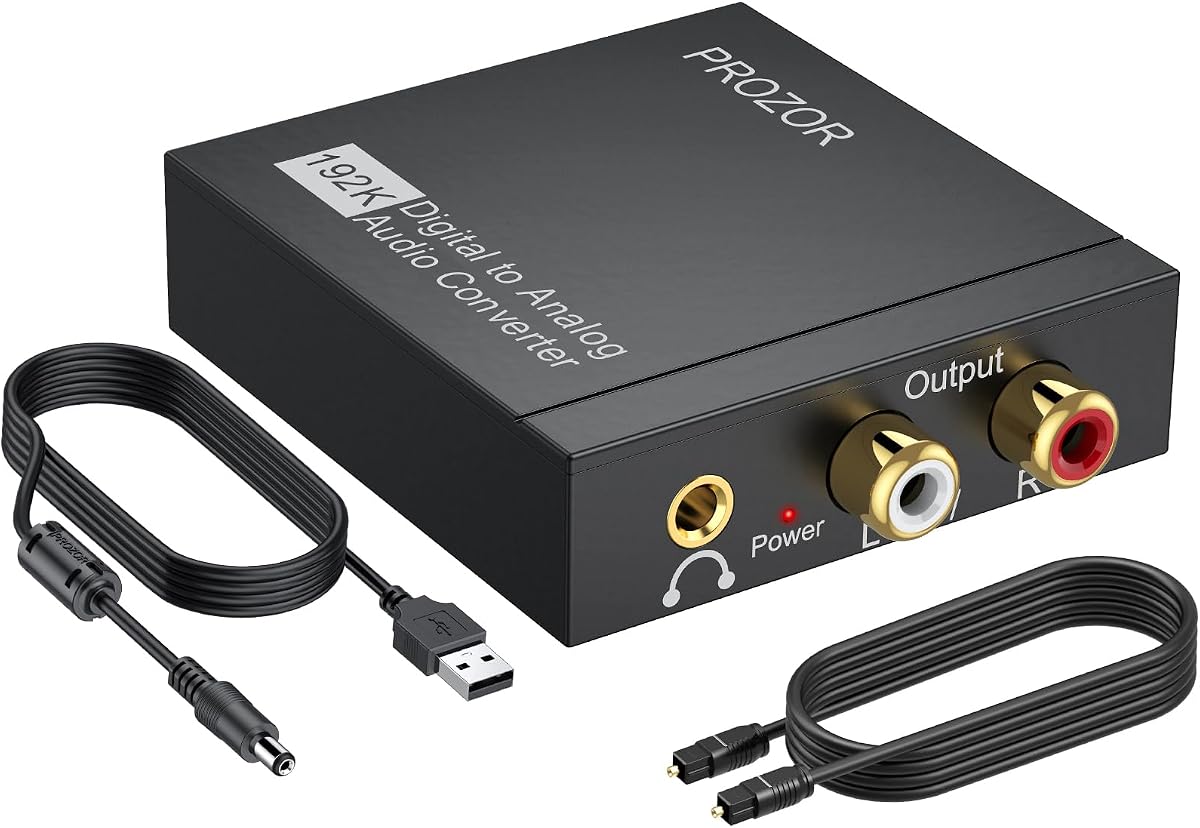

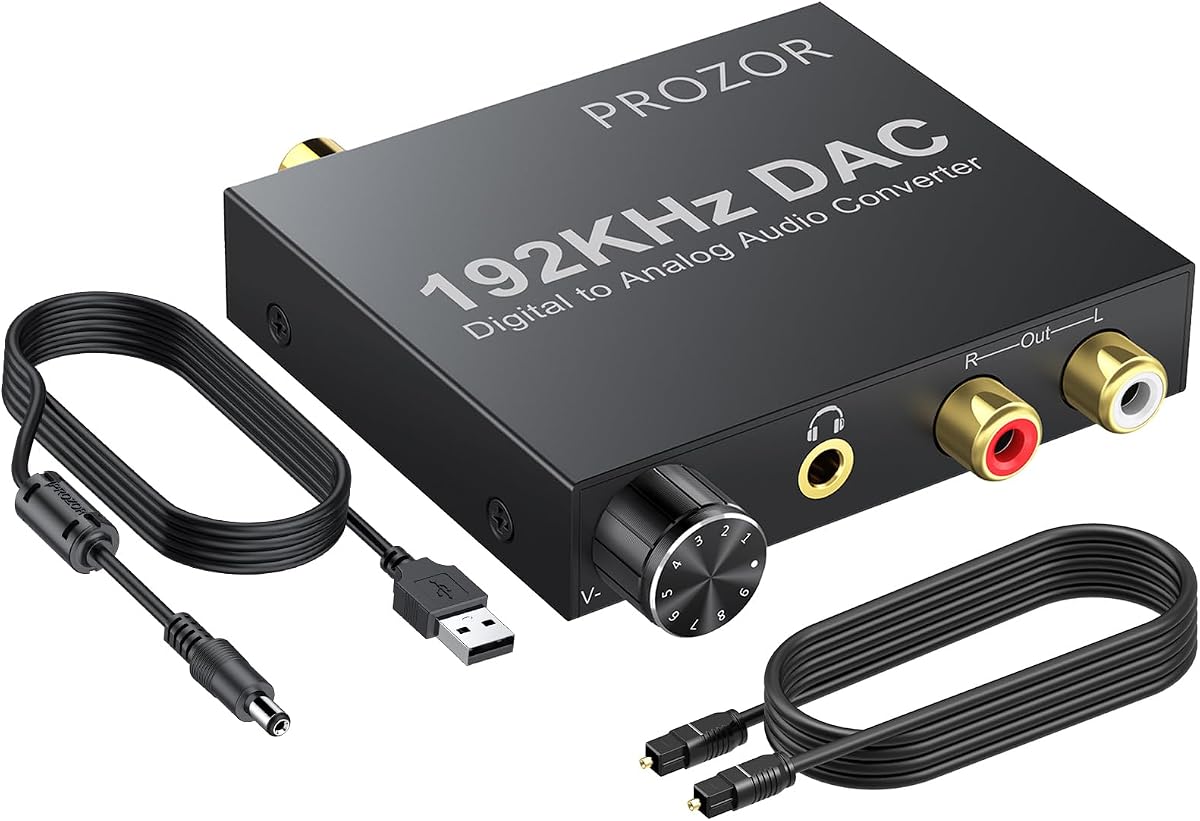

The PROZOR Aluminum DAC Converter is a well-rounded digital-to-analog adapter with a 4.4 rating. It accepts both optical Toslink and coaxial digital input while providing left and right RCA outputs plus a 3.5mm jack, making it suitable for modern source devices and older analog sound systems.
We may earn a commission when you buy through this link, at no additional cost to you.
Its upgraded amplifier chipset and dual-channel operational amplifier are intended to improve output level and clarity. The converter supports 32, 44.1, 48, 96, and 192kHz sampling rates, along with 24-bit S/PDIF streams on the left and right channels. Gold-plated RCA connectors and a detachable converter box improve connection flexibility.
The principal limitation is format support. It handles uncompressed two-channel LPCM or PCM rather than decoding Dolby AC-3 or DTS 5.1-channel streams, so the source must be configured correctly. It also requires a certified 5V 1A USB power supply, which is not included, and its detachable design is less convenient than a permanently integrated cable.
This is a strong choice for someone who wants both RCA and headphone outputs, a detachable cable arrangement, and a more substantial housing. It suits TVs, Blu-ray players, game consoles, amplifiers, and home cinema equipment as long as the source is set to PCM or LPCM.
The converter can feed analog left and right channels through RCA while also offering a 3.5mm output for headphones or compact powered speakers. This makes it easier to use one source with more than one type of analog audio equipment.
The aluminum housing is designed for heat dissipation and electromagnetic shielding. Its detachable box also means a damaged cable can be replaced without replacing the entire converter.
We may earn a commission when you buy through this link, at no additional cost to you.
The PROZOR 5.1 DAC Converter has a 4.4 rating and targets users whose source devices output Dolby AC-3, DTS, LPCM, or PCM. It accepts optical and coaxial signals and provides left and right RCA plus a 3.5mm jack, offering a useful bridge to analog audio equipment.
We may earn a commission when you buy through this link, at no additional cost to you.
The key attraction is format flexibility. The unit can accept 5.1-channel digital signals and present them as a 2.0-channel analog output. It also supports sample rates up to 192kHz and 24-bit S/PDIF streams. A magnetic-ring power cord and revised amplifier chip are intended to support stable, low-noise transmission.
Those features do not make it a true discrete 5.1-channel analog system. The outputs remain stereo, so multichannel content is downmixed rather than represented by six separate RCA channels. Buyers seeking genuine surround-channel separation should not mistake the 5.1 input support for full 5.1 output.
It is most appropriate for TVs, Blu-ray players, game consoles, and home cinema sources that may emit compressed surround audio. It is also a practical alternative to a basic PCM-only adapter when source-format flexibility matters more than the smallest possible footprint.
Unlike converters limited to PCM and LPCM, this model accepts Dolby AC-3 and DTS 5.1-channel digital input. That makes it useful when a source cannot easily be switched to an uncompressed stereo format.
The converter produces 2.0-channel analog audio, which lets older stereo equipment play surround-encoded content. It does not preserve six discrete analog output channels.
We may earn a commission when you buy through this link, at no additional cost to you.
The PROZOR Compact DAC Adapter has a 4.4 rating and offers a direct Toslink-to-RCA path for PCM audio. Its integrated amplifier chipset is intended to address the low output level that can occur when a modern source feeds an older amplifier or powered speakers.
We may earn a commission when you buy through this link, at no additional cost to you.
This model supports 32, 44.1, 48, 96, and 192kHz sample rates and 24-bit incoming streams. The built-in 1.1-meter RCA cable simplifies the layout, while the compact housing reduces visual clutter. A ferrite-core USB power cable is included to help limit electromagnetic and radio-frequency interference.
Its design is specialized rather than universally flexible. There is no 3.5mm output, no coaxial input, and no decoding for Dolby AC-3 or DTS 5.1-channel signals. The integrated RCA cable is also non-pluggable, so a damaged lead cannot be exchanged without replacing the unit.
Choose it when a straightforward PCM converter, strong output level, and tidy installation matter most. It is a good match for HD televisions, set-top boxes, DVD and Blu-ray players, game consoles, amplifiers, and speakers with RCA inputs.
Combining the converter and RCA lead into one compact unit makes setup faster. It is especially convenient beside a television cabinet or entertainment shelf where loose adapters can be inconvenient.
The built-in amplifier chipset is designed to raise RCA output level and maintain clarity. This can be helpful when the destination amplifier lacks a strong digital input or adjustable input gain.
We may earn a commission when you buy through this link, at no additional cost to you.
The LiNKFOR Compact DAC Converter has a 4.3 rating and is designed to connect an optical Toslink source to an analog stereo system. It is particularly relevant for modern televisions and media devices that have digital audio outputs but must drive older speakers or amplifiers.
We may earn a commission when you buy through this link, at no additional cost to you.
The built-in 1.1-meter RCA cable creates a compact installation, while the amplifier chip is intended to improve output level and clarity. The converter supports sample rates from 32kHz through 192kHz and accepts 24-bit S/PDIF streams on the left and right channels.
This is a PCM and LPCM converter rather than a surround decoder. Dolby AC-3, DTS, and other 5.1-channel formats are unsupported, so users must change the source output to PCM. There is also no 3.5mm output, coaxial input, or external volume control, and the permanent RCA cable limits repair flexibility.
The model remains a sensible option for anyone seeking a small, uncomplicated Toslink-to-RCA adapter. It works with HD televisions, set-top boxes, DVD and Blu-ray players, and game consoles when the source is correctly configured and powered through a 5V 1A USB connection.
The integrated RCA lead eliminates the need to match a separate analog cable with the converter. That simplicity is useful for permanent installations where reliability and minimal components matter.
The converter works best with uncompressed two-channel PCM or LPCM. Proper source settings prevent silence, distortion, or unsupported-format problems when connecting to older stereo equipment.
We may earn a commission when you buy through this link, at no additional cost to you.
The PROZOR Gold-Plated DAC Converter combines optical and coaxial inputs with analog RCA and 3.5mm outputs. Its 4.4 rating makes it a credible all-round option for TVs, set-top boxes, disc players, game consoles, amplifiers, and headphones.
We may earn a commission when you buy through this link, at no additional cost to you.
The converter supports PCM and LPCM across sample rates from 32 to 192kHz, including 24-bit S/PDIF streams. An integrated amplifier chip is intended to improve output level, while gold-plated RCA connectors support reliable signal transmission. The included USB power lead incorporates a ferrite core for cleaner operation.
It cannot decode Dolby AC-3 or DTS 5.1-channel audio, and that limitation requires attention during setup. The source must be set to PCM or LPCM. Like the first model, it requires a certified 5V 1A power adapter, and volume must be controlled through the source or output device rather than a local knob.
This is an appealing pick for users who want more than a basic one-cable adapter without paying for surround decoding. Its combination of digital inputs, two analog output formats, and shielded power connection gives it broad usefulness in a modern entertainment setup.
Optical, coaxial, RCA, and 3.5mm connections allow the converter to serve several source and destination types. This reduces the need to keep separate adapters for different components.
The gold-plated RCA connectors are intended to maintain dependable contact and reduce transmission loss. They also let users select the length and style of RCA cable that best fits the installation.
We may earn a commission when you buy through this link, at no additional cost to you.
The YGiTK 192kHz DAC Converter has a 4.5 rating and provides a compact bridge from optical digital audio to analog RCA. It is intended for HD televisions, set-top boxes, DVD and Blu-ray players, and game consoles that need to feed older stereo equipment.
We may earn a commission when you buy through this link, at no additional cost to you.
Its inbuilt amplification chipset is designed to raise the RCA output level and produce clear sound. Optical input supports sample rates of 32, 44.1, 48, 96, and 192kHz, with support for 24-bit streams. The compact construction makes it easier to position near a television or entertainment system.
The device accepts only two-channel PCM and does not support Dolby AC-3 or other 5.1-channel signals. The television must therefore be configured to output PCM through its optical connection. Volume adjustments are made on the output device because there is no local control on the converter.
Buyers seeking a small, uncomplicated optical-to-RCA adapter will find this model appealing. It is particularly useful when the goal is to connect newer digital sources to legacy speakers without adding a larger component to the setup.
The miniature housing is useful behind televisions and within crowded media cabinets. It keeps the necessary conversion step physically small while preserving standard RCA connectivity.
The built-in chipset is intended to make the analog signal easier to drive. It can be useful with amplifiers whose input sensitivity is limited, although final level remains a destination-device setting.
We may earn a commission when you buy through this link, at no additional cost to you.
The PROZOR Volume-Control DAC has a 4.4 rating and stands out from basic converters because it includes a physical volume knob. It accepts Toslink and coaxial digital audio and sends simultaneous signals to left and right RCA outputs and a 3.5mm jack.
We may earn a commission when you buy through this link, at no additional cost to you.
Sample-rate support extends from 32 to 192kHz, with 24-bit S/PDIF streams handled across the left and right channels. The aluminum casing provides heat resistance, and gold-plated input and output interfaces are intended to limit signal loss. The unit also mutes automatically when no valid audio signal is detected.
Its principal limitation is that it remains a two-channel PCM and LPCM converter, not a Dolby or DTS decoder. The source must be set to a compatible format. It also requires a 5V 1A power supply, and the larger control-oriented housing is less compact than an integrated-cable adapter.
This model is ideal when the television or source volume cannot conveniently control the audio level, or when users want fine adjustment near the speakers. It balances a durable housing, multiple connections, and hands-on level control for a wide range of legacy and modern audio equipment.
The front-panel knob provides direct control over output level. It can make daily use easier when the source device is inconvenient to operate or lacks useful control over its digital output.
The aluminum shell assists with heat dissipation, while gold-plated interfaces are intended to preserve signal quality. These details suit a converter intended for regular, long-term use.
We may earn a commission when you buy through this link, at no additional cost to you.
The Musou Analog-to-Digital Adapter has a 4.1 rating, but it performs the opposite function from most products in this guide. It accepts an RCA analog stereo signal and produces digital coaxial and optical Toslink output simultaneously.
We may earn a commission when you buy through this link, at no additional cost to you.
The device supports uncompressed two-channel LPCM and operates with a 48kHz output sampling rate. This makes it useful for connecting an older analog source to a modern amplifier, soundbar, or digital input, provided that source is already delivering stereo audio.
It is not a Toslink-to-RCA solution and therefore cannot connect a television’s optical output to analog speakers. Dolby content is unsupported, and only two channels are output. Buyers attracted by the product category must check signal direction carefully to avoid purchasing the wrong type of adapter.
It deserves consideration only for an analog-to-digital upgrade. For the requested conversion path, a dedicated digital-to-analog DAC is the appropriate choice, while this model is included to clarify the important distinction between the two directions.
The adapter gives equipment with RCA analog output access to optical and coaxial digital connections. It can be helpful when upgrading a sound system while retaining an older source component.
Audio converters are directional. This product transforms analog RCA into digital output and cannot transform a Toslink source into analog RCA.
We may earn a commission when you buy through this link, at no additional cost to you.
The PROZOR 5.1-Channel DAC Decoder has a 4.5 rating and is the most specialized option here. It accepts Dolby AC-3, DTS 5.1-channel, and PCM 2.0 digital signals, then supplies analog left and right RCA output plus a 3.5mm connection.
We may earn a commission when you buy through this link, at no additional cost to you.
Its 192kHz, 24-bit format support and RTOS-based converter chipset distinguish it from simple PCM adapters. A volume knob adjusts both the RCA and 3.5mm outputs together, allowing the user to set a comfortable level without relying exclusively on source or amplifier controls.
The output remains 2.0-channel. A 5.1 input is decoded and downmixed, but the converter does not provide six discrete analog channels, so it cannot reproduce a traditional six-speaker home theater layout. Automatic conversion reduces manual configuration, although the source and destination must still be connected correctly.
This is the premium choice for users whose television, disc player, or console emits encoded surround audio and whose analog system can accept only stereo. It is less necessary for PCM-only sources, but it offers greater flexibility and convenient local level adjustment when that coverage matters.
Dolby AC-3 and DTS decoding makes the converter adaptable to common television and home-theater output formats. Users do not have to rely on a source that can be switched to PCM when connecting to analog stereo equipment.
The knob controls the RCA and 3.5mm outputs simultaneously. It cannot fine-tune each interface independently, but it provides a convenient common level for either destination.
We may earn a commission when you buy through this link, at no additional cost to you.
The LiNKFOR 192kHz DAC Converter has the highest listed rating at 4.8 and offers a compact solution for connecting an optical source to analog RCA equipment. It is designed for HD televisions, set-top boxes, DVD and Blu-ray players, and game consoles.
We may earn a commission when you buy through this link, at no additional cost to you.
A built-in amplifier chip is intended to raise the output level and maintain clarity. The converter accepts 32, 44.1, 48, 96, and 192kHz sample rates with 24-bit S/PDIF streams on both channels. Its integrated 1.1-meter RCA cable makes installation straightforward, and 5V 1A USB power provides operation.
The key limitation is its support for digital PCM or LPCM only. Dolby AC-3, DTS, and other 5.1-channel signals are not supported, so the source must be configured correctly. There is also no 3.5mm output, coaxial input, local volume control, or surround decoder.
For a simple stereo conversion, the combination of a strong customer rating, compact construction, and integrated cable makes this a particularly attractive budget pick. It suits users who want a direct Toslink-to-RCA solution without a box full of additional features.
The integrated RCA lead means the user only needs to connect the source, converter, and destination. That limited configuration reduces installation time and makes the unit easier to position.
Support for sample rates through 192kHz and 24-bit streams makes the converter suitable for high-resolution stereo sources. Its format limits still make correct PCM output settings essential.
We may earn a commission when you buy through this link, at no additional cost to you.
The right converter depends mainly on source format, analog destination, channel needs, output level, cable layout, and power requirements rather than on resolution alone.
A Toslink to RCA converter must accept a digital optical or SPDIF signal and produce analog left and right audio. This is the opposite of an RCA-to-Toslink adapter, which digitizes an analog source. The Musou product in this list is included as a useful example of that reverse direction, but it cannot solve an optical-to-RCA connection.
Most inexpensive converters accept only uncompressed two-channel PCM or LPCM. If the television, console, or disc player is set to Dolby AC-3 or DTS, a PCM-only converter may produce no sound or may not decode the stream. Source-based models such as the PROZOR 5.1 DAC Converter and PROZOR 5.1-Channel DAC Decoder accept common encoded surround formats and downmix them to stereo.
Accepting a 5.1-channel digital signal does not necessarily mean the converter offers 5.1-channel analog output. The featured surround-capable models provide left and right RCA output, so surround content is downmixed to 2.0 channels. True discrete analog surround requires six RCA outputs and a correspondingly capable decoder and amplifier.
A converter with a built-in amplifier may provide a more useful RCA level than a basic passive-style adapter. Dedicated volume controls, such as those on the PROZOR Volume-Control DAC and PROZOR 5.1-Channel DAC Decoder, also allow convenient adjustment near the sound system. If the source cannot usefully change its digital output volume, local control is a meaningful advantage.
RCA left and right outputs are essential for conventional stereo equipment, while a 3.5mm jack can serve headphones or compact powered speakers. Some models also accept coaxial digital input, providing backup for equipment without a working optical port. The extra connections add flexibility, but they are unnecessary when a single source-to-speaker path is all that is required.
Most converters in the list support 32, 44.1, 48, 96, and 192kHz sample rates, with 24-bit incoming S/PDIF support. These figures indicate compatible digital input handling rather than a guarantee of improved sound. The source, converter, and analog destination should all be configured consistently, and actual audible benefit depends on the original recording and playback chain.
Integrated RCA cables create a compact and tidy installation, although a damaged fixed cable requires replacement of the unit. Detachable designs allow more flexible cable lengths and easier replacement. Buyers should also account for the reach between the source, converter, amplifier, and speakers, and avoid adding unnecessary strain to a permanently attached lead.
Most active converters require a 5V 1A USB power source, and the included listing may not include a wall adapter. Ferrite-core power cables, aluminum housings, shielding, and gold-plated contacts can support dependable operation, but they do not replace correct power or source configuration. Follow the stated power specification and avoid unofficial connectors that may not deliver stable voltage.
Begin by identifying the digital output on the source device. Connect a Toslink cable from that output to the converter, then connect the converter’s left and right RCA outputs to matching analog inputs on the amplifier, soundbar, or powered speakers. If using the 3.5mm output, confirm that the destination accepts the appropriate stereo connection.
Set the source’s digital audio output to optical or SPDIF as applicable, select PCM or LPCM for a PCM-only converter, and select a compatible encoded format for a decoder that supports it. Connect the specified 5V 1A USB power source, then power the converter and destination. If no sound appears, verify every connection, the selected output, and the source volume setting.
For stable results, keep the optical cable aligned and undamaged, avoid sharply bending the connector, and do not cover a ventilated unit. Do not exchange cables or power connectors based on appearance alone; match the stated voltage, current, and connector type. When a source is connected to a sound system through optical audio, remember that the television remote may not change the optical output level unless the television specifically supports that function.
It accepts a digital optical or SPDIF audio signal and converts it into analog left and right RCA audio. This lets modern televisions, game consoles, or disc players connect to older amplifiers, soundbars, and speakers that lack digital inputs. The converter requires appropriate power and may require a compatible PCM source setting.
The most common cause is an incompatible source format, particularly when the source outputs Dolby AC-3 or DTS to a PCM-only converter. Set the television or player to PCM or LPCM and confirm that the converter is powered with the specified supply. Also check the optical connection, the selected television output, and the amplifier’s input and volume settings.
Some models can accept 5.1-channel Dolby AC-3 or DTS input, but most still provide only left and right analog output. That means the surround signal is downmixed to stereo rather than sent to six separate channels. A true 5.1-channel analog system requires a decoder with six RCA outputs and suitable surround amplification.
The active converters listed here use USB power, commonly at 5V and 1A, but a wall adapter is not necessarily included. Check the product listing and package contents. Use a certified supply matching the specified voltage and current, as an unsuitable plug can cause instability, noise, or failure to operate.
No. Supporting 192kHz means the converter can accept input at that rate, but the result still depends on the source recording, device output, converter implementation, and analog playback system. Correct format selection, stable power, good connections, and a suitable output level usually matter more in everyday use.
Only with a model that includes a 3.5mm output, or by adding a suitable 3.5mm-to-RCA adapter. Some listed converters provide both RCA and 3.5mm outputs simultaneously, while compact integrated-cable models do not. Check headphone impedance and output level when using the 3.5mm connection.
Many compact converters rely on the source television, player, or connected amplifier to set the level. Models with built-in amplification or a physical knob offer additional control and can be easier to adjust. If your source has limited digital-output volume control, choosing a model with a local knob may be worthwhile.
No. The two devices work in opposite directions. A Toslink-to-RCA converter receives digital optical audio and outputs analog RCA, while an RCA-to-Toslink adapter receives analog RCA and outputs digital optical or coaxial audio. Always confirm the input and output direction on the product listing before ordering.
The PROZOR Aluminum DAC Converter is the strongest all-around recommendation because it combines optical and coaxial inputs, RCA and 3.5mm outputs, high sample-rate support, and a detachable aluminum design. The LiNKFOR 192kHz DAC Converter is a compact value choice for straightforward PCM conversion, while the PROZOR 5.1-Channel DAC Decoder serves users who need encoded surround-input support and local volume adjustment.
Before buying, match the converter to the exact signal produced by the source. PCM-only models are easiest to use, decoder-equipped models offer greater flexibility, and a volume knob adds convenience when source-level control is poor. Also consider cable length, fixed versus detachable construction, output style, and whether the required USB power adapter is included.
Ratings and features provide a useful starting point, but prices, availability, source configurations, and package contents can change. Confirm the current listing, connector direction, supported formats, and power requirements before making a final purchase.
