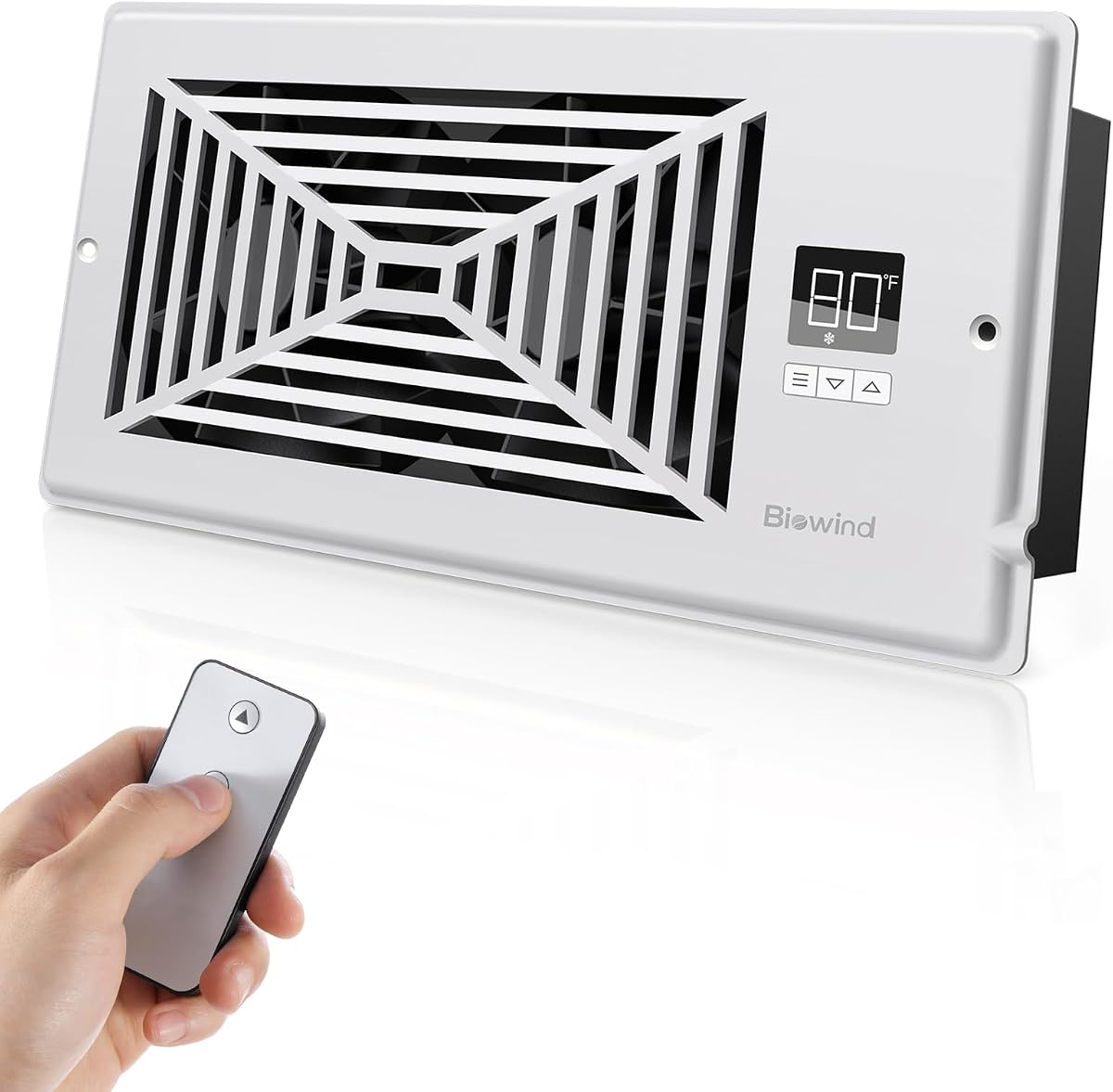
BIOWIND 4 x 10 Smart Register Booster Fan
4.3Editor score
Ten remote speed levels
Automatic temperature sensing
Six-watt rated power
Fits four-by-ten openings
Smart motorized HVAC register vents combine an airflow-control mechanism with temperature sensing, scheduling, or remote operation to address uneven heating and cooling. The best model should fit the actual duct opening, operate quietly, coordinate with the central system, and provide practical room-level controls without creating unnecessary installation complexity.
This guide compares ten register vents from Flair and BIOWIND, plus one smart booster fan with integrated controls. The evaluation considers airflow design, motorized behavior, temperature sensing, automation, installation requirements, electrical needs, noise specifications, dimensional accuracy, and the availability of mobile or remote control features.
Each pick highlights a different use case, from whole-room balancing to targeted airflow enhancement in a bedroom, office, or larger space. Ratings and technical specifications come from the supplied product information, while product availability and current prices can change, so readers should confirm the latest listing details before purchasing.
4.3Editor score

3.8Editor score

3.8Editor score
As an Amazon Associate we earn from qualifying purchases.
The comparison below places all ten options side by side, emphasizing vent size, control method, power requirements, airflow specifications, and the practical limitations that distinguish full room-balancing systems from plug-in booster fans.


The Flair Smart Vent 4 x 12 is a room-balancing register designed for central heating and cooling systems. Its 3.8 rating reflects an established product with a meaningful smart-home feature set, particularly the ability to open and close a vent according to thermostat and room-temperature data. It is best suited to households that want to redirect conditioned air rather than merely increase the volume of air coming through one opening.
We may earn a commission when you buy through this link, at no additional cost to you.
Its strongest quality is integration. The vent works with an existing smart or traditional thermostat, while the hvacOS platform supports individual seven-day schedules and room inactivity settings. Installation is designed to be less disruptive: the existing vent is removed and the Flair unit is dropped into place without drilling or wiring. That makes the product especially appealing in finished rooms where new ductwork or wall modifications would be inconvenient.
The important trade-off is system dependency. A Flair Bridge is required, and every room served by a Flair Smart Vent needs temperature data from a compatible sensor, smart thermostat, or Flair Puck. Those additional components increase planning complexity, and the 3.8 rating is not as strong as the ratings attached to several BIOWIND booster models. Buyers should therefore assess the complete Flair ecosystem rather than treating the vent as a stand-alone accessory.
This is the strongest overall recommendation for a homeowner seeking genuine room-by-room balancing. It suits people willing to add the required hub and sensors, especially when several rooms have persistently different temperatures. For a one-room airflow problem, a plug-in booster fan may be simpler, but for integrated HVAC zoning, the Flair Smart Vent offers the more complete control model.
Unlike a conventional register that remains fully open, this unit can adjust airflow according to room conditions. That makes it useful for directing conditioned air toward under-served rooms and reducing unwanted delivery to rooms that are already comfortable.
Individual room schedules and inactive-room settings provide more control than a basic timed booster. Homeowners can create routines for occupied and unoccupied periods while retaining compatibility with their existing thermostat.
We may earn a commission when you buy through this link, at no additional cost to you.
The Flair Smart Vent 6 x 10 shares the same intelligent room-control philosophy as the rest of the Flair line, but its opening size makes it relevant to homes with wider, shorter register cutouts. The 3.8 rating is consistent with the other Flair vents, and its standout feature is the ability to use thermostat and sensor data to regulate airflow automatically.
We may earn a commission when you buy through this link, at no additional cost to you.
The vent supports central heating and cooling, individual seven-day schedules, inactive-room settings, and remote access through hvacOS. It can also work with voice assistants, adding a convenient way to manage room-by-room comfort. As with the 4 x 12 model, installation is designed around removing an existing register and dropping the replacement into place without drilling or wiring.
This option is not a self-contained smart device. The Flair Bridge must be purchased separately, and the room needs a temperature source such as a Flair Puck, an integrated smart thermostat, or another compatible room sensor. Buyers should also verify that a 6 x 10 opening is genuinely the correct duct dimension and not merely the approximate shape of their existing faceplate.
The Flair Smart Vent 6 x 10 is a compelling choice for a multi-room zoning project when its dimensions match the property. It is better for organized, whole-home control than for a quick single-register upgrade. Homeowners who need independent room operation should be prepared to purchase and configure the required Flair components.
The vent uses available smart thermostat and temperature sensor information to decide when conditioned air should reach the room. This makes it more adaptive than a standard register that stays fixed in one position.
It can replace a suitable wall, ceiling, or floor vent. The straightforward replacement process is useful in existing homes where retrofitting a permanent zoning network would otherwise be difficult.
We may earn a commission when you buy through this link, at no additional cost to you.
The BIOWIND 6 x 10 Smart Register Booster Fan combines a 4.3 rating with a substantial listed airflow figure of 200 CFM. It is designed for homes where a room does not receive enough conditioned air from the central system. Unlike a Flair vent that redistributes airflow across a coordinated ecosystem, this booster actively pushes more air through the selected register.
We may earn a commission when you buy through this link, at no additional cost to you.
The product includes a high-precision temperature sensor and programmable LED controller. It can automatically turn the fan on or off, while its remote provides ten fan-speed levels for manual adjustment. The fan is rated at six watts, accepts a 100-to-240-volt AC input, and includes a wall adapter and plug. A stated 18 dBA noise level makes it suitable for bedrooms, offices, and living spaces where sound matters.
Its installation is convenient but not entirely plug-and-play from a structural perspective. The neck must fit inside a duct opening measuring exactly 6 x 10 inches, while the face rests over the surrounding wall or floor. The listed neck dimensions are 9.72 x 5.63 inches, the face is 11.98 x 7.92 inches, and insertion depth is 1.96 inches. Buyers must measure the cutout rather than the old cover.
This is the leading choice for a specific under-served room with a matching 6 x 10 opening and a need for strong airflow. It offers better stated airflow than the 4-inch-wide BIOWIND models, while the automatic temperature response and remote speed control add convenience. It does not provide the same integrated, multi-room zoning approach as a Flair system.
The 200 CFM specification gives this model an advantage for spaces that need a meaningful increase in delivered air. It can be particularly useful in upstairs bedrooms, living areas, basements, and other locations where circulation from the central system is weak.
Temperature sensing can trigger the fan automatically, but the remote preserves immediate control over ten speed levels. This combination is useful for changing seasonal needs without reconfiguring the register.
We may earn a commission when you buy through this link, at no additional cost to you.
The BIOWIND 4 x 12 Smart Register Booster Fan is built for narrow, elongated duct openings and carries a 4.3 rating. Its stated noise level of 16 dBA is lower than the 18 dBA figure associated with the wider BIOWIND models, making it a quiet option for bedrooms and other sensitive spaces.
We may earn a commission when you buy through this link, at no additional cost to you.
Its core features include automatic temperature-based operation, a programmable LED controller, and ten remote-controlled fan speeds. The booster is rated at six watts and uses a 100-to-240-volt AC input with an included wall adapter. Listed airflow reaches 140 CFM, which is less than the 200 CFM of the 6 x 10 and 6 x 12 BIOWIND models but still gives the unit a clear role in improving circulation.
Fit deserves careful attention. The product fits only a 4 x 12 inch duct opening, and its 9.72 x 3.93 inch neck must be inserted to a stated depth of 1.96 inches. The face measures 13.77 x 5.51 inches and sits over the wall or floor surface. If the old register cover looks similar but the cutout differs, the product will not be suitable.
This booster is a good option for a quiet room with a 4 x 12 opening and relatively weak central airflow. It is especially relevant for someone who wants automatic fan behavior and remote speed control without building a complete multi-register Flair ecosystem. The trade-off is a smaller airflow rating than the wider BIOWIND configurations.
A listed 16 dBA operating level is useful for bedrooms, nurseries, offices, and quiet living areas. The low-noise design helps preserve the benefit of added airflow without making the fan the dominant sound in the room.
Ten speed settings allow users to move from gentle circulation to a stronger boost. Remote adjustment makes it easy to respond to changing comfort needs without approaching the wall or floor register.
We may earn a commission when you buy through this link, at no additional cost to you.
The Flair Smart Vent 4 x 10 offers the same room-aware airflow control as the other Flair registers in a compact 4 x 10 format. Its 3.8 rating and broad feature set make it relevant for homes seeking to solve temperature differences between rooms rather than simply increasing airflow at one opening.
We may earn a commission when you buy through this link, at no additional cost to you.
The vent can use smart thermostat and room sensor information to open and close automatically. Through hvacOS, users can create individual seven-day schedules, mark rooms inactive, and manage the system remotely. Compatibility with existing smart or traditional thermostats and voice assistants expands the control options without requiring a new central heating and cooling system.
A complete Flair setup involves more than the register itself. The Flair Bridge is required, and each room needs an appropriate temperature source. Buyers must also confirm that the 4 x 10 size matches the actual opening. These requirements are manageable for a planned home project, but they make the product less convenient than a single plug-in booster.
The Flair Smart Vent 4 x 10 is a strong fit for a coordinated room-balancing system in a house with matching register dimensions. It rewards homeowners willing to configure multiple components, offering more granular scheduling than a basic remote-controlled fan. For one troublesome vent, however, a booster model may deliver a simpler solution.
Seven-day scheduling allows different rooms to follow their own occupancy patterns. This is valuable in homes where bedrooms, offices, and living spaces are not comfortable at the same time.
The vent can operate with a conventional or smart thermostat, but each room still needs temperature data. This distributed approach helps balance airflow while retaining compatibility with the home's primary climate-control setup.
We may earn a commission when you buy through this link, at no additional cost to you.
The Flair Smart Vent 10 x 10 is the premium configuration in this roundup because it combines the most substantial listed register size with the same full-featured room-balancing platform. Its 3.8 rating aligns with the rest of the Flair range, while its intended wall and ceiling placement targets larger openings that smaller booster necks may not cover.
We may earn a commission when you buy through this link, at no additional cost to you.
Like the other Flair models, it uses smart thermostat and temperature sensor data to regulate conditioned airflow automatically. hvacOS provides room-specific seven-day schedules, inactive-room settings, remote management, and compatibility with traditional or smart thermostats. Voice-assistant support further improves everyday access, while the no-drilling, no-wiring replacement process simplifies installation.
This premium designation is about feature depth and physical scale, not a claim that it produces more airflow than a booster fan. It remains dependent on a separately purchased Flair Bridge and a compatible temperature sensor in each controlled room. Its 10 x 10 format also narrows the pool of compatible homes, so accurate opening measurements remain essential.
The Flair Smart Vent 10 x 10 is best for homeowners with large square registers who are building a structured, multi-room HVAC control system. It is less appropriate for a single-room quick fix. When the dimensions fit and the household wants centralized software management, it is the most complete Flair option in the group.
The 10 x 10 format is useful in homes with large wall or ceiling registers. It offers a full-size replacement that retains the automated room-control approach instead of adding a smaller fan assembly.
Room schedules, inactivity controls, remote access, and thermostat integration provide a broad management layer. The result is most useful when multiple Flair vents operate as a coordinated system.
We may earn a commission when you buy through this link, at no additional cost to you.
The BIOWIND 6 x 12 Smart Register Booster Fan combines a 4.3 rating with 200 CFM of listed airflow, making it one of the strongest boosters in the group. It is designed for larger wall or floor openings where a boost can meaningfully improve distribution in rooms with weak airflow.
We may earn a commission when you buy through this link, at no additional cost to you.
Automatic temperature sensing allows the unit to turn the fan on or off as conditions change. A remote controls ten speed levels, while the motor draws a rated six watts from a 100-to-240-volt AC input. The manufacturer states that the fan can continue briefly after the central HVAC system stops, helping move residual conditioned air into the room. A stated noise level of 18 dBA keeps operation relatively quiet.
The physical fit must be exact. Its 9.72 x 5.63 inch neck is designed to enter a 6 x 12 inch duct opening, with a 1.96 inch insertion depth. The face measures 14.22 x 7.92 inches and rests on the surrounding surface. A nearby outlet and a sensible cable route are also needed, so the installation is simple electrically but not completely invisible.
This is the best option in the roundup for a large room with a 6 x 12 cutout and a need for high airflow. It offers a more immediate answer to weak delivery than a room-balancing register, and its automatic controls reduce the need for constant adjustment. The trade-off is that it boosts one opening rather than coordinating a complete network of rooms.
The 200 CFM figure supports use in spaces where the existing duct run underdelivers. It is a practical choice for large living areas, upper floors, basements, and other circulation-challenged locations.
The fan is described as continuing briefly after the HVAC system shuts off. That behavior helps push remaining warm or cool air into the room rather than leaving it in the duct immediately after the system stops.
We may earn a commission when you buy through this link, at no additional cost to you.
The Smart Register Booster 6 x 12 is a 3.9-rated option for improving uneven airflow in larger rooms. It adds a built-in aroma pad, ten adjustable fan speeds, an LCD display, remote operation, and two- or four-hour timers. These extras distinguish it from basic register fans without requiring a room-balancing hub.
We may earn a commission when you buy through this link, at no additional cost to you.
The unit is designed for floor, wall, and ceiling registers and targets weak airflow, uneven cooling, and hot-room conditions. Its listed 18 dBA operating level suits bedrooms, living rooms, nurseries, offices, and larger quiet spaces. Automatic thermostat airflow adjustment provides hands-off operation, while the remote lets users select gentler circulation or a stronger boost.
Aromatherapy is an optional secondary benefit rather than the main purpose of the product. Essential oils are not included, and users should follow the appropriate instructions for any oil placed in the pad. Installation also requires a nearby power outlet and advance planning for cable routing. Most importantly, the 6 x 12 opening must be measured before ordering, and the product's overall dimensions should be checked against the surrounding register area.
This register booster is best for a homeowner who wants automated fan control, flexible speeds, and convenient timers in a space with a 6 x 12 opening. The aroma feature may be especially attractive for a bedroom or office, although buyers should prioritize airflow specifications and accurate sizing when comparing it with the BIOWIND alternatives.
The integrated aroma pad allows essential oils to move with the circulating air. This adds a sensory benefit, though it is optional and the oils themselves must be supplied separately.
Two- and four-hour timers give users a predictable operating window, while the LCD provides visible status information. These controls complement automatic thermostat adjustment and the ten available speed levels.
We may earn a commission when you buy through this link, at no additional cost to you.
The Super Quiet Register Booster Fan stands out for its 4.0 rating and WiFi app control. It offers two control paths: straightforward button operation and mobile app access through a WiFi connection. That makes it a practical choice for people who want remote fan control without committing to a complete multi-register HVAC zoning platform.
We may earn a commission when you buy through this link, at no additional cost to you.
The upgraded thermostat controller monitors temperature and adjusts real-time fan speeds. It can automatically switch the booster on or off, while the app allows control from outside the home. The fan uses PWM stator-blade technology with hydro-mechanical blades and is described as capable of operating under high static pressure. Its listed airflow is 140 CFM, and the lowest setting is specified below 16 dBA.
One issue deserves careful attention: the product title refers to 6 x 12 register holes, while the supplied product information states that it fits only a 6 x 10 register vent. Buyers should verify the actual dimensions in the current listing and measure the opening before ordering. The panel is made from two-millimeter steel and supports up to 300 pounds, while a two-way airflow design is intended to broaden room coverage.
This product is best for users who prioritize app access, intelligent programming, and quiet operation in a compatible 6 x 10 register. Its 4.0 rating is solid, though the conflicting size references create uncertainty that only direct dimension checking can resolve. Once fit is confirmed, it offers a more connected control experience than a remote-only booster.
WiFi app control lets users adjust the fan from the couch, office, or while away. It adds convenience without requiring the separate hub and per-room sensor arrangement used by the Flair system.
The PWM stator-blade fan and hydro-mechanical blades are intended to move air efficiently under challenging static pressure. A stated operating level below 16 dBA supports use in quiet spaces where fan noise would be distracting.
We may earn a commission when you buy through this link, at no additional cost to you.
The BIOWIND 4 x 10 Smart Register Booster Fan earns the Best Budget designation in this guide because it combines a 4.3 rating with a focused set of useful features. It is designed to improve airflow through a narrow 4 x 10 register while remaining discreet and relatively quiet in occupied rooms.
We may earn a commission when you buy through this link, at no additional cost to you.
A high-precision temperature sensor allows automatic on-and-off operation, and the included remote controls ten speed levels. The fan is rated at six watts, accepts 100-to-240-volt AC power, and includes a wall adapter. Its listed airflow reaches 140 CFM, while the stated noise level is 16 dBA. An anodized aluminum frame and CNC-machined details are intended to create a clean, modern appearance.
As with the other BIOWIND boosters, accurate measurement is essential. The neck measures 9.72 x 3.93 inches and fits only a 4 x 10 inch duct opening. The face is 11.54 x 5.51 inches, and the insertion depth is 1.96 inches. The product also needs a nearby outlet, and power-cable planning may be necessary to maintain a neat installation.
This is the best value-oriented pick for a household with a 4 x 10 cutout, weak room airflow, and a preference for straightforward remote control. It provides many of the convenience features of larger and more integrated products without requiring a Flair Bridge. The main limitation is that it is a single-register booster rather than a full-room zoning solution.
The six-watt rating and listed 16 dBA noise level make this model suitable for continuous, low-impact use. It can support circulation in a bedroom or office without the sound level of a conventional high-output fan.
The built-in sensor can operate the fan according to room temperature, reducing the need to adjust it constantly. The ten-speed remote still provides direct control when conditions change or when additional airflow is wanted.
We may earn a commission when you buy through this link, at no additional cost to you.
Choosing wisely starts with understanding the existing vent, the type of airflow problem, and the amount of control needed. The most important distinction is between a room-balancing register that coordinates with a central HVAC ecosystem and a booster fan that actively pushes more air through one opening.
Measure the exposed duct opening rather than the outside frame of the existing register. Flair products are identified by their nominal vent dimensions, while BIOWIND boosters include separate neck, face, and insertion-depth measurements. Comparing the listed neck size with the cutout gives a more reliable compatibility check than comparing the decorative cover.
A Flair Smart Vent is designed to regulate the share of conditioned air delivered to a room as part of a coordinated system. A BIOWIND or other booster fan is designed to increase airflow through its opening. If one room consistently receives too little air, a booster may be a simpler solution; if several rooms need redistribution, a Flair ecosystem may be more appropriate.
Flair Smart Vents require a Flair Bridge, which is sold separately, and every controlled room needs a compatible temperature source. This can include a Flair Puck, an integrated smart thermostat, or another compatible room sensor. Consider the number of accessories, their placement, and whether the household wants to manage multiple devices before selecting a Flair configuration.
Flair vents offer remote room management through hvacOS, seven-day schedules, inactive-room settings, and voice-assistant compatibility. Most BIOWIND models use a handheld remote with ten speed levels. The Super Quiet Register Booster provides WiFi app control, although buyers should resolve the conflicting size descriptions in its supplied information first.
The listed BIOWIND airflow figures range from 140 CFM for the four-by-ten and four-by-twelve models to 200 CFM for the six-by-ten and six-by-twelve versions. The Super Quiet model is also listed at 140 CFM. A larger airflow figure can be valuable in a large room, although actual performance depends on the duct, static pressure, system condition, and room layout.
The BIOWIND 4 x 10 and 4 x 12 models are listed at 16 dBA, while their wider counterparts and the Smart Register Booster 6 x 12 are listed at 18 dBA. The Super Quiet model is described as operating below 16 dBA at its lowest setting. Lower figures are attractive for bedrooms, nurseries, offices, and rooms where background sound is especially noticeable.
Booster fans require a nearby power outlet and may need a visible cord routed along the wall or floor. Their listed input range is 100 to 240 volts, and a wall adapter and plug are included for the BIOWIND models. Flair vents do not require drilling or wiring for installation, but they do require power and network support through the larger Flair system.
The Flair 4 x 12, 6 x 10, and 4 x 10 models are listed for floors, walls, and ceilings, while the 10 x 10 model is intended for walls and ceilings. BIOWIND models describe wall and floor use. The Smart Register Booster is listed for all three positions. Verify the installation surface, surrounding trim, duct alignment, and the space required for the booster face and neck.
Begin by measuring the duct opening and comparing it with the exact product dimensions. For Flair installations, install the required Bridge and compatible room sensor, then use the app's step-by-step guidance to connect the vent. For a booster, insert its neck into the opening, secure the face, connect the included power adapter, and confirm that the cable can reach an outlet without creating a trip hazard.
After setup, establish a baseline by observing how the room feels with the central HVAC system running. Configure temperature automation gradually, avoid repeatedly changing schedules, and use a lower fan speed for quiet circulation. BIOWIND users can use the remote to compare speed levels, while Flair users can assign room-specific schedules and mark rooms inactive when they are not being used.
For care, dust the face and accessible openings with a soft, dry cloth and keep the control area away from moisture. Do not block the register or allow carpets, furnishings, debris, or paint to interfere with moving parts. Periodically verify that the fan or motorized mechanism remains smooth, the sensor responds normally, electrical connections are secure, and the installation shows no looseness or vibration.
A smart register vent regulates the airflow delivered to a room and can coordinate with other registers to rebalance a central HVAC system. A smart booster fan adds an active fan to increase the amount of air pushed through a particular opening. The first is better suited to room-level redistribution, while the second is useful when one room consistently receives weak airflow.
No. The supplied product information states that Flair Smart Vent systems require a Flair Bridge, which is sold separately. Every room with a Flair Smart Vent also needs a temperature source, such as a Flair Puck, an integrated smart thermostat, or a compatible room sensor. These components are essential to the product's automatic room-control operation.
Measure the duct opening or cutout, not the outside frame of the existing cover. For BIOWIND boosters, also compare the neck dimensions, face size, and insertion depth with the available space. The 4 x 10, 4 x 12, 6 x 10, and 6 x 12 labels refer to specific opening formats, and an approximate visual match is not sufficient.
Several models are designed with quiet operation in mind. The BIOWIND 4 x 10 and 4 x 12 versions are listed at 16 dBA, while the Super Quiet Register Booster is described as operating below 16 dBA at its lowest setting. Always start with a low speed and evaluate sound in the actual room and installation position.
No. They work with a central heating and cooling system by modifying or boosting airflow at selected registers. They cannot provide heating or cooling when the central system has no conditioned air available, and they do not replace the need for a functioning thermostat, ductwork, or central equipment.
Flair vents offer app-based management through hvacOS, including room schedules, inactive-room settings, and remote access. The Super Quiet Register Booster includes WiFi app control. Most BIOWIND models listed here use a remote control instead, so buyers who prioritize smartphone access should confirm that feature before choosing a model.
Choose the model whose listed opening matches your duct cutout. Flair options include 4 x 10, 4 x 12, 6 x 10, and 10 x 10 configurations, while the booster fans cover several four- and six-inch formats. The Super Quiet listing includes conflicting size references, so its actual fit should be confirmed directly with the seller before purchase.
It may help improve the use of conditioned air by delivering airflow where it is needed and reducing delivery to inactive rooms. The BIOWIND products also describe automatic and post-shutdown operation intended to use residual air more effectively. Actual savings depend on the home, system behavior, schedules, climate, and how consistently the controls are configured.
The Flair Smart Vent 4 x 12 is the strongest all-around option for a homeowner building genuine room-level control, while the BIOWIND 4 x 10 Smart Booster is the best budget pick for a single narrow register. The Flair Smart Vent 10 x 10 represents the premium choice for larger openings and a comprehensive Flair setup. For stronger localized airflow, the six-by-ten and six-by-twelve BIOWIND models provide 200 CFM specifications.
Prioritize the type of problem before the feature list. Choose a coordinated Flair system when several rooms need temperature balancing and room-specific schedules. Choose a booster when one room needs more air and you prefer temperature sensing, multiple speeds, and remote operation. Match the actual duct cutout, verify the surrounding dimensions, and plan power and sensor placement before making a final selection.
Product listings, technical details, ratings, and current prices can change, so check the latest seller information and manufacturer guidance before ordering. The included Amazon links provide convenient access to the current product pages, while the fit and ecosystem requirements outlined here should remain the decisive factors in your purchase.