
LED Sound-Controlled Music Spectrum Display
4.1Editor score
Compact sound-reactive LED panel
Adjustable sensitivity control
USB-C powered operation
No external wiring required
Best suited to ambient lighting
Sound pickup spectrum analyzers turn audio into visual information, but the category spans very different tools. Some react to nearby sound as ambient lighting, while others display detailed frequency information, monitor stereo levels, or analyze radio-frequency signals. The right choice depends on whether you want decoration, audio diagnostics, or technical signal measurement.
We compared the supplied products by examining their core function, input options, display behavior, frequency coverage, control features, portability, and intended environment. The list includes sound-reactive LED panels, an audio spectrum meter, stereo VU displays, and portable RF spectrum analyzers so readers can distinguish true analysis tools from decorative light effects.
Each review shows what the product is best suited to do, where it stands out, and where its limitations matter. Ratings reflect the supplied customer feedback, while technical details come from the product descriptions. Retail listings and availability can change, so readers should confirm current specifications and seller details before purchasing.
4.1Editor score

5.0Editor score

4.5Editor score
As an Amazon Associate we earn from qualifying purchases.
The comparison below separates the category by purpose. Sound-reactive LED products prioritize atmosphere, the Nobsound and Decibelvibe units provide audio visualization, the XVIVE AT-3 focuses on troubleshooting, and the TinySA devices specialize in radio-frequency analysis.



The Upgrade Audio Music Visualizer is a decorative sound pickup spectrum analyzer built around a real-time LED display. It receives a supplied customer rating of 5.0, making it one of the strongest-rated products in this guide. Its primary appeal is immediacy: the built-in sensor detects surrounding sound and converts that audio into changing LED colors and patterns without manual input.
We may earn a commission when you buy through this link, at no additional cost to you.
The product description specifically highlights a spectrum analyzer function that captures sound frequencies across multiple LED channels. That language is best understood in an ambient-visualization context rather than as a calibrated diagnostic display. The visual result can represent different frequency regions with different channels, giving listeners a more layered display than a single light that merely brightens and fades.
The main trade-off is that this is primarily a lighting product. It does not provide the numerical level readings, precision controls, or signal-generation features found in the Nobsound, XVIVE, and TinySA devices. It also relies on ambient sound pickup, so placement, room acoustics, and background noise will affect how the patterns look. Even with those limitations, its simple operation and strong rating make it particularly appealing for entertainment spaces.
Choose this model when the objective is a lively music-driven atmosphere rather than a laboratory-grade frequency chart. It is especially suitable for a gaming room, bedroom, home studio, or car interior where a colorful sound-responsive display is the main goal. For buyers who want an easy introduction to audio-reactive visuals, it is the most balanced and accessible option in the lineup.
The automatic sensor-to-light response removes the need for an external controller or complicated setup. Once powered, it can react to music and nearby environmental sound, creating movement and color changes that suit casual listening and gaming.
Using several LED channels gives the display a more spectrum-like appearance than a single-color reactive lamp. The result is decorative rather than quantitative, but it communicates the changing audio mix in an engaging way.
We may earn a commission when you buy through this link, at no additional cost to you.
The Nobsound AK2515 Pro is the most fully featured audio spectrum display in the roundup. It has a 4.5 customer rating and pairs a vacuum fluorescent display with microphone input, automatic gain control, and a wide range of visualization options. Unlike a basic rhythm lamp, it is designed to present changing audio information with considerably more definition.
We may earn a commission when you buy through this link, at no additional cost to you.
Its 25×15 VFD screen supplies enough resolution to make distinct frequency bands and peaks easier to follow. The stated 20Hz–20kHz frequency sweep covers the principal range of audible sound, while 3.5mm AUX and MIC inputs offer flexibility for different sources. The advanced AGC and spectrum algorithm help maintain useful visuals when input levels vary.
Customization is a major strength. Users can select among several gain levels, three display modes, adjustable brightness, peak and falling speeds, multiple frequency-division and amplification curves, and a power-off memory function. The product also includes a precise clock display, date and time features, and several font options, making it more than a one-purpose spectrum display.
Its complexity is the corresponding drawback. The many menus, curves, and modes may feel excessive for someone who only wants colorful room lighting. It is nevertheless a strong choice for musicians, recording enthusiasts, and listeners who want a recognizable VFD spectrum and finer visual control. It also functions as a clock when audio analysis is not needed.
The 25×15 illuminated screen provides a clearer visual structure than simple LED panels. Distinct bands and peaks make the display more engaging for close observation while still serving as an ambient audio centerpiece.
MIC and 3.5mm AUX connections allow the unit to handle both room pickup and wired audio. AGC and selectable gain settings help preserve a readable display when the source changes.
We may earn a commission when you buy through this link, at no additional cost to you.
The LED Sound-Controlled Music Spectrum Display is a compact ambient lighting module with a 4.1 customer rating. It is most appropriate for buyers who enjoy music-reactive illumination in a small space and do not need a numerical spectrum display. Its core strength is straightforward operation combined with a very small physical footprint.
We may earn a commission when you buy through this link, at no additional cost to you.
The dimensions are listed as 110 millimeters wide, 33 millimeters high, and 9 millimeters thick, reaching 17 millimeters at the thickest point without a shell. A sensitivity adjustment potentiometer lets the user tune how strongly nearby sound affects the panel. It draws power through a USB-C interface rated for five volts and one amp, and it can operate immediately after being powered.
Most importantly, the product description is transparent about the distinction between a flashing LED panel and a true frequency analyzer. It does not identify frequency bands, display measured levels, or provide diagnostic data. Those limitations matter if precise monitoring is the objective, but they do not diminish its value as a compact rhythm light for a desk, shelf, or entertainment area.
This is a good pick for users seeking uncomplicated sound-controlled ambience in a small footprint. It is less suitable for an installation requiring protected electronics, accurate spectrum analysis, or complex customization. The open-module design and limited feature set make it most practical when visual effect, simple setup, and compactness matter most.
At 110 by 33 millimeters before the thickest section, the module can fit places where a larger display would be intrusive. It works particularly well behind a monitor, near a compact speaker, or in a small gaming area.
The sensitivity control makes it possible to balance the reaction between quiet passages and louder music. This offers more control than a completely fixed sound-reactive panel without adding complicated menus.
We may earn a commission when you buy through this link, at no additional cost to you.
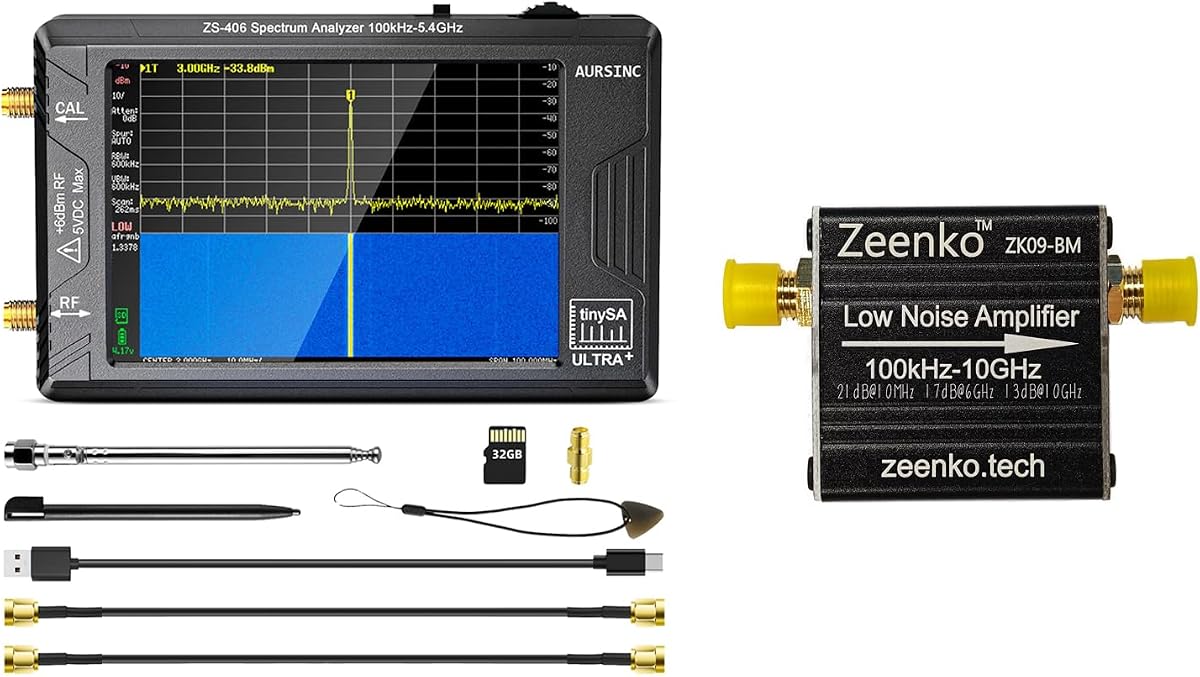
The AURSINC TinySA Ultra+ ZS406 is a portable radio-frequency spectrum analyzer rather than an audio-reactive lighting device. It combines a 100kHz–6GHz TinySA Ultra analyzer with a ZK-09 BM low-noise amplifier. That distinction makes it appropriate for RF testing, transmitter work, Wi-Fi investigations, drone frequency checks, EMI tasks, and receiver setup.
We may earn a commission when you buy through this link, at no additional cost to you.
The included amplifier covers 100MHz–10GHz, provides 21dB typical gain, and has a stated 13dBm OP1dB. The analyzer itself features a four-inch touchscreen, MicroSD logging, USB PC control, and signal-generator output. Its broader purpose comes through in features that would be unnecessary for music visualization but are valuable for technical diagnostics.
Portability is supported by the analyzer's compact screen and the amplifier's built-in 300mAh rechargeable battery. USB-C charging is included, while the package also provides charging cables, a stylus, and an antenna. The kit is positioned as a ready-to-use field-testing package, although users still need an appropriate antenna and suitable test arrangement for the frequency band under investigation.
This is the choice for users who specifically need RF spectrum analysis, not merely visible sound response. It is considerably more specialized than the LED products and should not be purchased merely as a novelty music display. The absence of a supplied customer rating also means it cannot be compared numerically with the rated audio products, making the detailed specifications and intended use especially important.
The ZK-09 BM amplifier is intended to improve sensitivity for high-frequency work, including 5.8GHz drone and Wi-Fi investigations. Its portable battery design reduces dependence on mains power during field diagnostics.
Beyond displaying the spectrum, the analyzer can generate signals for receiver and transmitter checks. MicroSD logging and USB control make captured measurements easier to store, transfer, and examine.
We may earn a commission when you buy through this link, at no additional cost to you.
The Sound Control LED Spectrum Display is a sound-reactive light with a 4.0 customer rating. It uses a built-in sensor to capture surrounding sound and convert it into lighting changes. The result is intended to add a dynamic atmosphere to a gaming room, car, home theater, bar, karaoke space, or festive setting.
We may earn a commission when you buy through this link, at no additional cost to you.
Its stated spectrum range extends from 20Hz to 25kHz, which gives the lighting system a broad response across low bass and higher frequencies. The description emphasizes energy-efficient LED beads, high brightness, and a long lifespan. These characteristics make the device suitable for sustained decorative use, provided it is positioned where its light can be enjoyed.
The compact design is another important benefit. It can sit on a desk, bedside table, or vehicle surface without requiring extensive installation. Because it works through ambient sound pickup, it avoids the need for a wired audio feed in many placements. However, that same feature makes the response dependent on room acoustics, placement, and the volume and tonal balance of nearby sound.
This product is a solid choice when a lively spectrum-inspired light is the goal. It does not offer a precision frequency chart or level meter, so it should not be selected for technical audio analysis. Its wider range of intended applications and straightforward sound-controlled behavior make it especially practical for casual users and decorative installations.
The product is described for home theaters, karaoke rooms, bars, festivals, and smart-home-style accent lighting. This broad positioning makes it useful wherever a room could benefit from colorful sound-responsive illumination.
The use of LED beads supports bright visual effects with relatively low power consumption. A compact body and simple ambient pickup also keep the setup unobtrusive.
We may earn a commission when you buy through this link, at no additional cost to you.
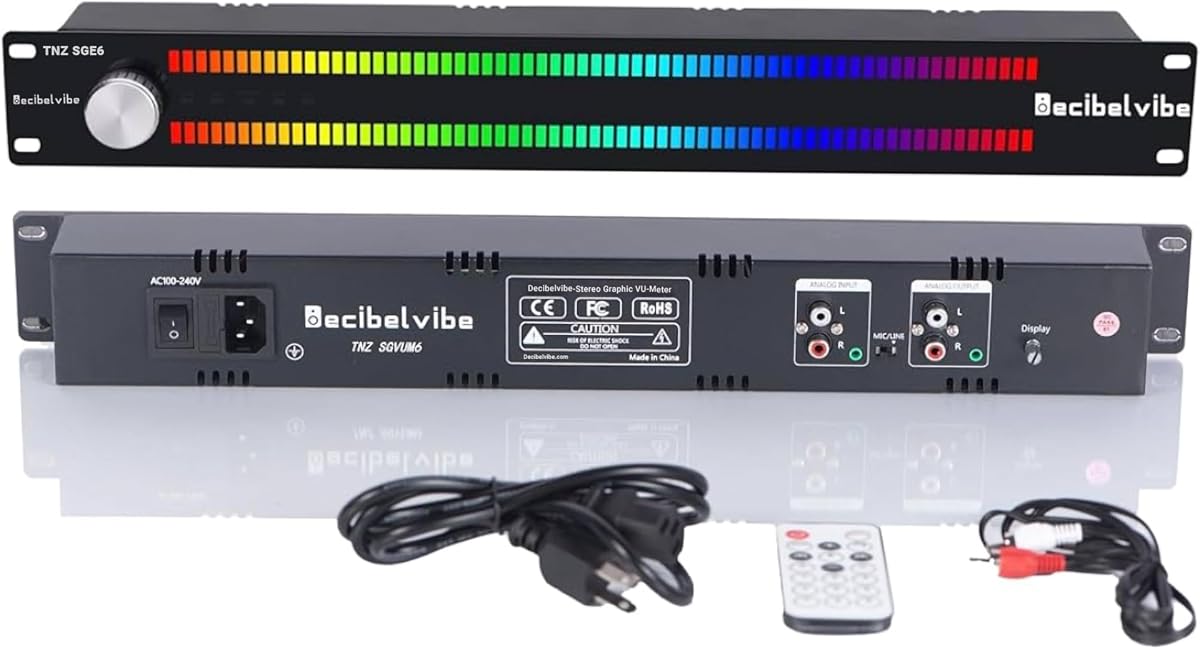
The silver Decibelvibe TNZ SGVUM6 is a stereo audio graphic VU meter designed to add both color and useful level feedback to a sound system. Its supplied rating is 4.4, and the display uses 128 full-color LEDs arranged as two channels of 64 indicators. This gives it a more structured appearance than a basic sound-reactive panel.
We may earn a commission when you buy through this link, at no additional cost to you.
Connection flexibility is a major strength. Rear RCA and 3.5mm auxiliary inputs and outputs allow it to sit within a stereo amplifier, preamp, hi-fi system, home theater, or mixing-console setup. A built-in microphone provides wireless input when no cable is convenient, while switching between microphone and line input lets the user choose the appropriate source.
The visual controls include brightness, speed, and gain adjustments, along with 19 color options. Built-in noise reduction processing can help improve the appearance of the meter when the source contains unwanted noise. These features make the unit more configurable than a simple decorative spectrum lamp and better suited to monitoring a connected audio signal.
It is a good fit for home-audio enthusiasts, car-audio builders, and professionals who want their equipment to display live activity. It is less appropriate for someone who only wants a plug-in decorative light because it calls for more deliberate source and gain setup. Even so, it balances useful feedback with an attractive professional-style display.
The two sets of 64 LEDs make the display suitable for stereo systems and provide a clear sense of each channel's activity. The result is more informative than a single combined bar while remaining visually engaging.
RCA and 3.5mm connections integrate the meter into existing equipment, while the built-in microphone offers a convenient alternative. Source switching keeps the unit adaptable across different setups.
We may earn a commission when you buy through this link, at no additional cost to you.
The gold Decibelvibe TNZ SGVUM6 offers the same core functionality as the silver version but provides a different finish for installations where appearance matters. It carries a 4.4 customer rating and uses 128 full-color LEDs to display stereo music and sound activity. The gold treatment may pair naturally with amplifiers, car interiors, or home audio components with warmer styling.
We may earn a commission when you buy through this link, at no additional cost to you.
Like the silver model, it supports rear RCA and 3.5mm auxiliary inputs and outputs. Those connections allow integration with stereo amplifiers, preamps, hi-fi equipment, home theater systems, and mixing consoles. A built-in microphone creates a wireless input option for users who want the meter to react to nearby sound without connecting an audio cable.
The display can be adjusted for brightness, animation speed, and gain, with 19 color choices available. Noise-reduction processing is also included. These features help the meter respond attractively to different listening environments and make the visualization easier to tune than a fixed lamp or panel.
Because the gold and silver products share the same essential electronics and connectivity, the deciding factor will often be finish and system compatibility. The gold version is a strong option for a polished display installation. It is not a calibrated measurement instrument, and incorrect gain or source selection can make its movement less representative, so setup attention remains important.
The gold finish can coordinate with premium-looking components better than a generic illuminated panel. It is especially useful when the display will remain visible as part of the equipment arrangement.
Multiple colors, speed settings, and gain controls let the display match the room and the source. The stereo LED arrangement preserves the visual character of a traditional graphic meter.
We may earn a commission when you buy through this link, at no additional cost to you.
The SeeSii TinySA Ultra+ ZS406 is a handheld RF spectrum analyzer kit built around the upgraded ZS406 platform. It includes a 32GB microSD card and a protective EVA case with a cutout designed for 4-inch analyzers. The kit is aimed at users who want a ready-to-carry RF measurement setup rather than a simple music visualizer.
We may earn a commission when you buy through this link, at no additional cost to you.
Its 4.0-inch 480×320 touchscreen provides a larger and more colorful operating surface than many compact analyzers. The stated measurement coverage runs from 100kHz to 5.3GHz, with Ultra mode extending to 6GHz, and the listing describes 450 scan points. Switchable resolution bandwidth filters and the included memory card support more detailed measurements and stored results.
USB connectivity allows the analyzer to operate under PC control through the TinySA app, and the interface can be used to transfer data or issue commands. The new ESD-protection function and included protective case are meaningful additions for a portable instrument, particularly when it is carried between field locations.
This product is a sensible complete kit for radio testing, electronics investigation, and users who value storage and protection. It does not analyze audible music in the way the Nobsound or Decibelvibe products do, and the lack of a supplied rating means numerical customer feedback is unavailable. Its strengths instead lie in screen size, recording, PC integration, and case protection.
A 32GB card allows the analyzer to record data directly and move it into a computer workflow. This is convenient for field logs, comparisons, and documentation.
The heavy-duty EVA case is cut for compatible 4-inch analyzers and helps prevent scratches, dust, and impact damage. Its wipe-clean surface also suits repeated transport.
We may earn a commission when you buy through this link, at no additional cost to you.
The XVIVE AT-3 Audio Tester Ultra is a professional troubleshooting device with a 5.0 customer rating. It combines a signal generator, long-distance XLR and DMX cable tester, phantom power checker, XLR input meter, and monitoring function. Although it does not create a music spectrum display, it provides more actionable audio diagnostic information than any decorative light in this guide.
We may earn a commission when you buy through this link, at no additional cost to you.
The split design includes an AT-3M send-and-generate unit and an AT-3F receive-and-monitor unit. This arrangement allows one person to test a long run without repeatedly walking between both ends. Automatic and manual pin-selection modes help identify cable faults, which is particularly valuable for intermittent stage lines and touring equipment.
The built-in generator can send a 1kHz sine wave or pink noise at three stated output levels. Signal presence can be observed through SG and PK metering, while phantom power is identified through solid or flashing indicators. The receiver also supports 1/8-inch headphone monitoring and a built-in speaker that automatically mutes when headphones are connected.
USB-C charging, a low-battery warning, and a magnetic mount support field use. The AT-3 is the strongest recommendation for live sound engineers, church technicians, DJs, rental crews, and touring teams. It is a specialized measurement tool rather than a visualizer, so buyers searching only for music-reactive lighting should consider the LED and V-meter products instead.
Placing the send and receive units at opposite ends enables quick checks across long XLR or DMX runs. Manual pin selection adds detail when an automatic test does not provide enough specificity.
Signal generation, input metering, phantom-power identification, and audio monitoring combine several common checks in one package. Visual indicators are especially useful when a venue is too loud for accurate listening.
We may earn a commission when you buy through this link, at no additional cost to you.
The AURSINC TinySA Ultra+ ZS407 is the highest-range RF spectrum analyzer in the roundup, with a stated 100kHz–7.3GHz coverage and a 4-inch IPS-TFT display. It is a technical instrument for radio-frequency and software-defined-radio work, not a sound-reactive light for bedrooms or gaming spaces. Its value comes from wide measurement reach, signal generation, and portable operation.
We may earn a commission when you buy through this link, at no additional cost to you.
The display can show as many as 450 points per scan at a 480×320 resolution, while USB connectivity enables PC control and data transfer. The analyzer can also function as a signal generator, offering sine-wave output from 0.1MHz to 900MHz, square-wave output up to 6.3GHz, and RF test signals up to 7.3GHz.
The included ZK09-BM low-noise amplifier provides 21dB gain with an indicated 13dBm typical OP1dB. Its built-in 300mAh battery is listed for approximately five hours of operation. The listing also advises against using the analyzer's built-in LNA and the external amplifier simultaneously unless specifically required, which is an important setup consideration.
This analyzer is best for experienced users who need extended high-frequency coverage or a versatile signal source. It has no supplied customer rating, so it should be evaluated from the specifications and compatibility requirements rather than numerical feedback. For ordinary music visualization, one of the audio-reactive or VU-meter products will be much easier to use.
The stated range and signal-generation limits make the ZS407 suitable for advanced RF investigations. It is particularly relevant to users working with high-frequency wireless or software-defined-radio equipment.
The rechargeable ZK09-BM module combines low-noise amplification with field-oriented battery life. USB power and the stated five-hour operating period reduce reliance on external power supplies.
We may earn a commission when you buy through this link, at no additional cost to you.
The most important first step is defining whether you need atmospheric visualization, audio-level feedback, cable troubleshooting, or RF analysis. Once that purpose is clear, compare input methods, display detail, controls, portability, and installation requirements.
In short, choose lighting for atmosphere, a VFD or stereo meter for audio feedback, and an RF analyzer for radio work.
Use ambient pickup for flexible decoration and use wired inputs when consistent monitoring matters.
Match the stated frequency range to the signal you need to monitor, not simply to the largest number.
Choose structured bands and controls for analysis, and bold light patterns for visual impact.
More controls are helpful when sources vary; fewer controls are convenient when the display is purely decorative.
Verify every connector, power standard, and source type before making a purchase.
Choose battery or USB power for mobility and dependable wired power for permanent installation.
For exposed or mobile use, favor suitable enclosure or protection over a bare decorative module.
Begin by identifying the sound source and intended result. For an ambient LED panel, place the unit where nearby music can reach the pickup sensor without obstruction, then connect the specified power. For a wired analyzer or VU meter, select the correct MIC, AUX, RCA, or other input before adjusting gain. On touchscreen RF devices, confirm the operating frequency range and compatible antenna before attempting a measurement.
After powering the unit, start with conservative display or gain settings. Increase sensitivity gradually so that ordinary passages look attractive without causing the display to remain constantly saturated. For a sound-reactive room light, reposition the device if the response is weak or overly aggressive. For professional meters and analyzers, use a known test signal to verify the source and make calibration-oriented comparisons before drawing conclusions about a system.
Care for the product according to its construction. Keep bare LED modules away from moisture and conductive objects, and avoid leaving them powered in enclosed spaces where heat can accumulate. Clean enclosed displays with a soft, dry cloth rather than aggressive liquids. Store RF analyzers in their protective case, keep the antenna secured, and remove or protect the memory card when transferring long-term records. For troubleshooting tools, inspect connectors and cables after each rental or touring cycle.
A sound pickup spectrum analyzer converts sound into a visual display using a microphone, frequency-band response, or electrical audio input. Depending on the model, the result may be a decorative LED pattern, a detailed VFD spectrum, a stereo VU-style meter, or an RF signal trace. The keyword therefore covers several distinct product categories, so the display's intended purpose should be checked carefully.
No. Some panels divide an audio signal into visual channels, while others simply flash or change color in response to overall sound. The LED Sound-Controlled Music Spectrum Display explicitly states that it is a flashing panel and does not perform frequency analysis. Products such as the Nobsound AK2515 offer a more recognizable spectrum presentation, while TinySA devices provide technical RF measurements.
The Upgrade Audio Music Visualizer is the strongest ambient-lighting choice for a gaming room because it reacts to surrounding audio and uses multiple LED channels. The compact LED module can work where space is limited, while the Decibelvibe meters are better when the display should be integrated into a wired stereo system. The best option depends on whether atmosphere or equipment monitoring is the priority.
That depends on the model. The Nobsound accepts 3.5mm MIC and AUX inputs, and the Decibelvibe SGVUM6 units support rear RCA plus 3.5mm input and output connections. LED panels generally operate through sound pickup and their own power connection rather than a conventional line-level signal. Check the supplied connector information and avoid forcing an unsupported adapter into a port.
Audio analysis focuses on audible sound, commonly covering roughly 20Hz to 20kHz, and is useful for visualizing music or monitoring level activity. RF analysis examines radio-frequency signals over much higher ranges and helps identify transmissions, interference, and signal behavior. The XVIVE AT-3 focuses on audio cable and signal troubleshooting, while the TinySA products are built for RF work rather than music visualization.
The XVIVE AT-3 is the most purpose-built option in the roundup. Its split design supports end-to-end XLR and DMX cable testing, and it includes signal generation, input metering, phantom-power checks, headphone monitoring, and a built-in speaker. Those functions help technicians identify faults in stages, churches, rental systems, and touring rigs without relying only on listening in a loud environment.
Usually not. Products designed for ambient room lighting use a built-in sound pickup sensor and react to nearby audio. Wired inputs are more relevant to the Nobsound and Decibelvibe units, which can accept connected sources for more consistent results. The XVIVE AT-3 and TinySA analyzers require appropriate test cables, antennas, or source connections because they perform technical measurements.
Place the panel near the sound source without blocking its pickup opening, and begin with a moderate sensitivity setting. Adjust the response only after listening to both quiet and loud passages. Room reflections, soft furnishings, and background noise can all affect the result, so repositioning the unit may improve the visual response more than changing the control.
The Upgrade Audio Music Visualizer stands out as the most compelling all-around ambient option, combining sound pickup, multiple LED channels, automatic color modulation, and a strong supplied customer rating. The Nobsound AK2515 Pro is the pick for listeners who want a more detailed VFD spectrum and extensive controls, while the compact LED module offers a straightforward decorative solution for smaller spaces.
Prioritize the type of information you need before considering appearance alone. Ambient lights are easy and engaging, stereo VU meters support connected audio systems, the XVIVE AT-3 helps diagnose live-sound faults, and the TinySA products provide the depth required for RF analysis. Choosing a device that directly matches the task will produce a more useful result than selecting solely on the phrase spectrum analyzer.
Finally, check the current retailer listing, included accessories, connector types, and manufacturer details before ordering. Technical specifications and customer feedback can change, and the supplied ratings apply only to products with a listed score. Confirm that the device suits your room, source, and power arrangement so the final choice works as intended.