
Griddy The Grid Complete Kit
4.0Editor score
Broad 5G, LTE, WiFi support
N-Type, TS9, SMA adapters
Suitable for MIMO installations
Our parabolic WiFi antenna guide compares 10 directional models for gain, frequency range, connectors, weather resistance, outdoor links, and WiFi compatibility
A parabolic WiFi antenna can turn a weak, unreliable connection into a focused link between two points, but only when its frequency range, gain, connector, and aiming direction fit the job. These grid-style antennas are especially useful for outdoor backhaul, point-to-point networking, remote cameras, and receiving signals from a distant access point.
We compared all 10 products by their operating bands, stated gain, directional behavior, included installation hardware, connector types, cable arrangements, and intended applications. The list includes dedicated 2.4 GHz WiFi dishes, ultrawideband cellular antennas, and parabolic models designed for satellite reception rather than conventional WiFi.
Each review shows why a particular antenna may suit a specific installation, along with the limitations visible in its specifications. Ratings and product details can change over time, and current listing availability, connector compatibility, and system requirements should be checked before ordering any hardware.
4.0Editor score

4.2Editor score

5.0Editor score
The table below compares the ten antennas by their primary use, operating band, gain, and connection method, making it easier to distinguish dedicated WiFi dishes from cellular, wideband, and satellite-oriented models.




The Griddy The Grid Antenna Only is a 4.2-rated, ultrawideband parabolic antenna designed for WiFi, LTE, 4G, and 5G installations. Its most distinctive feature is the 600–6500 MHz operating range, which allows one physical antenna to cover several low-band cellular frequencies and multiple WiFi and 5G bands without changing hardware.
We may earn a commission when you buy through this link, at no additional cost to you.
Gain varies by frequency, beginning at 12–17 dBi from 600–960 MHz, rising to 20–23 dBi from 1700–2700 MHz, and reaching 23–26 dBi from 3000–6500 MHz. That makes the antenna especially interesting for users who need a directional link to a cell tower, access point, hotspot, or LTE router. The 50-ohm N-Type connectors also provide a conventional interface for compatible radio equipment.
The trade-off is that this version is an antenna-only package. A signal booster, LTE router, WiFi access point, or similar device is still required, and the correct adapter must be selected for its antenna port. The manufacturer also emphasizes the need for line of sight. Trees, buildings, and reflective obstructions can scatter the signal and reduce the advantage created by the antenna's narrow directional focus.
This is a strong choice for technically confident users who want one antenna to support several radio bands or plan to build a multi-antenna MIMO arrangement. It is less convenient for a plug-and-play WiFi upgrade, but for a carefully aimed outdoor installation, its versatility and gain make it the most flexible model in this roundup.
The broad frequency coverage is the Griddy's defining advantage. It can serve a WiFi access point at one end of a link and cellular hardware at another, provided both systems operate within the antenna's published band-specific gain ranges and use compatible N-Type connections.
High gain concentrates energy toward the intended target, but it also makes orientation critical. Mount the antenna where it has an unobstructed view of the tower or access point, and expect performance to fall when the path crosses foliage, walls, or other reflective structures.
We may earn a commission when you buy through this link, at no additional cost to you.
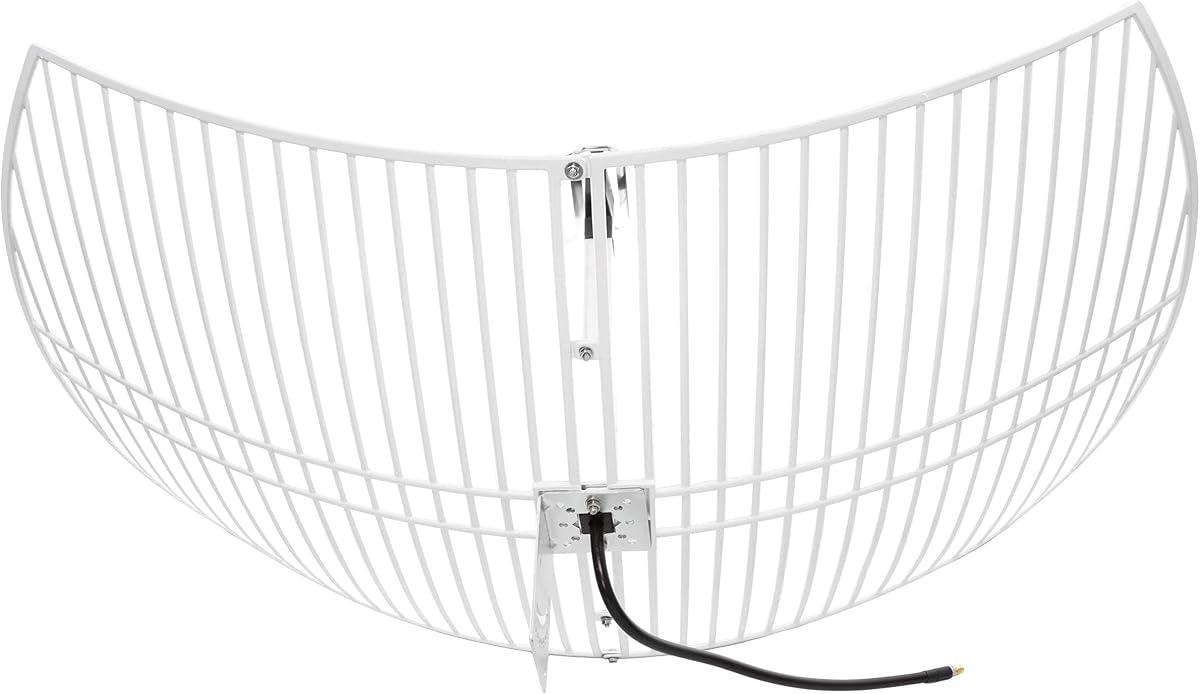
The Griddy The Grid Complete Kit earns a 4.0 rating and is the more self-contained version of the Griddy antenna. It retains the 600–6500 MHz wideband design and band-dependent gain, but adds TS9 and SMA adapters alongside the 50-ohm N-Type connectors. That broader selection of fittings makes it easier to connect the antenna to a wider selection of cellular and WiFi equipment.
We may earn a commission when you buy through this link, at no additional cost to you.
Its strongest use is a directional outdoor link to an LTE router, 5G device, hotspot, signal booster, or WiFi access point. The antenna can deliver 12–17 dBi in the 600–960 MHz bands, 20–23 dBi from 1700–2700 MHz, and 23–26 dBi from 3000–6500 MHz. The complete-kit approach is particularly practical when the exact connector on the receiving device is already known.
This package does not eliminate the need for compatible equipment, and its line-of-sight requirement remains important. A parabolic antenna concentrates power in a particular direction, so obstacles can undermine even a high-gain installation. Users considering two or four units for MIMO should also verify that their router or booster exposes the required number of external antenna ports.
Overall, the kit is a logical premium choice for a builder who wants broad compatibility without separately sourcing common adapters. It combines the same flexible frequency coverage as the antenna-only Griddy with a more installation-ready selection of connections, making it especially useful for cellular-and-WiFi projects.
N-Type, TS9, and SMA interfaces cover several common device arrangements. Buyers should still inspect the antenna terminal on the router or booster, because the presence of an adapter in the box does not guarantee that every device uses the same connector or pinout.
The wideband design lets the same directional hardware serve 4G LTE, 5G NR, and WiFi applications. It is a better fit for installers working across several radio systems than for someone who only needs a simple 2.4 GHz point-to-point link.
We may earn a commission when you buy through this link, at no additional cost to you.
The Nooelec GOES Weather Satellite Mesh Antenna is a 4.0-rated 21 dBi parabolic antenna centered at 1.7 GHz, with bandwidth exceeding 200 MHz. Its intended role is receiving high-resolution, near-real-time images from orbiting weather satellites, including GOES, NOAA HRPT, Meteor M2 HRPT, Metop, and FengYun systems operating near 1.6–1.8 GHz.
We may earn a commission when you buy through this link, at no additional cost to you.
The antenna can be deployed for both linearly and circularly polarized signals, including right-hand and left-hand circular polarization. It uses an LMR400 feed cable with a male SMA connector and includes mounting hardware. Unlike a standard WiFi accessory, it is intended to work with an SDR, filter, low-noise amplifier, and decoding software to produce satellite imagery.
Its most important limitation is purpose. Buying it for a home WiFi router would be a mismatch because the radio, modulation, and frequency needs are entirely different from a 2.4 or 5 GHz WLAN link. Even for satellite reception, the antenna still needs appropriate supporting equipment, and decoding software such as SatDump is required to turn received signals into images.
This is an excellent choice for amateur weather observers, remote-sensing experimenters, and technically experienced users building an SDR reception setup. It is not a general WiFi solution, but within its specialized category, the 21 dBi gain, 1.7 GHz center frequency, and polarization flexibility provide a thoughtfully matched parabolic system.
A 1.7 GHz center frequency and more than 200 MHz of bandwidth align closely with the downlink bands used by common weather-satellite services. The parabolic design then concentrates the relatively weak received signal toward the feed and receiver.
The antenna does not decode images by itself. Users need compatible SDR hardware, suitable filtering and amplification where appropriate, and decoding software such as SatDump, making it a specialized project rather than a plug-in WiFi upgrade.
We may earn a commission when you buy through this link, at no additional cost to you.
The WiFi Parabolic Directional Antenna Set is a 5.0-rated, 20 dBi grid dish designed specifically for the 2400–2500 MHz band. It is a focused option for outdoor backhaul, remote access-point reception, wireless camera links, and point-to-point connections that do not require 5 GHz support.
We may earn a commission when you buy through this link, at no additional cost to you.
The package includes one grid parabolic antenna, a right-angle mounting bracket, two U-bolt clamps, a 9.8-foot RF400 cable, and an SMA male adapter. The dish has 50-ohm impedance, vertical polarization, a maximum input power rating of 100 watts, and a stated VSWR of 1.5 or lower. The supplied low-loss cable and mounting pieces make it more installation-ready than an antenna-only purchase.
Its main limitation is frequency. The unit cannot cover 5 GHz, so it is not appropriate for a modern dual-band router that needs a single antenna to support both bands. It also uses an N-Type female connector, meaning the device-side connection must be checked carefully. The SMA adapter expands compatibility, but buyers should confirm the correct adapter and avoid unnecessary cable runs.
This antenna is a compelling option for a dedicated 2.4 GHz link, especially when a complete mounting package is desired. It is well suited to users building a rural backhaul connection, improving a camera's link to a distant access point, or extending coverage between two buildings where an unobstructed path exists.
The right-angle bracket, U-bolt clamps, RF400 cable, and SMA adapter cover several essential installation needs. This reduces the number of separate accessories required for a straightforward outdoor point-to-point deployment.
The 20 dBi gain and 2400–2500 MHz range make this a strong choice where both ends can operate exclusively on 2.4 GHz. It is not a substitute for a dual-band or wideband dish when the network must support 5 GHz.
We may earn a commission when you buy through this link, at no additional cost to you.
This wideband 2×2 MIMO parabolic antenna is built for 5G home internet, 4G LTE, and WiFi devices, with a stated gain of 34 dBi and an operating range of 600–6000 MHz. Its defining feature is the two-antenna configuration, which is intended to support modern cellular equipment that benefits from spatial diversity.
We may earn a commission when you buy through this link, at no additional cost to you.
The installation package is extensive. It includes one directional parabolic antenna, two 49-foot SMA cables, two TS9 cables, two N male adapters, and pole-mount brackets. This assortment gives an installer more flexibility in connecting the antenna to a compatible 5G or LTE router, and the long cable runs allow the dish to be mounted where line of sight is better.
The 3.0 rating is the lowest among the rated products and deserves attention. Although the specifications are appealing, the feedback signal suggests that real-world results may depend heavily on carrier compatibility, device recognition, mounting, and the absence of obstructions. A high stated gain cannot compensate for a router that does not support the antenna arrangement or for a blocked path to the tower.
This antenna is best for a user with a 2×2 MIMO cellular router who has a clear view of a tower and needs flexible connection options. It is less suitable for a simple indoor WiFi project or for someone who cannot accurately aim and align the dish. With those requirements met, the wideband coverage and long included cables provide a useful foundation.
A 2×2 setup uses two signal paths rather than one, and both elements need correct placement and orientation. The equipment should be mounted and aimed as a matched pair to preserve the diversity benefit intended by the design.
The antenna cannot add MIMO capability to unsupported hardware. Check the router's external antenna options, connector requirements, and carrier bands before installation, then use the included adapters only after confirming the appropriate electrical connection.
We may earn a commission when you buy through this link, at no additional cost to you.
The Eifagur 15 dBi dual-band panel antenna is not a dish, but it belongs in this guide because it offers a practical alternative when a full parabolic grid would be excessive. It supports 2.4 GHz from 2400–2485 MHz and 5 GHz/5.8 GHz from 5150–5850 MHz.
We may earn a commission when you buy through this link, at no additional cost to you.
The antenna is designed for wireless routers, repeaters, access points, PCI WiFi adapters, IP cameras, and video surveillance recorders. It uses an RP-SMA male connector and includes a 10-foot RG58 cable. Its directional design concentrates coverage toward the target, which can help a camera or remote network client receive a stronger signal from a nearby access point.
Compared with a 20 dBi grid parabolic, this model's stated gain is lower, and RG58 is not the most efficient cable choice for long runs. Its advantage is practicality: it covers both principal WiFi bands in a slim outdoor panel, making it easier to mount against a wall or in a constrained location. It also has a 4.3 rating and a 15 dBi gain specification that is more than adequate for many medium-range installations.
Choose this antenna when the priority is dual-band WiFi support, compact outdoor construction, and broad device compatibility rather than maximum gain. It is particularly useful for a security camera that struggles to connect to a distant router, provided the camera uses a compatible RP-SMA interface and the signal path is not blocked.
Covering 2.4 and 5 GHz in one directional unit is valuable when the remote device or access point may use either band. The flat panel format also makes it less visually and physically cumbersome than a large grid dish.
The 10-foot RG58 lead is manageable for a nearby installation, but cable loss and the need for an RP-SMA connection should be considered. For longer runs, a lower-loss cable and the correct adapter may produce a better result.
We may earn a commission when you buy through this link, at no additional cost to you.
The Nooelec Satellite Mesh Antenna Bundle is a 4.4-rated 20 dBi parabolic system centered at 1.4 GHz with bandwidth greater than 300 MHz. It is optimized for L-band signals used by Inmarsat, Iridium, and Hydrogen Line applications, as well as remote sensing and weather-tracking equipment.
We may earn a commission when you buy through this link, at no additional cost to you.
A sub-reflector is used to enhance the antenna's performance, and the assembly includes an arm with an attached coaxial feed cable. The LMR400 cable terminates in SMA, making it easier to integrate with compatible radio equipment. A mounting kit supports several installation arrangements, and the lightweight design is suitable for a stationary outdoor setup.
The antenna's 4.4 rating is among the stronger results in the roundup, although ratings alone do not make it a general WiFi recommendation. The 1.4 GHz center frequency and L-band focus are unsuitable for a conventional 2.4 or 5 GHz WLAN. Users must also determine whether the radio equipment requires linear or circular polarization and whether additional filtering or amplification is appropriate for their specific satellite service.
This model is a good fit for a technically equipped satellite-communications enthusiast or a remote monitoring project operating in the L-band. Its combination of 20 dBi gain, broad bandwidth, low-loss feed, and flexible mounting kit offers a specialized system that would be difficult to replace with a standard WiFi dish.
The greater-than-300-MHz bandwidth covers many popular L-band applications while the 1.4 GHz center frequency places the parabolic beam where those signals are received. This makes the antenna much more purposeful for satellite work than a generic WiFi grid.
The design is intended for a stationary outdoor installation, so the mount can be aligned carefully and left in position. The attached arm, coaxial feed, and included hardware reduce the assembly and routing work compared with a bare reflector.
We may earn a commission when you buy through this link, at no additional cost to you.
The 2.4GHz 25dBi Yagi is a high-gain directional WiFi antenna with a 4.5 rating. It operates from 2400–2483 MHz, has a stated maximum gain of 25 dBi, uses 50-ohm impedance, and connects through an RP-SMA male connector. Its 50-centimeter aluminum-alloy boom makes it considerably more compact than a large grid parabolic.
We may earn a commission when you buy through this link, at no additional cost to you.
It is compatible with many routers, access points, hotspots, USB adapters, desktop PCI wireless cards, IP cameras, DVR systems, industrial routers, IoT gateways, and remote-control equipment. Installation is straightforward when the target device already uses RP-SMA: the existing antenna can be unscrewed and replaced. The supplied 1.5-meter cable also offers enough reach to move the antenna away from a device's chassis.
The major limitation is that this antenna works only on 2.4 GHz. It cannot be used for a 5 GHz or 5.8 GHz connection. Its highly directional pattern also means that the source must be aligned carefully, and the 25 dBi figure should be understood as a peak directional specification rather than a guarantee of stronger performance under every installation condition.
For a user with a 2.4 GHz camera, router, or USB adapter that needs a strong link across a defined direction, this is a capable and compact option. It is especially attractive when replacing an existing RP-SMA antenna without assembling a large dish system, provided the target is clearly visible and only one WiFi band is needed.
A Yagi boom is easier to handle and mount than a deep parabolic reflector. The stated 25 dBi gain makes this model attractive for a fixed link where the receiving device and transmitter are already known and can be aligned directly.
The included cable and direct RP-SMA connection make the antenna convenient for routers and adapters that use the same connector. Users should confirm the connector and band before removing the existing antenna, because an RP-SMA connector does not guarantee that the device is 2.4 GHz compatible.
We may earn a commission when you buy through this link, at no additional cost to you.
This 16 dBi Yagi antenna is a 3.9-rated, 2.4 GHz directional option intended for long-range reception or transmission. It covers 2400–2500 MHz and offers both RP-SMA male and SMA male connectors, giving it useful flexibility across WiFi routers, USB adapters, cameras, modems, and other wireless equipment.
We may earn a commission when you buy through this link, at no additional cost to you.
The product is particularly relevant to drone remote controls, video transmission, remote monitoring, industrial routers, IoT gateways, trucks, RVs, and wireless extenders. A two-meter extension cable and included mounting accessories allow the antenna to be positioned away from crowded equipment or placed in a better line-of-sight location. Its focused beam can also reduce interference from signals arriving outside the intended direction.
Compared with the 25 dBi Yagi, this antenna offers less peak gain but covers a slightly wider stated frequency range and includes two connector styles. That can make installation more convenient when the available device termination varies. However, 16 dBi remains a strongly directional rating, so the target should be positioned in front of the antenna and not scattered by buildings or foliage.
This is a good choice for builders working with a 2.4 GHz drone link, remote camera, or compact point-to-point system where flexible connectors are useful. It is less appropriate for dual-band networking, omnidirectional room coverage, or long cable runs where a low-loss coaxial cable would be preferable to the included extension lead.
Having RP-SMA and SMA options can reduce adapter friction when connecting to different WiFi equipment. The correct connector still needs to be selected deliberately, and the antenna should never be forced onto an incompatible interface.
A directional Yagi works best when the source and antenna share a clear path. The two-meter lead helps with placement, but a longer or lower-loss cable may be more useful when the ideal position is farther from the connected device.
We may earn a commission when you buy through this link, at no additional cost to you.
The 2.4GHz 17dBi Grid Dish is a compact outdoor parabolic antenna for 2400–2500 MHz WiFi links. It has a 4.2 rating, a 50-ohm impedance, vertical polarization, a maximum input power of 100 watts, and a stated VSWR of no more than 1.5. These specifications place it squarely in the 2.4 GHz point-to-point category.
We may earn a commission when you buy through this link, at no additional cost to you.
The package includes the grid parabolic antenna, a right-angle mounting bracket, and two U-bolt clamps. The grid structure is described as weather-resistant and corrosion-resistant, with a capability to withstand wind speeds up to 60 meters per second. It is intended to establish stable, high-bandwidth wireless links between remote points or receive a signal from a distant source.
Unlike the 20 dBi grid set, this product does not list an RF400 cable or an SMA adapter. That makes it a leaner installation package with fewer included connection choices. The N-Type female termination also means the installer must source a suitable cable and device-side adapter. Its lower stated gain may be sufficient for many links while producing a smaller and simpler dish.
This antenna is a practical choice for a builder establishing a dedicated outdoor 2.4 GHz backhaul link and wanting a robust grid reflector without a larger 20 dBi system. It is not suitable for 5 GHz equipment, and the absence of a listed rating means prospective buyers should place greater emphasis on their own path length, visibility, and connector requirements.
The 17 dBi specification provides meaningful directional gain while remaining focused on the 2400–2500 MHz band. It is well matched to long links where both devices can use 2.4 GHz and the path has no major obstructions.
Because the listing does not include a coaxial lead or device adapter, those components need to be selected separately. A low-loss cable of suitable length and an N-Type-to-device connection will help preserve the benefit of the dish.
We may earn a commission when you buy through this link, at no additional cost to you.
The right antenna depends on the radio band, link geometry, device connections, and outdoor environment. Use the following factors to narrow the options before making a purchase.
Match the antenna's published range to the equipment on both ends of the link, not merely to the name of the router or modem.
Choose a high-gain directional antenna when the target is fixed and visible, but do not expect a narrow beam to work reliably around buildings.
Confirm the device connector, required adapter, cable length, and impedance before ordering, then keep the coaxial run as short as practical.
Choose based on the signal type you actually need, and avoid treating a satellite antenna as a general-purpose WiFi upgrade.
Prioritize visibility over raw gain. A 20 dBi antenna aimed incorrectly can perform worse than a lower-gain antenna with a clear path.
For MIMO, verify device support, use matched antennas, and position each element carefully to preserve the intended spatial diversity.
Choose mounting hardware that fits the mast or structure, tighten it evenly, and protect cable connections from water and movement.
List every required component before buying so an attractive antenna specification is not undermined by missing cables, adapters, or mounting hardware.
Begin by identifying the target radio, its frequency range, connector type, and external antenna support. Confirm that the antenna is designed for that exact application. For a point-to-point WiFi link, establish a clear path between both endpoints, choose a mounting site that keeps the reflector away from obstructions, and plan the shortest practical low-loss cable route.
Mount the antenna securely on a rigid mast or bracket and aim the reflector directly at the access point, tower, camera, or remote radio. Fine alignment can materially affect a directional signal, so adjust the direction gradually while watching the connected device's signal and throughput readings. For MIMO installations, follow the equipment manufacturer's antenna arrangement and ensure that the paired elements are oriented consistently.
After installation, inspect the reflector, connectors, cable, and mounting points for looseness, corrosion, water ingress, or physical damage. Do not work on an energized system, and follow local electrical and grounding rules when connecting outdoor equipment. Periodically check alignment, clean debris from the grid, and replace damaged weatherproof seals or corroded hardware.
Yes, but only when weak signal or interference is limiting the connection. A directional antenna can improve signal quality, reduce competing signals, and allow the radio to maintain higher modulation rates or throughput. If the link already has excellent signal and the bottleneck is local processing or internet service, the antenna may make little practical difference.
No. Higher gain usually produces a narrower beam, so the antenna must be aimed more precisely and may fail when the target moves or sits behind an obstruction. A lower-gain model with a clearer path can be the better choice. Consider gain together with coverage width, mounting stability, link distance, and the location of the target.
These are different connector and interface standards used with coax cables and radio equipment. N-Type is robust and often used for higher-power or outdoor installations, while SMA and RP-SMA are common on smaller WiFi devices. TS9 is frequently encountered on cellular equipment. An adapter can help with physical fit, but the correct electrical interface and frequency support must also be confirmed.
Only if its specified frequency range covers both bands. Some dual-band panel antennas do, while many dedicated grid dishes and Yagi antennas are 2.4 GHz-only. A 5 GHz network may also use several separate channels and subbands, so the antenna's upper operating range should be checked rather than assuming every product marketed for 5 GHz supports every channel.
A single dish is not automatically a MIMO antenna. The router or modem must support MIMO and provide the required external antenna connections. Some installations use two matched directional antennas, while others use a dedicated MIMO panel. Follow the radio manufacturer's layout and alignment instructions because incorrect spacing or orientation can reduce the benefit.
Generally, no. The Nooelec GOES and L-band antennas are optimized for satellite and radio-frequency reception in the 1.4–1.7 GHz regions. They require compatible receivers, filters, amplifiers, and software, while ordinary WiFi equipment uses different radio formats and usually operates at 2.4 or 5 GHz. Their parabolic construction is useful, but their intended application is specialized.
It matters, especially for high-frequency signals and long runs. RF400 and LMR400 are low-loss options that suit longer outdoor installations, while RG58 can introduce more loss over distance. Keep the cable as short as practical, use high-quality connectors, and avoid unnecessary adapters or splitters. Extra cable length should be arranged without sharp bends or strain.
First identify the exact location of the access point or transmitter, then position the antenna with the clearest view toward it. Mount it securely, connect the system, and make small directional adjustments while observing signal quality and throughput. Do not rely on the apparent direction of a nearby building or tower label, because the antenna must point toward the active radio rather than the structure itself.
The Griddy The Grid Antenna Only stands out as the most versatile overall option because it spans 600–6500 MHz and can serve WiFi, LTE, and 5G equipment. The Complete Kit version adds common adapters for a more convenient installation, while the 2.4 GHz grid set is a focused and well-equipped choice for dedicated outdoor WiFi links.
Prioritize frequency compatibility, connector type, and line of sight before focusing on the largest gain figure. A 2.4 GHz dish is ideal for a 2.4 GHz backhaul or camera link, a dual-band panel offers broader WiFi compatibility, and a MIMO or satellite antenna should be selected only when the receiving equipment supports that exact architecture and frequency range.
Finally, check the current listing, included components, weatherproofing details, and device requirements before making a final decision. Product configurations and ratings can change, and the right parabolic WiFi antenna is ultimately the one that matches the radio, connection, and physical path of the intended installation.