
Wireless Driveway Alarm – Motion Sensor Door Chime Motion Detector
4.2Editor score
500-foot wireless receiver range
58 selectable alert melodies
Five adjustable volume levels
Our guide compares the best motion sensor alarm for front porch use, covering range, weather resistance, alerts, power, detection, and installation.
A motion sensor alarm for the front porch can provide an early warning when someone approaches your entrance, whether that person is a visitor, a delivery driver, or an unexpected intruder. The most useful systems combine dependable detection, a clearly audible indoor chime, flexible alert tones, and straightforward installation without extensive wiring.
We compared these ten systems using the supplied specifications, focusing on detection range, wireless reach, outdoor suitability, alert volume, power options, expandability, and installation requirements. The list includes porch-friendly outdoor models as well as indoor alarms that work when the sensor is mounted in a covered, dry location.
Each review explains where the product fits best, what makes it distinctive, and where its limitations matter. Ratings reflect the supplied customer feedback, while practical details help distinguish a basic entry chime from a full driveway system. Product availability and prices can change, so check the current listing before purchasing.
4.2Editor score

4.5Editor score

4.3Editor score
The table below compares the ten alarms by their core specifications, including sensing distance, wireless reach, alert behavior, power, and weather suitability. These details reveal which systems are intended for fully exposed outdoor areas and which require a covered porch or indoor placement.
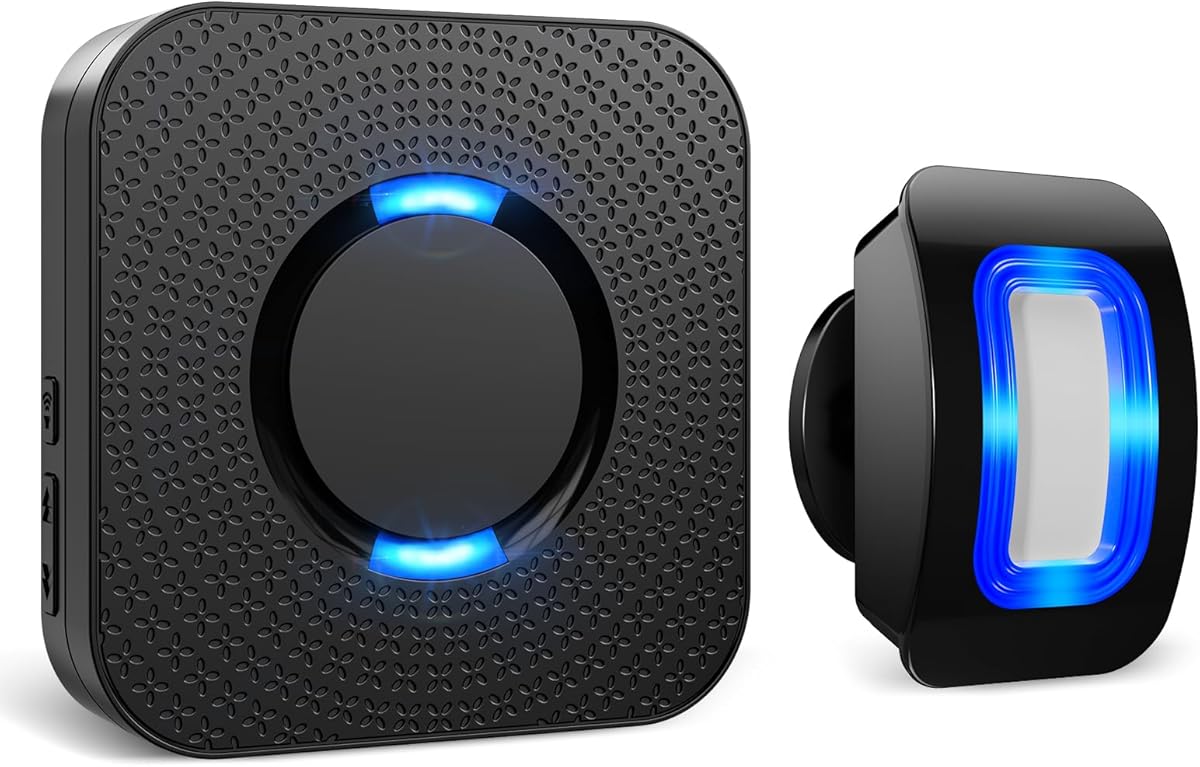


This wireless motion sensor door chime carries a 4.2 customer rating and offers an approachable way to detect arrivals at a front entrance. It provides 58 melodies, five volume levels, visual LED feedback, and a receiver with up to 500 feet of wireless reach. Its flexible design makes it useful for anyone seeking a basic porch visitor alert.
We may earn a commission when you buy through this link, at no additional cost to you.
The system supports a five-second interval between detections, which helps prevent one person crossing the detection area from producing a continuous stream of alerts. Its infrared sensor has a relatively narrow intended focus of 45 degrees vertically and 15 degrees horizontally. This precise coverage can reduce unwanted triggers from pets and background movement when the sensor is aimed correctly.
Installation is straightforward because the sensor can use either two AAA batteries or a Type-C connection for continuous operation. It mounts on walls, door frames, or ceilings using the included base. The important limitation is that the sensor is not waterproof and should be installed indoors or in a fully covered, dry area, with a recommended mounting height of 6.2 to 8.2 feet.
This is the best choice for a budget-conscious homeowner who wants a simple door chime rather than a complete security platform. It works particularly well when the receiver is placed inside and the sensor is protected beneath an awning or eave. Buyers needing an exposed, rain-resistant outdoor sensor should choose one of the weatherproof models instead.
With 58 melodies and five volume levels, the receiver can be tailored to distinguish different entrances or suit daytime and nighttime conditions. A silent level and colored LED indicator are particularly useful when audible alerts would be disruptive.
Install the non-waterproof sensor in a dry, covered location and avoid pointing it directly at glass or heat sources. Correct height and angle help the narrow detection field perform as intended.
We may earn a commission when you buy through this link, at no additional cost to you.
This weatherproof wireless driveway alarm has a 4.4 rating and is one of the strongest candidates for a porch exposed to ordinary outdoor conditions. Its sensor includes an IP44-rated housing, anti-freeze materials, and a 360-degree rotary mount for directing detection across an approach, walkway, or entrance area.
We may earn a commission when you buy through this link, at no additional cost to you.
The adjustable sensing distance extends from 19 to 65 feet in unobstructed conditions, giving this system more coverage than many compact entry chimes. Its infrared technology is designed to reduce false alerts caused by fog, rain, snow, haze, wind, and sunlight. Actual range may vary with temperature, humidity, and obstacles, so the stated maximum should be treated as a laboratory-style upper estimate.
Customization includes 60 ringtones and four volume levels. A single receiver can support as many as eight alarm sensors, while one sensor can communicate with unlimited receivers and use different melodies for different areas. The receiver is plug-in ready and the outdoor sensor mounts with screws, creating a simple setup for a porch, gate, or driveway.
This system is ideal for buyers who need true outdoor sensor placement rather than a protected indoor detector. Its main tradeoff is continued dependence on batteries despite the weather-resistant construction. It is also more of a property alert system than a compact indoor security alarm, but that makes it well suited to monitoring the full approach to a front door.
The 360-degree swivel mount makes it possible to shape the detection zone around a particular walkway or entrance. A shorter setting can limit unnecessary alerts, while the upper range can cover a longer approach.
The receiver can pair with multiple sensors, and one sensor can notify several receivers. This flexibility supports a growing property network or different chimes for separate entrances.
We may earn a commission when you buy through this link, at no additional cost to you.
The eMACROS system has a 4.3 rating and stands apart with a wireless transmission range of up to half a mile, or 2,600 feet. It is intended for long driveways, large properties, detached garages, barns, sheds, and multiple entry points, making it a premium choice when the porch is only one part of a broader monitoring area.
We may earn a commission when you buy through this link, at no additional cost to you.
The outdoor sensor is powered by a built-in solar panel that continuously charges its internal battery. This reduces routine battery replacement, while the wireless design avoids trenching and complex wiring. The package includes a receiver, sensor, charging cables, and adapters, and setup is structured around a quick-start guide.
Detection can be adjusted to a high setting reaching up to 30 feet or a low setting around 20 feet. The system detects people, cars, and large animals. It supports up to 64 sensors and unlimited receivers, allowing separate receivers to use different chime alerts for distinct property zones, although the supplied information does not list a tone count for the receiver.
This is the best premium choice for a homeowner who wants long-distance notifications and a scalable system. It may be more equipment than necessary for a single close porch entrance, and the included receiver may be a factor for buyers who prefer many selectable tones. Even so, the combination of solar power, long reach, and broad expansion support is unusually capable.
The integrated solar panel charges the internal battery automatically, making the system attractive where regular battery access is inconvenient. Positioning the panel where it receives sufficient sunlight is essential for dependable operation.
A half-mile transmission distance and support for many sensors suit expansive grounds. Different receivers can serve separate zones, helping occupants understand where movement occurred.
We may earn a commission when you buy through this link, at no additional cost to you.
This motion detector alarm chime has a 4.3 rating and combines a compact 13-to-16.5-foot infrared range with a much longer 500-foot connection between the sensor and receiver. It is best suited to a front porch, side entrance, or interior hallway where the immediate arrival zone matters more than coverage of a distant driveway.
We may earn a commission when you buy through this link, at no additional cost to you.
The receiver offers 58 ringtones and five volume levels, and a flashing LED provides a secondary visual signal. A single receiver can work with as many as 20 motion sensors, allowing a household to monitor multiple doors and zones. This expandability is especially useful for renters or homeowners who want alerts without a full security hub.
Installation is uncomplicated: the sensor uses two included AAA batteries, while the receiver plugs into a standard wall outlet. The sensor detects motion across up to 110 degrees. However, the supplied specifications do not identify the sensor as waterproof, so a covered and dry placement is the prudent choice during rain, snow, or direct weather exposure.
This product is a good fit for buyers who value variety and simple installation over long-range detection. It can be used as a door-entry chime, a small-property security alert, or a multi-room notification system. Its compact coverage makes it less suitable for a broad yard, but effective for a defined porch approach or doorway.
A selectable chime communicates the event audibly, while the flashing LED makes the alert easier to notice in a noisy room. This dual feedback is useful when household members cannot immediately hear the receiver.
Supporting up to 20 sensors per receiver allows separate alerts to be added over time. Pairing multiple sensors is easier than managing a complex integrated security platform.
We may earn a commission when you buy through this link, at no additional cost to you.
This TECKNET indoor motion sensor alarm has a 4.3 rating and emphasizes security-level sound. Its 125dB alarm mode, paired with a flashing strobe, is designed to create a conspicuous response when movement is detected. It is a strong option for a covered porch, garage, shop, hallway, or other indoor-adjacent area.
We may earn a commission when you buy through this link, at no additional cost to you.
The PIR sensor detects movement at approximately 16 to 26 feet across a 120-degree field, and the unit rotates 360 degrees to adjust its direction. In alarm mode, it sounds continuously for two minutes before returning to standby. The remote reaches up to 328 feet in open areas and can arm, disarm, change modes, or activate the SOS function.
There are two operating approaches: alarm mode for security notifications and doorbell chime mode for visitors or routine movement. Users can select 80dB, 100dB, or 125dB levels. The detector can run on AAA batteries or continuous USB-C power, although the supplied information explicitly notes that USB-C does not recharge the batteries.
This is the best option for someone who wants an aggressive audible response and remote control rather than a decorative door chime. It is not positioned as a weatherproof outdoor sensor, so it should be mounted in a dry location. Its two-minute continuous alarm may be unsuitable in shared homes, but it offers an effective warning and deterrent for private indoor spaces.
The 80dB, 100dB, and 125dB choices let users match the warning to the setting. A lower level can provide gentle visitor notification, while the highest level suits a garage or storage space.
The included remote reduces the need to approach the sensor for routine control. No Wi-Fi, app, or hub is required, which also keeps the setup accessible to nontechnical users.
We may earn a commission when you buy through this link, at no additional cost to you.
This wireless driveway alarm has a 4.2 rating and is designed for properties where more than one outdoor zone needs to be distinguished. It detects cars, moving people, and large animals across driveways, garages, doors, barns, and yards, with each area able to provide its own alert sound.
We may earn a commission when you buy through this link, at no additional cost to you.
Its sensitive microwave sensor offers a stated 20-foot detection width and a wireless signal range of up to 600 feet. The sensor is designed to filter common environmental triggers such as falling leaves, small animals, sunlight, wind, and temperature changes. These features make it attractive for a porch entrance connected to a larger outdoor monitoring layout.
The receiver provides 58 chimes, a five-level volume control from mute to 110dB, and a flashing light. Even in mute mode, the visual alert remains available, which is useful during quiet hours or in hearing-impaired households. The IP55 housing resists rain, snow, and temperatures from -4°F to 140°F, while the battery is stated to last up to three years.
This is a good middle option for buyers who want outdoor durability, multi-zone identification, and a generous tone selection. It is less suitable where a delicate doorbell sound is desired, because the strongest setting is intentionally loud. Careful placement will help ensure the microwave sensor covers the intended approach without unnecessary triggering.
The IP55 housing and wide operating-temperature specification suit exposed entrances in varied seasons. Each zone can use a distinct chime so occupants can tell which approach produced an alert.
Muting the audible level does not disable the flashing light. This creates a practical night-time option for households that want awareness without repeated noise.
We may earn a commission when you buy through this link, at no additional cost to you.
This TECKNET wireless door chime has a 4.5 rating, the highest among the ten products listed, and combines broad feature coverage with an approachable installation. It uses PIR sensing to detect movement within 20 feet across a 110-degree angle, making it suitable for a front entrance, business doorway, elderly-care space, or customer-notification area.
We may earn a commission when you buy through this link, at no additional cost to you.
The receiver offers 60 customizable melodies plus one emergency tone, five volume levels extending to 120dB, and a silent mode. An RGB light provides a visual alert, while the wireless transmission distance reaches up to 1,000 feet. The sensor components are described as weather resistant and operable from -4°F to 140°F.
Installation requires pairing through the included instructions and mounting the infrared sensor with the supplied stand and screws. No wiring or connected app is needed. One operational detail deserves attention: once triggered, the chime sounds every ten seconds. That repeated alert improves visibility but could become tiresome in a busy entrance unless the volume or mode is adjusted.
This is the most well-rounded choice in the group for a buyer who wants many tones, long wireless reach, and both visual and audible alerts. It is also the strongest candidate for a porch under partial shelter, although the supplied information does not provide a formal IP rating for full exposure to driven rain. Confirm the housing and placement conditions before relying on it outdoors.
The 61-sound selection can distinguish visitors, caregivers, or employees more easily than a single-tone alarm. Silent mode and lower levels make the system adaptable to both active and quiet environments.
The RGB indicator remains visible in bright sunlight and darkness, according to the supplied information. It provides a useful second signal when the audible chime cannot be heard easily.
We may earn a commission when you buy through this link, at no additional cost to you.
This PIR security alarm chime has a 4.4 rating and stands out because the package includes two receivers and one PIR detector. The system can inform different areas of a home or business simultaneously, while its stated wireless transmission range reaches up to 918 feet.
We may earn a commission when you buy through this link, at no additional cost to you.
Five modes cover welcome, alarm, doorbell, colorful light, and night-light functions. Four LED colors can distinguish entrances, and four brightness levels make the visual signal easier to tailor. The receiver includes 36 ringtones plus five welcome sounds, with four volume levels ranging from 25 to 113dB.
The detector senses movement at approximately 6.6 to 26 feet and can be wall mounted with its angle adjusted to reduce false alarms. It uses batteries or a micro-USB power supply, although batteries are not included. The receiver also uses self-adhesive installation, making it convenient to position multiple alerts around a home.
This system is a good choice for a household that wants notifications in two rooms or for a shop needing alerts at the counter and rear office. Its main limitation is that the detector has no waterproof function and is not suited to fully outdoor placement. It works best indoors or in a fully sheltered, dry area.
Welcome, alarm, doorbell, color, and night-light modes let one system serve both ordinary visitors and security concerns. This makes it more versatile than a basic single-purpose chime.
Two receivers let occupants hear alerts in separate areas without moving the sensor. Color indicators can further identify which entrance generated the notification.
We may earn a commission when you buy through this link, at no additional cost to you.
The CPVAN 125dB motion sensor alarm has a 4.1 rating and is built for portable indoor security. It can be used in homes, garages, sheds, shops, boats, vans, stairways, kitchens, or storage areas, although the product is explicitly not waterproof and should be kept dry.
We may earn a commission when you buy through this link, at no additional cost to you.
The PIR sensor has a maximum stated detection distance of 40 feet, with the supplied information indicating best performance typically occurs within 10 to 26 feet. It does not detect through walls, windows, or glass doors, so the sensing area must be open. This makes a covered porch work only if the relevant approach remains within the unobstructed field.
A remote control operates from up to 328 feet in open areas and can arm, disarm, or switch between a loud alarm mode and a gentler chime mode. The 125dB siren is intended to deter unwanted entry. The unit can be mounted using the included adhesive sticker or screws, or simply placed on a shelf, table, or other flat surface.
This is a good fit for temporary or mobile security, such as protecting a van, rental storage area, workshop, or garage without running wires. It does not need Wi-Fi, an app, or a hub. The trade-off is a less sophisticated alert system than the TECKNET model with many tones, but its simple controls and portable format remain compelling.
Because the unit can stand on a flat surface or run on batteries, it can move between a garage, van, boat, or storage room. That flexibility is more useful than a permanently fixed porch chime in some situations.
The 125dB setting provides a strong deterrent, while the remote allows the user to leave or change the system without walking directly toward the sensor. Chime mode offers a less disruptive alternative.
We may earn a commission when you buy through this link, at no additional cost to you.
This wireless motion sensor alarm chime has a 4.3 rating and focuses on an uncomplicated visitor-alert experience. The package combines a battery-powered PIR sensor with a plug-in receiver, offering 58 ringtones, five volume levels, and a flashing LED indication when a signal is received.
We may earn a commission when you buy through this link, at no additional cost to you.
The system supports as many as 20 sensors per receiver, allowing users to match transmitters and receivers according to their needs. The sensor-to-receiver operating range is listed at up to 500 feet, while the infrared motion detection covers approximately 13 to 16.5 feet with a field of up to 110 degrees.
Installation requires only mounting the sensor and plugging the receiver into a standard outlet. Two AAA batteries are included for the sensor. The receiver's ringtone can be selected and changed through the described button controls, with a hand wave used to confirm the new selection after programming.
This system is a practical option for a front door, covered porch, or small property where the immediate entrance is the main concern. It is not the right selection for a driveway or yard needing long sensing distance, and the lack of a stated waterproof rating calls for protected installation. Within that scope, it is an accessible and flexible chime.
The large tone library makes it easy to select a sound that is noticeable but not harsh. Different transmitters can also be paired with receivers to represent separate entrances.
The receiver uses a normal wall outlet, and the sensor needs only a mounted position and two AAA batteries. There is no need to route wiring between the two components.
We may earn a commission when you buy through this link, at no additional cost to you.
The most important choice is whether the sensor must operate in an exposed outdoor location. After that, compare detection distance, wireless reach, alert behavior, power requirements, expansion options, and the degree of visual feedback you want.
A porch may be fully open to rain and wind, partly sheltered beneath an eave, or effectively an indoor entry area. Products with an IP44 or IP55 weather-resistance specification are the clearest choices for exposed outdoor use. Other systems may work under a roof, but the absence of a waterproof rating should not be interpreted as permission to leave them in the weather. Temperature claims, housing materials, and anti-freeze construction also matter in regions with seasonal extremes.
Detection distance should match the space you want to monitor. A sensor intended to announce someone at the door may only need roughly 10 to 20 feet, while a driveway approach can benefit from 25 feet or more. Detection angle is equally important: a narrow beam can reduce background triggers but may miss people who approach from the side. Swiveling mounts and adjustable sensitivity help refine the coverage zone.
The receiver distance is not the same as the sensor's motion-detection distance. The first determines whether the indoor chime can communicate with a distant outdoor detector; the second controls how far in front of that sensor a person must be. Systems with 500 to 1,000 feet of wireless reach give ample flexibility for most homes, while a half-mile system is intended for large grounds and long driveways.
A useful porch alarm should offer tones that are easy to identify and a volume suitable for the household. Systems with 58 to 61 melodies make it possible to assign different sounds to different zones. Mute mode and a bright LED are valuable for nighttime use or for people who cannot hear audible alerts. A 110dB to 125dB alarm is more appropriate for security, storage areas, and garages than for light visitor notification.
Battery power makes placement simple and supports temporary or portable installations, but it requires occasional maintenance. Plug-in receivers provide dependable continuous power, while USB-C or micro-USB sensor options can reduce battery changes. Solar charging is especially attractive for a remote sensor where frequent access would be inconvenient. Whichever power method you choose, confirm how the unit behaves during a power interruption and whether it retains settings.
Expandable systems can grow from one porch to several entrances without changing the overall approach. Receiver capacity for multiple sensors, support for multiple receivers, and zone-specific melodies are especially useful in larger homes or small businesses. Very large supported counts are more relevant to a property-wide system than a single front door, so match expansion capacity to realistic plans rather than choosing by headline number alone.
The best porch alarm is one you can position accurately. Look for screw mounts, swivel hardware, adhesive options, and a clear method for changing tones or modes. A remote control is helpful for indoor security alarms because it allows arming and disarming without approaching the detector. Battery-only, app-free systems are often easier to maintain, while more complex control platforms may offer convenience that is unnecessary for a single entry.
Different products use PIR, microwave, or combined detection approaches. PIR sensors are designed to respond to movement and heat signatures, while microwave systems can detect a broader movement pattern through an area. Indoor security alarms often emphasize loud continuous sirens, whereas porch notification products commonly use repeat chimes. Consider whether the goal is immediate deterrence, friendly visitor awareness, or simply a quiet visual notification.
Before mounting the sensor, identify the area that should trigger an alert and remove obstacles such as dense plants, reflective surfaces, heat sources, and direct views of glass. Follow the manufacturer's height and angle guidance. For a covered or indoor-positioned model, the receiver should be placed inside the audible range, while an outdoor-rated system can use a stronger mounting point with a clear line toward the approach.
Pair the sensor and receiver according to the included instructions, then test the system before relying on it. Walk through the intended detection zone, wait for the receiver alert, and adjust the sensor angle if the response is delayed, incomplete, or too frequent. Program a recognizable tone and select a volume appropriate to the time of day. If the unit has a separate silent mode, test the visual indicator at night as well.
For maintenance, test the alarm periodically and clean the sensor lens gently according to the manufacturer's instructions. Replace batteries on a schedule based on actual usage and the battery-life claims, keeping spare batteries on hand for seasonal systems. Check the receiver connection, sensor angle, weather seals, and mounting screws after severe weather. Avoid painting over or obstructing the sensor, and remember that PIR devices generally cannot detect through glass or solid walls.
Yes, a covered porch is an ideal location for many non-waterproof entry chimes. Keep the sensor away from direct rain, wind-driven moisture, and excessive sunlight that could heat the housing. Models without a stated waterproof rating are safest in a fully dry, protected area. Outdoor-rated models offer more freedom but still benefit from secure mounting and periodic inspection.
A range of roughly 10 to 20 feet is usually sufficient for a porch, front walk, or immediate entrance. Larger driveways benefit from sensors capable of detecting movement at 25 feet or more. The more important consideration is accurate placement within that range, since walls, vehicles, vegetation, and mounting height can reduce or alter effective coverage.
Most of the systems listed operate as standalone wireless products without Wi-Fi, an app, or a connected hub. The receiver and sensor communicate directly, while buttons or a remote handle volume, mode, and pairing settings. This makes them practical for occasional users and easier to install than a network-dependent security platform.
Many systems support multiple sensors, though the limits vary. Examples in this guide include up to 20 sensors on some plug-in receiver systems and up to eight sensors for the weatherproof driveway alarm. Multi-sensor support is useful for several entrances, and different tones can help identify which area was activated.
Motion detection describes how far in front of the sensor the alarm can sense activity. Wireless range describes how far apart the sensor and receiver can communicate. A sensor may detect a person only 20 feet ahead while transmitting an alert to a receiver 500 or 1,000 feet away, depending on the model and environmental conditions.
Mount the sensor at the recommended height and use its adjustable angle or sensitivity to focus on the intended path. Avoid pointing it directly at windows, mirrors, heat sources, moving branches, or frequently traveled areas. Test by walking through the target zone, and reposition the unit if alerts occur outside that zone.
A chime is better for ordinary visitors, deliveries, and elderly-care reminders because it is less disruptive. A loud siren is more appropriate for a garage, storage room, or other area where the goal is strong deterrence. Several models include both modes, allowing one sensor to serve different purposes.
There is no universal interval because battery life depends on detection frequency, temperature, and the model. Check the manufacturer's guidance, replace batteries when alerts become weak or intermittent, and test the unit after replacement. A system advertising a multi-year battery life should still be tested periodically, particularly during periods of frequent use or extreme temperatures.
The best budget option is the Wireless Motion Sensor Door Chime with 58 melodies, five volume levels, and a 500-foot receiver range, provided its non-waterproof sensor stays in a dry, covered location. The TECKNET Wireless Motion Sensor Door Chime is the most feature-rich all-around choice, offering 61 sounds, a 1,000-foot link, and an RGB alert. For larger properties, the eMACROS solar system provides the strongest combination of long reach, scalable sensors, and low-maintenance outdoor power.
Prioritize environmental suitability before range or sound. A weather-resistant model is necessary for an exposed entrance, while a porch under deep cover may support a less expensive non-waterproof chime. From there, match the sensing field to the approach, select an audible or silent alert that suits the household, and confirm that the receiver has enough wireless reach to communicate through the building's walls and floors.
Before purchasing, compare the complete package, placement requirements, power needs, and included support information against the current Amazon listing. Prices, availability, product details, and customer ratings can change over time, so checking the live listing ensures that the selected alarm still matches the porch, coverage goals, and budget.