
VEVOR 100W Foldable Solar Panel
5.0Editor score
24% monocrystalline cell efficiency
Multiple USB charging ports
IP65 weather protection
Broad connector adapter selection
Our guide compares the 10 best foldable monocrystalline solar panels, evaluating efficiency, portability, weather resistance, charging options, and power-statio
Foldable monocrystalline solar panels combine efficient photovoltaic cells with a portable briefcase-style format, making them useful for campsites, RVs, emergency preparedness, and off-grid travel. The strongest models balance power output, low weight, durable construction, flexible connectors, and easy positioning in direct sunlight.
We compared all ten products by rated output, cell efficiency, portability, weather protection, included accessories, direct-charging options, and compatibility with portable power stations. The list covers models from 100W to 500W and highlights important differences in fold design, mounting systems, and connector support.
Each review identifies the strongest use case for that panel, from compact charging for small stations to high-output support for larger systems. Product ratings and availability can change over time, and current prices vary between sellers, so confirm specifications and connector requirements before purchasing.
5.0Editor score

4.2Editor score

This side-by-side comparison highlights the major differences in rated power, cell efficiency, portability, weather resistance, and connection options, helping readers match each panel to a power station, battery, or direct-charging need.




The Renogy 200W Portable Solar Panel is a well-balanced folding panel for travelers and campers who want meaningful charging capacity without moving to a full-size 300W or 400W design. It carries a 4.5 rating and stands out for 16BB N-type cells rated at 25% conversion efficiency. Its combination of direct USB charging, power-station compatibility, and a relatively low 13.89-pound weight gives it unusual flexibility for a portable monocrystalline panel.
We may earn a commission when you buy through this link, at no additional cost to you.
Its magnetic closure folds the panel to 23.72 by 22.99 by 1.97 inches, making it easier to organize than a deeply segmented four-panel array. Four kickstands provide 40-, 50-, and 60-degree positioning on the ground or against an RV, tent, or other support. The reinforced grommets and included accessory pouch add useful mounting and storage details, while direct outputs include USB-C PD at 45W and two USB-A ports for phones, tablets, laptops, GPS units, and cameras.
For larger storage systems, the panel uses MC4 output and works with models including the Jackery Explorer 1000 v2, EcoFlow DELTA 3 and DELTA 3 Max, River 3 Max, and Anker SOLIX S2000 when they meet the required input conditions. The important caveat is that the stated 4-in-1 adapter is sold separately, so buyers who need several connector types should account for that extra accessory. The panel also cannot overcome a power station's own input limit.
This panel is a strong fit for RV trips, campsites, and emergency kits where moderate charging capacity, low weight, and direct device charging matter. It may be less appropriate for anyone wanting one cable to connect immediately to many brands of power station, because the adapter is not included. Even so, the strong efficiency, clean folding design, and useful output options make it an appealing all-around 200W choice.
The 25% efficiency rating makes this panel more productive per unit of surface area than many conventional portable alternatives. That advantage is particularly useful in RV parking areas, wooded campsites, and shorter winter days when available sunlight is limited.
USB-C PD and dual USB-A outputs let the panel charge small electronics directly when a power station is unavailable. This makes it practical for communication devices, navigation equipment, cameras, and other essentials during travel or outages.
We may earn a commission when you buy through this link, at no additional cost to you.
The ZOUPW 200W Portable Solar Panel is a connectivity-focused 200W option with a 4.5 rating. Its A+ grade monocrystalline cells offer up to 23.5% conversion efficiency, while the included five-in-one cable covers XT60, Anderson, DC7909, DC8020, and DC5521 connections. That broad connector support makes it a practical choice for travelers who own a power station from more than one brand.
We may earn a commission when you buy through this link, at no additional cost to you.
The panel folds into a briefcase measuring 25 by 21.06 by 1.97 inches and uses magnetic handles. Its four kickstands allow the panel to be angled toward the sun, which the manufacturer says can improve energy capture by 25–30% compared with laying the panel flat. At 18.96 pounds, however, it is one of the heavier products in the 200W class, which matters for users carrying equipment between vehicles or campsites.
Outdoor protection comes from industrial-grade ETFE lamination, with the panel carrying an IP67 waterproof rating and resistance to corrosion, heat, rain, and splashes. The junction box is water-resistant but not submersible, so the panel should not be immersed. Direct charging is supported through a junction box with USB-A QC 3.0 and USB-C PD rated at 60W, useful for phones, tablets, GPS devices, and cameras.
This is a good option for RV campers and multi-device power-station owners who value included adapters more than minimum weight. Buyers should verify their station's connector and input requirements, particularly when using higher-power configurations. ZOUPW also includes a user manual, a 12-month warranty, a 30-day money-back guarantee, and customer-support access, adding useful confidence for buyers comparing portable solar options.
The five-in-one cable is the standout feature because it reduces the need to purchase separate adapters for common power stations. Its connector assortment covers several of the formats most often encountered among portable generators and RV battery systems.
Positioning the panel correctly can have a major effect on usable energy. The four kickstands and magnetic briefcase design make it easier to follow the sun than a flat, unsupported panel placed on the ground.
We may earn a commission when you buy through this link, at no additional cost to you.
The VEVOR 100W Foldable Solar Panel is the most compact primary selection in this guide and carries a 5.0 rating. It uses 16BB PERC monocrystalline cells with a conversion efficiency of at least 24%, giving it a strong efficiency rating despite its lower 100W output. That combination makes it well suited to lightweight kits, smaller power stations, hiking trips, and emergency charging of essential devices.
We may earn a commission when you buy through this link, at no additional cost to you.
Its charging selection is unusually broad for a compact panel. The built-in outputs include one standard USB-A, one USB-A with QC 3.0, one Type-C port, and one DC port. The supplied connection hardware includes a built-in MC4 cable, a three-in-one MC4-to-XT60/Anderson/DC5521 cable, and a ten-in-one DC connector adapter set, allowing the panel to work with many common portable power stations.
The panel has an IP65 protection rating and is specified to operate from 14°F to 149°F. That makes it suitable for ordinary camping, hiking, fishing, and travel conditions where routine moisture or dust exposure is likely. As with any electronics product, it should still be protected from immersion, prolonged severe weather, and conditions outside its stated operating range. Its foldable construction simplifies storage between trips.
This is the best budget-oriented choice for someone who does not need to recharge a large station rapidly and instead wants versatile outputs in a compact package. Its lower wattage means it will take longer to replenish substantial battery capacity than the 300W, 400W, or 500W models. For electronics, navigation, cameras, or a smaller power station, though, its efficiency, five-star rating, and connector assortment make it particularly compelling.
A 100W panel is easier to carry and quicker to deploy than a larger array, particularly when users are moving between a vehicle, tent, and picnic area. It offers enough capacity for essential electronics without requiring a four-panel fold.
USB-A, QC 3.0, Type-C, and DC outputs reduce dependence on a portable power station for common charging tasks. The included multi-connector cable also simplifies pairing the panel with different station brands.
We may earn a commission when you buy through this link, at no additional cost to you.
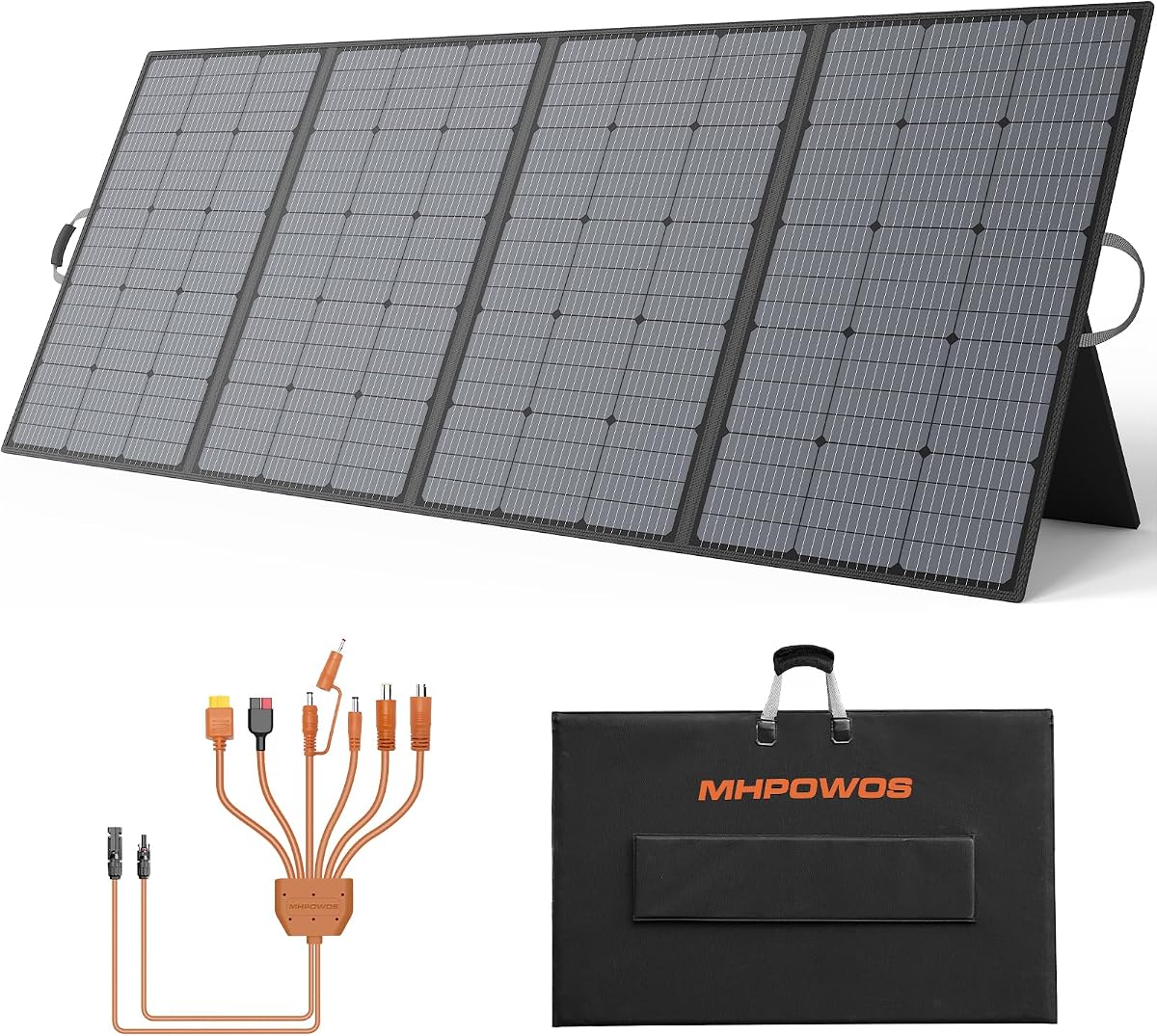
The MHPOWOS 400W Portable Solar Panel is a high-output folding model with a 4.1 rating. Its A+ monocrystalline cells have a stated conversion efficiency of 23.5%, and the four-panel format provides enough rated capacity to suit larger portable power stations. It is a practical choice for RV trips, camping, fishing, and other activities where fast replenishment matters more than carrying the smallest possible panel.
We may earn a commission when you buy through this link, at no additional cost to you.
Connector flexibility is one of its strongest features. The supplied solar connector supports Anderson, XT60, DC7909, DC5521, DC8020, DC5525, and DC35135 formats, covering many common power-station inputs. Four incorporated kickstands provide adjustable positioning, while the multifold layout packs into a zippered accessory pouch. This makes the system more convenient for storage than a permanently deployed rigid panel.
The panel is rated IP67 for waterproof and dustproof protection, and its professional solar output interfaces support straightforward plug-and-play setup. One major practical limitation applies to nearly every high-wattage folding panel: the connected power station can limit accepted input. Even in excellent sunlight, the station may receive less than the panel's full 400W rating if its maximum solar input is lower.
This model is best for buyers with a high-capacity station and a clear need for multiple connector options. It may feel excessive for charging only a phone or maintaining a small battery, and its 4.1 rating is not among the strongest in the group. Buyers should nevertheless verify the station's input voltage, connector, and maximum solar input before ordering, then ensure there is enough clear space to deploy all four sections.
The extensive adapter coverage makes this panel attractive to power-station owners who do not want to depend on one proprietary cable. Confirming the physical connector is still essential because visually similar DC plugs can use different pin arrangements.
A panel's rated wattage is its maximum output under specified test conditions, not a guarantee of the charging rate seen in the field. The power station's solar input ceiling, connector type, and conversion electronics ultimately determine how much energy it accepts.
We may earn a commission when you buy through this link, at no additional cost to you.
The PECRON 500W Portable Solar Panel is the high-output choice in this guide, with 500W maximum rated power and a stated 25.1% monocrystalline conversion efficiency. It does not currently have an available numeric customer rating, so its evaluation depends on the supplied specifications rather than a review score. Even so, it leads this group in maximum output and is aimed at large power stations, RV travel, and serious off-grid preparation.
We may earn a commission when you buy through this link, at no additional cost to you.
Its electrical details include a maximum power of 500W, Vmp of 42.5V, and Vov of 49.3V. The four-panel structure weighs 22.5 pounds and includes a thick built-in carry handle. Adjustable integrated kickstands can tilt the panel vertically to 90 degrees, allowing users to match the sun's angle more closely during winter mornings and summer midday conditions.
The panel carries an IP67 dustproof and waterproof rating for resistance to splashes, light rain, and outdoor dust. Its specified operating range is -10°C to 70°C, with a corrosion-resistant surface intended to preserve performance over time. It also uses standard MC4 output and includes an MC4 extension cable plus an MC4-to-XT60 adapter cable for compatibility with many portable power stations and RV solar systems.
This premium model makes the most sense for buyers who already have a station capable of accepting substantial solar input and need the highest rated output in the list. Its 22.5-pound weight and four-panel footprint require more transport and setup space than smaller models. Because no customer rating is currently listed, prospective buyers should review the current listing details and verify connector compatibility before purchasing.
A 500W rated panel can reduce the time required to replenish a high-capacity station when sunlight and input limits cooperate. It is better suited to users who charge large batteries regularly than to those seeking a lightweight panel for occasional phone charging.
Moving the panel toward a 90-degree position can improve exposure when the sun is low or high. This adjustable support is especially valuable for travelers who need to optimize limited setup space rather than lay a large panel flat.
We may earn a commission when you buy through this link, at no additional cost to you.
The VEVOR 300W Foldable Monocrystalline Solar Panel offers a middle ground between lightweight 100W and 200W designs and larger 400W or 500W arrays. It carries a 4.2 rating and provides 300W maximum output with premium monocrystalline cells rated at 22–23% conversion efficiency. The result is a versatile option for medium-sized portable power stations, RV trips, camping, and emergency use.
We may earn a commission when you buy through this link, at no additional cost to you.
Its connection package is thorough. A built-in MC4 cable is joined by a four-in-one MC4 connector cable covering XT60, Anderson, DC5521, and DC5525, plus a ten-in-one DC adapter set. These accessories make the panel adaptable to a broad selection of portable power stations. Unlike some smaller options in the guide, this VEVOR does not provide direct USB outputs, so it is designed primarily for charging larger systems.
The panel uses an ETFE construction and tempered-glass surface with an IP67 waterproof rating. Its stated operating range is -4°F to 149°F, or -20°C to 65°C, covering many common outdoor conditions. The foldable design supports storage and transport, while the rigid surface is intended to withstand regular handling and weather exposure during camping, fishing, hiking, and RV travel.
This panel is a sensible selection for buyers who want more capacity than a 200W model without carrying a 400W or 500W panel. Its efficiency is slightly below the leading N-type and high-efficiency monocrystalline options in the group, and direct phone charging will require a separate power bank or powered device hub. For stationary campsite and medium-power-station charging, it remains a practical, connector-rich option.
The 300W rating fills the gap between entry-level portable panels and larger four-panel systems. It can meaningfully support RV day trips and medium-sized stations without requiring the transport burden of the heaviest option in the guide.
The tempered-glass surface adds a rigid protective layer around the photovoltaic construction. Combined with ETFE and an IP67 rating, it is well suited to campsites and travel where impacts, dust, and splashes are common.
We may earn a commission when you buy through this link, at no additional cost to you.
The VEVOR 200W Foldable Solar Panel with Frame stands apart through its integrated 30A PWM controller and included alligator clips. It has a 4.0 rating and uses monocrystalline cells with at least 23% conversion efficiency. Rather than functioning only as a raw panel for portable stations, it offers a more accessible path to connecting suitable batteries and maintaining stable charging output.
We may earn a commission when you buy through this link, at no additional cost to you.
Its built-in MC4 cable and 30A PWM controller simplify the connection between the panel and a compatible battery. The included alligator clips make the system more approachable for users who may not carry multiple proprietary adapter cables. The rigid frame adds structural support around the foldable panel, while its stated IP67 protection is intended to withstand outdoor dust and moisture.
The listed operating range is 14°F to 149°F, which covers typical camping and travel environments. It is designed for biking, camping, hiking, fishing, and RV applications where a moderate amount of solar charging can keep small systems or batteries topped up. Compared with power-station-focused models in this list, it offers less plug-and-play variety but a more focused battery-charging feature set.
This is a good option for RV owners or campers already using compatible 12V battery setups and wanting a controller in the package. Buyers should confirm battery chemistry, voltage, and PWM-controller compatibility before connecting it. Its 4.0 rating and 200W output may not satisfy buyers seeking the highest efficiency or the broadest selection of station connectors, but the integrated charging hardware adds clear value.
Bundling the PWM controller and alligator leads creates a more integrated setup than a panel with only an MC4 lead. It is useful for users who want a straightforward battery connection and already understand basic charging parameters.
The surrounding frame gives the folding structure extra rigidity while it is deployed. That support can be useful on uneven ground and during frequent setup, although buyers should still follow the manufacturer’s handling and storage guidance.
We may earn a commission when you buy through this link, at no additional cost to you.
The Renogy 300W Portable Solar Panel is an excellent all-around choice for RV and off-grid users, earning a 4.2 rating and the Editor's Choice distinction. Its premium 16BB N-type cells are rated at 25% conversion efficiency, matching the efficiency of the 200W Renogy while offering substantially more rated output. At 18.74 pounds, it also remains lighter than many comparably powerful panels.
We may earn a commission when you buy through this link, at no additional cost to you.
The panel folds to 23.2 by 29.3 by 3.2 inches and opens into a multi-section arrangement with rust-proof kickstands. Setup is designed to take about a minute and requires no tools, making it easy to reposition as the sun moves. Renogy specifies up to 960Wh of daily energy under suitable sunlight, although actual production depends heavily on weather, orientation, shading, temperature, and system losses.
Durability comes from an IP67 waterproof construction, hail-resistant ETFE coating, and a stated extreme-temperature range of -40°F to 185°F. Parallel wiring is designed to reduce the effect of partial shading, helping maintain output when individual sections encounter different light conditions. IP68 connectors are included for compatibility with many portable power stations and batteries.
This is the strongest general recommendation for a traveler who wants high efficiency without moving to the 400W or 500W class. The 300W rating is large enough for meaningful power-station charging, while the folding footprint and tool-free supports preserve portability. Its key strengths are efficiency, shade tolerance, and straightforward deployment, although buyers should still match it to a station that can accept the intended input.
The 25% efficiency rating provides meaningful energy output from a panel that folds to a manageable size. It is especially attractive for RV users with limited mounting space or travelers who need meaningful charging without carrying a larger four-panel array.
Trees, buildings, and clouds can produce uneven conditions across a folding panel. Parallel wiring is designed to reduce losses from isolated shadows, making this a more dependable option for campsites where completely unobstructed sunlight may be difficult to find.
The rust-proof kickstands and simple folding layout allow rapid deployment and repositioning. This convenience is especially helpful when a campsite offers only a small patch of direct sun or when power needs change throughout the day.
We may earn a commission when you buy through this link, at no additional cost to you.
The E-POWO 400W Portable Solar Panel combines substantial rated output with a carefully thought-out folding design. It carries a 4.2 rating and uses high-efficiency monocrystalline cells with up to 23.5% conversion efficiency. A stated 15.57-kilogram weight means this is a larger system to transport, but that size supports a 400W rating and a broad set of outdoor charging connections.
We may earn a commission when you buy through this link, at no additional cost to you.
When folded, the panel measures 37.76 by 24.96 by 1.3 inches. Its built-in accessory pouch, briefcase-like appearance, and reinforced grommets support storage and optional mounting on an RV or tent. The product information also refers to adjustable kickstands and three supported angles of 40, 50, and 60 degrees, allowing users to improve the panel's alignment with the sun.
Connector support includes Anderson, XT60, DC7909, DC5521, DC8020, DC5525, and DC35135 formats through the supplied seven-in-one cable. The ETFE-laminated module has an IP67 waterproof rating, while the casing uses waterproof Oxford fabric and a fiberglass structure for corrosion resistance and thermal stability. Cloud cover and physical obstacles can still reduce charging efficiency.
This panel is a good fit for RV and campsite users who regularly operate a high-capacity station and value both angle adjustment and connector coverage. It is less suitable for a lightweight backpacking kit or direct electronics charging because it lacks USB outputs and has a substantial stated weight. Buyers should confirm station input limits and make sure their vehicle can accommodate the folded dimensions and deployed footprint.
The 40-, 50-, and 60-degree options make it easier to adapt the panel to different times of day and common camping surfaces. Correct orientation can improve usable output without requiring a separate elevated mounting system.
Reinforced grommets offer attachment points for RV or tent deployment, while the fabric casing and fiberglass structure are intended to withstand outdoor handling. These details suit stationary use where larger, sturdier equipment is practical.
We may earn a commission when you buy through this link, at no additional cost to you.
The MHPOWOS 400W Bifacial Portable Solar Panel is the only explicitly bifacial model in this guide. It has a 4.4 rating, uses N-type 16BB monocrystalline technology, and is rated for up to 25% conversion efficiency. Its two-sided construction can capture reflected light from the rear surface, with the manufacturer claiming up to 20% more energy than a comparable single-sided panel.
We may earn a commission when you buy through this link, at no additional cost to you.
The bifacial feature makes setup more important than it would be for a conventional panel. The rear side must receive useful reflected light rather than being blocked by grass, soil, a tent wall, or an opaque case. Three reinforced brackets provide 30- to 60-degree adjustment, and the rubber handle makes the 19.7-pound panel easier to carry. Its folded dimensions are 22.4 by 38.3 by 2.8 inches.
Weather resistance is provided by an IP68 waterproof rating, a weather-resistant ETFE coating, and an anti-corrosive aluminum frame. The manufacturer advises avoiding prolonged heavy rain even though the panel has a high protection rating. A seven-in-one cable provides DC7909, DC8020, XT60, DC5521, DC5525, DC35135, and Anderson connectors for broad power-station compatibility.
This panel is most attractive to RVers, van-life users, and installers who can optimize the rear-side light exposure. Its bifacial architecture rewards a thoughtful installation but may provide limited benefit when the panel is laid directly on grass or leaned against a dark surface. It cannot store electricity itself, so it must be paired with a battery or supported power station, and buyers should verify their station's input ceiling before purchase.
A bifacial panel can collect sunlight from the front and reflected light from the rear. The potential gain depends on the reflective ground or surroundings, meaning a pale surface and unobstructed rear face can produce a meaningful advantage over a single-sided design.
At a stated 19.7 pounds, this model offers a 400W rating while weighing less than several conventional choices in the guide. The result is a useful balance for travelers who want strong charging performance without moving into the 500W class.
The included seven-in-one cable covers many popular DC connector formats, reducing the chance that owners of different power stations will need to purchase another adapter. Electrical compatibility should still be confirmed before connecting a new system.
We may earn a commission when you buy through this link, at no additional cost to you.
Choosing a foldable monocrystalline solar panel requires balancing rated output with portability, connector support, weather protection, and the limits of the battery or power station that will receive the energy.
Rated output is the maximum power a panel is designed to produce under specified laboratory conditions. A 100W model may suit phones, navigation units, cameras, and smaller stations, while a 300W to 500W panel is more appropriate for replenishing substantial battery capacity during an RV trip or extended off-grid stay. Compare the panel's output with the receiving device's charging demand, but do not confuse panel wattage with the amount of usable energy stored in a battery.
Choose output according to your largest recurring charging task and the amount of setup space you have. A smaller panel is easier to carry, while a larger panel can restore energy faster when the connected station has a high solar input limit.
Monocrystalline cells can pack more power into a given surface area than many conventional polycrystalline designs. The panels here range from 22–23% efficiency to claims of 24%, 25%, and 25.1%. Higher efficiency is particularly valuable when the available panel area is constrained or sunlight is limited, although the real-world difference also depends on temperature, shading, and angle.
Prioritize efficiency when portability and footprint matter. For a fixed RV setup with ample room, a lower-efficiency panel may still meet your needs if its rated output and connector support are better matched to the installation.
Check the panel's output connector, voltage, and protocol against the input requirements of your portable power station, solar generator, or battery. MC4 is a common solar-panel connector, but portable stations often use XT60, Anderson, DC5521, DC7909, DC8020, DC5525, or DC35135. Some panels include multi-connector cables, while others require a separate adapter.
Confirm both physical and electrical compatibility before ordering. A connector that appears to fit can still use different pin arrangements, and a station may accept less solar input than the panel's maximum rating.
A large panel cannot force a smaller power station to accept more power than its internal charging electronics allow. Even under ideal sunlight, the station's maximum input rating can become the limiting factor. Connecting a 400W panel to a station with a lower solar input ceiling may work safely but will not produce the panel's full rated output.
Look for a panel that matches or modestly exceeds your station's accepted input after allowing for conversion losses. This avoids paying for capacity the station cannot use while maintaining flexibility if the station is upgraded later.
Foldable panels vary from compact two-panel designs to four-panel arrays weighing more than 20 pounds. Weight matters most for hikers and pedestrians, while dimensions become more important for RV storage lockers, vehicle trunks, and cases. Consider both the folded package and the clear space required once the panel is fully deployed and positioned.
A lighter model is generally easier to reposition as the sun moves. A larger system may be more practical for stationary campsites and RV trips where transport distance is short but charging capacity is the priority.
Look for an IP-rated panel, a protective surface layer, reinforced grommets, and a frame or substrate suited to outdoor handling. The options here include IP65 and IP67 panels and an IP68 bifacial model. These ratings indicate different levels of dust and water protection, but they should not be interpreted as permission to submerge any panel or expose electronics to every weather extreme.
Protect the junction box and cable junctions even when the photovoltaic surface is weather resistant. Store the panel dry, avoid prolonged heavy rain where advised, and inspect for damage before reconnecting it to a battery after rough travel.
Direct USB outputs can be valuable when no power station is available. The Renogy 200W includes USB-C PD and dual USB-A ports, while the ZOUPW 200W adds USB-A QC 3.0 and 60W USB-C PD. The VEVOR 100W also offers USB and DC outputs. Larger power-station-oriented models generally focus on MC4 and adapter cables instead.
Check whether a PWM controller, alligator clips, extension cable, XT60 adapter, accessory pouch, or multi-connector cable is included. These small additions can determine how easily the panel works with your existing equipment.
A foldable panel produces more usable power when it faces the sun directly. Kickstands with several preset angles are more useful than a panel designed to lie flat, especially in the Northern Hemisphere where winter sun angles are lower. Reinforced grommets or brackets allow attachment to an RV, tent, or other support, while bifacial models require careful consideration of light reaching the rear face.
Choose a support system that can be deployed quickly and remain stable in wind. For stationary use, elevated and adjustable mounting can outperform a heavier panel placed at a poor angle on the ground.
Before first use, read the manual for your specific panel and receiving power station. Confirm that the connector type, voltage, polarity, and maximum input rating are compatible. Inspect the photovoltaic surface, frame, cable, and junction box for damage, then unfold the panel only in a clear area where it can sit securely without blocking access to the equipment.
Position the panel in direct sunlight and use its kickstands, brackets, grommets, or another suitable support to face the sun. Adjust the angle as the sun moves. For a bifacial panel, leave room for light to reach the rear surface instead of placing it directly on dark or opaque material. Connect the panel to the power station or controller as instructed, then monitor the charging display rather than assuming the panel is delivering its full rated wattage.
After use, disconnect the panel before folding it, wipe the surface with a soft, clean cloth, and remove dirt from around the junction box and connectors. Never spray water directly on electrical components, immerse the panel, or use abrasive cleaners. Store the panel dry in its pouch or protective case, inspect cables after rough travel, and follow the manufacturer's warranty and care instructions for battery, controller, and connector components.
They can supplement small systems, charge batteries, or support essential devices, but most products in this guide are designed for portable use rather than whole-home electricity. A larger installation may require fixed panels, additional inverters, appropriate wiring, and a system designed by a qualified installer. Check local requirements before creating a grid-connected setup.
No, compatibility depends on the connector, voltage, polarity, and the station's maximum solar input. MC4 is common on panels, but the station may require XT60, Anderson, DC5521, or another adapter. Confirm the specifications and follow the manufacturer's wiring instructions before connecting.
Rated wattage is measured under specific laboratory conditions. Real output can be reduced by indirect light, heat, incorrect angle, partial shading, cable losses, dust, and the receiving station's input ceiling. A power station may accept substantially less than the panel's maximum even when the panel itself is operating correctly.
A bifacial panel can produce more energy when its rear face receives reflected light from a bright, open surface. The advantage may be small when the back is shaded, covered, or resting on dark grass. Installation quality therefore matters as much as the bifacial label.
Some models provide direct USB outputs, including USB-C PD, USB-A, and QC 3.0 on the Renogy 200W, ZOUPW 200W, and VEVOR 100W. Models without direct USB ports require a compatible power station or battery system. Charging speed also depends on device power needs, sunlight, and output conditions.
Panels in this guide carry IP65, IP67, or IP68 protection ratings, but every product still has limits. Water resistance does not make every junction box submersible, and one bifacial model advises avoiding prolonged heavy rain. Protect connections, follow the product manual, and store the panel dry whenever possible.
Use a soft lint-free cloth and gently remove dust or light dirt with a small amount of water if the manufacturer permits it. Avoid abrasive pads, harsh chemicals, and spraying liquid directly into the junction box or connectors. Let the panel dry completely before folding or storing it.
Higher efficiency can produce more watts from the same area and available sunlight, but charging speed also depends on total panel wattage and the power station's accepted input. A compact 25% panel may still charge a large battery more slowly than a lower-efficiency 400W panel. Match both area efficiency and rated output to your system.
The Renogy 300W Portable Solar Panel is the strongest all-around recommendation because it combines 25% N-type efficiency, a manageable folded format, rapid tool-free setup, and partial-shade considerations. The VEVOR 100W is the best budget-oriented option for smaller kits and direct charging, while the PECRON 500W serves buyers who want the highest rated output and efficiency in a premium four-panel design.
For most RV and off-grid users, prioritize the power station's real input limit, connector compatibility, and the amount of setup space available before chasing the highest wattage. Monocrystalline efficiency matters, but angle adjustment, weather protection, and a durable connection system often determine how useful a panel is throughout a long camping season.
Ratings, promotions, availability, and current prices can change after publication, so check the latest listing and manufacturer instructions before ordering. Confirm the panel's dimensions, operating temperature range, included cables, and weather limitations, and ensure the receiving battery or station is designed for the connection you plan to use.