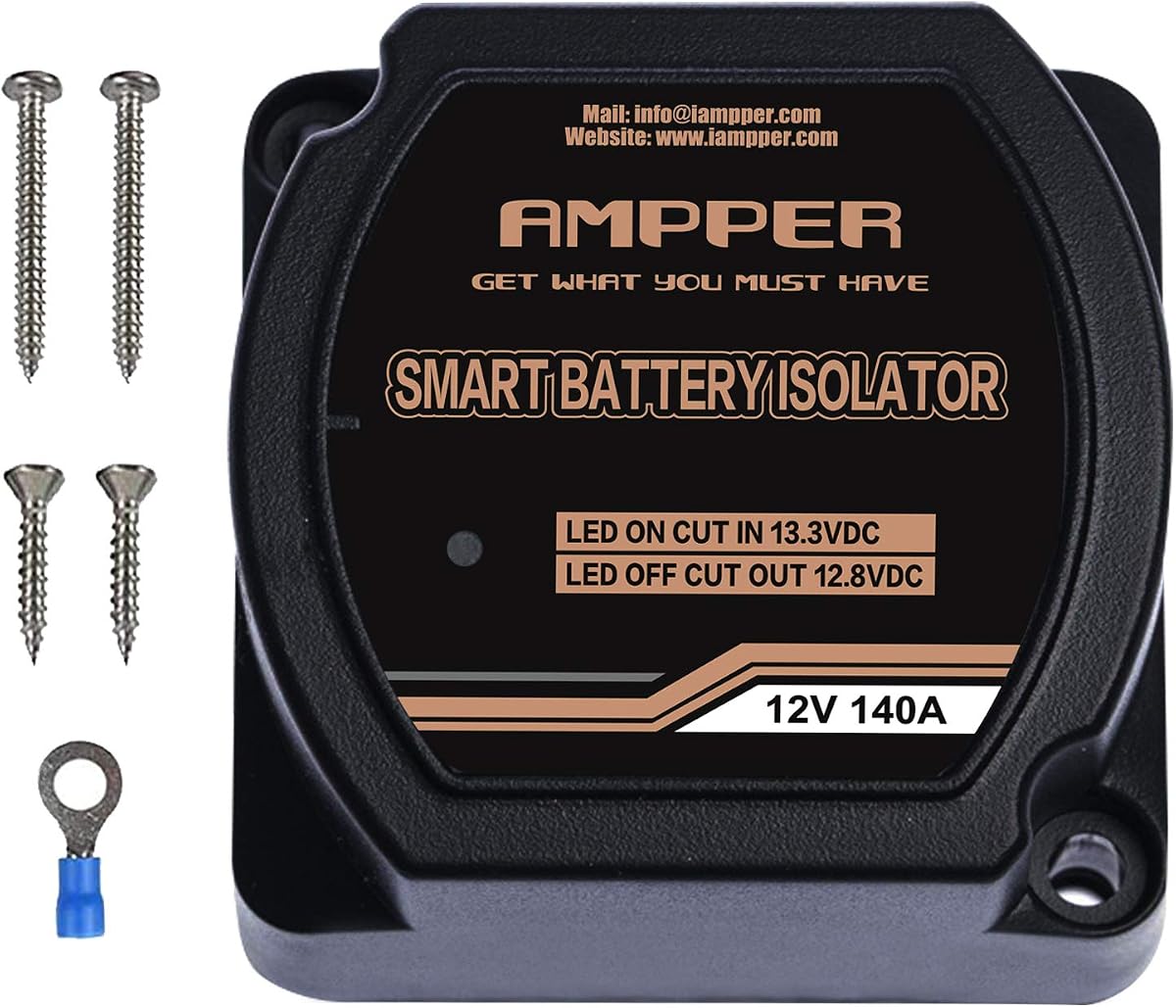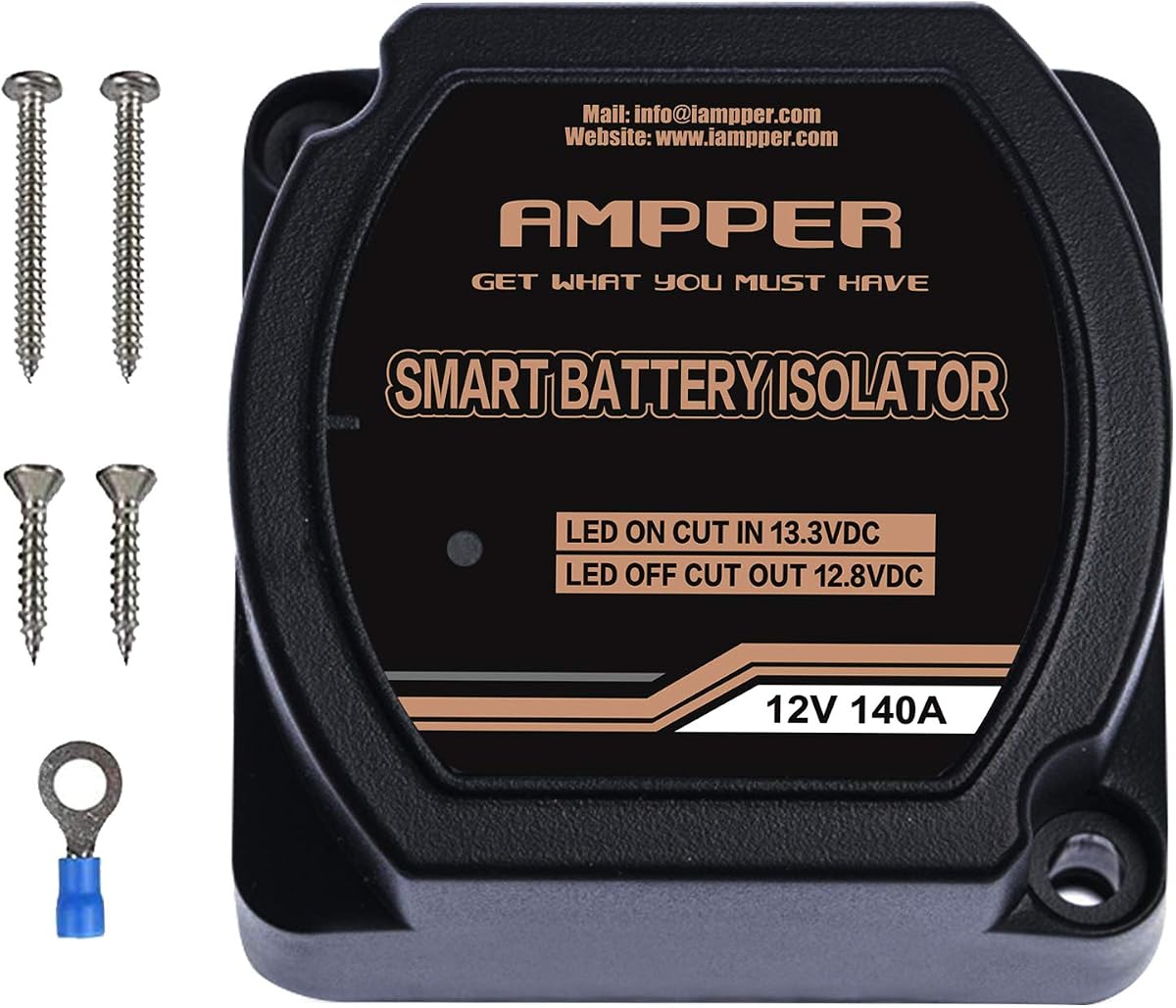
Ampper 12V 140A Dual Battery Isolator
4.5Editor score
Automatic voltage sensing
Compact relay housing
Mounting hardware included
Off-road ready construction
Our 12V DC dual battery isolator guide compares ten kits for voltage sensing, current handling, weather resistance, installation completeness, and vehicle fit.
A 12V DC dual battery isolator manages charging between a vehicle’s starting battery and auxiliary battery while helping prevent unwanted discharge. A worthwhile unit should match your electrical system, fit the installation space, tolerate relevant weather conditions, and include the hardware needed for a clean installation.
This guide compares ten isolators and complete relay kits using their stated voltage thresholds, current ratings, protection features, included components, and intended vehicle or marine applications. The list covers voltage-sensitive relays, automatic and manually controlled designs, and options suited to everything from cars and trucks to RVs, boats, and off-road vehicles.
Each review explains where a product stands out, where its specifications require caution, and which type of installer may find it most useful. The comparison also highlights practical differences in packaging, controls, waterproofing, and battery chemistry support. Prices and availability change, so confirm current listings before purchasing.
4.5Editor score

4.6Editor score
4.6Editor score
The table below compares the ten isolators by their voltage-management approach, stated current capacity, weather protection, and installation package. It is designed to make the differences between complete kits, compact voltage-sensitive relays, manual-control units, and high-current marine options easy to understand before buying.

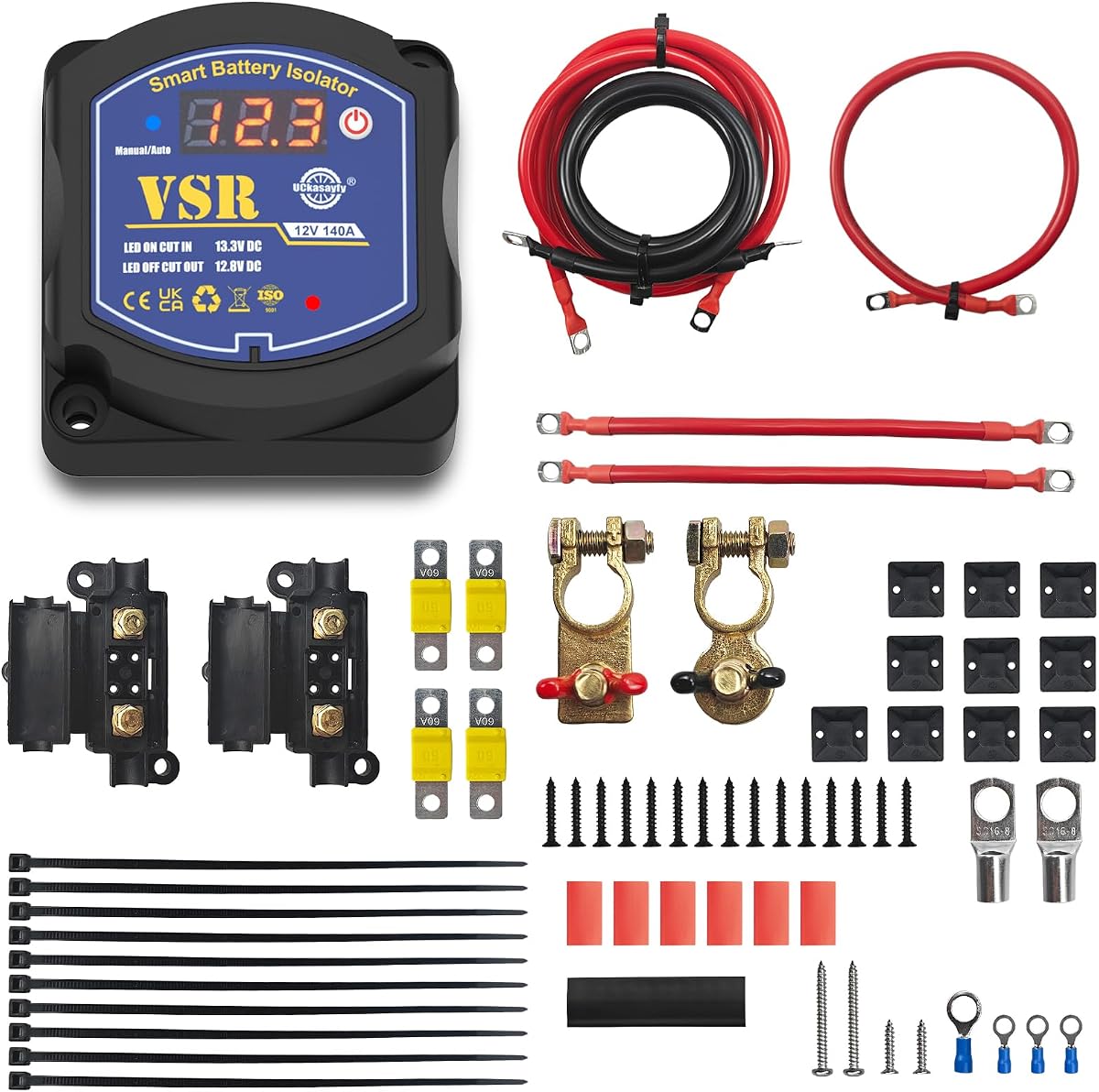


The VEVOR Split Charge Relay Kit is a 12V, 140-amp dual battery isolator package with a 4.4 rating. Its strongest attraction is the combination of automatic voltage control, a relatively compact housing, and a broad collection of installation accessories. The stated 13.3-volt cut-in and 12.8-volt cut-out thresholds are designed to connect the auxiliary battery once the primary charging system reaches an appropriate voltage.
We may earn a commission when you buy through this link, at no additional cost to you.
The relay is described as shockproof, dustproof, and waterproof to an IP65 rating, which makes it a logical option for off-road vehicles, camper vans, RVs, caravans, 4x4s, ships, yachts, and other marine applications. Its compact dimensions are especially useful where under-hood or equipment-space limitations make a larger enclosure inconvenient. The complete accessory approach also reduces the need to identify small hardware separately before beginning installation.
The trade-off is that the supplied information does not provide the same detailed inventory of terminals, cable gauges, fasteners, and heat-shrink pieces offered by some competing kits. It also does not expressly confirm lithium-battery compatibility. Buyers using lithium chemistry should not assume conventional lead-acid behavior and should verify the manufacturer’s instructions or support before connecting the unit.
This is a well-rounded choice for an installer who values environmental resistance, compact dimensions, and a broad accessory package. It is particularly compelling for recreational vehicles, trailers, boats, and off-road builds where the relay must operate in a damp, dusty, or vibration-prone location. It is our strongest all-purpose pick for users who want substantial installation support without moving to the high-current Stinger design.
The 13.3-volt cut-in and 12.8-volt cut-out behavior allows the primary battery to receive charging priority. The auxiliary battery is then connected as intended while the vehicle’s charging system is operating.
An IP65 rating, along with stated dust, shock, and water resistance, gives this kit a useful foundation for marine, off-road, and camper installations. Secure routing and sound connection practices remain essential.
We may earn a commission when you buy through this link, at no additional cost to you.
The Nilight 12V 140A Dual Battery Setup Isolator Kit combines a 4.6 rating with one of the most clearly described installation packages in the list. It is a voltage-sensitive relay designed to charge two batteries from one alternator while isolating them when the engine is off. Its detailed inventory of cables, terminals, fasteners, washers, heat-shrink tubing, and tie-wraps makes it a practical choice for a complete DIY build.
We may earn a commission when you buy through this link, at no additional cost to you.
The relay cuts in at 13.3 volts and cuts out at 12.8 volts, supporting the goal of keeping the starting battery charged while allowing the auxiliary battery to share the alternator’s output. Its high-quality casing, silicone seal, and IP66 rating are stated to withstand dust, moisture, vibration, and unpredictable conditions. That makes it a sensible match for camper vans, trucks, caravans, RVs, ATVs, UTVs, boats, and other 12V applications.
Two limitations deserve attention. First, the product is explicitly not compatible with lithium batteries, so it is best suited to the lead-acid systems addressed in its documentation. Second, it is designed for a genuine dual-battery setup and is not intended as a single-battery vehicle accessory. Its relatively extensive hardware package also means installers should inventory the parts before beginning to avoid unnecessary duplicate purchases.
Overall, the Nilight offers the best balance of electrical function, weather protection, installation completeness, and application breadth. It is our Editor’s Choice for a reason: the package goes well beyond the relay itself and gives an installer the principal connection hardware needed to build a dual-battery system. For compatible battery chemistry and a two-battery configuration, it is a confident recommendation.
The kit includes 6AWG red and black battery cables, marine-style terminals, battery clamps, screws, nuts, spring washers, heat-shrink tubing, insulated ring terminals, and cable ties. This level of detail simplifies planning a complete installation.
The stated 13.3-volt cut-in and 12.8-volt cut-out thresholds allow the starting battery to remain the priority while the auxiliary battery is connected to the charging circuit under the intended operating conditions.
We may earn a commission when you buy through this link, at no additional cost to you.
This Smart VSR 140A kit stands apart because it supports both automatic and manual operation. It has a 4.3 rating and uses a voltage-sensitive relay that cuts in at 13.3 volts and cuts out at 12.8 volts. A display allows the battery voltage to be checked, adding useful visibility to a system where the operating state matters.
We may earn a commission when you buy through this link, at no additional cost to you.
Its protection logic disconnects the circuit when input voltage falls below 11 volts or rises above 17 volts. The relay also provides a manual emergency function that can connect the batteries in reverse, allowing an auxiliary battery to charge a depleted primary battery. That recovery capability is valuable for campers, trailers, stored vehicles, and off-road machines that may sit for extended periods.
The housing carries an IP67 waterproof rating and is listed for ATVs, UTVs, boats, RVs, marine installations, vehicles, trucks, and caravans. However, the product information does not clearly enumerate the supplied installation hardware, and the title explicitly says it is not suitable for lithium batteries. Buyers should therefore plan for any missing cable or terminal components and confirm battery chemistry before installation.
This model is an excellent choice for someone who wants normal automatic charging but also wants a manual recovery option. It is less suited to a basic installation where simplicity is the priority, yet it offers more operational flexibility than a basic fixed-mode VSR. The combination of voltage display, wide protection thresholds, and reverse charging makes it especially relevant to users of stored recreational or utility vehicles.
Switching to manual mode connects the circuit in reverse so the auxiliary battery can charge the main battery. This is intended as an emergency function and should be used with attention to battery condition and correct polarity.
Automatic disconnection below 11 volts and above 17 volts provides a defined operating window. The display helps users monitor system voltage without relying entirely on hidden relay behavior.
We may earn a commission when you buy through this link, at no additional cost to you.
The Ampper 12V 140A Dual Battery Isolator is a focused voltage-sensitive relay with a 4.5 rating. It performs the core function of a dual-battery controller without adding a larger control panel. The primary and secondary batteries remain separate when appropriate, yet both can charge from one alternator while the engine is running.
We may earn a commission when you buy through this link, at no additional cost to you.
Its specified 13.3-volt cut-in and 12.8-volt cut-out thresholds prioritize the starting battery. Once the primary battery voltage exceeds the cut-in level, the auxiliary battery is charged. The housing is described as heavy-duty, water resistant, shock resistant, and dust proof, making it appropriate for off-road vehicles, cars, RVs, ATVs, UTVs, boats, and dual-battery electrical equipment.
The main advantage is simplicity. The package includes a mounting plate and four bolts, but it does not appear to include a complete set of battery cables, lugs, or terminals. That means the overall installation cost depends heavily on what the installer already has and the electrical demands of the vehicle. The product is also expressly unsuitable for lithium batteries, so Ampper is better matched to suitable lead-acid systems.
For a straightforward two-battery installation, the Ampper offers a compact, weather-aware relay without unnecessary controls. It is our Best Budget selection because it focuses on the essential charging and isolation function while retaining a strong customer rating. It is a sensible recommendation for a basic vehicle or marine auxiliary-battery setup where the installer already has wiring hardware.
The relay connects the secondary battery only after the primary voltage reaches 13.3 volts and disconnects at 12.8 volts. This straightforward sequence is easy to understand and maintain.
A mounting plate and four bolts are included, allowing the relay to be secured in a protected location. Users needing cables and terminals should plan to supply compatible components separately.
We may earn a commission when you buy through this link, at no additional cost to you.
The Compact Smart VSR 140A offers a smaller relay with several of the same sophisticated operating features found in larger kits. Its 4.2 rating is the lowest among the ten products, but the stated functionality includes automatic and manual modes, an on-board voltage display, and emergency reverse charging.
We may earn a commission when you buy through this link, at no additional cost to you.
The relay cuts in at 13.3 volts and cuts out at 12.8 volts to maintain a sensible charging priority. It also disconnects the circuit below 11 volts or above 17 volts, helping protect the battery system during unusual voltage conditions. Its IP67 rating supports use in dusty, wet, and vibration-prone environments, and the small housing can suit compact installations in ATVs, UTVs, boats, campers, and trailers.
The limitation is that the supplied information does not identify the exact contents of the package, making it important to confirm whether cables, terminals, and mounting fasteners are included. It is also explicitly not intended for lithium batteries. The manual reverse-charge function adds flexibility, but users must understand the correct connection sequence and battery limitations before using it as an emergency recovery method.
This relay is best for a builder who values compactness, visibility, and emergency control more than a fully specified installation bundle. It is a practical middle ground for a dual-battery system in a recreational vehicle or small utility machine. Although it does not lead the group in customer rating, its combination of protective thresholds, display, and recovery mode gives it a distinct functional profile.
A digital display provides a direct way to monitor battery voltage. Automatic operation handles normal charging, while manual mode creates a deliberate path for emergency reverse charging.
The small enclosure is intended to fit where a larger relay would be inconvenient. Its IP67 rating supports use in the wet, dusty, and high-vibration environments common to off-road and marine vehicles.
We may earn a commission when you buy through this link, at no additional cost to you.
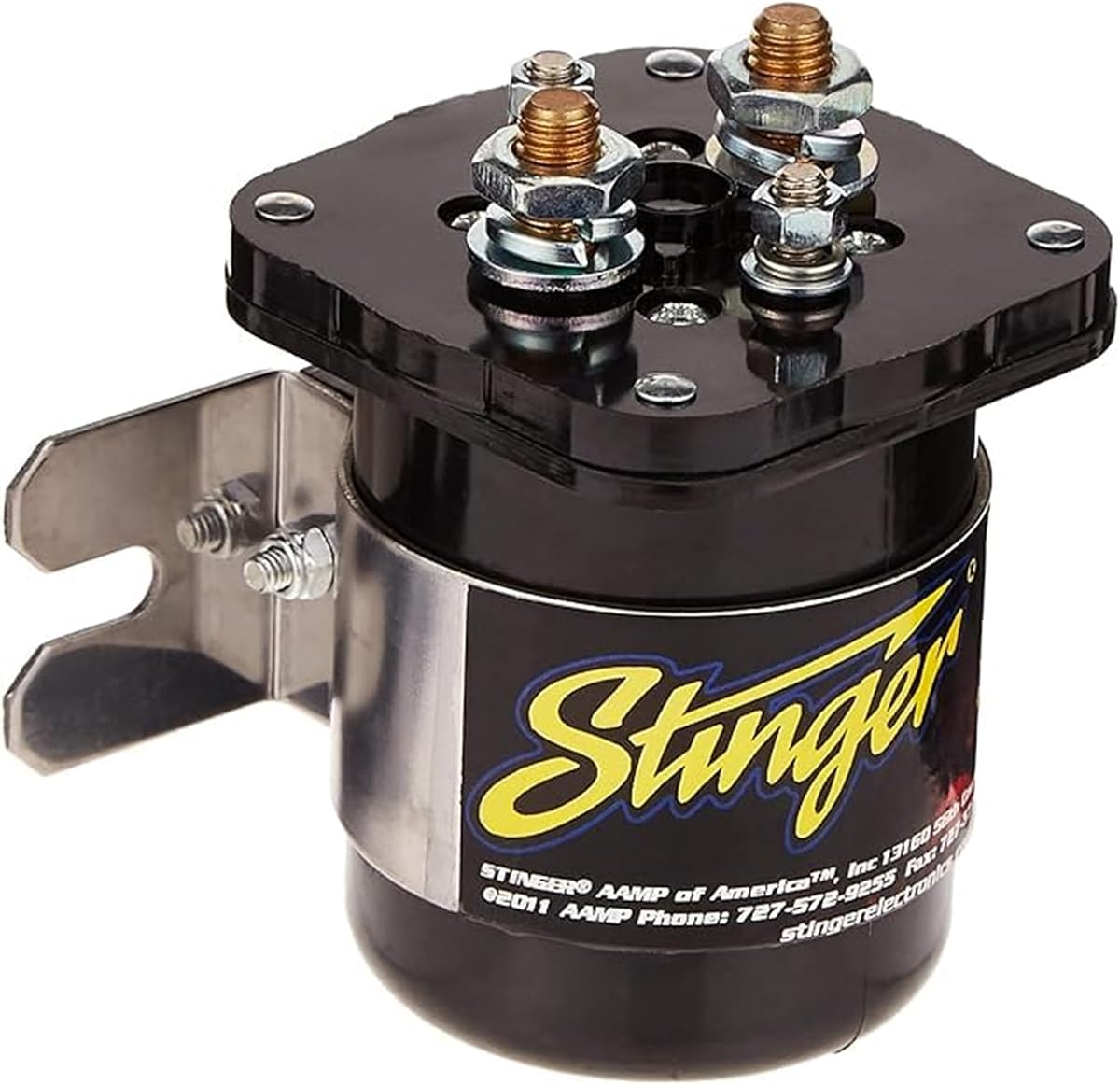
The Stinger SGP32 is a high-current 200A dual battery isolator and relay with a 4.6 rating. Unlike most of the voltage-sensitive relays in this comparison, it is presented primarily as a manually controlled high-current accessory isolator. Its stated ability to provide up to 200A continuously and up to 500A in surges gives it clear appeal for demanding electrical systems.
We may earn a commission when you buy through this link, at no additional cost to you.
The phenolic plastic construction is designed to protect against moisture damage in marine, powersports, and off-road applications. The relay also works with any type of vehicle alternator or charging system, a broad compatibility statement that can be useful when the exact charging configuration is not standardized.
Its isolation function prevents the primary battery from discharging into accessories, helping preserve starting power. The claimed 100,000 mechanical cycle life indicates a design intended for repeated switching, which is important for an isolator operated directly by a vehicle control rather than only through voltage sensing. As with the other products, the supplied information does not detail a complete wiring kit, so cable and terminal needs should be verified.
The Stinger is our Best Premium recommendation because it addresses a different, more demanding use case from the VSR competition. It is best suited to car-audio, powersports, marine, or other accessory systems that need a high-current isolated power source. Installers should pair it with appropriately rated wiring and protection and should not assume that its higher current specification makes it a drop-in alternative to a voltage-sensitive relay.
Access to up to 200A continuous current and 500A surge capacity makes this relay appropriate for high-load accessories. The installation wiring must be sized and protected consistently with the intended load.
A stated 100,000 mechanical cycle life supports regular relay operation. Moisture-resistant phenolic construction also suits the exposure demands of marine, powersports, and off-road environments.
We may earn a commission when you buy through this link, at no additional cost to you.
The KeyLine Chargers 140A Voltage Sensitive Relay is a compact automatic disconnect switch with a 4.5 rating. It is designed to manage power between primary and auxiliary batteries without the voltage loss associated with traditional battery-isolator diodes, according to the supplied product information. Its solid-state construction is central to that operating approach.
We may earn a commission when you buy through this link, at no additional cost to you.
The relay activates at 13.3 volts and disengages at 12.8 volts, giving the starting battery charging priority. Its IP65 rating covers resistance to water, dust, and vibration, while dimensions of approximately 2.6 by 2.6 by 2 inches make it suitable for under-hood installations or battery-relocation projects. It is listed for cars, trucks, RVs, UTVs, ATVs, marine systems, and off-grid power applications.
The product arrives with a mounting plate and hardware, but installation wires are explicitly excluded. That distinction matters when comparing this relay with complete kits such as the Nilight, VEVOR, or MaySpare. A buyer may need to add appropriately rated cables, lugs, and possibly circuit protection. The listing also mentions a 12-month warranty and a 30-day money-back guarantee, which are useful points to verify directly in the current listing.
This is a strong choice for an installer who already has quality wiring and wants a compact, efficient, automatic relay. It combines a strong rating with a clearly stated operating sequence and ruggedized design. It is less convenient for a first-time builder seeking a turnkey wiring package, but for experienced installers, its solid-state design and small footprint make it a versatile under-hood option.
The stated solid-state design is intended to avoid the power loss associated with traditional isolator diodes. That makes the relay attractive where efficient charging and compact packaging are priorities.
The approximately 2.6-inch-square housing can fit more readily beneath a hood or within a battery-relocation project. Buyers should still provide their own installation wires and compatible connection hardware.
We may earn a commission when you buy through this link, at no additional cost to you.
The Smart Auto Manual VSR combines automatic charging control with a digital voltmeter and a 4.5 rating. It is designed to connect or disconnect an auxiliary battery according to the primary battery’s voltage, giving users a visible indication of the system state and a choice between automatic behavior and manual intervention.
We may earn a commission when you buy through this link, at no additional cost to you.
The relay allows both batteries to charge from the engine alternator at the same time. It automatically disconnects below 11 volts and above 17 volts, helping protect the main battery from over-discharge and limiting operation during abnormal voltage conditions. Its IP68 waterproof rating is the highest stated ingress rating in this group, supporting use in wet, dusty, and changing outdoor conditions.
A compact housing can be placed in a wide range of locations, and the product is listed for RVs, cars, ATVs, UTVs, Polaris and Can-Am applications, boats, 12V marine systems, four-wheel-drive vehicles, and caravans. The information specifically says it is not compatible with ternary lithium batteries. Because battery chemistry and charging profiles can differ, installers should confirm suitability for their exact battery type rather than generalizing from the 12V label.
This isolator is a strong option for a user who wants feedback from a built-in voltmeter and flexibility over operating mode. It is particularly useful in systems where the operator wants to see voltage without adding a separate meter. Its feature set, environmental rating, and customer feedback make it one of the more well-rounded options for recreational and utility vehicles.
The integrated digital voltmeter makes operating voltage visible directly on the relay. This is useful when troubleshooting charging behavior or checking the system during a trip.
An IP68 rating provides the strongest stated water protection among the ten products. The compact enclosure is also suitable for installations where the relay must tolerate moisture, dust, and vibration.
We may earn a commission when you buy through this link, at no additional cost to you.
The 500A Pure Copper VSR is the highest-capacity model in the comparison, with a stated 500-amp rating and a 4.4 customer rating. It uses pure copper terminals and internal components rather than brass alternatives, with the product information claiming better conductivity, lower voltage drop, and stronger corrosion resistance.
We may earn a commission when you buy through this link, at no additional cost to you.
Its central function is straightforward: it connects the batteries during charging and disconnects them when the engine is off. That helps protect an RV’s starting battery from accessory drain and keeps stable power available for refrigerators, lighting, and other onboard systems. An IP67 waterproof rating supports use in harsh RV and outdoor environments, where moisture and road grime can accelerate corrosion.
The product includes pure-copper lugs and mounting screws, which supports a more complete installation than a relay-only package. Still, the 500-amp claim is exceptionally high relative to most competing units, and it should be evaluated against the alternator output, cable specifications, fusing, and actual accessory load. A high-current rating does not create charging capacity that the vehicle’s charging system cannot supply.
This model is best for RV owners with substantial accessory loads who specifically value copper contacts and a high stated current capacity. It may also appeal to installers seeking a high-current component for a custom system. The final decision should be based on verified load requirements and sound electrical design rather than on the headline current figure alone.
Pure copper is presented as a more conductive and corrosion-resistant alternative to brass. That material choice may be valuable in RV installations where terminals are repeatedly exposed to moisture and road grime.
The stated 500-amp rating is designed to address demanding RV accessory arrangements. The charging system, wiring, fusing, and loads must all be compatible with that level of demand.
We may earn a commission when you buy through this link, at no additional cost to you.
The MaySpare 140A VSR Kit is an automatic voltage-sensitive relay kit with a 4.4 rating. It uses a 13.3-volt cut-in and 12.8-volt cut-out sequence to keep the primary battery charged and ready before allowing the auxiliary battery to participate in the charging circuit.
We may earn a commission when you buy through this link, at no additional cost to you.
The product’s defining feature is its completeness. The listing states that it includes the pieces needed for a complete installation, including a wiring cable kit, reducing the need to source basic components separately. The small housing is suitable for ATVs, UTVs, boats, RVs, marine vehicles, trucks, and caravans, giving it broad appeal across common dual-battery applications.
The supplied information does not enumerate the individual parts or clearly describe the battery chemistry supported by the relay. That means buyers should check the package contents and compatibility documentation before beginning work. As with all products in this category, a complete-looking kit still requires correctly sized cable protection, secure battery connections, and an installation location that keeps electrical joints clean and protected.
MaySpare is a practical alternative for someone who wants an automatic dual-battery controller and believes the stated package is complete. It is especially relevant to camper and trailer users who want accessories to draw from a separate battery while the starting battery remains protected. Although it does not lead in rating or feature complexity, its straightforward installation philosophy and broad application range make it a solid general-purpose recommendation.
The stated inclusion of the necessary pieces and wiring cables can simplify purchasing for a straightforward dual-battery project. Buyers should still inspect the included hardware and add any required fuses, breakers, or terminals not supplied.
The voltage-sensitive behavior is designed to support two power sources: one for vehicle starting and another for accessories when the engine is off. The primary battery retains charging priority under the stated thresholds.
We may earn a commission when you buy through this link, at no additional cost to you.
The right isolator depends on your battery arrangement, charging demands, environment, and wiring plan. Compare the relay’s operating method and current rating first, then account for weather protection, installation hardware, and battery chemistry before making a final selection.
Summary: Choose a 13.3-volt cut-in and 12.8-volt cut-out VSR for automatic, engine-aware dual-battery charging.
Summary: Match the relay, alternator, cables, and protection to the real load rather than the marketing figure.
Summary: Treat lithium compatibility as unconfirmed unless the listing or documentation explicitly states it.
Summary: Automatic control is easier for daily use, while manual control offers intervention and recovery options.
Summary: Prioritize IP protection and secure mounting for exposed vehicles, boats, campers, and trailers.
Summary: Compare the component list, not just the relay, and budget for any missing wiring or protection hardware.
Summary: Measure first, then choose a relay that fits with room for secure mounting and serviceable connections.
Summary: Design the entire circuit with correctly sized cables, protection, grounding, and safe connection methods.
Begin by identifying the starting battery, auxiliary battery, alternator connection, and accessory loads. Disconnect the batteries before wiring, confirm polarity, and consult the relay’s instructions for the exact conductor and terminal arrangement. If the model includes a manual recovery mode, keep that function disconnected during the initial setup and test the normal automatic sequence only after all primary connections are secure.
Mount the relay in a dry, protected location that allows access to its terminals and mounting hardware. Use appropriately rated cables and compatible lugs, clean the battery connection points, and fit the required fusing or circuit protection. Route wiring away from sharp edges, heat sources, moving suspension components, and water traps. Tighten connections to the manufacturer’s specified guidance and apply suitable insulation or heat-shrink where required.
After installation, test the system with the engine off and on, observing the relay’s state and any built-in voltmeter. Confirm that the starting battery remains protected and that the auxiliary battery charges only as intended. Periodically inspect terminals for corrosion, looseness, heat discoloration, or damaged insulation, especially in marine, RV, and off-road installations. Disconnect the batteries before making adjustments, and periodically verify that the relay still follows its specified voltage thresholds.
A dual battery isolator manages the relationship between a starting battery and an auxiliary battery. In a voltage-sensitive design, it connects the auxiliary battery for charging when the primary voltage reaches the cut-in threshold, then disconnects it when the voltage falls to the cut-out point. This allows accessories to use the auxiliary battery while reducing unwanted discharge of the starting battery.
The cut-in voltage is the level at which the relay connects the auxiliary battery to the charging circuit. The cut-out voltage is the level at which it disconnects that connection. Most of the VSR products reviewed use a 13.3-volt cut-in and 12.8-volt cut-out, creating a clear separation between the two operating states and prioritizing the starting battery.
Only use a relay that explicitly supports your lithium battery type and charging profile. Several products in this guide state that they are not compatible with lithium batteries, and others do not provide enough information to confirm support. A 12V label describes system voltage, not full battery chemistry compatibility, so verify the documentation before connecting lithium or smart batteries.
An isolator is highly useful whenever a second battery is connected to a charging system and must be isolated during periods of inactivity. It helps prevent accessory loads from draining the starting battery and can ensure that the auxiliary battery charges only when appropriate. The exact wiring arrangement still depends on your alternator, battery placement, and desired control method.
A 140-amp rating may suit many standard dual-battery installations, but the correct choice depends on actual accessory load, alternator output, cable size, and protection. High-current audio, marine, or auxiliary power systems may call for a relay and wiring system rated above the normal requirement. Review the maximum load rather than relying on the isolator’s rating alone.
The included components vary substantially. The Nilight kit lists specific 6AWG cables, marine terminals, battery clamps, fasteners, heat-shrink tubing, ring terminals, and cable ties. VEVOR and MaySpare describe broader accessory packages, while the Ampper includes mounting hardware and the KeyLine excludes installation wires. Check the current package contents before buying additional components.
Choose a location that is protected from standing water, direct impact, excessive heat, and moving parts while remaining accessible for inspection. The relay must be mounted securely, and cable runs should avoid sharp edges and hot components. Although several products carry strong IP ratings, good placement and clean, protected connections remain important parts of a reliable installation.
Some of the smart relays offer a manual reverse-charge function for emergency recovery. The Smart VSR 140A Kit and Compact Smart VSR 140A describe this capability, allowing the auxiliary battery to charge the main battery when the primary is depleted. Use that function only as directed, because reverse charging behavior and battery condition can introduce significant safety and compatibility concerns.
The Nilight 12V 140A VSR Kit is the strongest all-around choice because it combines automatic voltage control, IP66 protection, and one of the most complete hardware packages. The Ampper 140A VSR stands out as the budget-focused option for a simple automatic installation, while the Stinger SGP32 serves buyers who need a high-current relay for demanding accessory systems.
Before choosing, prioritize the relay operating method, confirmed battery-chemistry support, current demand, and the quality of the entire wiring plan. Manual and reverse-charge functions are useful only when they match your operating needs, and a high current rating should be supported by appropriately sized cables, protection, and alternator capability. Verify the included components rather than assuming every relay arrives with a complete installation kit.
Finally, confirm the current specifications, package contents, compatibility notes, and warranty directly on the product listing before purchase. Product configurations and availability can change, and prices also fluctuate. Taking a few minutes to compare those details against your battery arrangement will help prevent missing hardware or choosing a relay whose features do not match your vehicle.