
Pyle PP999
4.3Editor score
Converts phono to line level
Supports magnetic pickup signals
Stereo RCA input and output
Explore the 10 best phono preamps for record players in 2026, comparing MM, MC, tube, compact, headphone-equipped, and feature-rich models for vinyl systems.
A phono preamp performs the essential bridge between a turntable’s low-level cartridge signal and modern amplifiers, powered speakers, computers, or headphones. A capable model restores the record with proper RIAA equalization, provides suitable gain, and keeps unwanted noise under control while preserving the warmth and detail associated with vinyl playback.
The models in this guide range from simple MM-compatible boxes to flexible MM and MC units, tube designs, and compact preamps with headphone outputs. We compared the stated cartridge support, gain controls, connection options, filtering features, dimensions, and intended applications to identify the strongest choice for different vinyl systems.
Each review shows where a product stands out, where its compromises are, and which listener it may suit best. The three leading selections cover budget, overall versatility, and premium cartridge support, while the remaining entries provide useful alternatives. As with all electronics, prices and availability can change, so confirm current listings before purchasing.
4.3Editor score
4.5Editor score

4.5Editor score
This side-by-side comparison highlights cartridge compatibility, gain flexibility, signal connections, listening features, and the most appropriate application for each phono preamp.


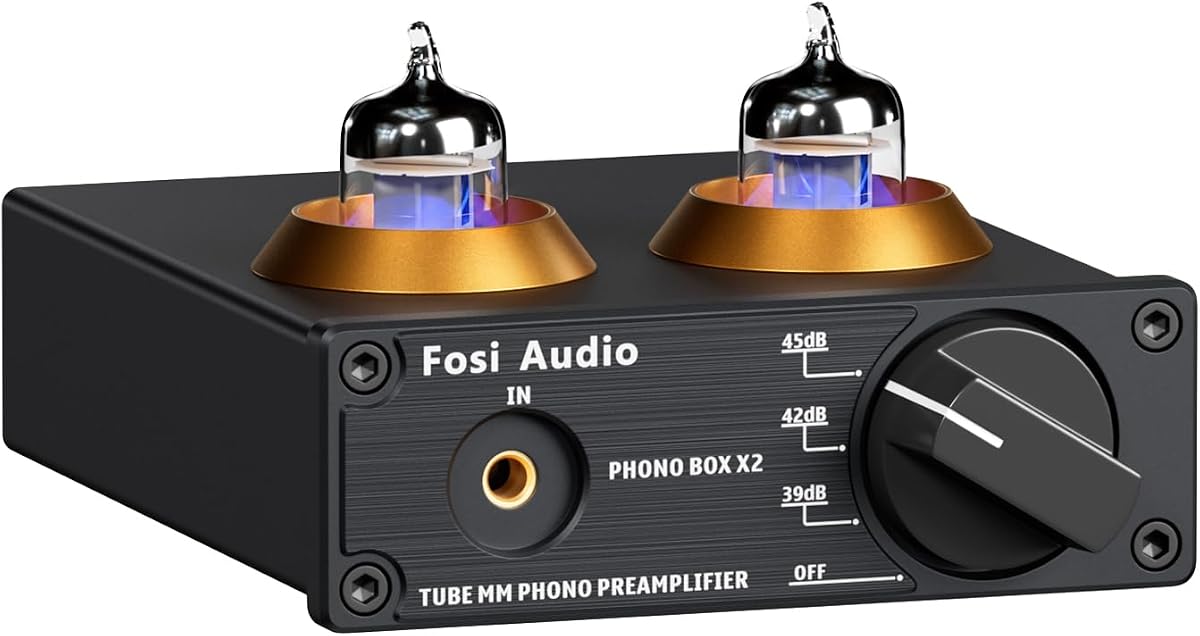
The Fosi Audio Box X2 combines an MM turntable preamp with a small tube-based audio preamplifier, earning a 4.5 rating among the products considered. Its defining attraction is the combination of three gain positions, replaceable tubes, and a conventional home-audio form factor. It gives users more control than a basic fixed-gain box without moving into the larger feature set of the Box X5.
We may earn a commission when you buy through this link, at no additional cost to you.
Gain can be set to 39, 42, or 45 dB, allowing the preamp to accommodate different MM cartridges and source conditions. The stated compatible tubes include 6K4, 6J1, 6J4, GE5654, 6AK5, and 66 examples, and the package includes two vacuum tubes, an RCA cable, a power adapter, and a manual. The additional 3.5mm AUX input also lets the unit serve as a compact tube preamp for another line-level source.
The important limitation is cartridge scope. The Box X2 is built around MM use and does not offer the MC/MM switching and higher gain range of the Box X5. Its tube options can also make installation more involved than a solid-state unit, and listeners seeking only a transparent, uncomplicated RIAA stage may consider the additional controls unnecessary. The grounding post remains an important part of setup because it helps reduce unwanted hum.
This is a strong recommendation for an owner with an MM turntable who wants adjustable gain, a hands-on tube design, and more than one source option. It works especially well as the central input box for a compact vinyl system. Buyers with a low-output MC cartridge should choose a model designed explicitly for MC compatibility instead.
Three gain modes let the listener account for differing cartridge output levels without committing to one fixed setting. This makes the Box X2 more adaptable than the simplest MM-only preamps while retaining a straightforward physical design.
Replaceable tube sockets make it possible to experiment with several compatible vacuum tube types. The supplied tubes provide an immediate starting point, while the auxiliary input extends the preamp beyond turntable-only use.
We may earn a commission when you buy through this link, at no additional cost to you.
The Pyle PP999 is a compact, budget-oriented phono preamp designed to move a turntable’s phono-level signal into the line-level range expected by modern equipment. Its 4.3 rating reflects a practical package built around low-noise operational amplifiers, a straightforward connection layout, and a 3mV input sensitivity for magnetic pickups.
We may earn a commission when you buy through this link, at no additional cost to you.
The preamp uses stereo RCA inputs for the turntable and stereo RCA outputs for the receiver, powered amplifier, speakers, computer, or laptop. Maximum output is specified at 2V peak-to-peak into 10k ohms. With that combination, it can serve as a simple bridge for a turntable that lacks a built-in phono stage, particularly when the rest of the system includes modern amplification.
Its main limitation is the absence of selectable gain and MC support. Fixed operation is easy to live with for a typical MM cartridge, but it offers less room to accommodate very different output levels or a low-output moving-coil cartridge. The recommended placement close to the turntable also matters because the supplied guidance notes that this can reduce unwanted noise and interference.
The PP999 is best for a first vinyl setup, a secondary turntable, or a listener who wants a dedicated box without many controls. It is a sensible budget pick when the priority is reliable signal conversion, recognizable RCA connectivity, and uncomplicated operation. The Box X2 is the more flexible step up when adjustable gain matters.
The PP999 focuses on the essential job of converting a phono signal to line level. Its stereo RCA arrangement makes it easy to place between a turntable and an amplifier without navigating complicated menus or software.
Positioning the compact unit close to the turntable can help reduce noise pickup over longer cable runs. The included power approach also keeps the signal path separate from many household audio components.
We may earn a commission when you buy through this link, at no additional cost to you.
The Fosi Audio Box X5 is the most comprehensively equipped phono preamp in this group, with support for both MM and MC cartridges, four gain settings, and a dedicated cartridge selector. Its 4.5 rating reflects a feature set aimed at listeners who may move between cartridge types or want a more flexible RIAA stage for a serious home system.
We may earn a commission when you buy through this link, at no additional cost to you.
The available gain levels are 38, 48, 56, and 66dB. The two lower settings accommodate MM cartridges, while the higher choices make the unit relevant to lower-output MC cartridges. A toggle switch selects the cartridge mode, and the grounding port provides a secure connection to the turntable. Stated component details include 2% precision polyester film capacitors, green sleeve copper lead audio capacitors, 0.1% high-precision film resistors, an OPA1612 operational amplifier, and gold-plated RCA jacks.
The tradeoff is that the X5 asks users to understand cartridge output and gain more carefully than a basic preamp. An incorrect mode or overly aggressive setting can produce distortion or an unsatisfactory level, and its control set may feel unnecessary for a single MM turntable. It also lacks the tube experimentation and integrated auxiliary input found in the Box X2.
For a system that could include an MM cartridge now and an MC cartridge later, the X5 offers the strongest long-term flexibility. It is also a compelling match for active speakers or compact amplifiers that need a dedicated phono-to-line converter. Choose it when cartridge support and precise gain selection matter more than the smallest possible control panel.
Dedicated MM and MC switching makes the Box X5 unusually useful for a varied vinyl collection. The higher gain positions are especially relevant when a low-output moving-coil cartridge needs substantial amplification.
The listed precision capacitors, resistors, operational amplifier, and gold-plated RCA connectors support a careful approach to signal handling. The rigid aluminum chassis also gives the unit a more substantial feel than a basic plastic enclosure.
We may earn a commission when you buy through this link, at no additional cost to you.
The Pyle PP444 is positioned as an ultra-compact preamp for record players, receivers, amplifiers, and other audio equipment. Its 4.3 rating gives it a favorable overall standing, while the key appeal is its ability to occupy very little room beside a turntable or within a crowded listening shelf.
We may earn a commission when you buy through this link, at no additional cost to you.
The supplied information confirms stereo RCA input and output, providing the familiar route from a turntable to a line-level device. The product is also described as suitable for guitar and microphone applications, which reflects its broader role as a small signal preamplifier rather than a highly specialized luxury phono stage.
The product data provides much less detail about the PP444 than it does for the other models. It does not identify selectable gain levels, cartridge support, equalization design, output specifications, grounding provisions, or included accessories. That makes direct comparison on technical performance difficult, and prospective buyers should examine the current listing and manual before assuming it meets a particular cartridge standard.
The PP444 is best for listeners with limited shelf space who prioritize RCA compatibility and a minimal footprint. It is less suitable for someone seeking MM and MC flexibility, detailed gain control, or confirmed rumble filtering. Its strongest argument is physical practicality rather than a broad feature set.
The PP444 answers a specific problem: fitting a dedicated preamp into a compact setup without crowding the turntable. Its ultra-compact format can be useful near desktop listening equipment or within a small stereo shelf.
Because the supplied product information is limited, buyers should check the current package details and compatibility information. Cartridge type and included accessories are especially important details to confirm before ordering.
We may earn a commission when you buy through this link, at no additional cost to you.
The Pyle PP777 is a small, low-noise phono preamp intended to give a turntable access to receivers, speakers, computers, and laptops that lack a dedicated phono input. Its 4.2 rating reflects a familiar Pyle approach built around straightforward signal conversion and uncomplicated RCA hookups.
We may earn a commission when you buy through this link, at no additional cost to you.
Stereo RCA inputs accept the turntable output, while matching RCA outputs feed an amplifier or other line-level destination. A 12V DC adapter is included, and the ground lead must be connected to help prevent unwanted hum. The stated input sensitivity is 3mV at 50k ohms, while maximum output is 2V peak-to-peak at 10k ohms.
Like the PP999, the PP777 does not offer gain selection. That keeps operation uncomplicated, but it also means the preamp is best matched to conventional magnetic pickups and a setup that does not require precise output adjustment. It has no documented headphone output, tone controls, auxiliary input, or cartridge-mode switch.
This model is a practical choice for a second turntable, a dorm or office system, or a basic home setup that needs a dedicated phono converter. It may also appeal to anyone who wants the stated 12V power adapter included rather than sourcing a compatible supply separately. The Pyle PP999 offers a similar basic approach with a slightly higher rating.
The included power adapter removes one potential compatibility problem. Once the ground and stereo RCA cables are connected, the preamp can serve as the only dedicated component added between a turntable and a modern amplifier.
The fixed-gain approach is most appropriate for standard MM-style applications. Advanced cartridge users should look for a selectable MM and MC preamp with a wider gain range.
We may earn a commission when you buy through this link, at no additional cost to you.
The Fluance PA10 is the highest-rated product in this comparison, carrying a 4.6 rating. Rather than spreading its design across many inputs and controls, it concentrates on a single objective: providing accurate RIAA equalization for MM turntables while maintaining a clear, low-noise stereo signal.
We may earn a commission when you buy through this link, at no additional cost to you.
The stated circuit design uses high-accuracy components, a low-noise power supply, and a low-impedance output stage. Separate left and right operational amplifiers support channel separation and reduce crosstalk during amplification. An internal metal shielding enclosure is intended to block electromagnetic interference and electronic noise, all of which are meaningful concerns when translating a delicate cartridge signal.
A selectable high-pass filter rolls off frequencies below 20Hz with a slow, gentle transition. This can help control subsonic resonance and feedback at higher listening levels without applying an abrupt cutoff. The trade-off is that the PA10 is limited to MM cartridges and does not offer the gain selection, MC switching, tone controls, or headphone output seen elsewhere in the list.
The PA10 is a compelling recommendation for an MM-focused system that values clean RIAA performance, low noise, and a minimal front panel. It is particularly interesting for listeners who have experienced rumble or feedback and want a dedicated filtering option. Those who need MC support should move up to the Box X5 or Douk Audio models.
The selectable filter begins rolling off below 20Hz. Its gradual approach targets subsonic problems while avoiding the abrupt bass reduction associated with a more aggressive fixed filter.
Individual left and right amplifiers support the PA10's goal of a vivid stereo image. Shielding and a low-noise supply also focus attention on keeping the background clean.
We may earn a commission when you buy through this link, at no additional cost to you.
The Douk Audio T9 is the most expansive option in the guide, combining MM and MC turntable support, RCA and phono inputs, a dedicated headphone output, tone controls, and a four-tube design. Its 4.4 rating reflects a feature-rich package aimed at listeners who want a preamp to serve as the control center of a home audio setup.
We may earn a commission when you buy through this link, at no additional cost to you.
The signal path includes two 6E2 tubes with a magic-eye dynamic signal display and two 6A2 tubes described as warm, natural, and full-bodied. Pluggable tube sockets permit replacement with compatible types such as 6K4, EF93, 6BA6, and W727. The visual presentation includes adjustable green or orange backlighting, a metal case, and a CNC aluminum panel.
The dedicated 3.5mm headphone output uses an independent headphone amplifier circuit and supports headphones from 16 to 300 ohms. Treble and bass controls provide additional tonal adjustment. These features increase versatility but also mean the T9 is not a minimal, set-and-forget device. The tube selection and tone controls should be treated as parts of the listening setup rather than defaults that require constant adjustment.
The T9 is best for a dedicated vinyl enthusiast who wants to compare cartridges, use headphones, and explore tube-driven sound characteristics from one enclosure. It is less attractive when the goal is the smallest possible box or a completely hands-off installation. Users should still confirm input routing and settings against the manual before operating the unit.
The independent headphone circuit supports a broad 16–300 ohm range. This makes the T9 useful for private listening without requiring a separate headphone amplifier alongside the turntable.
Pluggable sockets and several listed compatible tube types create room for deliberate experimentation. The illuminated tube display and adjustable color add visual character to a component-based system.
We may earn a commission when you buy through this link, at no additional cost to you.
The Jancane Phono Preamp distinguishes itself with a flexible output section that includes both stereo RCA and TRS connections. It earns a 4.4 rating and targets modern audio systems that need a phono signal converted to line level before reaching an amplifier, receiver, computer, or other equipment.
We may earn a commission when you buy through this link, at no additional cost to you.
The turntable connects through stereo RCA inputs, and the preamp can then feed a receiver through RCA or TRS outputs. Low-noise operational amplifiers form the stated basis of the signal path. A 12V DC adapter is included, while a 30-day return policy and one-year manufacturer guarantee are stated in the product information.
Its strongest practical benefit is output choice. TRS can be convenient when the destination uses a balanced-style connection or when a compact setup benefits from a single cable. However, the supplied information does not identify selectable gain, MM and MC modes, cartridge-specific equalization, or a headphone circuit. The lack of a documented headphone stage means it is less versatile than the Douk Audio T9.
This preamp is a good fit for a straightforward system whose amplifier or powered speakers offer either RCA or TRS inputs. It is also attractive to buyers who prefer having the correct power adapter in the box. Those who know they need MC support or fine gain adjustment should choose a model that explicitly provides those functions.
RCA and TRS outputs make it easier to match the preamp to different equipment. The available options also provide flexibility when rearranging a compact or mixed-connection system.
The preamp focuses on converting the turntable output and passing it onward to modern equipment. Ground the turntable and follow the manual's input and output routing to reduce setup errors.
We may earn a commission when you buy through this link, at no additional cost to you.
The Pyle Mini Preamp is a straightforward box for adding a turntable to receivers, speakers, laptops, and other modern equipment. Its 4.2 rating places it among the basic options in the group, while the appeal lies in a familiar RCA layout, low-noise operational amplifiers, and a compact enclosure.
We may earn a commission when you buy through this link, at no additional cost to you.
Stereo RCA inputs and outputs support the complete signal path, and the supplied 12V DC adapter makes installation uncomplicated. Input sensitivity is listed at 3mV for magnetic pickups, and maximum output is 2V peak-to-peak at 10k ohms. The manufacturer also states a one-year warranty and a 30-day money-back guarantee, adding some reassurance to the purchase.
The product does not advertise gain selection, MC compatibility, a headphone output, or an auxiliary input. That means it should be viewed as a dedicated converter rather than a flexible preamplifier. Fixed operation may be entirely suitable for an MM turntable, but it can limit the ability to optimize level for very different cartridges or unusual amplifier inputs.
The Pyle Mini Preamp is recommended for budget-conscious listeners who want a conventional turntable preamp and understand its limits. It is especially useful when a computer, powered speaker, or modern receiver lacks a phono input. Buyers seeking richer controls can compare it with the Box X2, while MC owners should choose the Box X5 or T9.
The preamp is intended to work with receivers, powered speakers, laptops, and other equipment that accepts line-level signals. It gives a turntable a practical route into a contemporary listening setup.
The stated guidance recommends placing the preamp close to the source to reduce noise and interference. Short, properly seated RCA connections and a secure ground are sensible installation practices.
We may earn a commission when you buy through this link, at no additional cost to you.
The Douk Audio T14-EQ is a compact MM and MC phono preamp that emphasizes convenient power, flexible output options, and personal listening. Its 4.2 rating does not lead the list, but its combination of USB 5V operation, RIAA circuitry, a headphone jack, and tone controls makes it distinctive within the compact category.
We may earn a commission when you buy through this link, at no additional cost to you.
A switch selects MM or MC operation, and the built-in low-noise RIAA circuitry handles the turntable signal. Stereo RCA outputs connect to an amplifier or powered speakers, while the 3.5mm headphone output supports headphones rated from 16 to 200 ohms. Independent treble and bass controls provide plus or minus 5dB of adjustment for matching different speakers or headphones.
The aluminum shell, gold-plated PCB and RCA terminals are intended to support shielding and signal integrity, while a built-in power isolation module is designed to reduce ground-loop noise. Its USB 5V supply can come from a wall charger, computer, or power bank. This is convenient, although it also means the unit is less appropriate for a permanently installed system that prefers a conventional low-voltage adapter.
The T14-EQ is best for a compact or portable listening setup, especially one that alternates between powered speakers and headphones. It is also useful for owners of both MM and MC cartridges who want more capability than a basic box. Users should avoid excessive tone boost or cut, since the RIAA stage is already correcting the record's frequency response.
USB 5V power broadens placement options around a home, office, or listening desk. A computer or power bank can supply the required power when a dedicated adapter is not convenient.
The integrated 3.5mm output supports common 16–200 ohm headphones. It creates a direct path for private listening while the stereo RCA outputs remain available for speakers.
We may earn a commission when you buy through this link, at no additional cost to you.
The right phono preamp depends on cartridge type, gain requirements, source equipment, noise control, and the features you actually intend to use. These factors help separate a simple MM converter from a flexible MM and MC preamplifier.
A turntable cartridge determines the signal level and the type of phono stage it needs. Moving-magnet, or MM, cartridges usually produce a higher output and can often use a conventional MM preamp. Moving-coil, or MC, cartridges produce a lower signal and normally require substantially more gain, precise impedance handling, and an explicit MC mode. The Box X5, Douk Audio T9, and Douk Audio T14-EQ support both MM and MC cartridges, while the Pyle PP999, PP777, and Mini Preamp are described as magnetic-pickup options and the Fluance PA10 is specified for MM turntables.
Gain is the amount of amplification applied to the turntable's small cartridge signal. Too little gain can leave the music quiet, while too much can overload an amplifier or create distortion. A fixed-gain unit is simple and may suit a conventional MM cartridge, but selectable gain offers more control across different turntables, cartridges, and downstream equipment. The Box X2 provides three MM-oriented modes at 39, 42, and 45dB, while the Box X5 offers four broader levels at 38, 48, 56, and 66dB to cover both MM and MC use.
Records are cut with a deliberately non-flat frequency response, and a phono preamp must reverse that curve to restore the intended balance. Proper RIAA equalization is essential for natural vocal weight, smooth treble, and accurate instrumental tone. The Fluance PA10 emphasizes high-accuracy RIAA performance, the Box X5 advertises precise RIAA equalization, and the T14-EQ includes a dedicated low-noise RIAA stage. Buyers should avoid using separate bass and treble controls to compensate for an incorrect equalization curve because that can only approximate the intended result.
A phono stage handles an exceptionally delicate signal, making background hiss, hum, and electromagnetic interference more noticeable than they would be with a line-level source. Look for a low-noise power supply, low-impedance output stage, stable grounding, and shielding. The Fluance PA10 uses a metal shielding enclosure and separate channel amplifiers, the Box X5 lists a low-noise component-focused design, and the T14-EQ includes a power isolation module. Proper setup remains critical: connect the turntable's ground lead and place the preamp close to the source when possible.
Most phono preamps use stereo RCA input and output connections, which makes them broadly compatible with turntables and amplifiers. Some models add TRS, a 3.5mm auxiliary input, or a headphone output. The Jancane preamp offers both RCA and TRS outputs, the Box X2 accepts an auxiliary source, and the Douk Audio T9 and T14-EQ include headphone outputs. Before buying, inspect the amplifier or powered speakers you intend to use and confirm that the preamp's outputs match the available inputs without requiring inconvenient adapters.
Tone controls, headphone amplification, tube sockets, displays, and multiple inputs can make a preamp more engaging, but each also adds cost, complexity, or a larger footprint. The T9 offers the broadest feature set with MM and MC switching, tube choices, a headphone circuit, and treble and bass controls. The T14-EQ provides a more compact USB-powered alternative. Conversely, the Pyle PP999, PP777, and Mini Preamp focus on the essential task of converting a phono signal. The best choice is the one whose controls support your listening habits rather than the one with the longest list of features.
A preamp that is convenient on paper may be awkward beside a small turntable or inside a crowded equipment shelf. The Pyle PP444 emphasizes an ultra-compact format, while the Tube-based T9 is a larger centerpiece-style component. Power design also affects installation: several models use a 12V DC adapter, the T14-EQ accepts USB 5V power, and the Box X2 includes a 12V supply. Choose a layout that leaves room for cables, allows access to switches, and keeps the preamp close enough to the turntable to minimize noise pickup.
The box should contain everything needed for a smooth installation, or the listing should clearly identify what must be purchased separately. The Box X2 includes tubes, an RCA cable, a power adapter, and a manual. The PP777 and Jancane preamp include a 12V adapter, and the T9 package includes a DC12V supply, manual, and necessary components. Warranty coverage can also add reassurance: the PP777, Jancane model, and Pyle Mini Preamp state a one-year manufacturer warranty and a 30-day return period.
Begin by identifying the input and output on the preamp. Connect the turntable's left and right RCA cables to the corresponding stereo RCA inputs, then connect the ground wire to the preamp's grounding terminal. Next, run the appropriate output cables to the amplifier, receiver, powered speakers, or headphone system. Do not connect the preamp output to another phono input, because a line-level signal entering a phono stage would be amplified and distorted incorrectly.
Power off all components before changing cables, and select the correct cartridge mode and gain setting before playing a record. Begin with a low volume, allow the amplifier to warm up if applicable, and listen for the correct channel balance, reasonable volume, and absence of hum. If there is a thin sound, use a higher appropriate gain setting; if the signal distorts, reduce gain or verify that the cartridge mode is correct. For tube models, follow the manual's tube orientation and replacement guidance.
For care, keep the preamp away from moisture, excessive heat, and strong magnetic fields. Use gentle pressure when connecting or removing RCA plugs, and avoid leaving cables hanging from the connectors. Clean the exterior with a dry or lightly damp cloth rather than abrasive cleaners or liquid directly on the unit. Store unused cables carefully, inspect the power adapter for damage, and preserve the manual and warranty information. Periodically check the ground connection and listen for new hum, crackling, or distortion if the system is moved or reconnected.
A phono preamp converts the tiny electrical signal produced by a turntable cartridge into a line-level signal that an amplifier or powered speakers can handle. It also applies the RIAA equalization curve needed to restore the record's intended frequency balance. Without this conversion and correction, vinyl playback can sound quiet, thin, overly bright, or distorted.
Usually not. A turntable with a built-in phono stage already performs the conversion, and connecting its phono output directly to a line-level input is the normal arrangement. Check the manual because some built-in stages include a pass-through switch that lets the same output serve as a line input. Adding a second preamp when one is already active can create an excessively amplified or distorted signal.
Choose according to the cartridge installed in your turntable, not according to the preamp's location in a ranking. MM cartridges generally need less gain, while MC cartridges require a compatible input with substantially more gain. The Box X5, Douk Audio T9, and T14-EQ support both types, whereas several compact Pyle options and the Fluance PA10 are focused on MM use.
Yes, provided the powered speakers accept a line-level input. Connect the turntable to the preamp and the preamp's RCA outputs to the speakers' line inputs. Do not connect the preamp to a speaker-level input because that would apply amplification twice. The Box X5 and several of the Pyle models are specifically described as suitable for active or powered speakers.
A hum is commonly caused by an incomplete ground connection, loose RCA wiring, or interference from nearby power equipment. Connect the turntable ground wire securely, reseat every RCA plug, and keep the preamp reasonably close to the turntable. If the hum persists, test another power outlet or arrangement and confirm that the downstream amplifier is not receiving both a phono signal and a separate line source accidentally.
Tone controls are optional rather than essential for a correctly designed phono stage. Accurate RIAA equalization should provide a natural starting point, after which tone controls can help match a room, speakers, or headphones. The Douk Audio T9 and T14-EQ include bass and treble controls, while simpler models such as the Pyle PP999 and Fluance PA10 keep the signal path focused.
Only if the preamp includes a headphone output or is paired with a separate headphone amplifier. The Douk Audio T9 includes an independent 3.5mm headphone circuit for 16–300 ohm headphones, while the T14-EQ supports 16–200 ohm headphones. A basic RCA preamp will need an additional headphone amplifier for private listening.
Tube designs are often chosen by listeners who enjoy a particular tonal presentation and the experience of changing tubes. The Box X2 and T9 use replaceable tubes and offer a more hands-on approach, while solid-state models focus on fixed circuitry and straightforward operation. The perceived difference depends on the rest of the system, the selected tubes, and personal preference, so neither architecture is automatically right for every listener.
The Fosi Audio Box X2 stands out as the most versatile all-around pick for an MM system because it combines three gain modes, replaceable tubes, and an auxiliary input. The Pyle PP999 is the practical budget selection for a simple dedicated converter, while the Fosi Audio Box X5 takes the premium position with broad MM and MC support, four gain levels, and an emphasis on precision components.
Prioritize cartridge compatibility first, followed by the gain range, RIAA accuracy, noise control, and connections that fit your existing system. Advanced features should support a real need: choose the T9 for tube exploration and headphones, the T14-EQ for USB-powered compact listening, the PA10 for focused MM performance and rumble filtering, or the PP444 when minimal size is the priority.
Check the current listing, package contents, cartridge details, and warranty terms before ordering, because specifications and product availability can change. Prices also fluctuate, so compare the complete feature set and ongoing compatibility rather than choosing on cost alone. With the correct preamp, a turntable can integrate cleanly with modern equipment while preserving the detail and tonal character that make vinyl listening appealing.