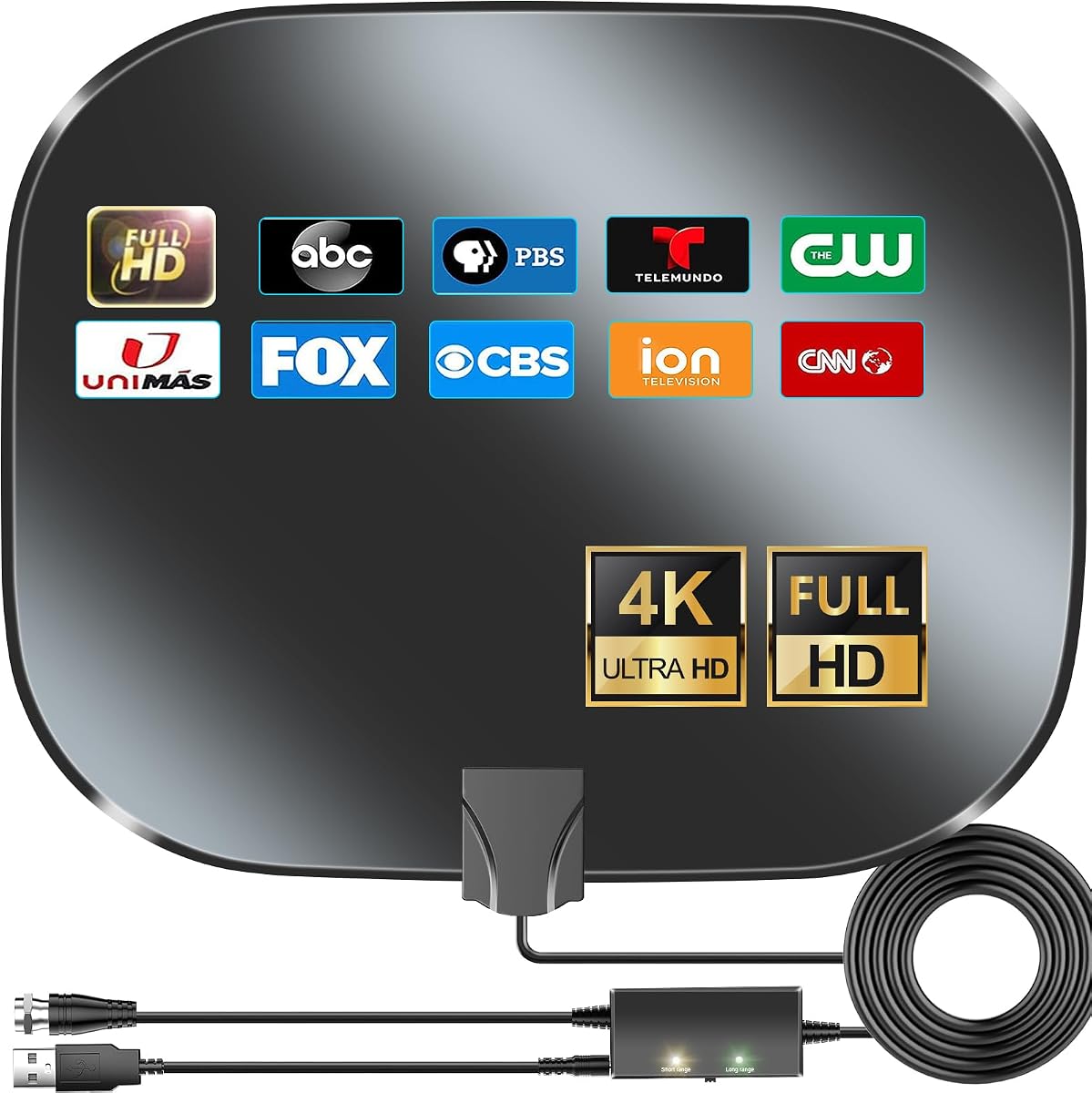
DAANT TV Antenna Indoor Long Range
4.0Editor score
16-foot shielded coaxial cable
Smart IC signal filtering
Supports digital smart TVs
Vertical or horizontal positioning
Our Coaxial Antenna for TV guide compares indoor, outdoor, amplified, and premium antennas for range, signal quality, installation, and compatibility.
A coaxial antenna for TV can provide a straightforward way to receive local broadcast channels without a traditional cable package. The best model depends on tower distance, building materials, available space, and whether an amplifier, directional design, or long cable would make installation easier in your home.
We compared all 10 products by examining their stated reception ranges, broadcast-band support, amplification features, coaxial cable length, mounting options, signal filtering, TV compatibility, and installation requirements. The list covers compact indoor antennas, flexible indoor or outdoor models, amplified units, and professional-style outdoor systems rather than relying on a single ideal antenna.
Each review explains the product's strongest use case and practical limitations, while the comparison table makes the main differences easier to scan. Signal availability remains local, and advertised range is not a guarantee, so check current coverage, product availability, and pricing before making a final purchase in October 2026.
4.0Editor score
4.7Editor score

4.6Editor score
This side-by-side comparison highlights each antenna's form factor, stated range, coaxial cable length, and principal reception features, helping readers match indoor and outdoor models to their local broadcast conditions.


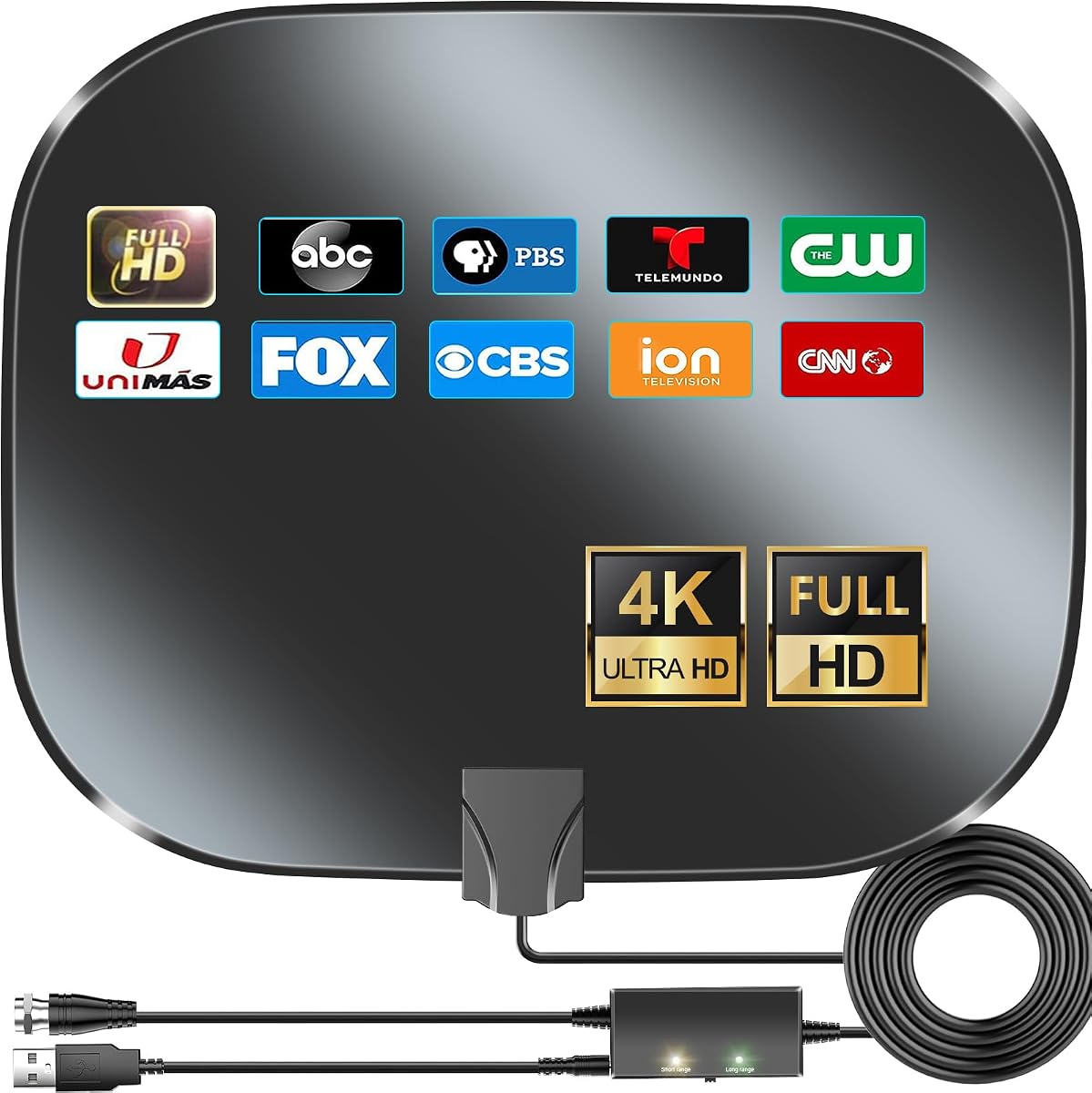
The DAANT TV Antenna Indoor Long Range is a straightforward indoor antenna with a 4.0 rating and a useful 16-foot coaxial lead. Its standout qualities are the upgraded Smart IC chip, broad digital broadcast support, and a cable long enough to place the antenna near a window while keeping the television in a more convenient location.
We may earn a commission when you buy through this link, at no additional cost to you.
The antenna is designed to receive local ABC, CBS, NBC, FOX, CW, ION, and other stations available in the user's area, including broadcasts in 4K, UHD, and 1080p HDTV formats where those signals exist. Its three aluminum shielding layers help preserve signal quality through the coaxial run and provide some protection against distortion.
A potential drawback is that this is strictly an indoor model, so it cannot be mounted outside to gain a clearer path toward broadcast towers. It also does not support older analog televisions, which is reasonable for a product aimed at smart and digital TV users but worth confirming against your equipment.
This is a sensible choice for renters, apartment residents, and households near strong local transmitters that want a simple indoor antenna without a complicated directional assembly. It is also our Best Budget pick because the generous cable and interference-management chip make it more adaptable than a minimal flat antenna.
Begin by checking local coverage, connect the included coaxial cable to the TV's ANT/IN connector, and scan. If channel count is disappointing, move the antenna, test both vertical and horizontal orientations, and scan again rather than assuming the first placement is the best one.
The 16-foot cable provides meaningful placement freedom for an indoor model. Position the antenna near a window or higher on a wall, then run the cable to the television without needing a separate extension.
The Smart IC chip and support for UHD, 4K, and 1080p broadcasts make this antenna suitable for current smart televisions. Actual picture quality and channel availability remain dependent on the strength of the signal at your address.
We may earn a commission when you buy through this link, at no additional cost to you.
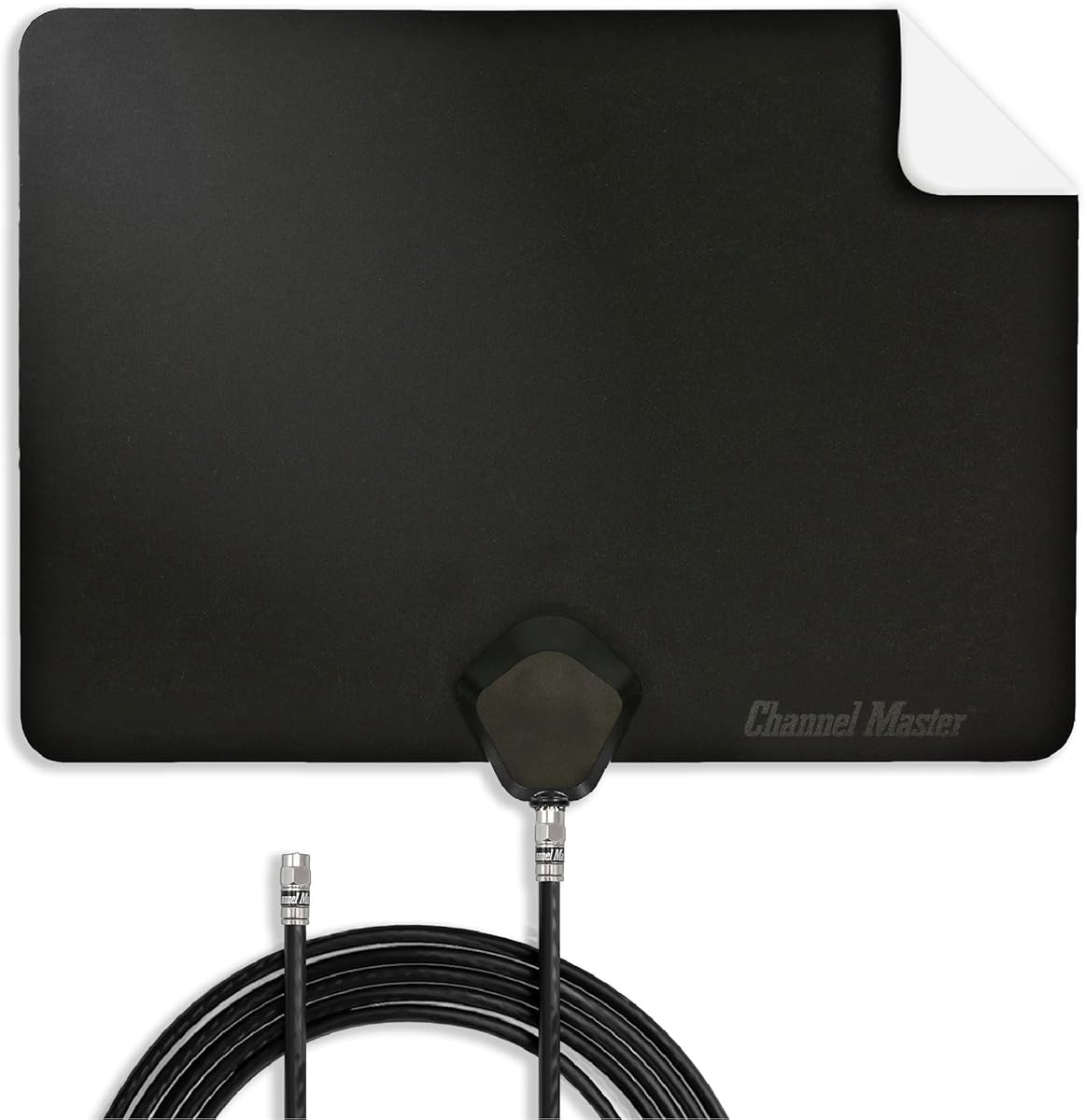
The Channel Master FLATenna has a 4.1 rating and distinguishes itself through its ultra-thin, reversible design. It is an indoor option for users who want a broadcast antenna that can blend into a room rather than dominate it, and its stated 35-mile range reflects a focus on realistic urban and suburban reception.
We may earn a commission when you buy through this link, at no additional cost to you.
Its 12-foot professional-grade RG6 coaxial cable has enhanced shielding intended to improve reliability. The panel can be mounted on a wall, window, or tabletop, and its reversible black-and-white face helps it fit different decorative settings. Reception of 4K broadcasts and ATSC 3.0 NextGen TV signals is also supported.
The main limitation is cable length. Twelve feet is adequate for many arrangements, but it may not let you place the antenna at the best window and still reach a television across a large room. The product is also primarily an indoor antenna, making it less suitable for households needing the height and unobstructed direction of an outdoor directional array.
Choose the FLATenna for apartments, condo units, dorm rooms, or homes near transmitters where aesthetics and simple mounting matter. It is also a sensible choice for viewers who want a recognized antenna brand with support for current broadcast standards, but local coverage should be checked before purchase.
For the best results, test both faces and orientations, perform a fresh channel scan after each move, and place the panel where it has the clearest view toward local towers. In areas with substantial obstructions, an amplified or outdoor model may be more appropriate.
The reversible panel is thin enough to sit on a tabletop or against a wall and unobtrusive enough for rooms where a larger antenna would be inconvenient. Its aesthetics should not be confused with directional gain, so placement remains important.
Support for ATSC 3.0, 4K smart TVs, and over-the-air broadcasts makes the FLATenna relevant for modern receiving equipment. An ATSC 3.0-capable tuner is required to view compatible NextGen TV services.
We may earn a commission when you buy through this link, at no additional cost to you.
This amplified digital antenna carries a 4.7 rating, the highest numerical rating among the products in this guide. It combines an 18-foot coaxial cable, a high-gain amplifier, upgraded smart IC technology, and compatibility with 4K and 8K HDR broadcasts, making it the most balanced recommendation for many households.
We may earn a commission when you buy through this link, at no additional cost to you.
The amplifier and smart chip are intended to strengthen weak signals and reduce cellular and radio-frequency interference. The long lead gives the antenna considerable freedom to move away from electronics, metal objects, and thick walls. It can also be used indoors or outdoors, giving users more options when an interior window position does not provide acceptable reception.
Its main caveat is the familiar limitation of all amplified antennas: it cannot receive a station that is not broadcasting at your location or reconstruct a signal completely blocked by terrain and buildings. Outdoor use also demands secure mounting and weather-conscious placement. The description includes 8K HDR support, but the quality of any received picture still depends on the broadcaster's original transmission.
This is our Editor's Choice because it offers the strongest combination of rating, placement flexibility, cable length, amplification, and installation versatility in the list. It suits users who live within moderate range of transmitters, want to experiment with placement, or need one antenna to work in several environments.
Start with the manufacturer's manual, set the television to the correct antenna input, and scan for channels. If reception is weak, relocate the antenna and rescan. Checking local tower information before installation will help set realistic expectations for the number of channels you should expect.
The 18-foot cable makes it easier to keep the antenna near a favorable window or high location while the television sits elsewhere. Amplification helps marginal signals, but finding a strong source position remains the decisive first step.
Because the product is suitable for both interior and exterior use, households can escalate from a simple indoor setup to a protected exterior position if needed. Ensure any outdoor installation is secure and weather-resistant.
We may earn a commission when you buy through this link, at no additional cost to you.
This indoor TV antenna has a 4.2 rating and a particularly useful feature: selectable short-range and long-range modes. The short-range setting is intended for locations within 35 miles of a transmitter, while the long-range mode is advertised for areas extending from 35 to 250 miles.
We may earn a commission when you buy through this link, at no additional cost to you.
The product includes a 16.5-foot coaxial cable, an upgraded Smart IC chip, and support for 4K, UHD, and 1080p broadcasts where available. The filter is intended to reduce cellular and FM interference, while the mode control offers a practical way to match the antenna's behavior to estimated tower distance.
The trade-off is that range figures cannot guarantee station availability, and selecting the wrong mode may reduce performance. The manufacturer also notes that the amplifier may not improve reception when the antenna is in a weak-signal area. In addition, the antenna supports UHF and high-VHF, but some low-VHF channels numbered 2 through 6 may require separate compatible equipment.
This antenna is best for users who know their approximate distance from local towers and want explicit range controls rather than a single fixed configuration. It is less suitable for households that need low-VHF coverage or live in locations where the available broadcast signal is too weak even for long-range mode.
Use the DTV coverage map before setup, choose the appropriate mode, and scan. If results are limited, move the antenna higher or closer to a window, avoid metal and thick walls, switch modes, and rescan after every adjustment.
The short- and long-range selectors provide a useful starting point based on tower distance. This can reduce guesswork, although users should still compare both modes after positioning the antenna.
The stated UHF and high-VHF support means some stations on channels 2 through 6 may not appear. Check your local station list and determine whether a separate low-VHF antenna is necessary.
We may earn a commission when you buy through this link, at no additional cost to you.
The Vansky Digital Amplified Indoor HDTV Antenna has a 4.0 rating and stands out for its detachable external signal amplifier. Instead of forcing one fixed configuration, it lets users remove the booster and rescan if an amplified setup does not produce the best result.
We may earn a commission when you buy through this link, at no additional cost to you.
Its 16.5-foot coaxial cable provides enough freedom to position the antenna near a window or on a wall. The unit supports 720p, 1080i, 1080p, 4K, and ATSC formats, along with VHF and UHF reception. The external booster is intended to help homes farther from broadcast towers where a weak but usable signal is present.
The detachable amplifier is both the feature and the complication. If no channels lock with the booster active, the manufacturer recommends removing it and scanning again, which is useful advice because too much amplification can sometimes make an installation less stable. As an indoor antenna, it also cannot avoid every effect of thick walls, valleys, and high-rise buildings.
This product is well suited to indoor users who want to experiment with amplification without committing to a permanently boosted signal chain. It also suits those who value a long lead and clear format support more than an outdoor mounting package. A TV with a functioning digital tuner is required.
Check DTV.gov or AntennaWeb before buying, place the antenna near a window, test with and without the amplifier, and rescan after every change. The goal is not simply maximum amplification but the cleanest stable signal your available broadcast coverage can produce.
The removable booster makes troubleshooting more flexible. If a stable signal is easier to acquire without amplification, disconnecting the module can simplify the setup and reduce overload risk.
A 16.5-foot lead lets the antenna leave the television's immediate vicinity. Experiment around windows, higher walls, and locations away from electronics to find the strongest usable source.
We may earn a commission when you buy through this link, at no additional cost to you.
The Tendodo Indoor/Outdoor Digital Antenna has a 4.4 rating and is especially attractive to renters, travelers, and households that want installation flexibility. Its 33-foot coaxial cable is among the longest in this group, allowing the antenna to be positioned in a stronger signal area well away from the television.
We may earn a commission when you buy through this link, at no additional cost to you.
A dual-amplifier and smart-chip design is intended to strengthen weak signals and reduce nearby cellular and radio-frequency interference. The weatherproof, flame-retardant enclosure and included mounting accessories allow use on a window, wall, balcony, patio, attic, or rooftop, depending on the selected installation method.
For apartments, the included double-sided tape avoids permanent drilling and removes cleanly when the renter moves. It can also be used in RVs and campers. The tradeoff is that its broader feature set may involve a power connection, and adhesive mounting must be applied to a clean, suitable surface to remain secure.
This antenna is a strong choice for users who anticipate trying several locations, want to move between homes or vehicles, or need indoor and outdoor flexibility from one package. It may also be useful in suburban or rural locations, but local terrain and obstructions still determine the outcome.
Connect the cable to ANT IN or CABLE IN, complete a channel scan, and reposition slowly while rescanning. If mounting outdoors, secure the unit appropriately and avoid cable runs where they could be damaged. Older analog televisions require a compatible digital set-top box.
The included double-sided tape makes the antenna practical for rentals and temporary living arrangements. It also offers a faster first setup than assembling a mast or drilling an exterior mount.
The 33-foot coaxial lead gives the antenna exceptional freedom within the home and around an RV. That flexibility matters because antenna orientation and position often influence results more than a modest increase in nominal gain.
We may earn a commission when you buy through this link, at no additional cost to you.
The Five Star HDTV Antenna has a 4.1 rating and is built for households seeking an outdoor directional installation. Its long Yagi-style receiving elements are designed to provide stable reception for both VHF and UHF broadcasts, with a stated capability of up to 200 miles from transmitters.
We may earn a commission when you buy through this link, at no additional cost to you.
The package includes a 40-foot RG6 coaxial cable, antenna elements, mounting bracket, J-pole, and an optional TV splitter. It can be installed on a roof, attic, chimney, eave, or mast, with or without a direct line of sight. This makes it more capable than a compact indoor panel when obstructions are substantial.
Advertised maximum range is not a promise of channel count. The manufacturer explicitly notes that reception depends on geography, distance, and signal strength. Outdoor installation also adds assembly, secure mounting, weather exposure, and potentially professional installation, making the system less convenient for renters.
Choose this antenna when local stations are blocked indoors, you have a safe outdoor mounting location, and you are comfortable assembling a directional system. It may also be useful for distributing a signal within a home when paired with the included optional splitter and suitable distribution equipment.
Point the elements toward the appropriate transmitter group, use quality connections, and scan after final positioning. Because direction matters, small adjustments can have a visible effect. Keep the unit securely mounted and avoid placing the long cable where it may be pinched or exposed to damage.
The elongated receiving elements focus reception toward broadcast transmitters, offering a practical advantage over simple indoor panels. Direction means finding the correct aim and, if necessary, rotating the unit toward another cluster of stations.
With a bracket, J-pole, and 40-foot RG6 lead, the package supports several exterior locations and a longer run to the television. The optional splitter can expand distribution options when the rest of the system supports it.
We may earn a commission when you buy through this link, at no additional cost to you.
The TV Antenna Indoor Outdoor has a straightforward feature set centered on versatility. It can be placed on a table indoors or mounted in a roof, attic, or RV setting, making it a flexible option for users who may need to change installation locations as their reception conditions change.
We may earn a commission when you buy through this link, at no additional cost to you.
A built-in high-gain amplifier is intended to improve weak-signal reception, while the multi-layer shielded coaxial cable is designed to reduce signal loss and maintain stability in bad weather. The product supports 4K UHD and 1080p HDTV broadcasts where available and works with smart TVs, HDTVs, and digital TVs.
The most significant limitation is the lack of a numerical customer rating in the supplied data, making it harder to assess user satisfaction alongside the rated products. The description also does not state a specific cable length or numerical reception range, so buyers have less information for comparison. A built-in amplifier also requires power and cannot compensate for a completely unavailable station.
This model is suitable for people seeking a straightforward indoor-to-outdoor progression without a complex directional system. It may be especially convenient in an RV, attic, or temporary installation where flexibility matters more than a permanently mounted outdoor array.
Connect it to the ANT port, complete a channel scan, and move it gradually if results are limited. Rescan every time it is relocated. Testing indoors before mounting outside can help identify which direction and height provide the strongest signal.
Support for tabletop, roof, attic, and RV placement makes this product adaptable to changing spaces. A compact indoor trial can be followed by a higher exterior position if indoor obstructions prevent satisfactory reception.
Multi-layer shielding around the coaxial cable is intended to reduce signal loss and resist interference. The built-in amplifier adds another layer of reception support, though placement remains the first priority.
We may earn a commission when you buy through this link, at no additional cost to you.
The Televes Ellipse Mix 148883 has a 4.6 rating and is the most technically sophisticated antenna in this guide. It is designed primarily for attic or outdoor use, combining a triple-boom directional structure, a built-in TForce preamplifier, automatic gain control, and filtering for FM, LTE, 4G, and 5G interference.
We may earn a commission when you buy through this link, at no additional cost to you.
Its intelligent gain system adjusts amplification independently by band, providing stated gains of 36.5 dBi for High VHF and 40 dBi for UHF. The curved reflectors focus reception toward towers and help reduce multipath interference. An important practical feature is dual operation: the antenna can pass signals passively if power is unavailable.
This sophistication comes with complexity. The directional array must be aimed correctly, and exterior or attic installation requires secure mounting. Its stated 75-mile range still cannot override terrain, obstructions, or transmitter power. It is also substantially more specialized than a simple indoor antenna, making it less appropriate for users seeking immediate plug-and-play convenience.
The Televes is our Best Premium pick for suburban, rural, and fringe-area households that can install a directional outdoor antenna and want sophisticated gain management. The package includes a 12V dual-output power inserter and mast clamp, while its compact dimensions and compatible mast diameters provide several mounting options.
Identify the direction of your local transmitters, mount the array securely, connect the power inserter in the correct direction, and scan. Aim for the strongest signal cluster, then fine-tune. If a smart television lacks an ATSC 3.0 tuner, compatible NextGen TV services will require separate tuner support.
Independent High VHF and UHF gain adjustment helps the system respond to changing signal conditions without applying one blanket amplification level. This is particularly relevant where different stations arrive with widely different strengths.
Integrated FM and cellular filtering reduces common sources of interference, while the triple-boom reflectors concentrate reception toward transmitters. Together, these features make the antenna a strong choice for professionally directed installations.
We may earn a commission when you buy through this link, at no additional cost to you.
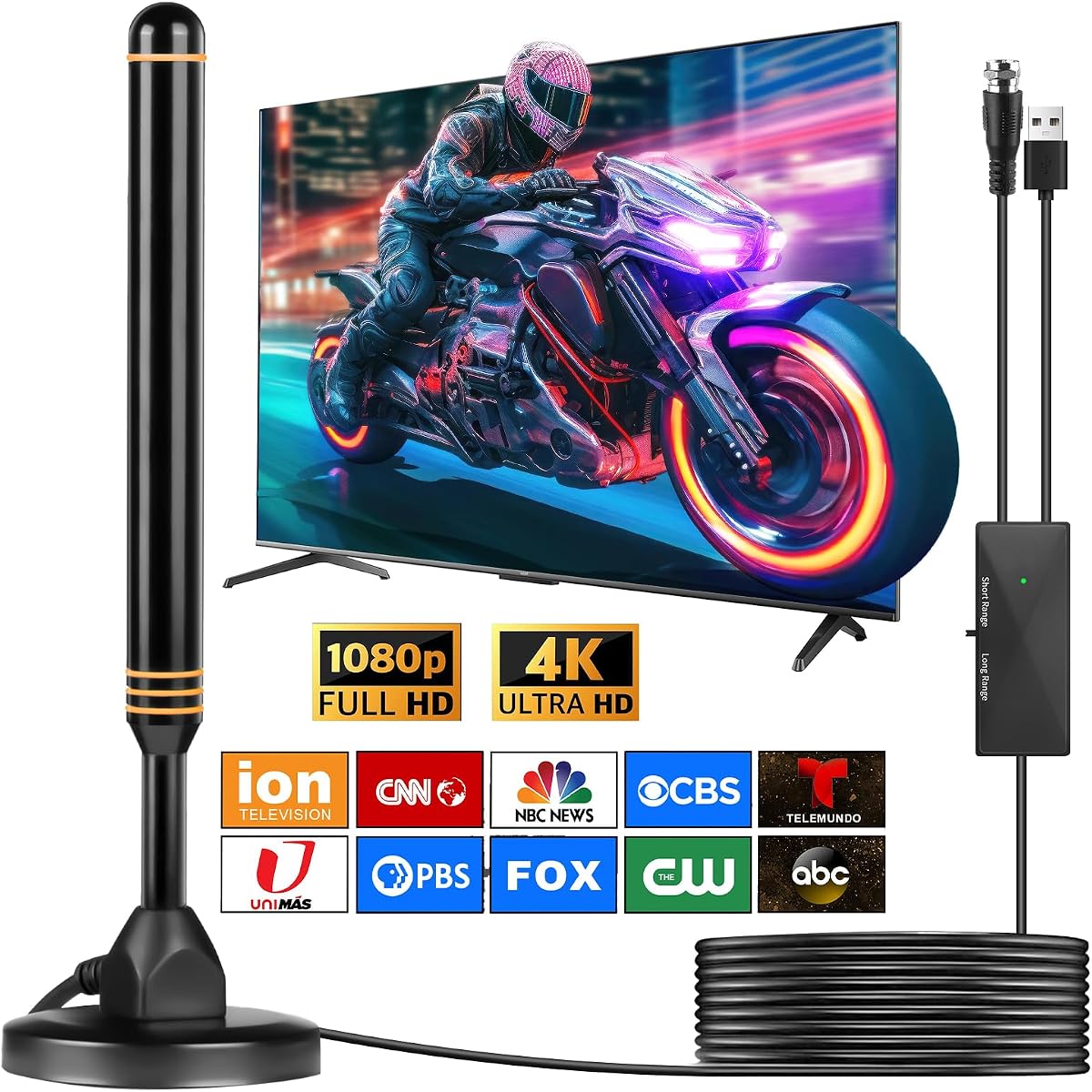
The TV Antenna for Smart TV Indoor is built around a convenient magnetic base and a 16.5-foot coaxial cable. Although marketed primarily as an indoor digital antenna, it can also be fixed outdoors with nylon or screws and placed on walls, tables, or windows to improve reception.
We may earn a commission when you buy through this link, at no additional cost to you.
The product supports 4K, 1080p, and other digital formats and is designed for local services such as ABC, CBS, NBC, PBS, FOX, and others available in the user's area. Its double-PC soft housing is described as flame retardant and intended to provide moisture and lightning protection, although safe outdoor mounting remains essential.
The magnetic base makes it easy to test positions without drilling, but the antenna requires assembly: the user must remove the red rubber sleeve from the base and screw it securely onto the antenna linkage. Decorative blue and orange rubber rings can be swapped, but they have no effect on reception.
This is a useful option for renters, temporary setups, and anyone who wants to relocate the antenna quickly. Its lack of a numerical rating makes customer-satisfaction comparison more difficult, and indoor placement may still be insufficient where thick walls or distant transmitters create severe attenuation.
Complete the base assembly, connect to the television's CABLE-ANT IN or equivalent antenna input, and scan. Move the magnetic unit around the room and rescan to find the strongest location. For exterior use, provide secure fastening and suitable weather protection.
The magnetic base eliminates permanent mounting during initial testing. Users can quickly compare windows, walls, and higher positions without tools, which is useful when signals are marginal.
Removing the red sleeve and attaching the base to the antenna linkage is the only required assembly step. The included long cable then connects to the television's antenna input for a standard channel scan.
We may earn a commission when you buy through this link, at no additional cost to you.
Choosing a coaxial antenna for TV requires balancing broadcast coverage, local obstructions, installation freedom, and available space. The most useful starting point is your location and the stations you want, followed by the antenna design and mounting method that can realistically reach them.
Begin with the television stations available at your address using the DTV.gov maps or a comparable coverage database. Record the transmitter directions, distance, and broadcast bands used by local stations. Advertised antenna range is only a broad guide because terrain, buildings, foliage, and transmitter power can change the usable signal considerably.
Choose a model that explicitly supports the bands your desired channels use. If you need low-VHF stations on channels 2 through 6, verify that the antenna covers them; some modern compact models only support UHF and high-VHF.
Indoor antennas are quieter, easier to install, and suitable for apartments or homes close to transmitters. Outdoor antennas generally provide more directional gain and better penetration through exterior walls, but they require assembly, secure mounting, weather resistance, and a longer route for coaxial cable.
If an indoor unit can receive your required channels after testing several rooms, it is usually the simpler choice. If walls and metal block the signal, consider an outdoor or attic model before purchasing another compact indoor panel.
A directional antenna focuses its receiving elements toward one transmitter or a cluster of transmitters. That focus can improve signal quality and reduce unwanted multipath interference, but it makes careful aiming important. Omnidirectional or broadly oriented indoor models are easier to position but may offer less control over interference.
Choose a directional outdoor system when transmitters are concentrated in a known direction. Choose a flexible indoor model when stations originate in different directions or when you are still determining where the best reception exists.
An amplifier can help preserve and strengthen a weak signal that reaches the antenna, but it cannot create coverage where no usable broadcast signal exists. Over-amplification may also contribute to instability or overload. Products with detachable boosters or selectable modes let you test amplified and unamplified configurations.
Prioritize good filtering for cellular and FM interference, especially in urban areas. Also consider whether the amplifier has an automatic gain system that can adapt separately to VHF and UHF rather than boosting every frequency equally.
Cable length gives you freedom to place the antenna near a window, high on a wall, outside, or farther from electronics. A 12-foot cable may be sufficient for a small room, while 18 to 40 feet supports more extensive placement and exterior installations. Longer runs also introduce more opportunities for poor connections or damaged cable.
Match the lead to your layout rather than selecting the longest option automatically. Verify that the cable is properly shielded, that connectors fit your television's antenna input, and that the entire run can remain supported and protected.
A useful antenna should support the digital formats transmitted in your area, including 1080p, 4K UHD, and ATSC 3.0 where available. Compatibility is only part of the equation: picture quality cannot exceed the quality of the original broadcast signal, and the receiving television must have an appropriate tuner.
Check whether the TV includes a tuner for ATSC 1.0, ATSC 3.0, or both. Older analog televisions need a compatible digital tuner box, while modern smart TVs and HDTVs generally include the required antenna connector and scanning functions.
Consider the surface and space where the antenna will live. Magnetic bases and adhesive mounting suit rentals and quick experiments, while brackets, J-poles, and masts are better for permanent rooftop or attic installations. Weather-resistant housings are important if the antenna or connection will be exposed outside.
For portable use, consider size, cable management, and whether the antenna can be mounted temporarily on a window or RV surface. For permanent use, favor secure hardware and clear access for future adjustment.
Reliable support can be valuable when reception is inconsistent because installation variables are numerous. Look for clear instructions, responsive technical assistance, and guidance that asks users to check coverage, reposition the antenna, and rescan channels rather than promising a fixed number of stations.
Support is especially important for amplified and outdoor models, where setup order and configuration affect results. A brand that provides practical troubleshooting is often more useful than one that relies only on a broad range claim.
Confirm that your television has a working digital tuner, identify the ANT IN or CABLE IN port, and connect the antenna's coaxial connector securely. Do not force a connector that does not fit, and avoid leaving a loose finger-tight connection because poor contact can cause intermittent channels. Before scanning, complete any required antenna assembly and power the amplifier if the model has one.
Use the television's channel search or antenna setup menu to create a fresh channel list. If the antenna includes a short-range and long-range mode, begin with the mode corresponding to your estimated distance from a transmitter. Then experiment with high and low positions, windows, and directions toward local towers, rescanning after every meaningful change because the television must rediscover available channels.
For indoor antennas, keep the unit away from metal objects, thick walls, and electronics when possible. Secure outdoor equipment, protect connectors from moisture, and inspect the coaxial cable for kinks or damage. Clean the housing with a dry or lightly damp cloth, avoid harsh chemicals, and never open powered equipment. If channels disappear unexpectedly, check connections and rescan before changing any settings.
No. Your available channels depend on the stations broadcasting in your area, transmitter distance, terrain, buildings, and the antenna's design. An antenna also needs to support the broadcast band used by each station. Check local coverage before purchasing, and remember that a stronger or more expensive antenna cannot receive a station that is not available in your location.
No. Amplification is most helpful when a weak but usable signal reaches the antenna. It cannot fix absent coverage, severe building attenuation, or incorrect placement. Some products can perform better without the amplifier, so follow the manual and test both configurations if the default setup produces unstable results.
Start near a window and as high as practical, especially if the transmitter is in that direction. Move the antenna away from metal, electronics, thick walls, and obstructed areas. Test horizontal and vertical orientations, perform a fresh scan each time, and allow several minutes for some televisions to complete the full channel scan.
Not by itself. A longer cable provides placement flexibility, which can improve reception by letting you find a stronger signal position. Additional cable length may introduce loss or poor connections, so use the supplied cable when practical and keep connectors clean and secure. For outdoor or distant installations, higher-quality shielded coax can be worthwhile.
Yes, though a larger directional array may be unnecessarily complicated for strong indoor coverage. Installing it in an attic can also work because fewer walls stand between the antenna and outdoor transmitters. Make sure the structure can support it safely, the cable run is protected, and the antenna can be aimed toward the correct transmitter cluster.
It depends on how the televisions receive broadcast signals. Each TV or tuner needs a connection to the antenna or to a suitable distribution system. Splitting one antenna signal among several TVs may require appropriate distribution hardware and correctly sized coaxial runs to avoid signal loss.
Moving the antenna changes signal strength and direction, so the television must rescan to reevaluate every available frequency. Weak stations may disappear while marginal stations become stable. After each adjustment, run a complete channel scan and compare the results rather than relying on the previous list.
A broadcast antenna receives over-the-air stations available in your area, not subscription cable or satellite packages. Some local affiliates may offer over-the-air versions of familiar networks, but their availability depends on your location and broadcast rights. An antenna does not unlock paid programming.
The DAANT TV Antenna Indoor Long Range is the value-focused choice for nearby transmitters and users who want a simple 16-foot indoor setup. The TV Antenna for Local Channels, Digital Antenna for Smart TV Indoor is the balanced all-rounder, offering strong amplification, an 18-foot cable, flexible placement, and indoor or outdoor versatility. The Televes Ellipse Mix 148883 is the premium choice for households ready to install a sophisticated directional outdoor array.
Prioritize local coverage before amplification, and prioritize placement before range claims. Indoor users should choose a model with enough cable to reach a clear window or wall position, while rural or obstructed locations benefit from directional gain, filtering, and a proper outdoor mount. Check band support carefully if your desired stations include low-VHF channels.
Product availability, specifications, customer ratings, and prices can change over time, so confirm the current listing and coverage details before ordering in October 2026. Comparing the television's tuner, the local transmitter map, and the installation space against the included cable will produce the most reliable setup.