
GIGABYTE B650 AORUS Elite AX
4.4Editor score
AM5 Ryzen processor support
DDR5 with EXPO profiles
PCIe 5.0 storage support
WiFi 6E and 2.5GbE
Our Motherboard for Fivem Server guide compares 10 models for CPU support, networking, expansion, memory, remote management, and reliability in dedicated game
A dependable FiveM server needs a motherboard that can sustain steady network traffic, support the processor and memory you choose, and provide enough storage and expansion options for your server’s changing needs. Server-oriented models can also add useful remote monitoring, ECC memory support, and high-speed networking that ordinary desktop boards often omit.
We compared these ten boards by examining processor-socket compatibility, memory configuration, PCIe and storage expansion, networking options, form factor, power delivery, and remote-management features. The list includes compact server boards, micro-ATX workstation models, full-size ATX boards, and high-end platforms designed for demanding virtualization or multi-GPU workloads.
Each selection demonstrates a different balance of size, capability, and specialization, from a practical compact AMD platform to expansive Xeon and Threadripper boards. Product prices and availability can change, so check the current listing and confirm every component in your planned server build before ordering.
4.4Editor score
4.3Editor score

5.0Editor score
The comparison below organizes all ten boards by their most important server-building attributes, including processor support, memory, expansion, and networking. It is intended to make the differences between compact, general-purpose, workstation, and enterprise-oriented platforms easier to understand.


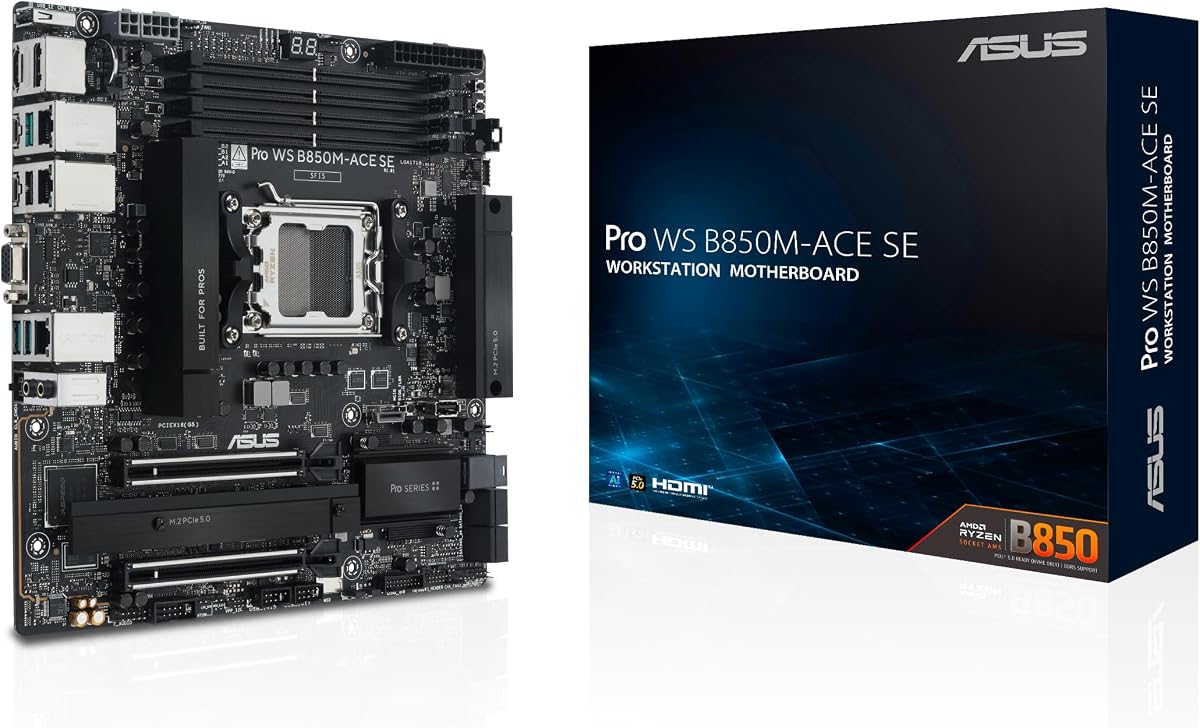
The ASUS Pro WS B850M-ACE SE is a business-oriented micro-ATX motherboard that brings useful server features to a manageable platform. Its 4.3 rating reflects a strong overall proposition, particularly for operators who want more networking and remote oversight than a conventional consumer motherboard provides. The AM5 socket supports current and previous-generation Ryzen 9000, 8000, and 7000-series processors, as well as AMD EPYC 4005-series processors.
We may earn a commission when you buy through this link, at no additional cost to you.
Its strongest server-oriented feature is the onboard AST2600 BMC and ASUS Control Center Express remote-management support. That lets an administrator monitor and manage compatible hardware away from the physical console, a valuable capability for hosted servers, remote offices, or machines installed in a difficult-to-reach rack. The board also combines 10GbE and 2.5GbE networking, two PCIe 5.0 x4 M.2 slots, front USB Type-C at 20Gbps, and MCIO NVMe support.
The trade-off is that this is a micro-ATX board, so it has less physical room for cards and drives than ATX, EEB, or CEB alternatives. The supplied specifications also emphasize broad processor compatibility without clearly detailing ECC UDIMM behavior, which matters if your planned server depends on corrected memory errors. You should confirm memory support, operating-system drivers, and cooling requirements with the manufacturer before completing the build.
This is an excellent general recommendation for a FiveM server expected to grow over time. It is particularly attractive when remote administration, fast wired networking, and modern NVMe storage matter more than maximum expansion. Choose it when you want server-style management without stepping into the complexity and physical demands of a large enterprise motherboard.
The integrated AST2600 BMC is the feature that most clearly separates this board from a typical desktop model. It supports hardware-level monitoring and management through ASUS Control Center Express, allowing compatible administrators to check system conditions and manage deployments without relying entirely on direct physical access.
Dual high-speed Ethernet options reduce the need to depend entirely on a single network path, while two PCIe 5.0 M.2 slots provide room for fast operating-system and application storage. MCIO NVMe support offers another route for denser storage configurations when a compatible adapter and chassis are available.
We may earn a commission when you buy through this link, at no additional cost to you.
The ASUS Pro WS W890E-SAGE SE is the most expansive premium choice in this guide, combining workstation-class Intel Xeon support with an EEB form factor and server-oriented connectivity. Its 5.0 rating reflects a feature set built for substantial professional workloads, although buyers should judge the rating as customer feedback rather than a laboratory performance result.
We may earn a commission when you buy through this link, at no additional cost to you.
The board supports Intel Xeon 600-series processors in the LGA 4710-2 socket and ECC R-DIMM DDR5 memory through NitroPath DRAM technology. Seven PCIe 5.0 x16 slots, four M.2 positions, MCIO, two SlimSAS connectors, dual 10GbE, USB4, and 20Gbps Type-C create a generous expansion envelope. A dedicated AST2600 management connection and ASUS Control Center Express support add remote oversight.
Its scale is both its primary benefit and main limitation. EEB is substantially larger than micro-ATX or standard ATX, so the enclosure, mounting hardware, airflow, and power-supply plan must all accommodate it. The 16+(2+2)+1+2-stage power design and active cooling for the voltage-regulator area, chipset, M.2 devices, and memory suggest a platform intended for sustained professional operation.
Choose the W890E-SAGE SE when you operate more than a single FiveM environment, need substantial virtual-machine capacity, or expect to add high-speed network adapters, storage controllers, and accelerators. It is overkill for a modest game server, but it offers the clearest route to a large, serviceable, and highly expandable server platform.
Seven PCIe 5.0 x16 slots make this board unusually flexible for high-end server work. That capacity can accommodate multiple high-speed network cards, storage controllers, or accelerator cards, subject to the physical chassis, cooling system, power limits, and operating-system support for each device.
Support for ECC R-DIMM DDR5 memory distinguishes the board from many enthusiast platforms. For an always-on server or a virtualization host, registered and error-correcting memory can improve resilience and capacity, although the processor, memory population, and firmware must all be validated together.
We may earn a commission when you buy through this link, at no additional cost to you.
The AsRock Rack B650D4U-2L2T/BCM is a compact server motherboard aimed at users who prioritize high-speed networking over abundant expansion. Its 3.6 rating indicates a more mixed customer response than the leading models, so careful compatibility checking is especially important before committing to a build.
We may earn a commission when you buy through this link, at no additional cost to you.
The board accepts AMD Ryzen 7000-series processors in the LGA 1718 socket and provides four DDR5 DIMM slots with support for ECC and non-ECC unbuffered memory. Its networking includes dual 10G LAN, while storage and expansion are handled through one PCIe 5.0 x16 slot, one PCIe 5.0 x4 slot, and one PCIe 4.0 x1 slot. One PCIe 5.0 x4 M.2 position supports a fast NVMe drive.
The limiting factor is storage flexibility. A system needing several NVMe devices, RAID controllers, or add-in network cards may exhaust the available connectors quickly. The compact 9.6-by-9.6-inch layout can help create a dense server, but it also demands a compatible case and careful attention to airflow, boot-device placement, and cable routing.
For a compact FiveM server that mainly needs a fast operating system drive, a strong processor, and high-throughput networking, this board can be a practical choice. For a multi-role server with extensive storage or virtualization, select a model with more M.2 and PCIe connectors unless the smaller platform is essential to the build.
Dual 10G LAN is the defining feature of this AsRock Rack model. It provides a high-bandwidth foundation for hosted game traffic and can also support link aggregation, separate management traffic, or multiple virtual networks when the relevant switch, driver, and network configuration are available.
The four DDR5 slots accept ECC or non-ECC UDIMMs, giving administrators a choice between resilience and ordinary consumer memory. Correct memory support depends on the exact processor and firmware, so the qualified vendor list should be checked before ordering.
We may earn a commission when you buy through this link, at no additional cost to you.
This C612 Mini-ITX board is built around a different idea of server usefulness: dense SATA storage combined with dual 10GbE networking. It supports Intel E5 v3 and v4 processors in the LGA 2011-3 socket and is intended for NAS, virtualization, router, firewall, private-cloud, and home-lab environments that can also serve a FiveM workload.
We may earn a commission when you buy through this link, at no additional cost to you.
Storage is the major attraction. Four SFF-8643 connectors and two native SATA 3.0 ports can support up to ten SATA drives when appropriate breakout cables are used. Two PCIe 3.0 x4 M.2 slots accept 2280 or 22110 NVMe drives, giving the operating system and active data separate high-speed storage options. The PCIe x16 slot supports several bifurcation layouts for network adapters, HBA cards, or RAID controllers.
Dual X550-T2 10GbE controllers provide a strong networking foundation and are listed as compatible with platforms such as TrueNAS, Unraid, Proxmox, VMware ESXi, and Windows Server. The trade-off is the older E5 platform and the additional planning required for SFF-8643 cabling, drive bays, cooling, and power. Consumer graphics are not the central focus, so headless operation and server use are more natural than gaming.
This board makes the most sense for a FiveM server that doubles as a storage or virtualization host. It is less suitable when you need a new high-end desktop processor, many PCIe devices, or a simple plug-and-play modern platform. Confirm the processor’s memory, graphics, and virtualization support before building.
Up to ten SATA devices can be valuable for backup repositories, logs, downloadable content, and shared storage. The practical drive count depends on the case, power connections, cooling, cable quality, and whether the storage controller or operating system supports the chosen configuration.
Dual 10GbE controllers and flexible PCIe bifurcation make the board useful as a multi-purpose host. Network cards, hardware storage controllers, or virtual-machine workloads can be organized across separate interfaces, giving administrators more control over traffic and storage paths.
We may earn a commission when you buy through this link, at no additional cost to you.
The ASRock Rack EPYC4000D4U offers unusual flexibility by supporting AMD EPYC 4005 and 4004 processors as well as Ryzen 9000, 8000, and 7000-series chips. Its deep mini-ITX dimensions preserve a compact footprint, making it interesting for dense server builds where conventional full-size boards would be too large.
We may earn a commission when you buy through this link, at no additional cost to you.
Four DDR5 ECC UDIMM slots provide a useful balance of memory capacity and a relatively restrained board size. Expansion includes one PCIe 5.0 x16 slot and three OCuLink connectors. Two can operate as PCIe 4.0 x4 connections, while the listed options also allow PCIe 4.0 x4 or SATA 6Gb/s operation in the appropriate alternate configurations.
This board requires more careful chassis planning than a standard mini-ITX product. Its 6.7-by-8.2-inch shape is not interchangeable with every compact case, and the available full-length slot is limited compared with ATX boards. Software support, boot-device arrangement, and OCuLink mode compatibility should therefore be verified before purchasing the enclosure and accessories.
For a compact, headless FiveM server, the board can be attractive because ECC memory and a flexible AMD processor platform provide room for growth. It is best suited to builders who are comfortable with less common server hardware and who value density over abundant PCI expansion or multiple native M.2 connectors.
Supporting both EPYC 4005/4004 and current Ryzen families can simplify parts planning for builders working across server and desktop ecosystems. Firmware features, memory profiles, and board-specific features may still differ by processor, so the manufacturer’s compatibility documentation should be checked.
The OCuLink connectors can provide compact high-speed storage or expansion links, depending on the selected mode and attached device. This makes the board more flexible than its single full-length slot might initially suggest, although the final chassis and cabling arrangement must support the intended configuration.
We may earn a commission when you buy through this link, at no additional cost to you.
The Supermicro X14DBI is an enterprise-scale board built for substantial memory, storage, and compute demands. It supports dual Intel Xeon 6500- and 6700-series processors with E-cores and P-cores in LGA-4710 sockets, with CPU thermal design power support stated as high as 350W. It is an unusually capable platform for a FiveM deployment.
We may earn a commission when you buy through this link, at no additional cost to you.
Memory is the principal draw. Sixteen DIMM slots can hold as much as 4TB of ECC RDIMM DDR5-6400MT/s, making the board suitable for large virtualization estates, memory-heavy services, and consolidated infrastructure. Three PCIe 5.0 x8 connections through MCIO, two PCIe 5.0 x4 M.2 positions, CXL 2.0 capability, dual LAN, and ten SATA connections create a broad expansion foundation.
The same scale introduces serious operational considerations. A dual-socket server normally requires a specialized chassis, substantial cooling, and carefully planned power delivery. The motherboard is not a sensible choice for a small group needing only one game server, and its capabilities may remain unused unless the host is designed as a multi-service platform.
Operators consolidating many virtual machines, storage tasks, and network services should give the X14DBI serious consideration. For a dedicated FiveM server, however, it makes more sense as the foundation of an infrastructure-as-a-service build than as a straightforward one-game installation.
The capacity ceiling makes the X14DBI relevant to organizations running many services on a single physical platform. ECC RDIMM support can also improve data integrity and stability, but the full memory population, balanced configuration, and processor capabilities should be checked against Supermicro’s guidance.
PCIe 5.0, CXL 2.0, M.2, SATA, and dual LAN support create several paths for specialized infrastructure. That breadth is valuable for storage-heavy virtualization or shared compute, although every accelerator and controller should be validated for physical clearance, firmware, cooling, and operating-system compatibility.
We may earn a commission when you buy through this link, at no additional cost to you.
The GIGABYTE B650 AORUS Elite AX is the most approachable motherboard in the guide, bringing the AM5 platform, DDR5, and modern storage support into a full-size ATX layout. Its 4.4 rating is among the strongest shown by the rated products, although it lacks some of the remote-management and high-speed networking found in dedicated server boards.
We may earn a commission when you buy through this link, at no additional cost to you.
The board supports Ryzen 9000, 8000, and 7000-series processors and offers four DIMM slots with AMD EXPO and Intel XMP memory-profile support. A 14+2+1-phase digital VRM, eight-layer two-copper PCB, 6mm heatpipe, covered MOSFET heatsinks, M.2 Thermal Guard, and PCIe Ultra Durable Armor form the foundation for sustained desktop-server workloads.
Connectivity includes PCIe 5.0, a PCIe 5.0 x4 M.2 slot, front and rear USB-C, 2.5GbE, and WiFi 6E. Those features are sufficient for many hosted FiveM servers, and ATX size leaves more room for add-in cards and multiple storage devices than micro-ATX alternatives. The trade-off is the absence of a listed BMC or server-grade remote-management controller; without one, administration generally depends on software running inside the operating system.
This is a sensible pick for a straightforward, dedicated server that does not require dual 10GbE or out-of-band management. Its broad expansion space and modern AM5 support make it easier to build around than many specialized server boards. For a value-conscious one-role server, it provides a practical balance of features, familiarity, and physical flexibility.
The combination of current Ryzen support, DDR5, and a 4.4 customer rating makes this board approachable for administrators who do not need a specialized enterprise platform. A modern desktop processor can provide a strong foundation for FiveM when the server does not require registered memory, dual-socket scaling, or out-of-band administration.
Full ATX dimensions provide room for multiple cards, M.2 devices, and cooling hardware, making the board easier to pair with common cases and server-oriented power supplies. EZ-Latch, Q-Flash, and Q-Connector features can also simplify assembly and maintenance compared with designs that require more manual fiddling.
We may earn a commission when you buy through this link, at no additional cost to you.
The ASUS Pro WS W880-ACE SE combines a modern Intel LGA 1851 platform with features borrowed from ASUS’s professional motherboard range. It supports Core Ultra 9, 7, and 5 desktop processors, DDR5 memory, and a 3.6 customer rating. Its 2.5GbE networking is suitable for many hosted game servers, though it does not match the 10GbE options in this guide.
We may earn a commission when you buy through this link, at no additional cost to you.
Storage and expansion are more generous than a typical compact server board. The product specifications list one PCIe 5.0 x16 slot, one additional PCIe 5.0 connection, three PCIe 4.0 M.2 slots, and a fourth M.2 position, for four M.2 devices in total. Thunderbolt 4, front-panel USB 20Gbps Type-C, and dual 2.5GbE interfaces broaden connectivity options.
A major strength is server-grade IPMI remote management through the AST2600 BMC and ASUS Control Center Express. That capability makes the board more appropriate for unattended operation than a typical consumer ATX product. The 8+1+2+2 power stages, ProCool II connectors, SafeSlot, M.2 Q-Latch, BIOS FlashBack, and Q-Connector support everyday maintenance, while AI Cooling II and AI Advisor are useful firmware-level tools.
This board is a good choice for a modern Intel-based FiveM server that values a desktop processor, flexible NVMe storage, and remote management without requiring enterprise memory or an EEB board. Its main limitation is expansion scale: ATX and two 2.5GbE ports are less capable than Xeon-oriented alternatives when the server grows into a heavily virtualized infrastructure host.
LGA 1851 support brings the board up to date with Intel Core Ultra desktop processors while retaining a practical ATX footprint. The AST2600 BMC adds the out-of-band monitoring that many desktop motherboards omit, making the platform suitable for remote server management.
Four M.2 positions make it straightforward to separate the operating system, logs, assets, and backup workloads across high-speed drives. Q-Latch support can simplify installation and servicing, while the thermal design and M.2 heatsink arrangement help manage heat in a densely populated server.
We may earn a commission when you buy through this link, at no additional cost to you.
The ASUS Pro WS TRX50-SAGE WIFI CEB is a high-end workstation platform for Threadripper PRO and Threadripper processors. It is not designed for a modest single-purpose server; instead, it targets installations that need exceptional core counts, large memory capacity, several high-speed devices, or multiple graphics cards.
We may earn a commission when you buy through this link, at no additional cost to you.
The AMD sTR5 socket supports up to 96-core Threadripper PRO 7000 WX-series processors and Threadripper 7000-series processors. The board supports as much as 1TB of ECC R-DIMM DDR5 memory in a one-DIMM-per-channel configuration, giving virtualization and compute workloads considerable room to operate.
Three PCIe 5.0 x16 slots, three M.2 positions, SlimSAS NVMe support, WiFi 7, 10GbE, 2.5GbE, and front and rear USB 20Gbps Type-C provide a very strong feature set. A 36-stage power design with two 8-pin CPU connectors, extensive VRM cooling, and chipset and M.2 heatsinks reflects the board’s workstation ambition. ASUS IPMI expansion-card support and Control Center Express add remote oversight when paired with supported hardware.
Choose this board when the FiveM host is part of a larger workstation that also performs rendering, simulation, compilation, or GPU-assisted work. For a standalone game server, its power, cooling, size, and cost requirements are difficult to justify. The CEB chassis and Threadripper cooling solution must be selected with care.
Support for high-core-count Threadripper processors and up to 1TB of ECC R-DIMM memory makes the board relevant to virtual-machine consolidation and compute-heavy workflows. The exact memory speed and capacity depend on processor generation, DIMM population, and validation requirements.
Three full-length PCIe 5.0 slots and several storage interfaces support accelerators, professional graphics, and fast NVMe devices. The multi-GPU capability is valuable for workloads beyond ordinary FiveM hosting, provided the chassis provides sufficient space, power, and cooling.
We may earn a commission when you buy through this link, at no additional cost to you.
The Supermicro MBD-X13SEI-F-B is a server motherboard centered on the Intel C741 chipset, LGA-4677 socket, and fourth-generation Xeon processors. Its extended ATX format preserves a familiar board size while targeting the management, reliability, and component ecosystem associated with Supermicro server platforms.
We may earn a commission when you buy through this link, at no additional cost to you.
The supplied listing identifies the board as a server motherboard and confirms C741, LGA-4677, fourth-generation processor, and Xeon support. Those details make it relevant to administrators who want an enterprise-oriented platform but do not need the dual-socket scale or very high memory capacity of the X14DBI. A FiveM host can benefit from a Xeon platform when memory capacity, supported peripherals, or enterprise deployment practices are priorities.
The main limitation is the sparse specification information. The listing does not provide a detailed inventory of memory slots, expansion connectors, storage ports, networking, or management interfaces. That makes thorough review of the manufacturer’s manual and qualified hardware list essential. A board-level compatibility check should cover the exact processor, memory modules, heatsink, chassis, and operating-system driver set.
This is a sensible starting point for a compact enterprise-style build when you are comfortable doing deeper platform research. It may be particularly useful when you want Xeon-class platform support without a full-size enterprise board. Confirm that its actual connector layout satisfies your storage, network, and expansion requirements before treating it as a complete FiveM server foundation.
The board provides a recognizable server-building foundation based on fourth-generation Xeon and the C741 chipset. That makes it useful for operators who want server-platform conventions but do not need dual processors or the extreme expansion capacity of larger Supermicro boards.
Because the available product information is concise, buyers should review the official manual for DIMM count, network options, storage connectors, PCIe lanes, and BMC functions. Checking those details against the actual server case and planned devices prevents an otherwise suitable platform from becoming a parts mismatch.
We may earn a commission when you buy through this link, at no additional cost to you.
The best motherboard for a FiveM server is the one that matches the server’s workload, case, processor, memory, network plan, and maintenance strategy. Rather than treating every board as interchangeable, compare the following factors in the context of the number of concurrent players and the other services the machine will host.
The processor platform should be selected before the motherboard because each socket has its own physical layout, supported generations, firmware behavior, and memory rules. AMD AM5 options such as the B850M-ACE SE, B650D4U-2L2T/BCM, and B650 AORUS Elite AX can work well with modern Ryzen processors, while the EPYC4000D4U broadens the AMD choice to selected server families. Intel alternatives range from the C612 board’s older E5 v3 and v4 processors to Xeon 600, Xeon 6500 and 6700, and Core Ultra desktop processors. Match the exact CPU, cooler, and board revision to the manufacturer’s compatibility list.
Memory requirements depend on the operating system, number of FiveM instances, background services, and whether the machine also runs containers or virtual machines. Standard DDR5 UDIMMs are easier to source for Ryzen and Core Ultra systems, while several server platforms can support ECC UDIMM, registered ECC RDIMM, or other qualified memory configurations. ECC can improve data integrity in an always-on server, but it is not a substitute for a tested hardware platform. Check supported DIMM type, capacity per module, maximum population, memory speed, and whether registered memory is allowed.
A 2.5GbE port can support a modest dedicated game server, while dual 10GbE is attractive for busy hosting, aggregation, or shared infrastructure. The C612, B650D4U-2L2T/BCM, and W890E-SAGE SE provide dual 10GbE, and the B850M-ACE SE pairs 10GbE with 2.5GbE. Wireless features such as WiFi 6E or WiFi 7 can aid setup, but a production FiveM server should normally use stable wired Ethernet. Also account for switch capability, network adapter drivers, virtual network behavior, and whether link aggregation is supported by the operating system and switch.
A FiveM server benefits from separating the operating system and server artifacts from logs, caches, backups, and other workloads. NVMe support provides fast access, while SATA remains useful for bulk storage and inexpensive capacity. The W890E-SAGE SE, W880-ACE SE, and TRX50-SAGE WIFI CEB offer multiple M.2 positions, whereas the B650D4U-2L2T/BCM lists one and the C612 emphasizes SATA expansion. Ensure the board has a practical boot-device path, supports your chosen operating system, and provides enough connectors for the case’s drive backplane.
Expansion requirements should reflect extra network cards, storage controllers, accelerators, or virtual-machine passthrough rather than a desire to fill every slot. Full ATX boards are easier to pair with common cases, micro-ATX options reduce footprint, and EEB or CEB boards demand specialized enclosures. The W890E-SAGE SE offers seven PCIe 5.0 x16 positions, while the X14DBI provides three PCIe 5.0 x8 MCIO connections. Smaller boards may rely on OCuLink, M.2, or bifurcation instead. Always check physical clearance, lane sharing, slot power limits, and case airflow.
Out-of-band management can be a deciding feature for hosted or unattended servers. The ASUS Pro WS B850M-ACE SE, W880-ACE SE, and W890E-SAGE SE provide listed AST2600 BMC support, while the TRX50-SAGE WIFI CEB supports ASUS IPMI expansion cards and Control Center Express. Server-oriented models also tend to emphasize qualified component lists, stability validation, and continuous-operation readiness. These claims do not replace stress testing, but they can indicate a platform designed with uptime in mind. Consider the value of monitoring power, temperature, sensors, and boot status without a local display.
A powerful workstation processor does not automatically make a good server processor. Airflow, sustained thermals, power-supply quality, and the heat generated by dense memory or accelerators determine whether a system remains stable under continuous load. The W890E-SAGE SE, X14DBI, and TRX50-SAGE WIFI CEB use extensive power stages and active cooling, but all require compatible enclosures and cooling solutions. E5 systems are often attractive for efficiency, while modern Ryzen and Core Ultra options can provide strong single-thread performance. Choose a cooler and power supply with headroom rather than relying only on the board’s advertised power design.
The hardware should support the operating system you intend to run, including its network drivers, storage controller, BMC utilities, and virtualization features. Windows-based FiveM hosts are common, while Linux-based deployments may also use Unraid, Proxmox, VMware ESXi, TrueNAS, or other platforms. Some listed boards are explicitly presented as compatible with several of these systems, but that does not guarantee every function works without additional drivers or configuration. Check the operating system’s hardware compatibility list and ensure that remote-management utilities are available for the chosen platform.
Before installing components, read the board manual and identify the processor socket, memory slots, storage connectors, PCIe lanes, front-panel headers, and clearances around the CPU cooler. Install the processor and memory according to the manual, then mount a compatible I/O shield and confirm that every power cable is fully seated. A visual inspection for bent pins, misplaced headers, and obstructed heatsinks is worthwhile before the first power-on.
Update the motherboard firmware and operating-system support files as needed before installing the FiveM server. Configure the network interfaces, enable appropriate remote-management access, and keep the BMC or monitoring account protected by strong credentials and restricted network access. Create separate network roles where possible, such as a management connection, player traffic, and backup transfer, then test stability rather than assuming the configuration is reliable.
Ongoing care includes monitoring temperature, fan speed, storage health, memory errors, and network utilization. Keep the chassis interior clean, verify that intake and exhaust paths remain unobstructed, and schedule maintenance windows for firmware and operating-system updates. Back up the server configuration, custom resources, database files, and license-related information, and rehearse restoration procedures so hardware maintenance does not become a prolonged outage.
A server motherboard can be better when uptime, remote monitoring, ECC memory, dual high-speed networking, or extensive expansion matter. A desktop motherboard can be more economical and easier to build for a small, dedicated server. The best choice depends on the host’s size and workload rather than the FiveM application alone.
Not always. A 2.5GbE connection can be sufficient for a modest server with limited player traffic, especially when upstream and internal network speeds are modest. Dual 10GbE becomes more compelling for busy public servers, shared infrastructure, storage transfers, virtual machines, or environments that want separate traffic and management paths.
FiveM does not require a special motherboard class, but the CPU, memory, storage, and network behavior determine how comfortably the server handles players, scripts, databases, and other services. A modern processor with adequate memory and reliable networking is generally more important than decorative RGB or other consumer-oriented motherboard features.
ECC can add data-integrity protection and is useful in systems that run continuously or host multiple services. It also tends to be more expensive and restricts compatible platform choices. A desktop Ryzen or Core Ultra board is often sufficient for a small dedicated server, while a Xeon or EPYC platform becomes more relevant when enterprise memory and remote management are priorities.
Micro-ATX and compact server boards can suit space-constrained or rack-mounted installations, while ATX is easier to expand with common cases and components. EEB and CEB boards offer more slots but require specialized chassis, cooling, and power arrangements. The server’s physical location and expansion plan should determine the best format.
It is highly useful when the machine may be unattended or operated remotely. A compatible BMC can expose power, temperature, fan, and boot information and may allow management tasks without an active local session. Several boards in this guide support AST2600-based remote management or ASUS management expansion hardware, while consumer-oriented boards generally do not.
Both Windows and Linux-based systems can host FiveM, depending on the scripts, tools, administration preferences, and compatibility of the other services. Linux distributions may suit experienced administrators who want a lightweight command-line environment, while Windows can be more familiar to some operators. Confirm that network drivers, BMC tools, storage controllers, and any virtualization software work with the chosen board.
The correct amount depends on player count, custom resources, database use, monitoring, and any co-hosted applications. A basic server can begin with a modest amount, while busy public servers and hosts that consolidate multiple instances need considerably more. Avoid populating a board arbitrarily; use its qualified memory list and a balanced configuration for the best chance of stable operation.
The ASUS Pro WS B850M-ACE SE stands out as the most balanced overall selection because it combines modern AMD support, high-speed networking, flexible NVMe connectivity, and useful AST2600 remote management in a manageable micro-ATX design. The GIGABYTE B650 AORUS Elite AX is the practical budget-oriented option for a straightforward dedicated server, while the ASUS Pro WS W890E-SAGE SE represents the premium choice for large, highly expandable workstation-class infrastructure.
Prioritize the parts of the platform that affect uptime: validated processor and memory support, adequate cooling, reliable storage, a fast wired network, and remote monitoring when the server is not physically accessible. Compact boards can reduce deployment size, but high-end enterprise platforms make more sense when virtualization, enormous memory capacity, many accelerators, or multiple network services justify their larger footprint and greater complexity.
Before purchasing, recheck the current listing, support documentation, memory qualification, case compatibility, and accessory requirements. Motherboard availability and component prices can change, and the final configuration may involve a processor, cooler, memory, storage, network card, and chassis that must all work together. A careful compatibility check is the final step in choosing a reliable FiveM server foundation.