
GE Digital 2-Way Coaxial Cable Splitter
4.6Editor score
5 to 2500 MHz
Gold-plated RG6 connectors
Two balanced outputs
Cable TV Splitter guide comparing 10 options for port count, frequency range, power passing, connector quality, and home TV setup compatibility needs today.
A cable TV splitter distributes one coaxial television signal to multiple televisions, set-top boxes, antennas, or internet equipment. A useful model balances the right number of outputs with adequate frequency coverage, dependable connectors, clean signal transmission, and compatibility with the coax system already installed in your home.
This guide compares ten cable TV splitters based on the supplied product specifications, including output count, supported frequency range, connector design, power-passing capability, housing construction, MoCA support, and intended applications. The list covers two-way through eight-way models, compact adapters, and multi-pack options for different home-entertainment layouts.
Each review explains the splitter's strongest features, practical limitations, and most suitable installation. The top selections highlight balanced performance and broad compatibility, while the remaining options show where smaller packages, simpler designs, or fewer specialized features may make more sense. Prices and availability can change, so verify current listings before buying.
4.6Editor score

4.6Editor score

4.6Editor score
The comparison below places every splitter side by side, making it easier to evaluate output count, frequency support, connector construction, and practical features before choosing a model for your television or coaxial network.





This two-way coaxial splitter is the strongest all-around choice in the group, combining a 4.6 rating with a feature set suited to modern television networks. It divides one incoming coax signal into two balanced outputs while supporting frequencies from 10 MHz to 2.6 GHz. That makes it relevant not only to conventional CATV and antenna installations but also to HDTV, satellite, high-speed internet, and MoCA 2.5 or 3.0 configurations.
We may earn a commission when you buy through this link, at no additional cost to you.
Its internal printed circuit board and nickel-plated zinc die-cast housing are designed to improve return loss, insertion loss, and isolation between ports. Those details matter because a splitter inevitably divides the available signal among its outputs. A well-isolated, sealed design helps maintain cleaner transmission and reduces the chance that one connected device will interfere with another. All ports also support power passing, allowing the model to work in powered satellite arrangements without blocking the relevant power path.
The main trade-off is that this is a more specialized model than a minimal two-way adapter. It has a grounding screw and mounting holes, which can be useful in a permanent installation but may not be necessary for a simple temporary connection. The stated maximum power-pass currents of 15V DC at 0.5A and 30V AC at 1A should also be considered when comparing it with a simpler consumer splitter.
This is the most flexible recommendation for a homeowner with two televisions, a combination of antenna and MoCA equipment, or a satellite installation that requires power to continue through the splitter. Choose it when connector quality, high-frequency coverage, and power passing matter more than maximum compactness. For a basic two-TV setup, the GE option later in the guide may offer a more streamlined alternative.
The stated support for MoCA 2.5 and 3.0, along with CATV, satellite, antenna, HDTV, and internet use, gives this splitter a wider application range than a basic TV-only adapter. It is particularly attractive for mixed installations in which one coax line serves several types of equipment.
Power-pass-enabled ports support compatible satellite arrangements, while the grounding screw and accessible mounting holes help create a more permanent installation. These features make the unit practical for owners who want more than a loose tabletop connector.
We may earn a commission when you buy through this link, at no additional cost to you.
The GE Digital 2-Way Coaxial Cable Splitter is a straightforward option for distributing one signal to two televisions or other coax-connected devices. It carries a 4.6 rating and covers 5 to 2500 MHz, a range appropriate for many digital television, amplified antenna, and general coax applications. Its uncomplicated two-output design makes it easy to understand before installation.
We may earn a commission when you buy through this link, at no additional cost to you.
Gold-plated RG6 connectors are one of its most appealing features because they are intended to support reliable connectivity and resist corrosion. The splitter is also listed as compatible with amplifiers, amplified antennas, HDTVs, and other coax equipment. Its stated all-brand compatibility means it can be useful when the television, antenna, set-top box, and amplifier come from different manufacturers.
Compared with the first-ranked model, this splitter offers less explicit information about MoCA configurations and does not advertise power-pass-enabled ports. Its maximum listed frequency is also slightly below 2.6 GHz. Those distinctions may matter in a complex satellite or networking setup, but they are less significant for a straightforward two-television installation using conventional RG6 runs.
Choose this model when you want an uncomplicated, reputable-looking solution for splitting a coax line between two displays or components. It is a strong budget-oriented pick because it focuses on the essentials without requiring a larger housing or more elaborate installation features. Users with MoCA networks or powered satellite equipment should verify the exact requirements of their system before installation.
Gold-plated RG6 connectors are designed to maintain dependable connections and provide corrosion resistance. For a permanent two-television installation, that attention to the connection interface is more important than decorative housing features.
The splitter takes one source and makes it available to two separate televisions or compatible devices. That makes it a natural selection for a bedroom TV, second living-room display, or another coax-enabled screen.
We may earn a commission when you buy through this link, at no additional cost to you.
This three-way coaxial splitter is the best feature-rich pick for buyers who need one extra television but want the electrical and installation features found in a more permanent splitter. It has a 4.6 rating, three balanced outputs, and a 10 MHz to 2.6 GHz operating range. CATV, satellite TV, antenna systems, and MoCA configurations are all listed as supported applications.
We may earn a commission when you buy through this link, at no additional cost to you.
The internal printed circuit board, nickel-plated zinc die-cast shell, and sealed body are intended to support low loss, port isolation, and protection against electromagnetic and radio-frequency interference. Every port provides power passing, so the splitter can be used in compatible satellite installations where power must reach a dish, multiswitch, or other upstream component. The grounding screw and two mounting holes support a tidier fixed installation.
As with any multi-output splitter, adding a third branch can reduce the signal available at each endpoint. If the source is weak or the coax runs are long, an amplifier or better antenna placement may be needed. The model also provides less explicit cable compatibility detail than the first selection, which names both RG6 and RG59; this product specifically identifies RG6 compatibility.
This splitter is well suited to a household with three coax-connected televisions, a television and tuner arrangement, or a mixed home network. Its combination of high-frequency coverage, power passing, and MoCA support makes it the most versatile three-way choice here. If your setup only needs two destinations, the simpler GE two-way model may be easier to integrate.
The three-way layout adds useful distribution capacity while retaining the same broad bandwidth and power-passing approach found in the leading two-way model. It is a practical middle ground for homes that need more than two endpoints.
A sealed metal housing, grounding screw, and accessible mounting holes make this option easier to integrate into a structured installation. Those details are particularly helpful when the splitter will remain behind a television stand or entertainment cabinet.
We may earn a commission when you buy through this link, at no additional cost to you.
The six-way coaxial splitter is built for larger homes or commercial-style rooms that need to feed numerous televisions and coax-enabled devices from a single line. It carries a 4.6 rating and supports 10 MHz to 2.6 GHz, offering the same broad frequency ceiling as the first three selections. Six balanced outputs can serve multiple displays, internet equipment, tuners, or antenna components.
We may earn a commission when you buy through this link, at no additional cost to you.
MoCA 2.5 and 3.0 support is explicitly listed, as is compatibility with RG6 and RG59 coax. All ports are power-pass enabled for suitable satellite arrangements, and the construction includes an internal circuit board, nickel-plated zinc die-cast housing, and a sealed body designed to improve isolation and resist outside interference. A grounding screw and mounting holes support a fixed installation.
The important limitation is inherent to high-output distribution. A single incoming signal is divided among as many as six outputs, so each endpoint may receive less signal than it would from a smaller splitter. Long cable runs, older wiring, and a modest antenna can compound that issue. A high-quality source or appropriate amplification may be necessary to maintain stable service across every branch.
This is a strong option for a home with several TVs, a large family room, or a building where many coax endpoints need access to one service. It is less appealing for a one- or two-screen setup, where a smaller splitter will divide the signal more efficiently. Confirm that the source can support six branches before committing to this configuration.
Six outputs give the installer room to connect multiple televisions and related coax equipment without chaining several two-way units. That simplifies the layout when every screen needs the same programming or network access.
The splitter does not create additional signal, so a strong input remains essential. Before installing, test the source at each intended endpoint or plan for an appropriate amplifier and high-quality RG6 runs.
We may earn a commission when you buy through this link, at no additional cost to you.
This package includes two coaxial cable splitters with an F-type RG6 male input and dual F-type female outputs. Its 4.2 rating is lower than the ratings of most models in the guide, but the two-pack format is the distinguishing feature. It is designed for users who need one adapter in each of two locations or want a spare for a separate television setup.
We may earn a commission when you buy through this link, at no additional cost to you.
The nickel-plated metal construction is intended to provide durability, reusability, low signal loss, and good conductivity. Installation requires only screw-on F connectors, with no specialized tools. The listed applications cover cable TV, MATV, CCTV, satellite systems, over-the-air antennas, broadcast receivers, streaming devices, and home-theater equipment.
A significant drawback is the absence of a stated frequency range. Because a coax splitter's performance can vary by frequency, buyers who require detailed compatibility specifications or have a modern high-frequency network should confirm suitability before installation. The product information also does not explicitly advertise power passing, making it less suitable for powered satellite arrangements unless the seller confirms compatibility.
This product is most useful for straightforward, compact installations where two simple adapters are convenient and the devices operate within the source system's established range. It may be a better fit than a permanently mounted splitter for a temporary second display. For installations requiring explicit MoCA support, broad frequency data, or power passing, one of the more specialized models would offer greater certainty.
The two included units can be installed in different rooms, used in separate branches, or kept as a replacement. That makes the package practical when a single compact adapter would not cover the intended layout.
Standard F-type screw-on connections reduce installation complexity. The design is easy for a homeowner to position near a television, antenna, or tuner, although careful hand tightening is still important.
We may earn a commission when you buy through this link, at no additional cost to you.
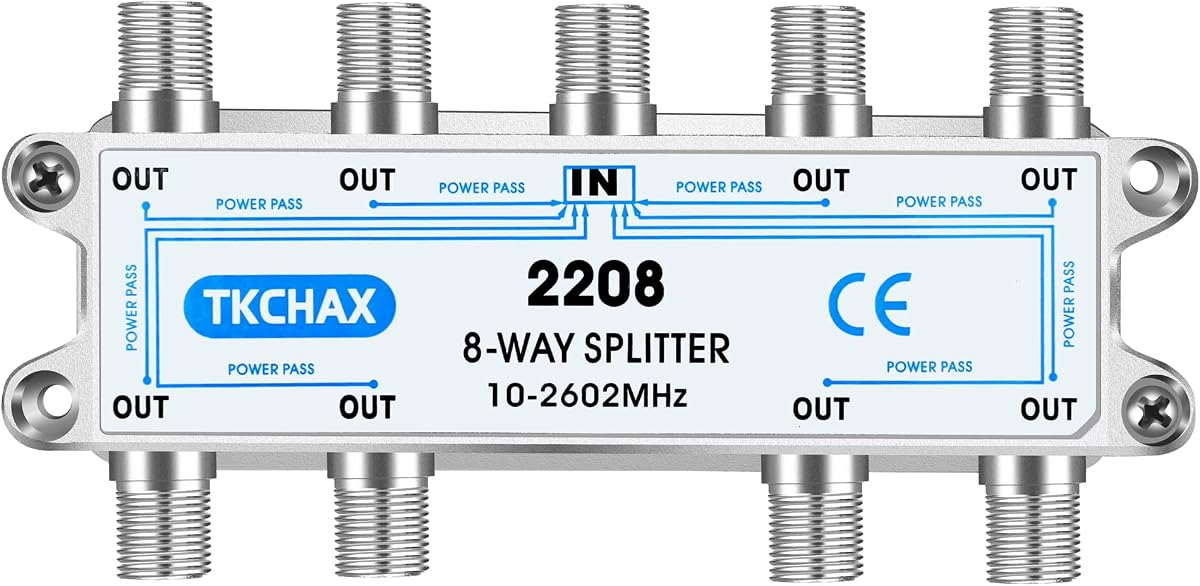
The eight-way splitter is the highest-capacity option in this guide, allowing one digital coax source to feed as many as eight devices. It has a 4.6 rating, eight balanced outputs, and a 10 MHz to 2.6 GHz frequency range. It is aimed at installations with numerous televisions or other compatible coax equipment, rather than a typical one- or two-screen setup.
We may earn a commission when you buy through this link, at no additional cost to you.
The design includes an internal printed circuit board, nickel-plated zinc die-cast housing, and sealed construction intended to improve return loss, insertion loss, and port-to-port isolation. All ports are power-pass enabled, and the product is listed for CATV, satellite TV, antenna systems, high-speed internet, HDTV, and MoCA configurations. A grounding screw and two mounting holes are provided for a fixed setup.
The tradeoff is signal availability. Dividing one source among eight outputs places a greater demand on the incoming line, amplifier, antenna, or provider feed. Even with high-quality components, a weak source can produce marginal reception at some endpoints. An eight-way unit also occupies more space and presents more cable connections to organize than a two- or three-way splitter.
Choose this model for a large home, a shared building, or a carefully designed television distribution system in which eight endpoints are genuinely required. It is a poor substitute for a smaller unit merely because it sounds more capable. Test the source, minimize long cable runs, and use appropriate amplification when necessary so every connected branch has enough signal.
Eight outputs suit large display areas, multiple rooms, or installations that combine televisions with internet and tuner equipment. Centralizing distribution can make the overall cable layout easier to manage.
More outputs create more signal division, so the source should be strong enough for the entire network. This splitter is best viewed as a high-capacity distribution component, not as a substitute for a quality signal source.
We may earn a commission when you buy through this link, at no additional cost to you.
The GE Digital 4-Way Coaxial Cable Splitter provides a balanced middle ground between a basic two-way unit and a larger six- or eight-way model. It has a 4.6 rating, four outputs, and a frequency range of 5 to 2500 MHz. The listed applications include HDTV, satellite TV, cable TV, high-speed internet modems, amplified antennas, amplifiers, and other coax devices.
We may earn a commission when you buy through this link, at no additional cost to you.
All four outputs provide balanced signals with power pass through, expanding its usefulness in compatible satellite and powered coax arrangements. Gold-plated connectors are specified for connectivity and corrosion resistance, and the splitter works with both RG59 and RG6 cable. The product listing also mentions a limited-lifetime replacement pledge and free U.S.-based technical support during stated weekday hours.
MoCA configurations are not explicitly mentioned, so a buyer relying on that standard should seek additional confirmation. As with all four-output splitters, the incoming signal is shared among more endpoints than in a two-way model. Long runs, numerous connections, or a weak source can therefore affect image stability, especially at the farthest device.
This is an appealing pick for a household with three televisions plus a tuner or another coax endpoint, or for someone who wants one spare output. The combination of power passing, gold-plated connectors, broad equipment compatibility, and support makes it a confident four-way choice. It is particularly suitable for buyers who value a recognized support option and straightforward installation.
Four outputs can cover several televisions or a combination of displays, internet equipment, and tuners. It provides enough distribution capacity without moving to a six- or eight-port housing.
Gold-plated connectors support reliable, corrosion-resistant connections, while the stated technical-support arrangement can help with setup questions. Power pass through adds flexibility in compatible powered networks.
We may earn a commission when you buy through this link, at no additional cost to you.
This digital eight-way splitter is designed to feed up to eight devices from one digital coax signal. It has a 4.6 rating and is positioned for television signals, satellite service, wireless internet access, digital signal transmission, cable TV, amplified antennas, amplifiers, and other coax equipment. RG59 and RG6 cables are supported.
We may earn a commission when you buy through this link, at no additional cost to you.
The specified 5 to 2400 MHz range covers a 2.4 GHz ceiling. Within the 1750 to 2400 MHz region, the manufacturer states a low signal loss of 4.5 dB per output and notes low-amplitude attenuation, high-isolation shielding, and synchronization signal support. The die-cast zinc alloy shell has a nickel-plated surface, and the listed weight is 86 grams.
All ports provide power passing for compatible satellite connections, but the instructions warn that only one highest voltage may pass at a time. Installation involves preparing the cable, attaching an F-type male connector, and connecting the finished run to the splitter. The stated one-year warranty and technical support add some reassurance, though the upper frequency is below that of the 2.6 GHz alternatives.
This model suits a high-capacity MoCA or satellite installation where a compact eight-way unit is needed. It is particularly interesting for users who value a lightweight housing and explicit high-frequency loss information. Ensure the source can support eight branches, and avoid assuming that a splitter alone can compensate for a weak or poorly distributed coax signal.
MoCA is the central application named in the product listing. The splitter is therefore well aligned with homes using coax networking to carry high-speed data and television services through a shared wiring system.
At a listed 86 grams, the die-cast zinc alloy housing is designed to provide multiple connections without the bulk of many larger components. That can help when arranging a dense home-theater or equipment-rack setup.
We may earn a commission when you buy through this link, at no additional cost to you.
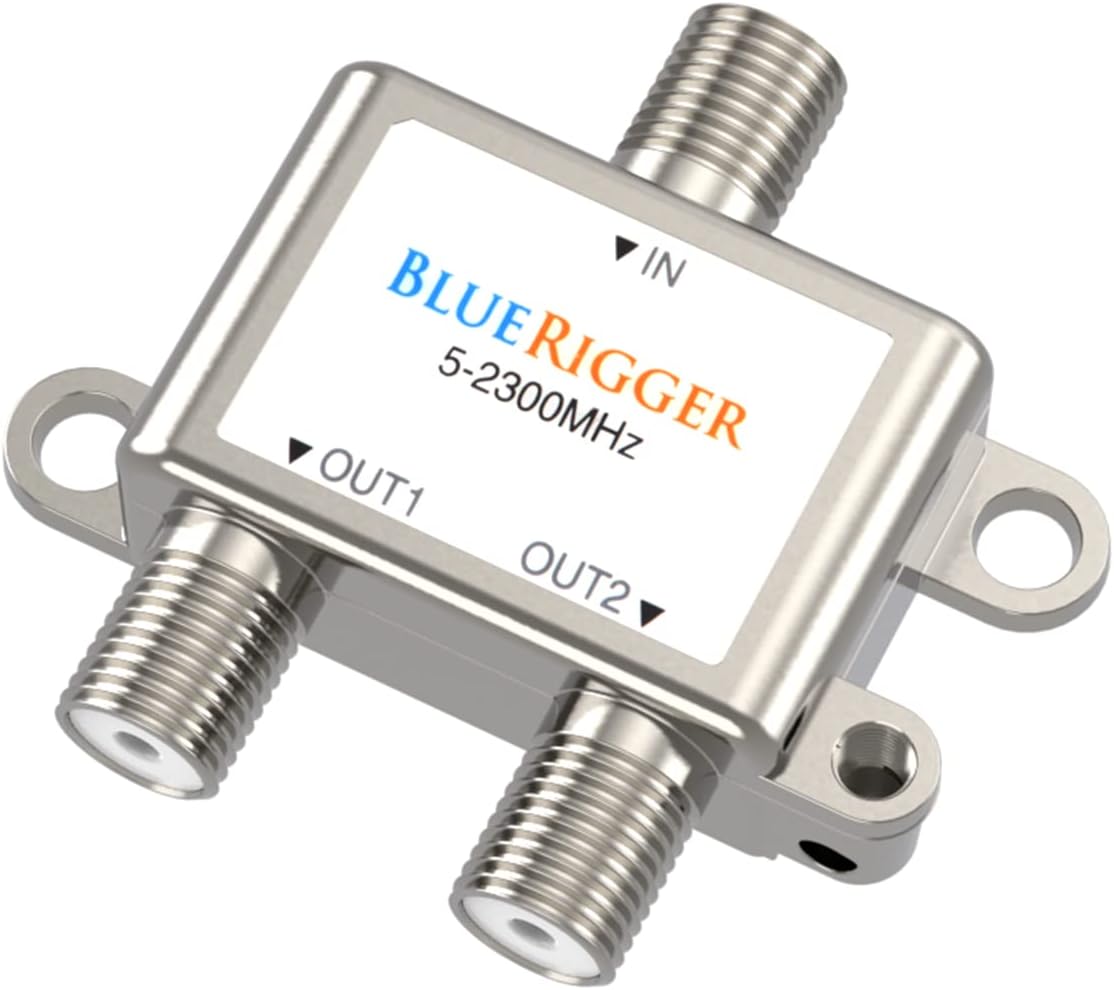
The BlueRigger 2-Way Coaxial Cable Splitter is a compact option for dividing one digital signal into two and delivering it to multiple devices. It has a 4.3 rating and a stated frequency range of 5 to 2300 MHz. Its title identifies it as an RG6 two-way mini diplexer with F-type connections, making its general purpose clear.
We may earn a commission when you buy through this link, at no additional cost to you.
The nickel-plated zinc alloy die-cast housing is designed to provide durability and reduce digital noise, while the screw-on F-type connectors support straightforward installation. Compatibility is broad: the product is listed for HDTV, antennas, CATV, cable modems, coaxial couplers, set-top boxes, satellite, amplifiers, cable TV, and dishes. It also works with standard RG59 and RG6 coax cables.
The 2.3 GHz upper frequency is lower than the 2.4 and 2.6 GHz models elsewhere in the list, and power passing is not explicitly stated. Those details deserve attention if the splitter will carry a powered satellite arrangement or participate in a network operating near the top of the coax frequency range. Its 4.3 rating is also lower than the 4.6 ratings attached to most other selections.
Choose this model for a compact two-device installation involving an antenna, HDTV, amplifier, cable service, or other standard coax equipment. The lifetime warranty and stated U.S.-based customer support can be helpful for simple installations. For a network requiring verified MoCA, power passing, or a wider frequency ceiling, one of the more explicitly specified splitters would be the safer choice.
The mini format can be easier to place behind a television or inside a crowded entertainment cabinet. It is especially convenient when the two connected endpoints are close together.
Support for both RG59 and RG6 allows use with common household coax wiring. The listed device compatibility also makes the splitter relevant to antennas, set-top boxes, cable modems, and amplifiers.
We may earn a commission when you buy through this link, at no additional cost to you.
The Superbat F-Type Splitter Cable is a short, flexible jumper that converts one F-type male connection into two F-type female connections. Its 4.5 rating and 15-centimeter, or six-inch, length distinguish it from the larger block-style splitters in the guide. It is designed for cable television, CATV, VCR, DVD, HDTV, DTV, satellite receivers, cable boxes, LTE filters, antennas, and other audiovisual equipment.
We may earn a commission when you buy through this link, at no additional cost to you.
Its primary benefit is placement flexibility. The short cable allows the connector position to be adjusted according to the available space, which can make it easier to reach two female F connectors from one source. The 75-ohm RG6-style construction and familiar F-type interfaces suit conventional coax networks.
The fixed length can be a limitation in installations where the devices are farther apart or where a cleaner wall-plate arrangement is needed. The product listing does not state a supported frequency range, power-pass capability, or detailed loss figures, so it offers less certainty for specialized high-frequency or powered networks. It is also less adaptable than a standard splitter paired with separate coax cables.
This product is best for a compact temporary setup, a nearby second display, or a connection where cable routing space is tight. It may also serve as a convenient short jumper between an existing coax line and another F connector. Buyers building a permanent multi-television network should prioritize a clearly specified frequency range, grounding provisions, and power-pass information.
The six-inch length can solve tight-routing problems that make a rigid block splitter inconvenient. The flexible section can be positioned to reach nearby female connectors without a long jumper.
The 75-ohm F-type design fits the coaxial ecosystem used by many televisions, antennas, tuners, and set-top boxes. It is best suited to standard installations where those established connection and frequency requirements are already known.
We may earn a commission when you buy through this link, at no additional cost to you.
Choosing a cable TV splitter involves balancing output count, frequency range, power passing, connector type, and installation method. Begin with the devices and coax services you already have, then select the least complex splitter that can support the full network without creating unnecessary signal loss.
Choose an output count that matches the number of endpoints you actually need, plus one unused output when future expansion is likely. A two-way splitter serves two televisions or components, while four-, six-, and eight-way models support progressively larger networks. Every additional branch divides the available signal further, so a larger splitter does not automatically provide better reception.
Match outputs to devices, and avoid unnecessary branches. A two-way model is usually preferable to a four-way model when only two screens require the signal.
The frequency range indicates the portion of the coax spectrum a splitter is designed to handle. Products in this guide extend from 5 MHz up to either 2300, 2400, 2500, or 2602 MHz. Higher ceilings are relevant for advanced television, internet, MoCA, and other high-frequency coax services, but they matter only if the source equipment and wiring use those frequencies.
Select a range that covers your full service plan. For a high-frequency network, avoid choosing solely by output count; verify the splitter's upper frequency limit as well.
Power passing allows a compatible power source to travel through a splitter, which can be necessary in certain satellite installations. Several models here explicitly provide power passing on all ports, while others do not make that claim. Using the wrong splitter in a powered system could interrupt service or prevent an upstream component from receiving required power.
Check the requirements of every satellite, multiswitch, amplifier, or powered device. Use a clearly power-pass-enabled model when the installation depends on that function.
MoCA uses the existing coax wiring to carry high-speed data alongside television service. A splitter intended for MoCA should have a suitable frequency range and be identified as compatible with the relevant MoCA configuration. The first, third, fourth, and sixth products explicitly list MoCA support, while the eighth product is specifically designed around MoCA applications.
Prioritize explicit MoCA compatibility for a mixed television-and-network installation. If your network depends on a particular version, confirm that the splitter names it or provides compatible technical documentation.
F-type screw-on connectors are the standard interface used by most household coax equipment. RG6 is common for modern television and internet installations, while RG59 remains used in some older or shorter runs. Models listing both can offer greater flexibility. Gold-plated or nickel-plated connectors are intended to support conductivity and resist corrosion.
Match the splitter to the cable already in the wall. Verify both connector type and supported RG6 or RG59 rating before installation, especially in an older home.
A block-style splitter with a sealed metal housing is well suited to permanent installations, while a compact adapter or short jumper cable is convenient for temporary setups or tight spaces. Grounding screws, mounting holes, and sealed bodies can support a more organized installation, but they also make the device larger and less portable.
Choose a sealed, mountable splitter for permanent wiring. Choose a compact adapter or jumper when flexibility and simple placement matter more than a finished installation.
A splitter divides one input among multiple outputs and therefore reduces the signal available at each endpoint. This effect is more noticeable with more outputs, longer cable runs, poorer connectors, or a weak antenna signal. Some high-output installations require a quality amplifier, short RG6 runs, or a stronger source to maintain stable service across every television.
Test the source before adding many branches. If reception is already marginal, choose a smaller splitter or improve the antenna and cable run first.
The best splitter is one that fits the actual service involved. Listed applications across this guide include CATV, HDTV, satellite, antennas, set-top boxes, internet modems, amplifiers, and home-theater equipment. A splitter intended for conventional television may still be appropriate for antenna distribution, but powered satellite and network equipment deserve more specific verification.
List every connected device and its service type. Select the splitter whose stated compatibility covers that complete list, not just the television itself.
Plan the coax path before connecting the splitter. Identify the incoming service line, decide where the splitter will sit, and confirm that each output can reach its intended television or device without unnecessary slack. A dry, accessible location near the source is preferable to a cramped space where connectors may be bent or strained.
Turn off the relevant television, set-top box, amplifier, and any powered coax equipment before changing connections. Connect the incoming RG6 or RG59 line to the splitter's input, then attach an appropriate RG6 run to each output. Hand-tighten every F-type connector in the same general direction, taking care not to cross-thread or overtighten the threads.
Reconnect and power the equipment one device at a time, then perform a channel scan and check each output for stable reception. Keep the splitter away from moisture, direct heat, and heavy objects. If you notice signal loss, inspect the connectors for loose threads, damaged cable, or corrosion and review whether an amplifier is needed.
Yes, a splitter divides the incoming signal among its outputs, so each connected device receives a share of the available signal. Loss is generally more noticeable with higher output counts, long cable runs, poor connectors, and a weak source. Using the smallest suitable splitter, quality RG6 cables, and a good antenna or amplifier can help preserve stable reception.
A two-way splitter provides two outputs, while an eight-way splitter provides eight. The larger model can serve many televisions or other coax devices, but it divides the source signal more extensively. Choose the number of ports based on actual demand rather than on unused capacity, since every additional branch may reduce signal strength.
It depends on the satellite equipment and wiring arrangement. Some powered systems require power to travel through the coax line to a dish, multiswitch, or other component. If that is required, select a splitter that explicitly states that all ports are power-pass enabled, and follow the equipment manufacturer's instructions about allowable power and connection limits.
Many of the listed models support both RG59 and RG6, although the specifications vary. RG6 is generally preferred for modern HDTV, satellite, and high-speed internet installations, while RG59 may still appear in older wiring. Always check the individual product listing and confirm the connector style before purchasing.
Yes, many models in this guide list over-the-air antennas as compatible applications. The source signal, cable length, and number of outputs will determine whether an amplifier is needed. A splitter can also allow multiple devices to combine or distribute antenna signals, but its stated antenna compatibility should be checked first.
MoCA compatibility means the splitter is intended to carry high-speed network data over coax while supporting television distribution. It is important to match the splitter's supported MoCA configuration and frequency range with the network equipment. A splitter that is only marketed for basic TV use may not provide the performance or isolation needed for a reliable MoCA network.
Hand tightening is generally sufficient for standard F-type coax connections, and a wrench can cause overtightening or damage. Turn the connector clockwise until it is snug and secure, keeping the connector straight so the threads do not cross. If the signal is unstable, check for loose fittings and damaged cable rather than applying extra force.
Start by reducing unnecessary outputs, replacing damaged or poorly fitted coax, and shortening long cable runs where possible. Confirm that the antenna or provider feed is strong at the source and that every connector is fully seated. If the network still needs help, add a compatible amplifier positioned according to its instructions rather than relying on the splitter to amplify the signal itself.
The 2 Way Coaxial Cable Splitter is the strongest overall choice because it combines a broad 10 MHz to 2.6 GHz range, RG6 and RG59 compatibility, MoCA 2.5 and 3.0 support, and power passing in a practical two-output format. The GE two-way model offers a simpler alternative for conventional two-display setups, while the three-way selection adds capacity without giving up the specialized features.
Prioritize output count, frequency coverage, power passing, and cable compatibility in that order only after identifying your actual devices. Larger splitters are not automatically better because they divide the source more extensively. A smaller, clearly compatible unit is often the better choice for a two-television home, while four-, six-, and eight-output models make sense when many endpoints genuinely need service.
Finally, review the current product listing, availability, and price before ordering. Technical specifications and connector details can vary by listing, and a splitter cannot correct a weak source or poor cable run. Use the product data to confirm the important electrical features, then choose the model that matches your installation with the fewest necessary outputs.