
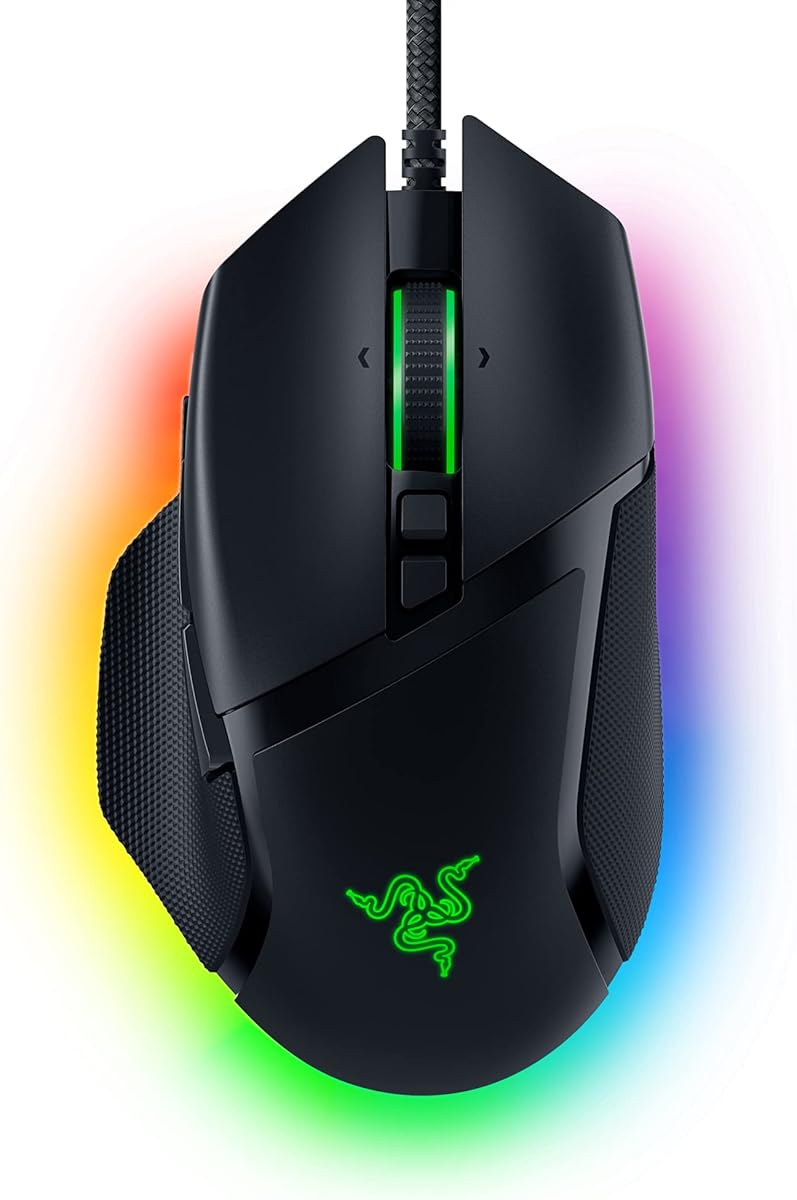
Razer Cobra
4.5Editor score
58-gram lightweight design
0.2 ms actuation speed
50-DPI sensitivity increments
Explore the best mouse for aiming in FPS games, comparing sensors, weight, switches, wireless latency, grip, customization, and battery life today.
A mouse built for aiming in FPS games must deliver predictable tracking, responsive clicks, a comfortable shape, and enough control to support rapid corrections. Sensor resolution, polling performance, button layout, and grip compatibility can matter more than decorative features when every flick, hold, and quick turn affects the result.
This guide compares ten gaming mice using the supplied specifications, including sensor capability, weight, switch technology, connectivity, programmable controls, battery information, and advertised features. It covers wired and wireless models for players who value precise movement, competitive responsiveness, comfort, or flexible configuration.
Each review explains the strongest reasons to consider a particular mouse, along with its trade-offs and ideal gaming style. The top selections represent the overall, budget, and premium choices, while the full list includes additional options for different grips, setups, and priorities. Product prices can change, so check current listings before buying.
4.5Editor score
4.6Editor score

4.6Editor score
The comparison below highlights the main hardware differences among all ten mice, including weight, sensor resolution, switch type, connectivity, and control layout. These specifications help identify which models are best suited to precision aiming, competitive movement, or extensive customization.


The Razer Basilisk V3 stands out as the most versatile all-around option in this guide, combining an ergonomic palm-oriented form with a 26,000 DPI optical sensor and 0.2 ms optical switch actuation. Its 4.6 rating reflects a favorable balance of tracking performance, build characteristics, and extensive customization, making it a strong candidate for players who want precision without giving up convenient access to secondary controls.
We may earn a commission when you buy through this link, at no additional cost to you.
The sensor tracks movement with zero smoothing, which is particularly relevant for aim corrections and controlled strafe adjustments. Optical Gen-2 switches provide crisp actuation and are rated for up to 70 million clicks. Eleven programmable buttons make the mouse useful for abilities, weapons, push-to-talk, communication commands, and other functions, while the HyperScroll tilt wheel can be switched between rapid free-spinning movement and tactile mode for weapon or skill cycling.
Its wired design may be less convenient for players who prefer a completely cable-free desk, and the extensive feature set may take time to configure. The ergonomic shape and thumb rest also make it more compelling for palm and relaxed claw grips than for players who prefer a very compact, symmetrical mouse. Razer Synapse support provides the tools for assigning controls, while the supplied guidance recommends disabling Windows Enhance Pointer Precision for more direct movement.
The Basilisk V3 is a strong recommendation for FPS players who want accurate tracking, fast clicks, and a large selection of programmable actions in a comfortable wired mouse. It is especially suitable for MMO, MOBA, tactical, and mixed-game setups where extra controls have practical value. For a strict competitive minimalist setup, the Cobra may be easier to prefer, but the V3 offers the broadest feature set here without compromising the core aiming hardware.
The combination of a 26,000 DPI sensor and 0.2 ms optical switch actuation supports both controlled corrections and quick directional changes. The sensor is specified to track without smoothing, which can make visual feedback feel more direct during precise aim adjustments.
Eleven programmable buttons and a dual-mode HyperScroll wheel give players more ways to bind actions than a conventional six-button layout. The tilt wheel is particularly useful for moving between abilities or weapons without taking the mouse hand away from its normal aiming position.
We may earn a commission when you buy through this link, at no additional cost to you.
The Razer Cobra is the best-value choice in this roundup for players who want a light, responsive wired mouse without paying for a broad collection of secondary controls. It weighs 58 grams, uses Gen-3 optical switches with a stated 0.2 ms actuation time, and carries a 4.5 rating. Its compact proportions and low mass are well aligned with quick flicks and rapid repositioning in competitive shooters.
We may earn a commission when you buy through this link, at no additional cost to you.
The mouse is designed to fit most grip styles, while its low weight can make fast directional changes easier to perform without moving a heavier device. Gen-3 optical switches are rated for up to 90 million clicks and are designed to eliminate double-clicking issues. Sensitivity can be fine-tuned in 50-DPI increments, allowing players to move through meaningful adjustments without relying on extremely granular steps.
Its main limitation is the lack of wireless connectivity, which may be a drawback for players who value a cleaner desk or have previously become accustomed to low-latency wireless mice. There is also no indication of a large bank of side buttons, so the Cobra prioritizes core aiming rather than extensive ability mapping. The SpeedFlex cable and full PTFE feet are intended to reduce drag and support smooth movement across surfaces.
This is a strong recommendation for budget-conscious FPS players who prefer a lightweight, conventional gaming mouse and do not need numerous remappable controls. It also suits players building a simple setup around fast clicks, predictable tracking, and a flexible cable. Those seeking tactile wheel feedback, an ergonomic thumb rest, or multiple side actions should look toward the Basilisk V3 instead.
At 58 grams, the Cobra is among the lighter models in the list and is explicitly designed around fast, precise control. Its streamlined construction should appeal to players who value rapid swipes and flicks more than extensive accessory features.
The flexible SpeedFlex cable is designed to minimize drag during movement, while the 100 percent PTFE feet are placed at the front, rear, and sensor ring for smooth gliding. The wired connection also removes battery and wireless-latency considerations from the setup.
We may earn a commission when you buy through this link, at no additional cost to you.
The Logitech G PRO X2 SUPERSTRIKE is the premium selection for competitive players who want extensive control over click behavior, tracking, wireless response, and tactile feedback. It earned a 4.6 rating and combines the HERO 2 sensor with 8 kHz polling, 10 levels of actuation, and a five-level rapid trigger reset. Its Haptic Inductive Trigger System is the feature most likely to distinguish it from conventional gaming mice.
We may earn a commission when you buy through this link, at no additional cost to you.
The HERO 2 sensor is specified to track at more than 888 IPS, 88 g-force, and up to 44,000 DPI. Those figures support precise movement across a broad range of speeds, while the 8 kHz LIGHTSPEED wireless connection is intended to provide frequent input updates and lag-free communication with a compatible setup. The mouse can operate for 60 to 90 hours on a charge and includes a USB-A to USB-C cable.
Several advanced functions depend on Logitech G HUB software, which adds a configuration step and may not appeal to players who prefer simple plug-and-play operation. The optional POWERPLAY 2 system is sold separately, and the supplied polling information references testing on a G640 mousepad. Its premium feature set also makes the SUPERSTRIKE more complex than a basic aiming mouse, particularly for beginners who do not need adjustable actuation or haptics.
Choose the SUPERSTRIKE if you are a competitive FPS player who values click customization, rapid trigger adjustment, haptic confirmation, and very high wireless polling. It is less compelling for casual players who only need a comfortable mouse with a fixed click. For those who do not need haptic feedback, the Razer Viper V4 Pro offers an even lighter design and strong high-resolution tracking, but the Logitech model remains the most complete premium package in this comparison.
Ten selectable actuation points and five rapid-trigger levels allow players to tune click response more closely than a conventional binary switch. The Haptic Inductive Trigger System adds physical confirmation so the user can better perceive when a click registers.
The HERO 2 sensor reaches up to 44,000 DPI and tracks at more than 888 IPS, while 8 kHz polling increases how frequently the mouse reports movement. Together, these specifications target players who want very responsive input during quick corrections and high-speed movement.
We may earn a commission when you buy through this link, at no additional cost to you.
The Razer Viper V3 HyperSpeed is a balanced wireless option for FPS players who want a lightweight shape, strong tracking specifications, and unusually long advertised battery life. Its 4.4 rating, 82-gram mass, and 30,000 DPI Focus Pro sensor make it a credible all-round option for players who do not need the Basilisk's large control bank or the SUPERSTRIKE's haptic system.
We may earn a commission when you buy through this link, at no additional cost to you.
The sensor is positioned toward the front and is designed to maintain accurate tracking across a wider variety of surfaces, including glass. Razer specifies a stable, low-latency HyperSpeed wireless connection that remains consistent in noisy wireless environments, while multi-device support can simplify switching among devices. The mouse can run for up to 280 hours on one AA battery, an important advantage for players who dislike frequent charging routines.
Its Gen-2 mechanical switches are rated for 60 million clicks and use gold-plated contact points, but they are not as fast or configurable as the optical systems found in the Cobra or SUPERSTRIKE. An AA battery also means players will need to keep spares or plan regular replacements, unlike a rechargeable mouse. The top-mounted DPI button toggles five stages and can be remapped to another command through configuration software.
The Viper V3 HyperSpeed works well for competitive players who prefer a centered, lightweight design and want freedom from a cable. It is a particularly attractive option for long sessions because of its stated battery endurance. If absolute click latency and the lightest possible shell are the main priorities, compare the Cobra or Viper V4 Pro. For most players, however, the Viper V3 offers a compelling balance of accuracy, endurance, and low-latency wireless convenience.
The forward-mounted Focus Pro 30K sensor is designed to preserve tracking on a wider range of surfaces, including glass. That flexibility can be useful for players who alternate between dedicated pads, desks, and other surfaces.
The advertised 280-hour battery life reduces the need to interrupt a gaming setup for charging. Multi-device support and the HyperSpeed connection add convenience for players who regularly move between computers or gaming roles.
We may earn a commission when you buy through this link, at no additional cost to you.
The Corsair NIGHTSWORD RGB is distinctive because it lets players adjust both the total weight and balance of the mouse. Its smart tunable weight system can alter the mouse between 119 and 141 grams and automatically detects the center of gravity in real time. That makes it a strong choice for players who want to fine-tune how a mouse feels during flicks rather than accepting a fixed weight.
We may earn a commission when you buy through this link, at no additional cost to you.
The native Pixart PMW3391 optical sensor supports up to 18,000 DPI and adjusts in one-DPI steps, giving players more granular sensitivity control than models with wider increments. Two sets of weights and six mounting locations create 120 weight and balance combinations. Its contoured shape, rubber grip areas, and ten fully programmable buttons further distinguish it from minimal esports shells.
Compared with the 49-gram Viper V4 Pro, 58-gram Cobra, and 69-gram SteelSeries Aerox 3, the NIGHTSWORD is substantially heavier. That is not inherently negative, but players who favor rapid movement or prefer a nearly weightless mouse may not want added mass. The physical weight system and software-assisted center-of-gravity detection also make the setup more involved than a simple plug-and-play mouse.
Buy the NIGHTSWORD if you enjoy tuning your equipment and want the ability to change the feel of your aim between sessions. It is well suited to FPS, MOBA, and MMO play because it combines precise sensitivity controls with a generous button count. Players seeking an ultralight competitive design should choose a lighter model, while those who value hand comfort and customizable handling may find this Corsair unusually accommodating.
A broad weight range and multiple mounting positions let you change how the mouse resists or follows movement. The automatic center-of-gravity detection helps identify the balance point as configurations change, reducing guesswork when experimenting with different setups.
The PMW3391 sensor supports one-DPI-step adjustments up to 18,000 DPI. That level of granularity is useful for players who want to reproduce a known sensitivity precisely or make small changes without losing their preferred feel.
We may earn a commission when you buy through this link, at no additional cost to you.
The SteelSeries Aerox 3 is built specifically for players who want a light FPS mouse and prefer a straightforward competitive layout. Its 69-gram design was developed with input from more than 100 professional players, and the shape supports finger, palm, and claw grip styles. The 4.3 rating indicates a generally favorable reception, though it sits slightly below the highest-rated models in this list.
We may earn a commission when you buy through this link, at no additional cost to you.
The TrueMove Pro sensor provides 1-to-1 lift and tilt tracking at up to 18,000 CPI, 450 IPS, and 50G. Optical magnetic switches are rated for 100 million clicks and are designed to deliver quick response. With five programmable buttons, the Aerox 3 keeps the focus on core aiming rather than dedicating much space to a large array of side inputs.
Its specialized right-handed shape is an important consideration for left-handed players, and even among right-handed users it may require adjustment if the raised design does not match a preferred grip. The RGB lighting and customization options are useful, but there are fewer remappable controls than on the Basilisk V3, NIGHTSWORD, Rival 5, or Basilisk V3 X. As a wired option, it also needs a reliable cable position that will not interfere with aim.
The Aerox 3 is a good fit for FPS players who prioritize weight, tracking consistency, and fast optical clicks over extensive side-button mapping. It also suits players who want support for several grip styles without moving to a completely symmetrical, ultra-minimal esports design. For a more button-heavy alternative, consider the Rival 5; for even lower mass, the Razer Cobra offers a lighter 58-gram design.
Development with more than 100 professional players shaped the Aerox 3's streamlined body and grip approach. Its support for finger, palm, and claw styles gives it more flexibility than many specialized competitive shells.
The optical magnetic switch system is rated for 100 million clicks and is designed for a quick response. Combined with the 69-gram body, it targets players who want rapid click execution without carrying a heavier ergonomic mouse.
We may earn a commission when you buy through this link, at no additional cost to you.
The SteelSeries Rival 5 is a versatile competitive mouse designed for battle royale, FPS, MOBA, MMO, and other fast-paced games. Its 4.4 rating reflects a solid combination of an 85-gram body, TrueMove Air optical tracking, and a nine-button programmable layout. It gives players more control options than minimalist esports mice while remaining lighter and more streamlined than many full-size ergonomic models.
We may earn a commission when you buy through this link, at no additional cost to you.
TrueMove Air is specified to provide true 1-to-1 tracking, which is useful for players who want input to closely correspond to physical mouse movement. Five quick-action side buttons allow common abilities or commands to be accessed without moving the hand away from a standard grip. The Golden Micro switches carry an IP54 rating, adding a level of protection against everyday dust and moisture exposure.
At 85 grams, the Rival 5 is not as light as the Aerox 3, Cobra, or Viper V4 Pro, so players who make very fast swipes may prefer a more aggressively lightweight design. It is also wired, which means players cannot take advantage of the convenience offered by the Viper V3 HyperSpeed, Basilisk V3 X, or other wireless choices. The button-rich design is less minimalist, but that is an advantage for games and players who benefit from remappable side inputs.
Choose the Rival 5 if you want a conventional competitive shape with quick-access side buttons and solid optical tracking. It is a practical recommendation for players who move between several game genres and want more controls without starting with a large ergonomic shell. Those seeking the lightest possible setup may prefer the Cobra, while players wanting a wireless configuration should review the Viper V3 HyperSpeed.
Five quick-action side buttons make the Rival 5 useful for binding abilities, communication tools, or other commands. Its 85-gram weight keeps it competitive while retaining a more functional layout than a basic five-button esports mouse.
The TrueMove Air optical sensor is designed for true 1-to-1 tracking across fast-paced games. IP54-rated Golden Micro switches also add environmental durability for regular desktop use.
We may earn a commission when you buy through this link, at no additional cost to you.
The Razer Basilisk V3 X combines the comfort-focused shape of the Basilisk line with HyperSpeed wireless connectivity, Bluetooth support, and multi-device functionality. It holds a 4.4 rating and is a strong option for players who want an ergonomic, button-rich mouse but prefer not to remain tied to a cable. Its 18,000 DPI sensor and nine customizable controls support both FPS aiming and broader gaming setups.
We may earn a commission when you buy through this link, at no additional cost to you.
Razer specifies up to 285 hours of battery life on HyperSpeed wireless and up to 535 hours over Bluetooth, although actual results may vary with usage. The mouse can maintain a low-latency connection for gaming, switch to Bluetooth for longer periods, and support multiple devices. Razer Chroma lighting provides 16.8 million color options and effects, with dynamic integration in supported games.
Unlike the wired Basilisk V3, the X version uses Gen-2 mechanical switches rated for 60 million clicks, so it does not offer the same 0.2 ms optical actuation. Its tracking is described as pixel-precise with zero spinouts, but the lower stated sensor ceiling and mechanical clicks make it less directly competitive with the Razer Cobra in raw input specifications. The ergonomic construction also carries more mass than the lightest esports designs.
The Basilisk V3 X is ideal for players who prioritize a comfortable hand position, wireless freedom, and a generous selection of controls. It is particularly useful for players who alternate between gaming and everyday computer use, thanks to Bluetooth and multi-device support. For a more aggressively competitive, lower-weight design, the Viper V3 HyperSpeed or Viper V4 Pro may be preferable. For wired optical clicks and a higher sensor ceiling, the standard Basilisk V3 is the stronger match.
Players can use HyperSpeed for low-latency gaming or Bluetooth for longer everyday use. Multi-device support also makes the mouse easier to move between systems without changing routines.
The advertised 285-hour HyperSpeed battery life pairs well with the comfortable Basilisk shape and nine accessible controls. It is a practical choice for extended sessions where hand support and a spacious button layout are priorities.
We may earn a commission when you buy through this link, at no additional cost to you.
The Razer Viper V4 Pro is the ultralight leader in this guide, weighing just 49 grams while offering a 50,000 DPI sensor and true 8 kHz wireless polling. Its 4.5 rating and specification-heavy design make it a compelling choice for competitive FPS players who want minimal hand movement, fast response, and extensive tuning without the weight of an ergonomic shell.
We may earn a commission when you buy through this link, at no additional cost to you.
The Focus Pro 50K optical sensor tracks up to 930 IPS and 90 G acceleration, and Frame Sync aligns sensor data with the PC to reduce latency. The optical scroll wheel uses nonmechanical actuation for more consistent tracking and tactile feedback. Gen-4 optical switches are rated for 100 million clicks and are designed to preserve a tactile click feel while delivering responsive actuation.
The mouse supports up to 180 hours of battery life at 1,000 Hz or up to 45 hours at 8,000 Hz, so maximum polling has a clear battery trade-off. Synapse 4 provides detailed sensitivity, rotation, and one-DPI-step controls for PC and Mac, but that level of software access is another consideration for players who want minimal maintenance. The included cable also allows a wired alternative, although its main advantage is wireless flexibility.
The Viper V4 Pro is the strongest recommendation for players who want the lightest body in the list and an extremely high tracking ceiling. It suits high-speed flicking, low-sensitivity aim, and competitive players who value the newest wireless capabilities. Those who prioritize ergonomics, more programmable controls, or longer maximum battery life may prefer the Basilisk V3 X or another model, but the Viper V4 Pro is hard to overlook for maximum agility.
At 49 grams, the Viper V4 Pro is the lightest model listed. The low weight can reduce the effort required for quick swipes and helps keep rapid directional changes smooth.
Razer provides up to 180 hours at 1,000 Hz and up to 45 hours at 8,000 Hz. Players can therefore choose between longer sessions and maximum polling according to how often they can recharge.
We may earn a commission when you buy through this link, at no additional cost to you.
The Logitech G Pro remains a recognizable classic for players who prefer a simple wired FPS mouse without an abundance of side buttons. It has a 4.4 rating and was created with input from competitive esports professionals. Its compact measurements and six-button design make it suitable for players who want a straightforward aiming tool rather than a heavily featured productivity mouse.
We may earn a commission when you buy through this link, at no additional cost to you.
The PMW3366 optical sensor covers a 200 to 12,000 DPI range and is specified to maintain accurate tracking at varying hand speeds. A metal spring button tensioning system supports consistent clicks, while onboard memory lets users store custom commands for preferred games. RGB lighting offers 16.8 million colors and can synchronize with compatible Logitech G gear for players who value coordinated setups.
Its 12,000 DPI maximum is lower than the 18,000 to 50,000 DPI ceilings offered by most newer models in the list. Six buttons also provide fewer binding options than the Basilisk V3, NIGHTSWORD, Rival 5, and Basilisk V3 X. Nevertheless, these limitations may be irrelevant if you prefer a simple layout, and the lack of unnecessary controls can make mouse movement and button placement more consistent.
The Logitech G Pro is a good recommendation for players who want a proven compact FPS shape, reliable wired tracking, and onboard profile storage. It is also approachable for beginners because it does not introduce complicated weight systems or highly specialized trigger behavior. If you want the newest low-latency wireless technology or a higher sensor ceiling, consider the Viper V4 Pro or Cobra instead.
The PMW3366 sensor supports a broad 200 to 12,000 DPI range and is designed for accurate tracking at different hand speeds. That makes it suitable for both slow corrections and faster targeting movements.
Onboard memory allows a player to keep a custom trigger or game-specific commands available without recreating them each session. Six programmable buttons keep the layout compact while retaining useful customization.
We may earn a commission when you buy through this link, at no additional cost to you.
The best FPS aiming mouse is one whose sensor, shape, weight, clicks, and connection style match your grip and competitive habits. Review these factors together rather than treating the highest DPI or polling figure as the only measure of precision.
A mouse sensor should translate hand movement consistently and without unwanted smoothing, acceleration, or spinouts. The models here range from a 12,000 DPI ceiling on the Logitech G Pro to 50,000 DPI on the Razer Viper V4 Pro, but a higher maximum does not automatically make every player more accurate. FPS players often benefit from one-to-one tracking, stable lift-off behavior, and the ability to make small sensitivity changes while retaining a familiar setup.
Choose a sensor that offers a wide and finely adjustable range, then select a DPI and in-game sensitivity that produce comfortable movement. More resolution is useful when working at low in-game sensitivity, while a stable sensor at moderate settings may matter more for ordinary competitive play.
Weight affects how easily a mouse can be stopped, redirected, and moved across a pad. The Razer Viper V4 Pro is the lightest option at 49 grams, followed by the 58-gram Cobra and 69-gram SteelSeries Aerox 3. Heavier or adjustable models such as the 82-gram Viper V3 HyperSpeed and the 119-to-141-gram NIGHTSWORD can feel more planted, though the preferred result depends on grip technique and personal movement habits.
Favor a light model for fast flicks and frequent resets, or consider an adjustable model if you want to experiment with resistance and balance. The best choice is the weight that lets you make controlled corrections without moving the entire mouse unnecessarily.
Fast, consistent clicks can matter during close engagements and repeated shooting. Optical switches are prominent in this comparison: the Cobra advertises 0.2 ms actuation, the Basilisk V3 also uses Gen-2 optical switches with the same stated actuation, and the SUPERSTRIKE offers adjustable actuation levels with rapid-trigger control. The Viper V4 Pro uses Gen-4 optical switches, while several Razer and SteelSeries models use mechanical switch systems.
For a fixed and very fast response, prioritize an optical-switch model. For adjustable click behavior, the SUPERSTRIKE offers the deepest configuration. Mechanical switches remain familiar and dependable, but they do not provide the same low actuation figure as the fastest optical options.
Wireless mice have become viable for competitive aiming, but polling rate and connection stability remain useful distinctions. The Logitech G PRO X2 SUPERSTRIKE and Razer Viper V4 Pro support true 8 kHz polling, while the Viper V3 HyperSpeed and Basilisk V3 X use Razer HyperSpeed wireless with multi-device support. Polling rate is only one part of the total input path, so software configuration, USB connection, and system behavior can also affect the experience.
Choose a high-polling wireless model for fast competitive input, and verify that your computer and setup are ready for it. If you prefer zero charging or cable-management concerns, prioritize long advertised battery life. Wired models remain the simplest option for players who want a direct connection with no wireless power management.
Grip style should influence the shape you choose more than appearance should. The Basilisk V3 and Basilisk V3 X use a supportive ergonomic form with a thumb rest, while the SteelSeries Aerox 3 is a right-handed design intended for finger, palm, and claw grips. Smaller symmetrical shapes may encourage fingertip control, whereas larger contoured bodies can support palm-oriented movement and longer sessions.
A comfortable mouse should let you maintain a relaxed hand position without pinching or stretching toward controls. If possible, compare dimensions and button placement with a mouse you already enjoy. Correct grip, hand position, and desk space can be just as important as the advertised sensor and switch specifications.
FPS games can require weapon switching, ability activation, communication commands, and other secondary actions. The Basilisk V3 leads this group with eleven programmable buttons, followed by the NIGHTSWORD with ten and the Rival 5 and Basilisk V3 X with nine. The Aerox 3 keeps five programmable buttons, and the Logitech G Pro uses six, favoring a simpler competitive layout.
Choose more buttons if you regularly use game-specific shortcuts. Choose fewer if a compact layout is important or you want to avoid accidental inputs. Confirm that the side buttons are easy to reach without shifting your aiming hand.
Battery life determines how often a wireless mouse needs charging or replacement. The Viper V3 HyperSpeed is rated for up to 280 hours, while the Basilisk V3 X is rated for up to 285 hours on HyperSpeed and 535 hours on Bluetooth. The Viper V4 Pro offers up to 180 hours at 1,000 Hz and 45 hours at 8,000 Hz, demonstrating how high polling can increase power consumption.
Prioritize the longest endurance available if you game for long periods or travel frequently. If maximum polling is your priority, look for a clear battery estimate under the mode you intend to use. Wired mice avoid this concern entirely.
Most gaming mice use companion software for sensitivity, button assignments, lighting, and other profiles. Razer emphasizes Synapse, Logitech relies on G HUB for advanced features, and Corsair's weight system automatically detects center-of-gravity changes. Software depth can be valuable, but it also creates a learning curve and makes a mouse less convenient to use across computers unless profiles are stored onboard.
Check which settings matter most and how easily they can be saved. Players who frequently attend tournaments or change systems may prefer onboard memory, while those who enjoy tuning behavior may appreciate per-DPI adjustments, click configuration, and lighting options.
Begin by installing the manufacturer's recommended software and then set your operating-system pointer speed to its standard position. For the Razer models, the supplied guidance specifically recommends disabling Windows Enhance Pointer Precision and using Razer Synapse to optimize performance. Use the game's own sensitivity multiplier and the mouse's DPI control to reach a setting that supports smooth movement and controlled corrections.
Choose a consistent grip and keep the mouse buttons arranged so that your primary aiming finger never shifts to reach a secondary action. Place the device on a suitable surface, use an even amount of pressure, and let the mouse move naturally rather than forcing abrupt corrections. If your model supports multiple polling or battery modes, begin with a comfortable setting and only move to a higher-performance mode when your setup is ready.
Keep the sensor opening clear of dust, and clean the feet and cable or receiver area periodically. Avoid dragging the mouse across rough surfaces, and check the feet for accumulated debris that could interrupt gliding. Store wireless models with sufficient charge, and follow the manufacturer's guidance for firmware, cleaning, and battery replacement. Small, deliberate adjustments to sensitivity, grip, and hand position are usually more valuable than constantly changing multiple settings at once.
There is no single DPI that is best for every player. Higher-DPI settings require smaller physical movements, while lower-DPI settings allow larger mouse movements, so the right choice depends on desk space, arm movement, sensitivity preference, and the game's rules. A mouse with broad and finely adjustable sensitivity options is more useful than choosing a number in isolation. Start with a setting that feels smooth, then make small adjustments rather than changing several variables at once.
A lightweight mouse can make rapid swipes and resets easier because less force is required to move it. It may be especially appealing to players using a fingertip or claw grip, but weight is only one part of control and comfort. Some players prefer the steadier feel of a heavier or adjustable mouse. Consider grip style, available desk space, and how consistently you can stop the mouse before choosing.
Modern wireless gaming mice can be appropriate for competitive play because models in this guide advertise stable, low-latency connections and polling rates as high as 8 kHz. Performance still depends on the specific mouse, receiver, software, computer, and network conditions. Wired mice offer the simplest setup, while wireless models provide cleaner desks and flexible device use. Choose based on the complete hardware and software experience rather than the connection label alone.
Optical switches can offer very fast actuation and help avoid mechanical double-clicking, while mechanical switches provide a familiar physical response. The Cobra advertises 0.2 ms actuation, and the SUPERSTRIKE goes further by offering multiple actuation levels and rapid-trigger adjustments. Mechanical options can still be appropriate for players who prefer their feel or do not need sub-millisecond specifications. Match the switch type to your responsiveness and customization priorities.
Palm, claw, and fingertip grips each suit different mouse shapes and movement habits. A palm grip generally benefits from a fuller body, a claw grip needs support without excessive bulk, and a fingertip grip often works with smaller shapes that leave more of the mouse exposed. The SteelSeries Aerox 3 is designed for several right-handed grip styles, while the Basilisk models take a more ergonomic approach. Comfort and control under stress are better guides than grip popularity.
A higher polling rate allows the mouse to report movement more frequently, but it cannot compensate for an uncomfortable grip, unsuitable sensitivity, inconsistent hardware, or poor technique. It is one part of the input system and may increase power consumption. Players should consider polling together with sensor quality, click latency, wireless stability, and personal comfort rather than treating it as a guarantee of accuracy.
Five or six buttons can be sufficient when you rely on the keyboard for most communication and ability commands. More buttons are useful if you regularly bind weapon changes, abilities, push-to-talk, or other actions. The Basilisk V3 and NIGHTSWORD provide the broadest layouts, while the Aerox 3 and Logitech G Pro prioritize compact simplicity. Choose the smallest comfortable layout that covers the commands you expect to use.
Keep the sensor free of dust, use a consistent surface, and avoid changing several settings simultaneously. For the Razer models included here, the product guidance recommends disabling Windows Enhance Pointer Precision and optimizing settings through Razer Synapse. Periodically check the mouse feet for debris and update the relevant software. If tracking becomes inconsistent, move the mouse to a clean flat surface and confirm that no operating-system acceleration option is altering the input.
The Razer Basilisk V3 is the best overall choice because it combines a precise 26,000 DPI sensor, fast optical switches, an ergonomic shape, and eleven programmable buttons. The Razer Cobra is the best budget option for players seeking a 58-gram body and fast fixed clicks, while the Logitech G PRO X2 SUPERSTRIKE is the premium selection for adjustable actuation, haptics, and 8 kHz wireless polling.
The right alternative depends on what you value most. The Viper V4 Pro offers the lightest shell and a 50,000 DPI sensor, the Viper V3 HyperSpeed prioritizes battery endurance, the NIGHTSWORD supports detailed weight and balance tuning, and the SteelSeries models serve players seeking practical competitive layouts. A comfortable grip and sensitivity settings you can maintain are more important than choosing the highest number in every specification.
Before buying, compare the current product listing, included accessories, software compatibility, and warranty information. Prices and availability can change, and promotions may affect one model more than another. Use this guide to narrow the field by connection, weight, sensor, switches, and controls, then select the mouse that best complements your grip and competitive routine.
