
SINCHI Robust 6-Roller LCD Laminator
4.4Editor score
105 adjustable control settings
99 programmable memory presets
90-inch-per-minute maximum speed
A heavy duty laminator should handle frequent batches, varied pouch thicknesses, and demanding projects without producing warped, cloudy, or poorly sealed results. The best models combine even roller pressure, useful speed, dependable heat control, convenient recovery from misfeeds, and enough capacity for school, office, or commercial work.
This guide compares ten laminators based on the specifications and features listed for each model, including warm-up time, throughput, roller count, pouch compatibility, width, safety controls, and included accessories. It covers both high-volume commercial equipment and more compact machines intended for lighter-duty schools, offices, homes, and creative businesses.
The picks that follow show how each model balances speed, capacity, automation, and convenience rather than treating every heavy duty laminator as the same. Specifications and availability can change, so readers should confirm current product details, pouch requirements, included accessories, and electrical compatibility before purchasing.
4.4Editor score

4.9Editor score

5.0Editor score
As an Amazon Associate we earn from qualifying purchases.
The table below compares warm-up time, throughput, pouch range, width, and notable controls, making it easier to identify the laminator that fits your workload and required document sizes.



The SINCHI 13-Inch 4-Roller Laminator stands out with a 4.6 rating, quick 48-second warm-up, and a stated maximum speed of 40 inches per minute. Those figures make it appealing for offices, schools, and small businesses that regularly protect cards, certificates, signs, and dark-colored prints while still need a machine that is ready relatively quickly.
We may earn a commission when you buy through this link, at no additional cost to you.
Its four-roller system is central to the heavy duty proposition. A wider intake supports standard pouch sizes from ID cards through 13-by-19-inch posters, while the three-to-ten-mil range accommodates light documents, heavy cardstock, and more protective pouches. The product information also emphasizes seamless thickness switching after warm-up, reducing delays when a batch contains different pouch weights.
The trade-offs relate primarily to operating environment. SINCHI states that this is a durable, higher-output machine rather than an ultra-quiet option, and its industrial metal gearbox will produce more sound than a compact home model. It also uses a US plug and 120-volt power, so the warranty is not supported outside North America. These limitations are understandable for a machine positioned around sustained commercial-style work.
This model is a strong recommendation for users who value quick startup, broad media compatibility, and fewer interruptions. The anti-jamming design, included cleaning paper, safety sensors, and built-in foil applicator add practical value. Choose it when speed and production flexibility matter more than low noise or international electrical compatibility.
The 48-second warm-up and no-reheat thickness switching minimize interruptions. That makes the laminator well suited to mixed batches containing documents, photographs, and heavier cardstock.
Four rollers, a 13-inch intake, and support for 10-mil pouches provide a useful combination of capacity and finishing consistency. The built-in foil applicator also broadens its creative production options.
We may earn a commission when you buy through this link, at no additional cost to you.
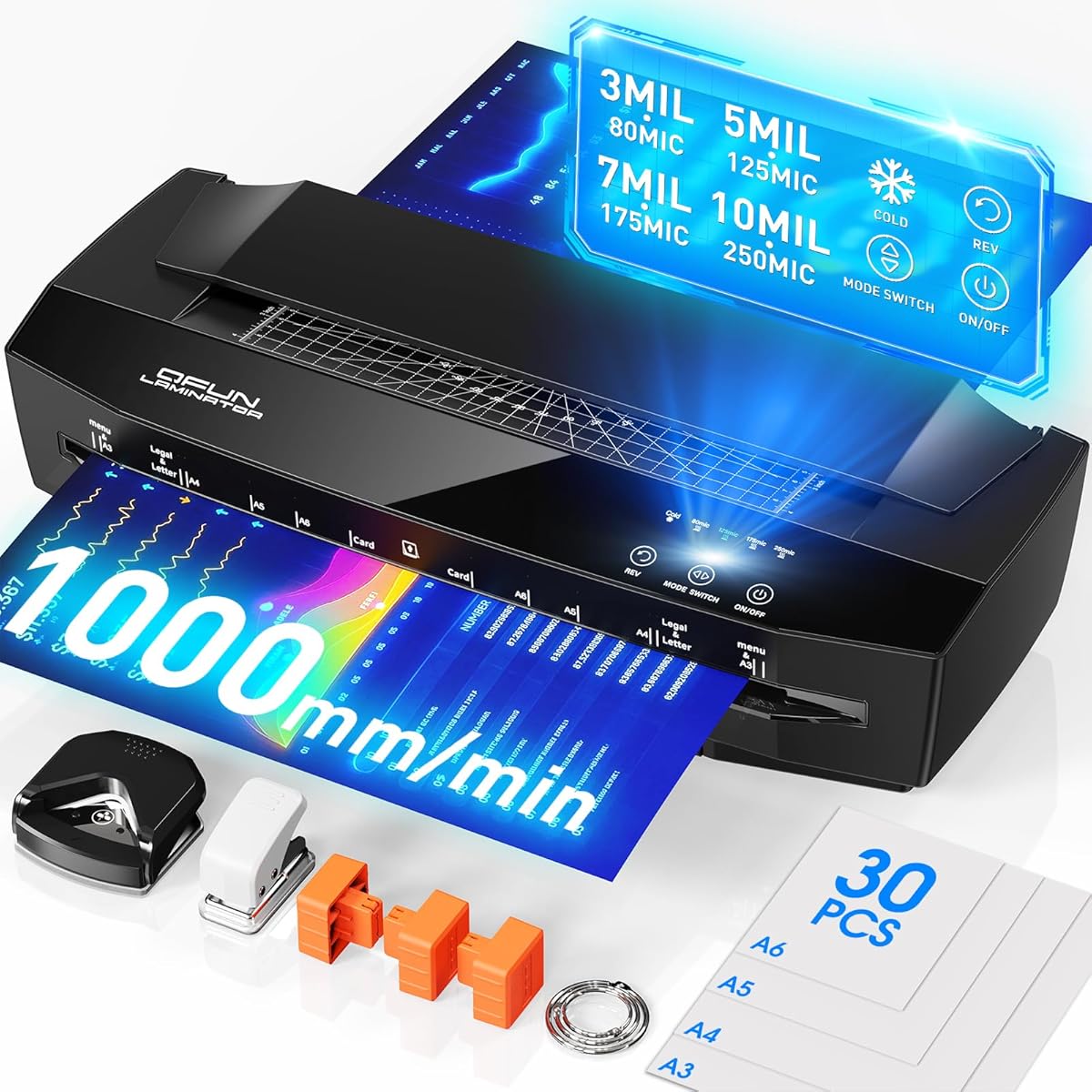
The Qfun 10-Mil Thermal Laminator earns a 4.3 rating by pairing a one-minute warm-up with a maximum throughput of 1000 millimeters per minute. Its 13-inch slot accepts project sizes from compact ID cards to 11-by-17-inch posters, making it suitable for educators, business operators, studios, and production teams.
We may earn a commission when you buy through this link, at no additional cost to you.
The four-roller pressure system is designed to provide uniform pressure, reduce bubbles, and limit wrinkles and curled edges. An LCD touch interface makes it possible to adjust settings for pouch thickness and switch between hot and cold lamination. For users who value guided operation rather than a single on/off control, this model offers a more sophisticated interface.
Jam handling is addressed through a REV smart reversal function that reverses the rollers for retrieval of a misfed sheet. Temperature monitoring, overheat protection, and automatic shutdown after 30 minutes add layers of operational safety. The included cutter, corner rounder, punch, binder rings, and 30 sheets make it easy to produce finished documents without several separate tools.
This laminator is best for organizations that want speed, finishing tools, and touch controls in one package. It may be more feature-rich than necessary for occasional home projects, but for regular business and classroom production, the integration can reduce workflow friction. It is the most rounded choice for teams producing documents as well as finished presentations.
The accessory compartment consolidates a cutter, corner rounder, hole punch, and binder rings with the laminator. This is especially useful for workshops, classrooms, and offices that need a complete presentation workflow.
The LCD interface simplifies thickness selection, while the reverse ejection system helps recover misfeeds. Together they make the machine approachable even when users are processing different materials throughout the day.
We may earn a commission when you buy through this link, at no additional cost to you.
With a 4.9 rating, the SINCHI 13-Inch 6-Roller Laminator is the strongest overall recommendation for production-oriented users. It combines a two-minute warm-up with a maximum speed of 81 inches per minute, allowing the manufacturer to describe processing in fewer than nine seconds per page.
We may earn a commission when you buy through this link, at no additional cost to you.
Six rollers are the defining feature. The system is intended to produce clean sealed edges without bubbling, warping, or curling, which is valuable for menus, certificates, signage, and training materials. The 13-inch feed accepts items from ID cards to 13-by-19-inch posters and supports three-to-ten-mil pouches.
This is clearly not positioned as a quiet home appliance. Its aluminum housing, metal gearbox, and commercial orientation indicate that it is designed for workplaces where throughput matters. It also uses a 120-volt US plug, and the product information specifies that use outside North America is unsupported. Buyers should also note that it is intended for standard pouches, not DTF decals, sublimation films, vinyl rolls, or industrial transfer materials.
Despite those boundaries, it is a compelling choice for schools, offices, and print shops that need rapid batch production and broad media compatibility. The included starter sheets, cleaning paper, safety protections, foil capability, and thickness-switching convenience further strengthen its case. For serious daily throughput, this is the pick to prioritize.
The machine can run at up to 81 inches per minute while accepting documents up to 13 by 19 inches. It remains suitable for mixed three-to-ten-mil projects without a lengthy reheating pause.
The aluminum housing and metal gearbox indicate a durability-focused design. Automatic shutdown and built-in protections help manage heat and unsafe operating conditions, while cleaning paper supports routine roller maintenance.
We may earn a commission when you buy through this link, at no additional cost to you.
The Apache 13-Inch Thermal Laminator provides a different approach to heavy duty work: a compact, lightweight, two-roller machine with straightforward controls. Its 4.4 rating and support for common pouches through 10 mil, plus Apache specialty 13- and 16-mil products, make it worth considering for users who need capability without a large commercial housing.
We may earn a commission when you buy through this link, at no additional cost to you.
One of its more notable productivity features is the ability to laminate three 3-mil pouches simultaneously, producing up to three pages per minute. The product guidance notes that a carrier is recommended for a single or two-pouch batch, since extra exposure to heat can be undesirable. Its 13-inch width accommodates A3, 11-by-17-inch, large menu, 12-inch, and sideways letter-size projects.
The simple interface uses an on/off switch, power and ready indicator lights, and an anti-jam release button. That limited control scheme is both a strength and a limitation. It makes the machine approachable and easy to place in a shared workspace, but it does not offer the fine adjustment, memory, or display-based feedback found on more sophisticated commercial models.
Apache is a sensible choice for schools, small offices, craft businesses, and home users who want a wider format and thicker pouch capability in a simpler package. Buyers should confirm their pouch thickness and use a carrier for small multi-pouch batches as directed. It prioritizes versatility and ease over six-roller refinement.
The ability to process three 3-mil pouches at once can meaningfully improve short-batch productivity. Correct carrier use helps control excess heat when fewer or smaller pouches are being laminated.
Two indicator lights, one switch, and a jam-release control keep operation uncomplicated. This makes the laminator suitable for shared spaces where a complex interface would not add meaningful value.
We may earn a commission when you buy through this link, at no additional cost to you.
The LOTHANEK 4-Roller Laminator has a 4.5 rating and a balanced set of features for everyday heavy use. A 60-second warm-up and maximum speed of 990 millimeters per minute make it especially attractive for teachers, office professionals, and crafters who cannot afford long delays between individual projects.
We may earn a commission when you buy through this link, at no additional cost to you.
Its four-roller system is intended to distribute heat and pressure consistently across the pouch. Once the machine reaches operating temperature, users can move between three- and ten-mil settings without reheating. That feature is valuable in mixed workflows involving lightweight school materials alongside heavier cards, menus, and displays.
Jam recovery is handled with a reverse button, and the smooth output tray helps keep finished pieces flat. Unlike several feature-heavy competitors, this model does not advertise a large screen or complex control panel. That simplicity may be an advantage in busy classrooms and shared workspaces, where a straightforward routine is easier for occasional operators to follow.
The package includes 50 laminating sheets and a corner rounder, providing useful tools for creating polished results. This model is a strong middle ground for users who want four rollers and fast output without a commercial metal gearbox or premium touchscreen. Choose it for frequent mixed-material projects in an office, school, or home craft business.
Switching between three- and ten-mil pouches without reheating helps preserve momentum. The four rollers and smooth exit tray support a practical workflow built around varied project sizes.
Fifty starter sheets and a corner rounder make the package more versatile. The accessories are especially convenient for teachers and small businesses that regularly prepare cards, menus, and classroom materials.
We may earn a commission when you buy through this link, at no additional cost to you.
The 13-Inch 4-Roller Heavy Duty Laminator carries a 5.0 rating and offers one of the strongest specification sets in the group without moving into the premium LCD category. It supports document sizes through A3, including A4, Letter, Legal, and smaller formats, and handles three-to-ten-mil thermal pouches.
We may earn a commission when you buy through this link, at no additional cost to you.
Four heating rollers are designed to distribute heat evenly for bubble-free, wrinkle-free results. The DC motor supports a maximum speed of 900 millimeters per minute, while a one-minute preheat gets the machine ready. Once warm, users can change between three- and ten-mil pouches without reheating, which is particularly useful for mixed classroom or office work.
Unlike many competing four-roller models, it offers both hot and cold modes. Cold operation accommodates self-adhesive laminating sheets, while thermal mode covers common three-to-ten-mil pouches. A reverse button handles misfeeds without pulling or dismantling the machine, and the integrated exit tray helps prevent finished sheets from curling.
The included 50 A4 three-mil pouches and corner rounder add immediate utility. Its 900-millimeter-per-minute maximum is below the fastest machines here, and the A3 limit means it cannot take 13-by-19-inch work. Even so, it is an excellent budget-oriented recommendation for users who value four rollers, mode flexibility, and a generous starter kit.
Hot mode covers thermal pouches from three to ten mil, while cold mode expands the machine's usefulness to self-adhesive sheets. This flexibility makes it practical for more than one laminating method.
The four heated rollers promote even results, and the one-touch reverse function helps recover a jam. The smooth exit tray supports flat, neatly stacked output.
We may earn a commission when you buy through this link, at no additional cost to you.
The Fellowes Venus 2 125 has a 4.0 rating and focuses on automated operation for high-volume school preparation. Its AutoSense system detects pouch thickness and selects the appropriate setting, reducing guesswork when educators process large quantities of mixed teaching materials.
We may earn a commission when you buy through this link, at no additional cost to you.
The machine becomes ready in 30 to 60 seconds and laminates at up to 43 inches per minute. A six-roller core supports clear results, while document widths reach 12.5 inches. It accepts hot pouches up to 10 mil as well as cold sheets, giving schools flexibility in how they protect worksheets, visual cards, and instructional displays.
Advanced safety and maintenance features include automated misfeed clearing and energy-saving power management. These systems suit an environment where the machine will be operated repeatedly, often by different people. The primary limitation is width: it cannot match the 13-inch intake of many competitors, and letter-size media must be oriented to fit.
Fellowes is a strong pick for schools and educators who want automatic thickness handling more than maximum media width. Its rapid startup, six-roller design, and automated recovery reduce training and workflow complexity. It is particularly attractive for intensive classroom preparation where varied pouches are processed back-to-back.
AutoSense adjusts to the pouch thickness automatically, which is useful when an operator is processing mixed stacks. This removes the need to stop and manually configure each thickness.
Fast warm-up, high-speed processing, and a six-roller core align well with intensive school preparation. Automatic recovery and power management further support frequent shared use.
We may earn a commission when you buy through this link, at no additional cost to you.
The Scotch TL901X Thermal Laminator has a 4.7 rating and represents a more compact alternative to the full commercial-style machines in this guide. It accepts pouches up to nine inches wide and supports three- and five-mil thicknesses, making it appropriate for photos, flyers, schedules, and frequently handled school documents.
We may earn a commission when you buy through this link, at no additional cost to you.
Two heated rollers and two temperature settings are intended to create bubble- and wrinkle-free results. The machine laminates one letter-size page per minute and includes a release lever for quickly removing a pouch. Its straightforward design makes it suitable for a dorm room, home office, classroom, or small creative workspace.
This is not the strongest choice for genuinely heavy production. It lacks the six-roller pressure system of higher-end models, processes substantially fewer pages per minute, and cannot accept the 10-mil or oversized pouches supported by many competitors. The limited nine-inch width also restricts large signs, posters, and wide presentation materials.
Even so, users who mainly need a dependable compact laminator for standard paper and photos will find the TL901X focused and uncomplicated. It is best viewed as a light-duty or occasional complement to a truly commercial system. For schools, homes, and offices with modest weekly volume, its simplicity and compactness are meaningful benefits.
The machine can create marker-resistant, tear-resistant, and spill-resistant documents and photos. It is well matched to calendars, school flyers, schedules, and memorabilia.
Two temperature settings and a release lever reduce complexity and support quick operation. The small format also makes storage easier in offices, classrooms, and home workspaces.
We may earn a commission when you buy through this link, at no additional cost to you.
The SINCHI Robust 6-Roller LCD Laminator is the premium selection because it combines the fastest stated throughput in the group with the most extensive control system. Its 4.4 rating reflects a capable commercial machine with a 90-inch-per-minute maximum speed, a 13-inch inlet, and support for three-to-ten-mil pouches.
We may earn a commission when you buy through this link, at no additional cost to you.
Six silicon rollers include four hot and two cold components. The LCD panel lets users choose settings based on pouch thickness and document type, adjust speed, and access 105 available settings. Up to 99 memory presets can save favored configurations, reducing repetitive setup when a production team regularly uses the same combinations.
Its luxury aluminum housing and heavy duty metal gearbox make clear that this is not a quiet home model. SINCHI explicitly describes the noise as normal and says the machine is not intended for home or quiet office use. It also has a 120-volt US plug, and international use is not supported under the stated warranty.
For commercial print shops, packaging operations, signage teams, and high-volume offices, these limitations are part of the intended positioning. The machine offers broad media compatibility, sophisticated controls, foil application, automatic shutdown, and a maintenance sheet. It is the premium choice when maximum speed, repeatable settings, and production-level construction outweigh quiet operation.
The LCD panel, micro-adjustable speed, 105 settings, and 99 memories allow operators to build repeatable processes. That granularity is valuable when different projects require distinct heat, pressure, or speed combinations.
Six rollers and a 90-inch-per-minute maximum support demanding daily production. The 13-inch inlet and three-to-ten-mil range cover a broad mix of cards, posters, and printed pieces.
We may earn a commission when you buy through this link, at no additional cost to you.
The Chilino 4-Roller Laminator offers a 55-second warm-up, a maximum speed of 1000 millimeters per minute, and a four-roller design within a 13-inch frame. Those specifications position it as a capable option for A3 and 11-by-17-inch work, although its 3.0 rating is the lowest among the listed machines.
We may earn a commission when you buy through this link, at no additional cost to you.
The feed handles cards, legal documents, A3 sheets, and 11-by-17-inch posters, as well as letter, photo, and business-card sizes. Three- to ten-mil pouches cover light documents through more durable protection, making the machine relevant for menus, signs, certificates, photos, and classroom displays.
A REV reverse function helps eject misfed sheets, while automatic shutdown after 30 minutes and overheat protection improve safety. The machine does not provide the elaborate displays, memory presets, or detailed adjustments seen on the premium commercial models, so its appeal rests more on core performance and included accessories.
The accessory kit is unusually extensive, with 30 sheets in several sizes and a corner rounder, cutter, hole punch, and binder rings. This makes Chilino a practical option for users who want a ready-made document-finishing setup. Its lower rating warrants comparing owner feedback carefully, but the measured specifications and accessories make it a credible choice for standard commercial-style tasks.
The included cutter, corner rounder, punch, sheets, and binder rings cover several finishing steps. It is convenient for schools and small businesses building educational, promotional, or presentation materials.
A 55-second warm-up and 1000-millimeters-per-minute maximum support quick workflows. The 13-inch intake provides room for large posters while retaining a four-roller pressure system.
We may earn a commission when you buy through this link, at no additional cost to you.
Choosing a heavy duty laminator means balancing document width, pouch thickness, throughput, controls, and the amount of noise your workspace can tolerate. The following factors help narrow the options before you commit to a model.
The intake width determines the largest project you can laminate without trimming or rotating it. Thirteen-inch models accommodate A3, 11-by-17-inch, 13-by-19-inch, wide menu, and poster projects, while the Fellowes Venus 2 125 handles documents up to 12.5 inches. Smaller machines such as the Scotch TL901X accept pouches up to nine inches, making them more appropriate for standard paper, photos, and school sheets.
Choose a width that fits your regular workload, not merely the largest advertised project. A wider machine adds flexibility but may require more counter space and may be unnecessary if every document fits letter or A4 paper.
Three-mil pouches suit lightweight paper and routine protection, while five-mil pouches provide greater rigidity and five- through ten-mil products are useful for cards, badges, menus, and frequently handled items. Heavy duty models in this guide commonly support three-to-ten-mil pouches, while Apache also advertises its specialty 13- and 16-mil products.
Confirm both the machine's pouch range and the exact thickness of your supplies. A model that supports a wide range but requires a special carrier or particular feed method may not suit every pouch configuration equally well.
More rollers can improve pressure distribution, reduce bubbles, and limit edge curling, especially on thick or uneven materials. The SINCHI 6-Roller models and Fellowes Venus 2 125 use six-roller systems, while several other commercial-style choices use four. Apache and Scotch use two rollers, which keeps their designs simpler and more compact but places greater emphasis on correct thickness settings and preparation.
Prioritize more rollers for sustained professional production. For occasional work with standard pouches, a simpler two- or four-roller machine may be sufficient and easier to store.
Warm-up time affects how quickly the laminator can begin a job, while throughput determines how efficiently it handles a batch. Models range from a 30-to-60-second readiness window on the Fellowes to two minutes on the larger SINCHI commercial units. Maximum speeds vary from one letter-size page per minute on the Scotch to as much as 90 inches per minute on the premium LCD model.
For intermittent work, a fast warm-up may matter most. For long batches, sustained throughput and consistent roller performance usually matter more than the first few seconds of preparation.
Even heavy duty machines can encounter crooked pouches, debris, or adhesive buildup. Reverse functions appear on most models in this guide, including Qfun's REV system, LOTHANEK's reverse button, and Chilino's REV control. The SINCHI 13-Inch 4-Roller adds a patented anti-jamming system intended to keep misaligned sheets moving, while Apache provides a dedicated release button.
Look for recovery controls that are easy to identify and use. Routine roller cleaning is equally important, so a machine supplied with cleaning paper or with a simple cleaning routine is easier to maintain properly.
The control range runs from simple on/off operation to extensive programmable settings. Apache uses two indicator lights and a switch, while the Qfun offers an LCD touch interface with hot and cold modes. The premium SINCHI LCD model offers 105 settings, speed adjustment, and 99 memory presets, making it well suited to operators who repeat specific production configurations.
Choose simple controls for occasional use and advanced settings for complex workflows. More features are useful only if staff will understand and maintain them, so consider the experience level of the people operating the machine.
Safety features include overheat protection, temperature monitoring, automatic shutdown, and abnormal-condition sensors. The commercial SINCHI models are intentionally louder because of their metal gearboxes, while Apache emphasizes a compact, lightweight design and LOTHANEK describes efficient, quiet operation. All three SINCHI commercial units specify a 120-volt US plug and limited warranty coverage outside North America.
Check the expected sound level, electrical requirements, ventilation, and automatic shutoff behavior before installation. A machine that is too loud for the intended room or incompatible with local power will create practical problems despite strong lamination specifications.
Starter pouches make a new laminator immediately useful, while cutters, punches, corner rounders, and binder rings can create a more complete finishing station. Qfun includes 30 sheets and several tools, Chilino includes 30 mixed-size sheets and a similar accessory set, and the budget-oriented 4-Roller model includes 50 A4 pouches. The three SINCHI models include ten three-mil sheets and a cleaning sheet.
Accessory value is most useful when it matches your normal projects. Extra pouches are helpful for immediate testing, but a larger machine should still be chosen primarily for width, speed, reliability, and compatibility rather than included items.
Before the first run, read the machine's instructions, confirm that the voltage and plug are appropriate, and place the laminator on a stable, level surface with clearance around the intake and output tray. Insert the correct pouch, allow the machine to reach its ready indicator, and confirm that the selected thickness setting matches the pouch before feeding the project.
Feed each pouch straight and keep the document centered within the seal area. Avoid feeding multiple pouches unless the manufacturer specifically permits it and the required carrier is being used. If a pouch stops moving or enters crooked, use the reverse or jam-release control instead of pulling it forcefully. For foil work, use compatible heat-transfer material and the specified thickness setting.
Turn the machine off when the workday ends and unplug it according to its instructions. Keep the rollers clean by following the supplied guidance, use the included cleaning paper where recommended, and remove adhesive residue before it becomes a jam risk. Store spare pouches flat in a clean, dry area and do not use the laminator for materials it was not designed to process.
Use the pouch thickness explicitly supported by the machine and its instructions. Most models here accept three-to-ten-mil pouches, while Apache also advertises specialty 13- and 16-mil products. Choose three mil for ordinary paper, five mil for stronger everyday protection, and thicker pouches for rigid cards, badges, menus, or heavily handled displays.
Six-roller systems generally offer more opportunities for consistent heat and pressure distribution, which can benefit thick or demanding projects. Four-roller machines can still deliver strong results and often provide a better balance of speed, size, and convenience. The right choice depends on workload, pouch range, and the importance of fine production controls.
Models with a 13-inch intake can support A3, 11-by-17-inch, and some 13-by-19-inch projects. Check the maximum pouch size and document dimensions rather than assuming every oversized sheet can pass through. Smaller models may require trimming, rotating the media, or using an entirely different laminator.
Heavy duty machines often use powerful motors, metal gearboxes, and fast roller assemblies to produce high throughput. Those components naturally generate more sound than compact home models. If noise is a concern, identify where the machine will be used and compare models that explicitly describe quieter operation.
Keep the rollers clean, remove adhesive residue promptly, and make sure each pouch is inserted squarely. Use the machine's reverse function for a misfeed rather than pulling the pouch out. Cleaning paper is included with the SINCHI models, while all machines benefit from following their manufacturer-specific maintenance instructions.
No. Cold mode appears on the Qfun model and the 13-Inch 4-Roller Heavy Duty Laminator, and the Fellowes Venus 2 125 accepts cold sheets. Other machines primarily focus on thermal pouches. Check the specifications if you intend to use self-adhesive laminating sheets.
It depends on the session. A long batch can hide a short warm-up, while repeated one-off projects make startup time more noticeable. Faster models such as Apache, Chilino, LOTHANEK, and Fellowes reach readiness in approximately 30 to 60 seconds, whereas larger commercial SINCHI models use longer warm-up periods.
The three SINCHI commercial laminators list built-in foil applicator functionality that works with compatible SINCHI heat transfer foils at the 10-mil setting. Other machines may support specialized foils only if their instructions specifically permit it. Confirm material compatibility before running foil through any laminator.
The SINCHI 13-Inch 6-Roller Laminator is the strongest all-around high-volume choice, combining six rollers, broad media compatibility, and strong throughput. The budget-oriented 13-Inch 4-Roller model provides four heated rollers, hot and cold modes, a quick warm-up, and a generous starter kit, while the SINCHI Robust LCD model offers the most sophisticated premium controls.
Prioritize the features your workload actually requires. Frequent poster jobs call for a 13-inch intake, thick or rigid cards call for appropriate 10-mil support, and mixed classroom production may benefit from automatic thickness detection. High-volume operators should also consider roller pressure, sustained speed, jam recovery, noise, and the availability of maintenance supplies.
Finally, verify current specifications, electrical requirements, included accessories, and warranty terms before purchasing. Product configurations and marketplace details can change, so checking the latest listing ensures that the selected heavy duty laminator matches the materials, volume, and working environment you have planned.