
6mm Lens USB Dental Camera
Slim 6mm lens tip
Thirteen-megapixel CMOS sensor
Dual capture buttons
A dental camera transforms an oral examination into a clear visual record that can support diagnosis, treatment planning, documentation, and patient conversations. A useful model should deliver sharp images, illuminate hard-to-see surfaces, fit comfortably in the mouth, and integrate smoothly with the software already running in the practice.
We compared ten dental cameras across image resolution, lens design, lighting, autofocus behavior, connection method, supported imaging platforms, capture controls, and everyday usability. The list covers USB, wireless, and universal-connection options for practices, mobile clinics, educators, and consumers who need dependable intraoral views.
Each review explains the product's strongest features, practical limitations, and ideal user, while the comparison table provides a quick reference. Product specifications and availability can change, and prices fluctuate, so buyers should confirm the current listing, software requirements, and included accessories before purchasing.
4.4Editor score

4.3Editor score
As an Amazon Associate we earn from qualifying purchases.
This side-by-side overview highlights the principal differences among the ten cameras, including sensor resolution, lens width, lighting, connection type, focus behavior, and software support. It is designed to help readers identify the most suitable option before reading the full reviews.


The DY-50 Intraoral Camera combines a 4.5 rating with a direct USB workflow and one-button capture, making it a practical option for practices that already rely on established dental imaging platforms. Its stated 1600-by-1200 still-image resolution is modest by current standards, but the camera is designed around dependable documentation rather than elaborate video features.
We may earn a commission when you buy through this link, at no additional cost to you.
Its standout strength is compatibility. The supplied capture-button driver is listed for numerous platforms, including Eaglesoft, DEXIS, Apteryx, Carestream, Dentrix Ascend, Romexis, and many other systems. The camera connects directly to a computer through USB, eliminating the need for a separate power supply, receiver, or other hardware. It also includes a holder, cable, and disposable sheaths.
The 34-gram handset and two-meter cable should be manageable during routine examinations, while the anti-fog, non-spherical lens is intended to preserve clarity in a moist environment. Fixed autofocus, JPEG still images, and 640-by-480 video provide a straightforward specification set. The main limitation is that its resolution and video format trail newer models, especially for detailed presentations or magnified inspection.
This is a strong choice for a practice that uses one of the many supported programs, values a simple one-button workflow, and prefers a wired connection. Buyers should verify the exact software name and version in the compatibility list before ordering, particularly if their practice relies on a platform not mentioned or uses a modern operating system outside the stated Windows range.
The included capture-button driver is the DY-50's defining feature. Once the camera has been integrated with a compatible program, the clinician can save images without navigating a mouse or keyboard, which helps preserve a natural conversational flow during consultations and examinations.
At 34 grams, the handset is light enough for extended use, and the two-meter cable provides ample movement around a treatment chair. The anti-fog lens and included disposable sheaths support hygienic, repeatable operation in clinical settings.
We may earn a commission when you buy through this link, at no additional cost to you.
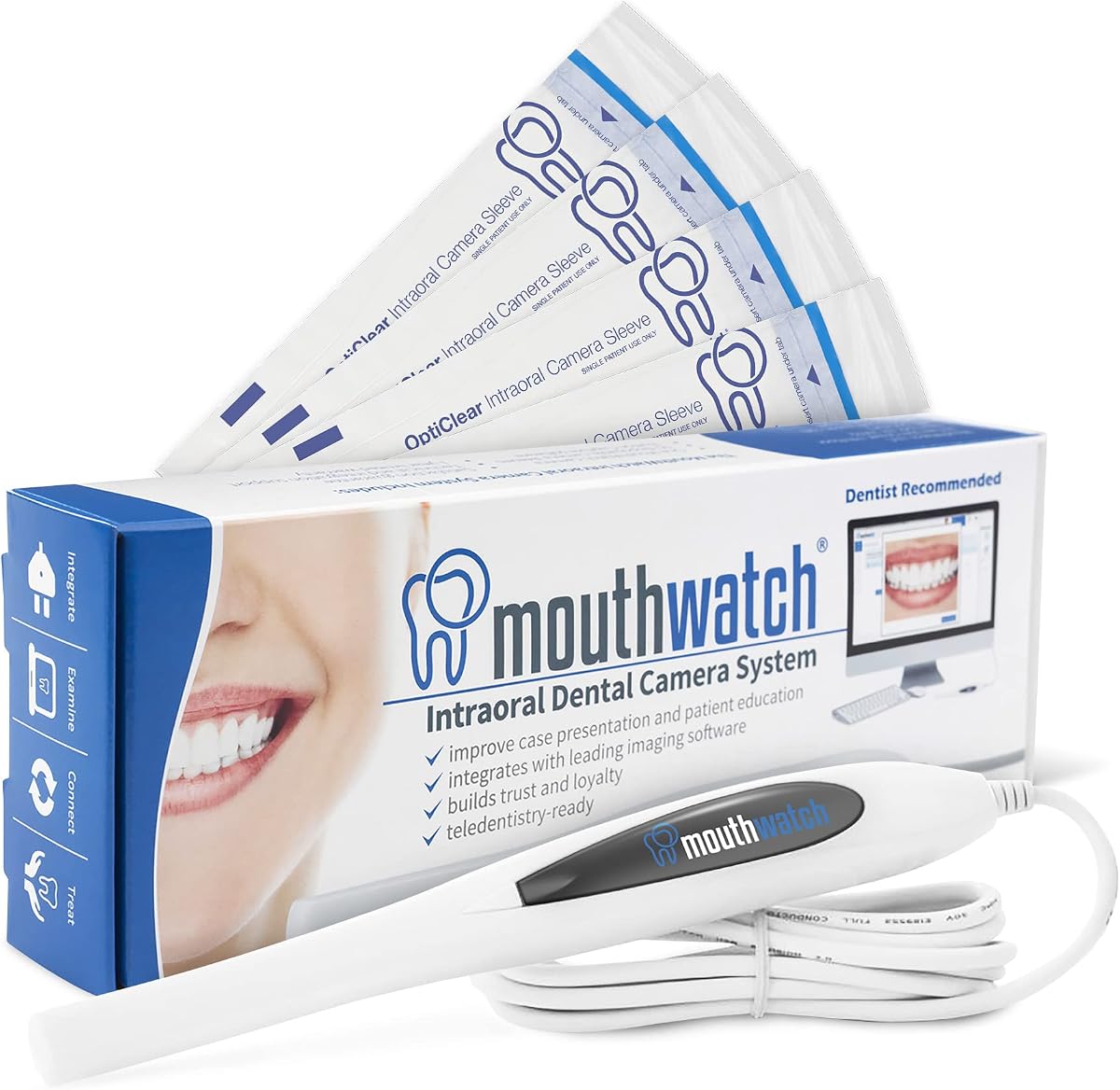
The MouthWatch Intraoral Camera earns a 4.4 rating and stands out for a highly efficient image-capture process. Its lightweight, ergonomic 31-gram handset is designed for fast chairside use, while a single capture button allows an image to be saved directly to a patient's chart without mouse or keyboard input.
We may earn a commission when you buy through this link, at no additional cost to you.
The camera uses a fixed 4mm-to-45mm focal distance rather than autofocus. That decision removes the delay and visual uncertainty associated with autofocus hunting, which can be valuable during time-sensitive examinations. It also includes proprietary capture software and supports more than 50 dental imaging integrations, including Eaglesoft, DEXIS, Schick, and Apteryx.
Potential limitations include the lack of a stated zoom function and the fixed focus range, both of which may require close positioning for very fine detail. It is also a wired model, so cable routing needs to be considered in compact operatories. Nonetheless, the device is explicitly optimized for clear, well-illuminated images without lag and quick chart-based storage.
The MouthWatch is best suited to practices that value speed, simple controls, and dependable integration over wireless freedom. It is especially compelling for clinicians who take frequent images during consultations and want to avoid a cumbersome capture sequence. Confirm that the practice's exact imaging suite appears among the supported integrations before installation.
A fixed 4mm-to-45mm working range helps the clinician frame an image without waiting for the lens to refocus. In a patient conversation, that predictable response can make the difference between a smooth demonstration and a distracting technical delay.
The 31-gram handset reduces hand fatigue and supports balanced handling. Its ergonomic shape is particularly useful for practices that routinely document multiple teeth, soft tissues, and treatment areas during a single appointment.
We may earn a commission when you buy through this link, at no additional cost to you.
The DARYOU DY-60 pairs 720P HD video with a four-times zoom function, giving it a distinct advantage when a clinician wants to highlight a small area of interest. Its 4.3 rating reflects a well-rounded feature set, and the inclusion of a capture-button driver helps the device fit into established imaging workflows.
We may earn a commission when you buy through this link, at no additional cost to you.
The product supports numerous dental platforms, including Eaglesoft, DEXIS, Apteryx, Carestream, Suni, Dentrix, Romexis, and other listed systems. A direct USB design keeps the connection uncomplicated, and no foot pedal is required. The DY-60 appears particularly well suited to case presentation, remote review, and documentation that benefits from magnified video.
The available product information is less detailed than for some alternatives. It does not provide a specific sensor size, still-image resolution, focal range, or exact lens-tip diameter, so buyers cannot fully compare its optical characteristics with newer 13-megapixel models. Digital zoom can also magnify image data rather than add optical detail, making capture technique and lighting important.
Choose the DY-60 when zoomable HD video is a priority and the practice uses a supported platform. It may be less appealing for buyers who require detailed optical specifications or want a very thin probe for difficult access. Confirm integration, operating-system support, and included components with the seller before making a final decision.
The four-times digital zoom can make cracks, discolored areas, and other localized findings easier to discuss. Used with steady positioning and even illumination, it gives clinicians another way to emphasize a specific detail during a consultation.
The included capture driver is designed to make the hardware button function across an extensive list of imaging solutions. This support is valuable for established practices that do not want to replace their chart or imaging workflow simply to accommodate a new camera.
We may earn a commission when you buy through this link, at no additional cost to you.
The Wireless 13MP Intraoral Camera is built around freedom from a tether during the examination. It uses wireless transmission and includes a charging base, allowing the clinician to move between the patient, computer, and other parts of the operatory without managing a long cable.
We may earn a commission when you buy through this link, at no additional cost to you.
Its imaging system combines a 1/2.8-inch CMOS sensor with smart autofocus and eight integrated LEDs. The 13-megapixel still-image capability is higher than the resolution stated for several wired alternatives, while the lighting system is designed to reduce dark corners and provide more uniform views of teeth and gums.
Because the product has no supplied customer rating, the strongest claims here come from its published specifications rather than a large body of user feedback. A USB receiver is included for connection to a computer, and the camera is described as compatible with most dental management software. Wireless stability, battery endurance, and exact integration requirements should still be confirmed in the intended clinical environment.
This model is a good candidate for practices seeking a modern cordless design and a generous sensor resolution. It is especially attractive for mobile examinations or operatories where cable management is inconvenient. Before buying, verify the receiving software, operating-system requirements, charging procedure, and whether wireless capture is supported by the practice's preferred platform.
Removing the cable can reduce snagging, cable crossing, and the need to reposition a computer during an exam. The included wireless charging base also gives the camera a defined storage location, making it easier to keep the device ready between patients.
Multiple integrated LEDs provide illumination from the camera tip, helping reveal surfaces that may be difficult to see under reflected room light. Combined with autofocus, this is intended to support both still documentation and real-time observation.
We may earn a commission when you buy through this link, at no additional cost to you.
The ProDENT HD PD760 is a wired intraoral camera designed for practices running common versions of Windows. It holds a 4.0 rating and distinguishes itself through broad operating-system support, plug-and-play installation, and a capture application designed to integrate with many American dental imaging programs.
We may earn a commission when you buy through this link, at no additional cost to you.
A quick-connect USB 2.0 interface simplifies attachment to the treatment unit, while the holder-triggered automatic power-off function helps conserve energy between patients. The ProDENT CAPTURE application is intended to make the hardware button function with Eaglesoft, DEXIS, Carestream, CurveHero, OpenDental, Dentrix, TigerView, Apteryx, and other supported software.
The product information does not state a specific still-image resolution, lens diameter, video format, or zoom capability. That makes direct image-quality comparisons less precise than with models that publish detailed sensor and optical specifications. Its wired design also requires adequate cable reach and a convenient computer location. Integration with an unlisted platform may require additional configuration.
The PD760 is best for clinics that value a familiar Windows workflow, straightforward USB attachment, and vendor support over wireless convenience or advanced magnification. Before ordering, check the exact imaging software and operating-system version, and confirm whether the required capture application and connection components are included for your setup.
Placing the camera in its holder automatically turns it off, reducing the need for manual shutdown between appointments. This is a small workflow feature that can support cleaner patient turnover and help preserve battery or system readiness.
The dedicated capture application is designed to bridge the physical camera button and multiple imaging programs. For practices already using one of the listed platforms, that bridge can make image storage feel like a natural part of the existing chart workflow.
We may earn a commission when you buy through this link, at no additional cost to you.
The 6mm Lens USB Dental Camera combines a thin tip, thirteen-megapixel CMOS sensor, and six adjustable LEDs in a simple wired design. It is a compelling value-oriented option for buyers who prioritize physical access, useful controls, and basic USB operation over wireless convenience or extensive branded integration support.
We may earn a commission when you buy through this link, at no additional cost to you.
The narrow six-millimeter probe is designed to reach back molars and interdental areas, while its 105-degree field of view and LED illumination are intended to capture dental detail. Front and rear buttons provide one-click image capture from different grip positions. Power comes from the computer's USB port, and the product is described as working with most mainstream dental imaging software without extra drivers.
There is no supplied customer rating, so there is no rating history to help gauge long-term consistency. The claim of compatibility with most mainstream software is broad and should be checked against the practice's exact platform before purchase. It is also a wired camera, and no information is provided about a proprietary application, waterproof rating, autofocus, or supported video format.
This camera makes the most sense for a clinic seeking a slender probe and dual-button operation without a wireless receiver or charging dock. It can also suit dental education or personal oral-health monitoring, as the product description notes. Confirm the software workflow, capture storage location, and operating-system requirements before integrating it into a clinical system.
A six-millimeter lens is slim enough to enter tight posterior spaces and work between teeth more readily than a bulky probe. This can improve access during examinations when comfort and visibility are both important.
Capture buttons on both sides of the handle reduce the need to rotate the camera while composing an image. The magnetic holder also turns off the LEDs when the device is placed down, helping conserve energy and extend LED service life.
We may earn a commission when you buy through this link, at no additional cost to you.
The 13MP USB Dental Camera offers a detailed still-image specification and a clearly defined 10-to-40mm focus range. Its 105-degree field of view, six white LEDs, and plug-and-play USB power make it a flexible option for examinations, education, mobile setups, and personal oral monitoring.
We may earn a commission when you buy through this link, at no additional cost to you.
The camera uses a 1/4-inch CMOS sensor with a stated 13.0-megapixel resolution. A smart magnetic holder automatically switches off the LEDs when the device is hung, while front and back capture buttons support quick operation. USB 2.0 power at 5 volts means the camera can run without a separate external supply, which is useful in a mobile environment.
The product listing states compatibility with all dental software on the market, but such a universal claim should be treated cautiously. In practice, compatibility may depend on the operating system, imaging application version, capture method, and whether the images are opened through a standard image library or direct chart integration. No customer rating is available, so long-term user feedback is limited.
Buyers should consider this model when a high stated still-image resolution, specific focus range, and simple USB power are priorities. It may be particularly appropriate for education or a second viewing device where precise clinical-software integration is less demanding. Before purchasing, test the capture process in the intended software and confirm that saved images appear correctly in the patient record.
The stated 10-to-40mm working range gives users a clearer idea of how close the lens should be to the target surface. That is helpful for maintaining consistency across photographs and reduces reliance on trial-and-error positioning.
Because the camera draws power from a USB 2.0 port, it can operate without a separate power brick. That makes the device easier to deploy in mobile dental work, training environments, or secondary operatories where conventional equipment connections are limited.
We may earn a commission when you buy through this link, at no additional cost to you.
The 5mm Ultra-Thin Intraoral Camera combines a narrow probe, anti-shake stabilization, built-in capture software, and optional diagnostic analysis in one package. Its 4.4 rating places it among the stronger choices in the guide, especially for clinics seeking more than basic image capture.
We may earn a commission when you buy through this link, at no additional cost to you.
The camera offers a fixed 5mm-to-50mm focus range to reduce blur and eliminate the waiting involved with autofocus hunting. Its built-in software supports major imaging solutions such as Eaglesoft, DEXIS, Schick, and Apteryx, with more than 50 integrations stated. The included oral diagnostic software may analyze captured images, identify or mark possible conditions, and help generate reports for record management.
Those diagnostic functions should be treated as decision-support tools rather than independent clinical diagnoses. Image recognition can depend on lighting, focus, positioning, and the condition being assessed, so output requires professional review. The product information does not state a specific image resolution, connection method, or waterproof rating, and it appears to use a wired setup.
This is a strong option for a clinic that values a very thin probe, broad chart integration, and software-assisted image review. The anti-shake and wide focus range are particularly useful when one-handed positioning varies. Confirm the exact connection, operating requirements, and how the practice's preferred imaging program stores files before choosing it over simpler models.
The built-in analysis tools can examine captured images and potentially mark visible oral conditions. These features may help organize observations and support reporting, while the dentist or hygienist remains responsible for interpreting the image and determining the appropriate care.
The ultra-thin five-millimeter design is intended to reach confined areas with minimal intrusion. It can improve comfort and access in posterior teeth while also helping the clinician photograph interproximal or other difficult-to-view surfaces.
We may earn a commission when you buy through this link, at no additional cost to you.
The 13MP 4.8mm Intraoral Camera prioritizes access and patient comfort with an ultra-thin probe, eight integrated LEDs, and thirteen-megapixel still images. It is designed to capture detailed photographs and real-time video of teeth and gums, including in low-light conditions.
We may earn a commission when you buy through this link, at no additional cost to you.
The four-point-eight-millimeter tip is narrow enough for insertion with only a slight mouth opening, making the camera potentially useful for children, anxious patients, and anyone with limited jaw opening. Front and back snapshot buttons support different hand positions, while a magnetic holder turns the LEDs off when the camera is not in use.
The camera connects through a USB 2.0 controller cable and is described as compatible with most dental imaging software. However, no customer rating is available, and the product information does not specify the still-image format, video resolution, focal range, autofocus behavior, or waterproof rating. Those omissions make it important to verify whether the camera can save images directly into the intended chart workflow.
This model is a good fit for a practice prioritizing a very thin tip, strong tip illumination, and simple capture controls. It may be particularly useful for pediatric, orthodontic, or general examinations where patient tolerance is important. Confirm software support, operating-system compatibility, and image export behavior before purchasing.
The four-point-eight-millimeter probe is among the slimmest options in this guide. Its reduced diameter can make entry less intimidating and improve access in tight spaces, supporting a more comfortable examination for sensitive patients.
Eight high-brightness LEDs surround the imaging area to create consistent illumination inside the mouth. This can improve the visibility of enamel, gingiva, and localized findings when a procedure is difficult to see under ordinary room lighting.
We may earn a commission when you buy through this link, at no additional cost to you.
The 1920P 3-in-1 Oral Endoscope is the most consumer-oriented product in this guide, designed for magnified inspection on compatible Android devices and Windows computers. It is best viewed as a flexible visual tool for personal oral care rather than a practice-grade camera built to integrate into a dental chart.
We may earn a commission when you buy through this link, at no additional cost to you.
Its integrated connector supports USB, USB Type-C, and Micro USB, reducing the need to carry separate adapters. The device can provide real-time high-definition imagery on an OTG-enabled Android phone or computer, and six adjustable high-intensity LEDs illuminate otherwise dark areas. An IP67 water-resistance rating allows the camera head to be rinsed after use.
Compatibility is limited in a meaningful way: the product does not work with iPhone or iPad systems. It also lacks the dental-software integration, capture-button workflow, patient-chart support, and professional diagnostic tools found in the clinical models. Buyers should not mistake its high-definition output for a fully compatible dental imaging system.
Choose this endoscope for personal inspection, travel, education, or general household viewing on Android and Windows devices. It is less appropriate for a clinical practice that needs reliable image storage inside a patient record. Check connector type and device support before purchasing, and follow the manufacturer's care and rinsing guidance.
The three-in-one connector approach is useful for buyers who move between USB-A, USB Type-C, and Micro USB devices. It reduces adapter clutter, although the compatible device must still support the appropriate connection and data transfer mode.
Real-time magnification and adjustable LED illumination help reveal small surface details that are difficult to inspect directly. The feature set is particularly useful for personal monitoring, demonstrations, and learning how oral surfaces look under magnification.
We may earn a commission when you buy through this link, at no additional cost to you.
The right dental camera is not defined by megapixel count alone. Compatibility, image workflow, lens access, lighting, connection stability, and cleaning requirements should determine which model fits a particular practice, classroom, or personal routine.
The camera must communicate with the practice's chart, imaging, or management software, and a device can be technically capable while still being awkward to integrate. Look for explicit mentions of the exact platform used by the practice, including Eaglesoft, DEXIS, Dentrix, Carestream, Schick, Apteryx, or other systems. Pay attention to the version of the capture driver or application and whether images are stored directly in the patient chart, opened through a generic image viewer, or exported as files. A compatibility list is useful, but it is not a substitute for confirming the practice's actual configuration.
Briefly: verify the exact software name, operating system, and capture workflow before buying.
USB models offer direct computer power, straightforward setup, and no separate receiver, while wireless cameras provide greater freedom from the treatment chair. Wired devices are often easier to integrate with established workstation setups because they avoid network pairing and connectivity interruptions. Wireless models can improve movement around the patient, yet they introduce questions about signal stability, battery charging, receiver placement, and how the capture button interacts with software. Mobile clinics may also favor USB power, while fixed practices may value wireless freedom more highly.
Briefly: choose wired simplicity or wireless mobility according to the operatory and the practice's integration priorities.
Resolution influences how much fine detail is retained in a saved photograph, but a high pixel count cannot compensate for poor focus, unstable lighting, or moisture on the lens. Some models specify still-image resolution while others emphasize video output, so buyers should compare the actual capture format rather than a marketing term such as HD. Fixed-focus cameras can offer consistent results when the working range is known, while autofocus models may be more convenient when camera-to-subject distance varies considerably.
Briefly: match resolution to the output you need, then prioritize steady focus, clear lighting, and smooth transmission.
A slim lens tip is important for reaching posterior molars, interproximal spaces, and areas where patients have limited opening. Options in this guide range from 4.8mm to 6mm, with the thinnest designs most likely to improve comfort and access. A smaller tip can also make positioning in tight anatomy easier, although the illumination system must still deliver an even view. Buyers should consider the dimensions of the probe as well as the size and balance of the handle to ensure the whole device feels manageable.
Briefly: select a thin, ergonomic probe that can reach the areas you routinely examine without forcing access.
Even illumination is essential because shadows can conceal cavities, cracks, discoloration, or soft-tissue details. Models with multiple integrated LEDs generally offer better visibility than a single light source, particularly in deep or narrow areas. Fixed focus can remove autofocus delay and image hunting, but the stated working range must suit the intended examination distance. Autofocus adds convenience when positioning changes, though the device may pause briefly while adjusting. The best results come from lighting, focus, and stable camera movement working together.
Briefly: favor uniform LED illumination and a focus method that matches your typical camera-to-tooth distance.
One-button capture can make a substantial difference during a patient consultation. If the camera can save directly to a chart with one press, the clinician does not need to move attention to a mouse, locate the correct patient, and manually import the image. Dual-sided buttons provide flexibility for different grip positions, while a foot pedal may be useful in some workflows. Also consider what happens when the device is placed in its holder, since automatic LED shutdown and power-off behavior can simplify patient turnover.
Briefly: prioritize a capture process that stores images quickly without interrupting conversation or attention to the patient.
A dental camera enters the mouth, so its cleaning requirements should influence the selection. Some models include disposable sheaths, while others are described as water-resistant or have an anti-fog lens coating. None of the listed specifications should be assumed to mean the entire device can be sterilized; buyers should follow the manufacturer's instructions and confirm compatible barriers or protective methods for their clinical protocols. The included holder, cable, receiver, charging base, and software should also be checked against the intended setup.
Briefly: confirm the approved cleaning method, sheath availability, and included accessories before deployment.
A professional intraoral camera and a consumer oral endoscope serve different purposes. Clinical users need predictable saving, chart integration, support, and a compatible desktop environment. Personal users may care more about phone compatibility, magnification, portability, and simple lighting. The 3-in-1 endoscope in this guide supports USB, Type-C, and Micro USB connections but explicitly excludes iPhone and iPad devices. Even among USB cameras, operating-system and capture-software requirements can vary, so the final purchase should match both the device and the environment where it will be used.
Briefly: match the device to the task, platform, and environment rather than comparing specifications in isolation.
Begin by installing the supplied capture application or driver, confirming that the camera is recognized by the computer, and testing a still image in the intended dental program. If the practice uses several workstations, verify that each one has the required software and configuration. Open a test chart, capture an image with the device button, and confirm that it appears in the correct patient record before beginning a full appointment.
During an examination, clean and protect the probe according to the manufacturer's instructions, use a fresh sheath or approved barrier if applicable, and keep the lens dry. Begin with a moderate distance, adjust the working position to bring the target into the stated focus range, and avoid moving the camera while capturing. Consistent lighting and short, stable movements produce clearer images than repeatedly changing distance or relying on digital magnification.
After the appointment, disconnect the camera, inspect the lens and cable, and remove debris using the approved method. Do not immerse a component beyond its stated water-resistance rating, and do not use automatic power-off or holder features as a substitute for proper shutdown. Store the device in its holder or protected case, and arrange periodic checks of image quality, button operation, software integration, and the condition of disposable sheaths or other accessories.
A clinical dental camera is designed to capture images for documentation and integration with professional imaging or practice-management software. An oral endoscope is generally intended for real-time magnified viewing on a compatible phone or computer. The endoscope can be useful for personal inspection, but it generally does not provide the same chart integration or button-driven clinical workflow.
No. A higher still-image resolution can preserve fine detail, but focus, lighting, motion, lens quality, and software integration also influence the result. A lower-resolution camera with stable focus and even illumination may be more useful than a higher-resolution model that produces poorly lit or inconsistently focused images.
Check the product's compatibility list for the exact name and version of your imaging or management program. You should also confirm the required driver or capture application, operating-system support, and whether images save directly into a patient chart. A test setup before purchase can prevent unexpected workflow problems.
Wireless models provide more freedom from the computer cable and may be convenient in mobile or flexible setups. Wired models often have simpler power, setup, and integration because they connect directly to a computer. The better choice depends on signal stability, charging needs, software compatibility, operatory layout, and how often the camera changes between workstations.
A thin probe can reach posterior teeth, interproximal areas, and other confined regions with less stretching of the mouth. It may also improve comfort for patients who have difficulty opening widely or feel anxious during an examination. The camera should still provide adequate illumination to avoid trading access for image clarity.
Yes, clear intraoral photographs can document tooth color, alignment, chips, wear, restorations, and visible soft-tissue conditions. A camera with a good close focus range and even lighting is especially useful for before-and-after records and patient education. Clinicians should still avoid implying that images alone establish a complete diagnosis.
Follow the manufacturer's cleaning and disinfection instructions for the exact model, including which parts may be exposed to liquid. Use an approved barrier or sheath where specified, and do not assume an anti-fog lens or water-resistant component is automatically suitable for full sterilization. Cleaning methods that are incompatible with the materials can damage the camera or create safety risks.
Some consumer oral endoscopes support compatible Android phones and computers through USB, Type-C, or Micro USB connections. Most clinical intraoral cameras in this guide are designed around a computer and a compatible dental imaging application instead. Verify device support, data-transfer requirements, and whether the product can save images into a patient chart before selecting a phone-oriented model.
The MouthWatch Intraoral Camera is the strongest all-around choice for practices seeking a light, fast, one-button workflow with extensive software integration. The DARYOU DY-60 stands out for zoomable 720P video, while the 6mm Lens USB Dental Camera offers a thin, high-resolution, dual-button design suited to value-conscious clinical and educational use.
For a fixed practice, prioritize compatibility with the exact imaging platform, a capture method that saves images directly to the chart, comfortable handling, and dependable lighting. Wireless users should validate signal stability and charging, while buyers seeking diagnostic assistance should scrutinize how the software analyzes images and retain professional responsibility for every clinical interpretation. Personal users should choose a device based on connector and operating-system support rather than dental-software claims.
Finally, check the current listing, included components, warranty information, operating requirements, and available accessories before ordering. Product configurations and software compatibility can change, and prices fluctuate over time. Comparing the camera against your actual workflow is more valuable than relying on resolution or compatibility language alone.