
Handheld Sewing Machine
4.8Editor score
Two selectable sewing speeds
USB and battery power
Fabrics up to 1.5 mm
Extensive repair accessory kit
Our Simple to Use Sewing Machine guide compares 10 beginner-friendly options for threading, stitches, portability, mending, projects, and learning.
A simple to use sewing machine should make basic stitching feel approachable rather than intimidating. The most helpful models combine clear setup guidance, easy threading, understandable controls, useful stitch selections, and enough capability for common mending, crafts, and clothing projects.
This guide compares ten beginner-focused products using the information in their listings, including stitch options, threading systems, bobbin access, included accessories, dimensions, power options, and intended fabric weight. It covers full-size machines, compact home models, handheld devices, and a companion guide for learning sewing fundamentals.
Each review explains the product's strongest benefit, practical limitations, and ideal buyer, helping you decide which option fits your experience, workspace, and projects. Product availability, features, ratings, and prices can change, so confirm current details and listings before purchasing.
4.8Editor score

4.6Editor score

4.5Editor score
The table below compares all ten options by their core simplicity features, including stitch selection, setup assistance, portability, and supported projects. One entry is a beginner's instructional book rather than a machine, offering complementary guidance for new sewists.



The Brother XM2701 is a compact, beginner-oriented machine that combines a 4.6 rating with a broad set of practical features. Its most important simplicity advantages are the automatic needle threader and drop-in top bobbin, which reduce two common setup hurdles while leaving the machine ready for basic seams, hems, and other everyday work.
We may earn a commission when you buy through this link, at no additional cost to you.
The 27 built-in stitches cover decorative, blind hem, zigzag, and stretch applications, along with an automatic-size buttonhole. That selection gives a new sewist more room to experiment than a basic straight-stitch-only model. A versatile free arm also helps when working around cuffs, sleeves, and other narrow or cylindrical areas, while the included six sewing feet, needles, twin needle, and bobbins support a variety of tasks.
Its compact format is a trade-off as well as a benefit. The listing describes it as suitable for beginners through advanced users and emphasizes everyday sewing, but it is not positioned as a commercial or industrial machine. It is also intended only for sale and use in the United States at 120 volts, so buyers elsewhere should verify electrical compatibility and warranty terms before ordering.
This is the strongest all-around choice for someone who wants a genuine sewing machine without a complex learning curve. The combination of automatic threading, top-loading bobbin, 27 stitches, a free arm, and included accessories gives a beginner meaningful capability without making the controls unnecessarily complicated. It is especially well suited to home mending, garments, and light craft projects.
The automatic needle threader pushes thread through the needle, while the jam-resistant drop-in top bobbin makes bobbin replacement more direct. Together, these features streamline two routines that can otherwise discourage newcomers.
With 27 built-in stitches, an automatic-size buttonhole, multiple included feet, and a free arm, the XM2701 supports more than the simplest repair tasks. It leaves room to build confidence through repeated use.
We may earn a commission when you buy through this link, at no additional cost to you.
The Handheld Sewing Machine is a compact repair tool with a 4.8 rating, making it a compelling option for quick mending rather than complete garment construction. Its tiny, lightweight body and two speed settings are especially useful for beginners who want manageable control while learning how to guide fabric.
We may earn a commission when you buy through this link, at no additional cost to you.
The machine can operate through USB power at home or with battery power while traveling, and its compact dimensions make storage in a drawer, handbag, or suitcase practical. It is listed for fabrics up to 1.5 mm thick and for clothing, jeans, loose hems, seams, pillowcases, curtains, tablecloths, and other simple projects.
The included kit is unusually comprehensive for a handheld device. It contains four thread spools, a replacement needle, extension shaft, USB cable, safety pins, scissors, measuring tape, tweezers, needle and thread, and a long rod. The main limitation is capacity: this is not a full-size machine, and the stated fabric thickness means it is better for simple repairs than demanding construction.
Choose this model if your priority is a portable, uncomplicated device for emergency hems and light everyday repairs. It is less appropriate if you want buttonholes, large decorative stitch libraries, or the stability required for multilayer sewing. Within its narrow purpose, however, it is one of the simplest and most approachable options in the list.
Two speed settings let beginners select a comfortable pace for learning and then move faster for familiar stitches. The control makes the handheld format less intimidating without adding a complicated interface.
USB power and battery operation support travel and on-the-go repairs. The small body also makes it convenient to keep available for quick clothing fixes rather than storing it in a dedicated cabinet.
We may earn a commission when you buy through this link, at no additional cost to you.
This 12-Stitch Mini Machine is designed for beginners, kids, and adults who want a feature-rich compact option. Its 4.2 rating is lower than many alternatives, but the product's pre-threaded setup, printed threading guides, LED work light, automatic bobbin winder, and included tutorial video create a learner-focused package.
We may earn a commission when you buy through this link, at no additional cost to you.
Its 12 stitch patterns include basics, hems, buttonholes, sleeve sewing, and decorative stitching, while forward and reverse functions add useful control over seams. A dual-thread system is designed to produce balanced stitching with fewer tangles, and the metal hook supports fabric feeding on thicker materials such as denim. The built-in storage compartment helps keep essential sewing items together.
The machine accepts either the included AC adapter or four AA alkaline batteries, which are not included. You can operate it with a foot pedal for conventional control or a push button for hands-on use. The listing advises using only one power source at a time, and buyers should remember that the included fabric is described as a production-testing item rather than a new project supply.
This is a good choice for learners who value guided setup and multiple control methods more than a full-size free arm. The lower rating should prompt buyers to review current customer feedback, but the stated feature set is well aligned with the simple-to-use goal. It is best suited to home practice, small projects, and users comfortable learning from the supplied tutorial.
The machine arrives pre-threaded and carries printed threading guides directly on its surface. Together with the included tutorial video, these features provide a clear path for first-time users.
A foot pedal offers a familiar sewing-machine workflow, while the push button provides simple hands-on control. The two-speed switch lets users balance precision and speed as their confidence improves.
We may earn a commission when you buy through this link, at no additional cost to you.
The Janome Blue Couture combines a 4.5 rating with a traditional full-size sewing-machine format and a strong beginner-support package. Its built-in bobbin diagram, tutorial videos, and quick-start guide distinguish it from compact machines that expect users to learn threading and bobbin placement through a generic manual alone.
We may earn a commission when you buy through this link, at no additional cost to you.
The machine offers 15 built-in stitches and a four-step buttonhole, while adjustable stitch length and zigzag width provide useful control over different tasks. A reverse lever, darning plate, three-piece feed-dog system, removable free arm, and dual retractable spool pins round out its versatility for garments and other sewing tasks.
The heavy-duty interior metal frame adds stability, while the front-loading bobbin system offers a familiar arrangement for many new sewists. The trade-off is that this is not quite as streamlined as a handheld tool or a minimalist mini machine. There are more components, and the feed-dog system and adjustable controls require a short period of orientation.
For a buyer seeking a capable, durable home machine with unusually clear learning aids, the Blue Couture is an excellent top-end option in this roundup. It offers enough stitch and control capability for growing sewists while keeping tutorials, diagrams, and a quick-start guide close at hand. New owners should begin with the included instruction materials and practice basic operations before beginning a substantial project.
The built-in bobbin diagram, tutorial videos, and quick-start guide cover information that many beginners find unfamiliar. These resources make it easier to understand the machine before moving into advanced techniques.
The interior metal frame provides a stable foundation, and the free arm expands access to narrow areas. Multiple stitch controls make the machine a practical platform for developing beyond basic repairs.
We may earn a commission when you buy through this link, at no additional cost to you.
Sewing Machines Made Simple is not a machine but a 4.7-rated beginner's guide written by seamstress and sewing educator Jessica Shaw. It is included because strong instruction can be as important as hardware when the goal is becoming comfortable with a sewing machine and understanding the skills required to use one.
We may earn a commission when you buy through this link, at no additional cost to you.
The book walks readers through machine anatomy, the function of different settings, needle selection and changes, threads, bobbins, stitch types, presser feet, zippers, and fabric. It then connects that knowledge to practical work such as creating seams and hems, adding interfacing and embellishments, attaching zippers, and making alterations.
Because it is an instructional resource, it does not sew, include a needle, or solve the problem of choosing hardware for your home. You still need a suitable machine, materials, and practice fabric. The included shopping guidance and exercises are useful, but readers should check the machine's own manual and safety instructions before operating it.
This guide is an excellent companion for someone who feels more intimidated by sewing terminology than by the physical work itself. It is also valuable to owners of the mini and full-size machines in this roundup because the explanations can make their included instructions easier to understand. Choose it as a learning aid alongside a machine, not as a substitute for one.
A glossary, shopping list, and six focused guides help readers understand essential terms and equipment. This foundation can make a machine manual and tutorial video much easier to follow.
Step-by-step exercises and five beginner-friendly projects provide a structured way to develop confidence. The book is particularly useful for learners who prefer organized lessons over discovering features one at a time.
We may earn a commission when you buy through this link, at no additional cost to you.
The Brother XM3700 is a lightweight beginner sewing machine with a 4.6 rating and 37 built-in stitches. Compared with many compact models, its larger stitch library gives users more opportunities to try different techniques while still benefiting from an automatic needle threader and convenient drop-in top bobbin.
We may earn a commission when you buy through this link, at no additional cost to you.
A one-step auto-size buttonhole is included alongside decorative, utility, and stretch-oriented choices. The free arm supports cuffs, sleeves, baby clothes, and other smaller cylindrical projects, while the accessory bundle includes a pouch, five feet, a three-piece needle set, a twin needle, four bobbins, and a user manual.
As with the XM2700, the listing states that this model is intended for sale only in the United States and operates at 120 volts. Using or selling it in another manner may void the warranty. Buyers should also consider that 37 stitches can be more than a complete beginner needs initially, although having room to grow is a meaningful advantage.
The XM3700 is best for users who want a straightforward setup but anticipate moving beyond plain seams. Its automatic threading, top-loading bobbin, one-step buttonhole, and broad stitch selection reduce early friction while supplying useful options for clothing and craft development. It is a strong alternative to the XM2701 for anyone who values more built-in stitch choices.
Thirty-seven built-in stitches create a broad toolbox for a new machine. The collection allows beginners to start simply while preserving access to decorative and specialized options later.
The automatic needle threader and drop-in top bobbin streamline routine preparation. Combined with a one-step buttonhole, these features make common tasks less demanding.
We may earn a commission when you buy through this link, at no additional cost to you.
The SINGER MX60 is a lightweight, portable sewing machine with a 4.5 rating. It occupies a useful middle ground between a tiny repair device and a large stationary model, offering 57 stitch applications while remaining easy to carry, store, or transport to a sewing class.
We may earn a commission when you buy through this link, at no additional cost to you.
Preset stitch length and width are central to its beginner-friendly design. Rather than requiring a new user to adjust every setting from scratch, the machine offers straightforward controls for seams, quilting pieces, crafts, and simple mending. Its heavy-duty metal frame is intended to provide stable, skip-free sewing, including when handling multiple fabric layers.
The accessory kit contains an all-purpose foot, zipper foot, buttonhole foot, darning plate, L-screwdriver, seam ripper and brush, spool pin felts, three needles, and four SINGER Class 15 bobbins. This is a capable bundle for a portable machine, although the large number of stitch applications and included components may initially feel more substantial than a minimalist setup.
Choose the MX60 when you want real-machine features but have limited space or plan to take classes. Its preset controls make it approachable, while the metal frame and 57 applications provide room for increasingly ambitious work. It is especially relevant to beginners who want portability without reducing their machine to a single-function repair tool.
Preset stitch length and width simplify early operation. New users can begin with familiar settings and gradually explore the broader stitch library as their skills develop.
The lightweight body is easy to store or transport, but the machine still provides multiple stitch applications, specialized feet, and a stable metal frame. That balance makes it useful beyond emergency repairs.
We may earn a commission when you buy through this link, at no additional cost to you.
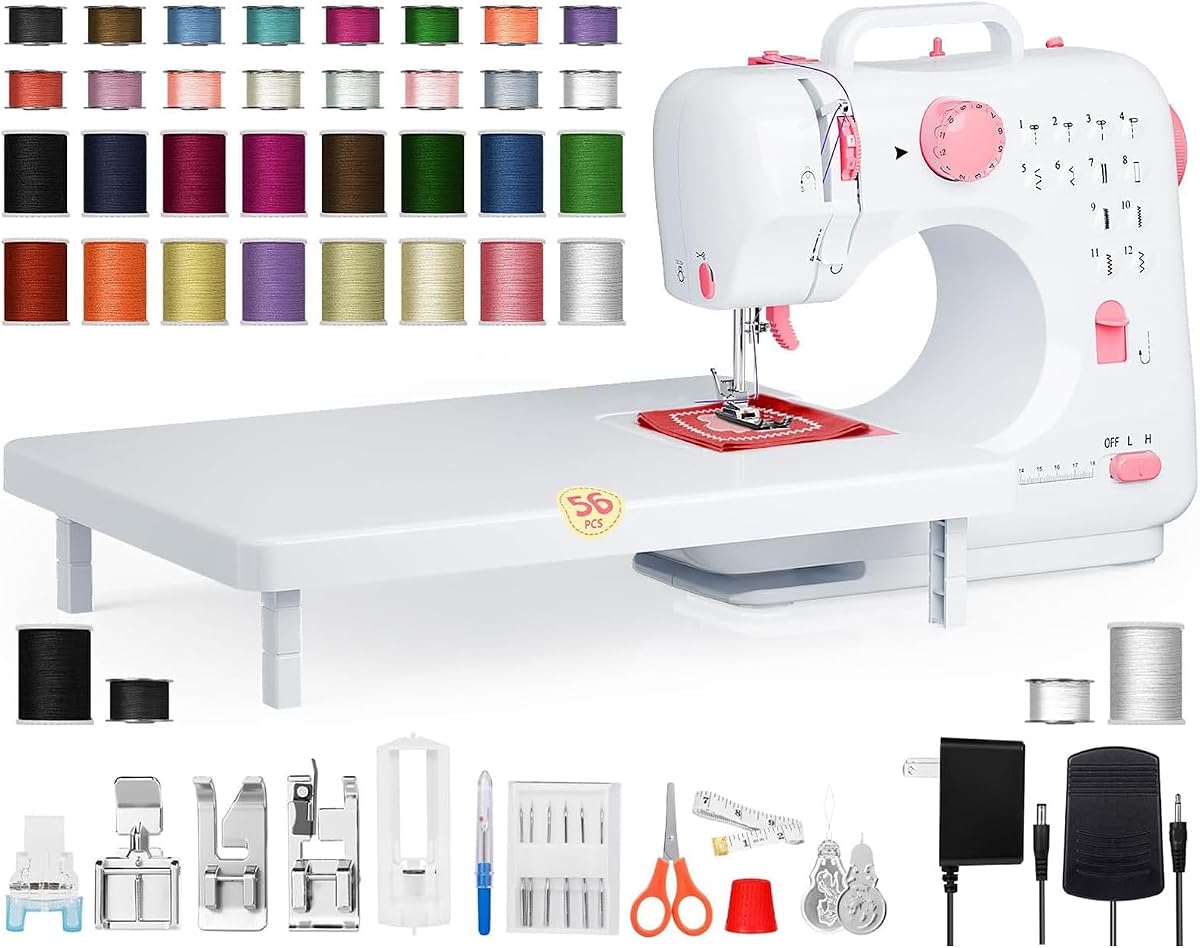
The Pink Portable Machine is a small, pre-threaded option intended for beginners making home repairs, crafts, and simple clothing projects. It measures 10.6 by 9.3 by 4.5 inches and weighs about five pounds, making it suitable for apartments, dorm rooms, small rooms, and compact craft areas.
We may earn a commission when you buy through this link, at no additional cost to you.
Its beginner-oriented design includes a built-in sewing light, adjustable speed control, simple button operation, and forward and reverse stitching. The 12 stitch patterns cover basic seams, hems, buttonholes, sleeve sewing, and simple decorative work. An automatic bobbin winder, thread cutter, storage drawer, interchangeable presser feet, and extension table add everyday convenience.
You can use the included AC adapter or four AA alkaline batteries, although batteries are not included. The listing advises operating with only one power source at a time. As with the other compact models, the product's 4.2 rating makes it important to examine current customer feedback and confirm expectations before purchase.
This machine suits a buyer who wants a compact, attractive setup for light projects and has limited storage space. The pre-threaded delivery and LED light reduce setup and visibility concerns, while the extension table supports more controlled work. It is best treated as a convenient craft and mending machine rather than a heavy-duty sewing platform.
The compact body is easy to place on a desk or shelf, while the extension table provides a more stable working area. This makes the machine practical for small homes and temporary craft spaces.
Pre-threading, a simple button interface, adjustable speed, and reverse stitching create a manageable starting point. The integrated light also makes it easier to follow the needle and thread path.
We may earn a commission when you buy through this link, at no additional cost to you.
The DAPRIL Mini Machine is a compact gift-oriented option for kids, women, beginners, and experienced sewists who want an easily operated machine for smaller spaces. Its 4.3 rating and beginner-focused description position it as a practical introduction rather than a heavy-duty production machine.
We may earn a commission when you buy through this link, at no additional cost to you.
Setup is supported by a detailed manual and video, while a low/high speed button lets users choose an appropriate pace. A built-in light improves visibility, the thread cutter provides a convenient finishing tool, and the extension table is intended to make the machine more stable on larger projects. The listing also describes upgraded environmental material and attention to durability.
The mini format saves space and makes the product easier to give or carry to a sewing class. However, the listing provides fewer specific stitch and fabric details than many competing machines, so buyers should consult the manual and current product information to verify suitability for their materials. A small footprint can also limit the size and complexity of projects.
This is a sensible choice for a child learning basic sewing under adult supervision, a gift for a beginner, or a sewist who needs a secondary machine for simple tasks. Its straightforward controls, visual aids, and supportive accessories make the initial experience approachable. For demanding fabrics or advanced construction, a full-size machine would offer a more clearly defined capability set.
The detailed manual and video help walk users through thread installation and basic operation. These aids are useful when a child or true beginner is making the first attempt.
The extension table, work light, thread cutter, and dual-speed control make the compact format more practical. Together they support clearer, steadier, and more comfortable sewing sessions.
We may earn a commission when you buy through this link, at no additional cost to you.
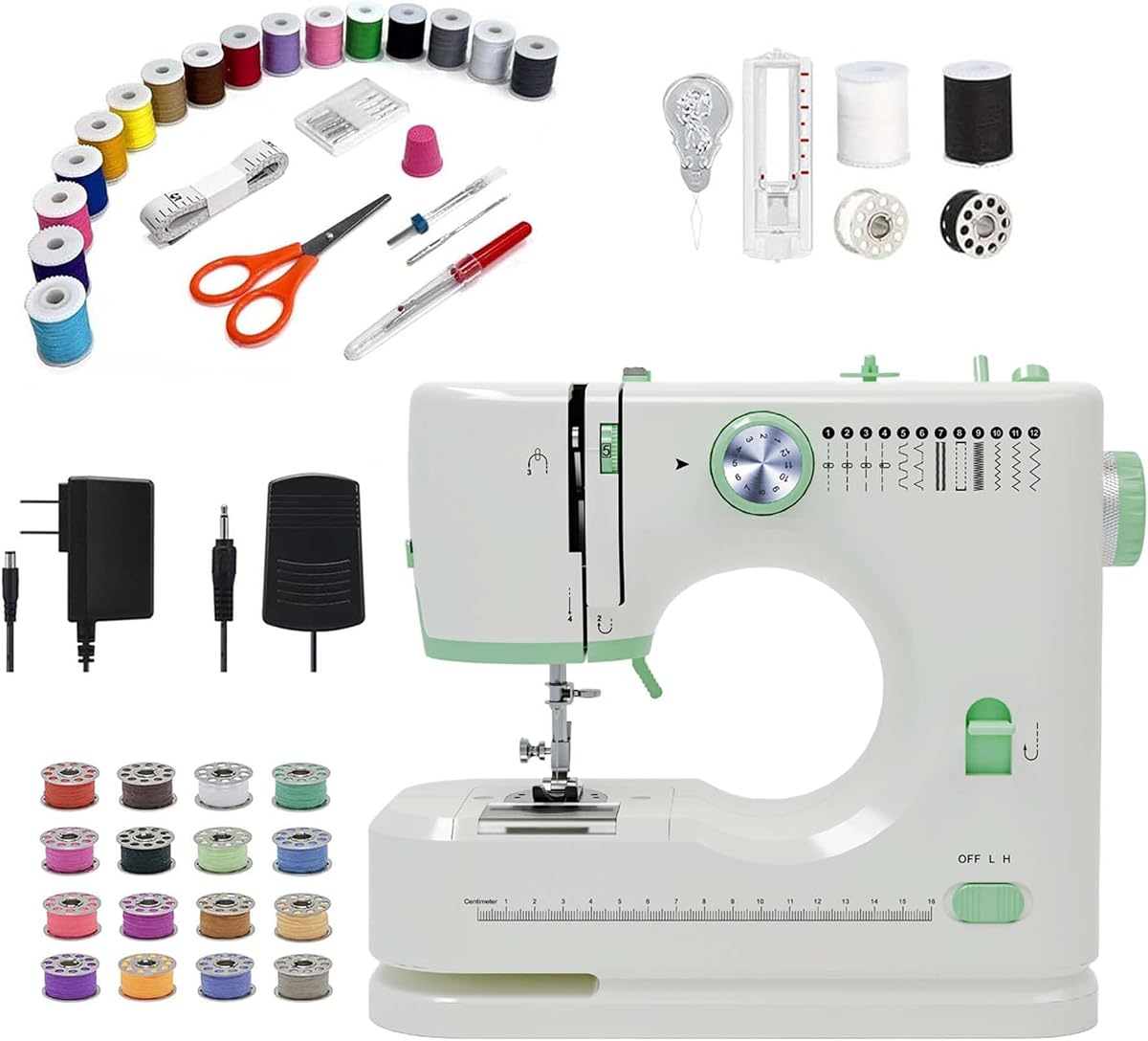
The Small Light-Fabric Machine has a 4.9 rating, the highest among the listed options, and is explicitly designed for beginners working with light materials. Its 10.3-by-9.5-by-4.4-inch body and 4.2-pound weight make it one of the most portable traditional machines in the roundup.
We may earn a commission when you buy through this link, at no additional cost to you.
Its 12 built-in stitches include straight, zigzag, overlock, and reverse, while two-speed control helps beginners learn at a manageable pace and move faster on larger items. The included 32-piece kit contains 32 colorful thread spools, a foot pedal, power cord, bobbins, needles, and a threader, allowing a new user to begin without immediately shopping for basic supplies.
The important limitation is explicit: this is a home and school entry-level machine for light fabrics, not a commercial, industrial, or heavy-duty unit. It works best with thin cotton, linen, and lightweight woven materials up to four to six layers. For slightly heavier material, the listing recommends two to four layers, while heavy denim and canvas should be avoided to reduce the risk of jamming.
This model is a strong fit for beginners making pajamas, underwear, children's dresses, matching sets, aprons, plush toys, or other lightweight items. It is less suitable for anyone expecting to work with thick denim, canvas, or demanding construction. Read the fabric guidance carefully, use the included low speed while learning, and test on similar material before beginning a valuable garment.
The 32-piece kit includes a substantial thread selection and the core tools needed to begin sewing. This makes the package convenient for beginners who want a coordinated setup.
This machine is designed for lightweight cotton, linen, and similar woven materials. Staying within the stated layer limits is the best way to reduce jamming and protect the machine.
We may earn a commission when you buy through this link, at no additional cost to you.
The easiest sewing machine is not necessarily the smallest or least capable. Your best choice depends on the fabrics you expect to sew, the projects you want to make, your available space, and how much hands-on guidance you need.
Threading is one of the most common obstacles for a first-time sewist, so it deserves careful attention. An automatic needle threader is the most direct solution, while a clearly marked thread path and pre-threaded delivery can also reduce setup time. Bobbin placement is another frequent source of confusion. Drop-in top bobbin systems are straightforward because the bobbin sits in an accessible top compartment, whereas front-loading systems may require a little more practice.
Prioritize a visible threading diagram, simple bobbin access, and instructions suited to your experience level. A machine that feels confusing during the first setup may remain frustrating even if its stitch list is impressive.
Beginners do not need to use every available stitch, but a useful selection creates room to grow. Straight, zigzag, buttonhole, blind hem, stretch, and decorative stitches cover common needs in garments and repairs. Preset stitch length and width can make the first projects less complicated because you can begin with established settings instead of learning every adjustment simultaneously.
Choose a machine with a few clear controls and an understandable selection method. More stitches are useful when paired with clear organization; a large but confusing menu may be less approachable than a smaller, well-guided set.
The fabrics and layers you plan to sew should determine the machine category. Handheld devices and compact mini models are generally best for light materials, simple hems, and small repairs. A full-size machine with a metal frame is a more logical choice for clothing, quilting, and repeated work. None of the compact home models in this guide should be treated as a commercial or industrial machine.
Check the stated thickness and layer limits carefully. A machine marketed for beginners may still be unsuitable for heavy denim, canvas, thick upholstery fabric, or numerous stacked layers. Choose based on your realistic project list, not on an aspirational one.
Your available workspace matters because a sewing machine needs room to sit steadily and allow the fabric to feed. A handheld model can fit into a drawer and travel easily, while a mini home machine may require a modest table or shelf. A traditional full-size unit demands more space but provides a more stable platform and a removable free arm for narrow sections.
Measure the intended location before buying. If you plan to attend classes or repair clothes away from home, portability may outweigh the broader capabilities of a larger machine. If your projects are mostly at a dedicated craft table, a larger model may be the more satisfying long-term choice.
A useful accessory package can make the first project much easier. Look for standard feet, bobbins, needles, a foot pedal, a power cord, and a clear instruction manual. A larger thread kit is helpful for experimentation, but a few reliable colors may be more useful to a new owner than dozens of options. Tutorial videos, printed threading guides, and technical support can be decisive when learning independently.
Check whether essential accessories are genuinely included and whether consumables such as batteries or practice fabric are excluded. Also review the manufacturer's support policy. Long-term help is more valuable than a generous box when a machine needs troubleshooting.
Power requirements affect where and how you can sew. Mini machines that support an AC adapter and batteries are more flexible, while a handheld unit may be particularly convenient through USB power. Traditional sewing machines generally use a foot pedal for speed control, which can feel natural and hands-free. Some beginner machines also offer a push button for direct operation.
For new users, dual controls can be helpful: the pedal offers fine speed management, while buttons make starting and stopping straightforward. Always follow the listed power guidance, and never combine two power sources unless the manufacturer specifically permits it.
The best beginner package combines understandable hardware with clear instruction. Built-in bobbin diagrams, quick-start guides, tutorial videos, and printed thread paths help you understand the machine before beginning a project. If you are completely new, a structured beginner's book can add valuable explanations of tools, settings, fabric, and exercises.
Plan to practice on inexpensive fabric, keep fingers clear of the needle area, and begin at a low speed. Make sure children have adult supervision and use age-appropriate materials. Instruction is especially important for compact machines because their simplified operation may not be immediately obvious.
A flat bed is useful for general seams, while an extension table can add support for smaller or more delicate pieces. A removable free arm is especially helpful for sewing around sleeves, cuffs, and other tubular areas. Buttonhole, zipper, blind hem, and darning accessories expand the machine's usefulness for specific construction and repair tasks.
Consider which accessories correspond to projects you already intend to make. A large selection is helpful, but matching feet and a reliable feed system are more important than a long list of rarely used components. Confirm that the included accessories fit the machine model.
Begin by placing the machine on a stable, clean surface and reading its manual from setup through threading, bobbin loading, foot selection, and power connection. Use only the intended power source, install the appropriate needle and foot, and check that the thread is correctly placed. Before using expensive fabric, sew several straight lines on inexpensive material at the lowest speed.
Choose a stitch and test its length, width, and tension on scrap fabric. Hold the fabric gently and guide it without pulling or twisting it. Learn the reverse lever, buttonhole sequence, and speed controls before starting a garment. Keep the work area illuminated, keep loose hair and loose clothing away from moving parts, and stop the machine if thread begins tangling or the fabric stops feeding.
For care, unplug the machine before cleaning or changing components. Remove lint from the bobbin area, feed dogs, and needle plate with the brush or tool recommended in the manual. Store the machine in a dry location, cover it when not in use, and replace worn needles and bobbins as needed. Follow the specified fabric limits, and avoid forcing thick layers through a compact machine.
The easiest machine for you is the one whose setup matches your learning preferences. A model with automatic threading, a drop-in bobbin, clear instructions, and straightforward controls is a strong starting point, while a pre-threaded mini machine can make the first session less intimidating. Match the machine's fabric limits to your planned projects rather than choosing only by stitch count.
Yes, handheld sewing machines are designed for simple, portable repairs such as loose hems, basic seams, and other light tasks. Their two-speed operation and small size can make them approachable, but they are not intended to replace a full-size machine for complex garments. They are best for light fabrics up to the thickness stated in the product listing.
A mini sewing machine can be an excellent choice for learners with limited space or simple project goals. Features such as pre-threading, LED lighting, automatic bobbin winding, and printed guides improve the initial experience. Check the supported fabric weight and layer count before using the machine on anything heavier than the manufacturer recommends.
Prioritize an easy threading path, automatic needle threader, accessible bobbin, and understandable controls. You also want an appropriate foot pedal or button control, a good work light, and a manual or tutorial that matches your experience. A broad stitch library matters less than the ease and reliability of the features you will use first.
It depends on the machine and the project. Compact home models can handle selected lightweight garments and small household items, while full-size models with metal frames are better suited to varied clothing work. A mini machine may struggle with heavy denim or canvas, so check its fabric limits and test on similar material before beginning a valued piece.
Choose a mini machine if your main goals are mending, crafts, teaching children, or working in a small space. Choose a full-size model if you expect to sew garments regularly, use multiple layers, work with heavier fabrics, or need more stitch and foot options. The mini machines listed here are entry-level home devices and are not commercial or industrial machines.
Read the machine's instructions, identify the thread path and bobbin system, and practice with inexpensive scrap fabric. Use a tutorial video or the included beginner guide alongside the manual. Begin with straight seams and simple hems, learn one control at a time, and keep the fabric flat rather than pulling it through the machine.
Unplug the machine before cleaning or changing the needle, foot, or bobbin. Follow the manual's instructions for removing lint from the feed dogs, needle plate, and bobbin area, and use a dry soft brush when appropriate. Store the machine in a dry place, avoid forcing unsupported fabrics through it, and replace worn needles promptly.
The Brother XM2701 is the strongest overall choice because it combines automatic threading, a drop-in bobbin, 27 stitches, a free arm, and a useful accessory package without becoming excessively complex. The Handheld Sewing Machine is the leading budget and portability option for simple repairs, while the Janome Blue Couture is the premium selection for buyers who want a durable full-size machine with extensive beginner aids.
Prioritize the qualities that match your actual work: easy threading, understandable bobbin access, enough stitches for realistic projects, adequate workspace, and a fabric range you can manage. The mini and portable machines are particularly suitable for light crafting and mending, while full-size options offer a sturdier platform for clothing. A beginner's guide can add valuable structure if you are learning terminology as well as machine operation.
Before purchasing, verify the current listing, electrical requirements, warranty conditions, included accessories, and fabric limitations. Ratings, product details, availability, and prices can change, so use the latest seller and manufacturer information to confirm that your chosen machine still meets your needs.