
RVBOATPAT Remote Disconnect Switch
4.3Editor score
Remote and manual disconnect control
Automatic low-voltage cutoff
Magnetic latching relay design
Driving-related safety interlocks
Discover the best battery disconnect switch for cars, trucks, RVs, and boats, with expert comparisons of fit, voltage, current rating, controls, and protection.
A battery disconnect switch gives vehicle, RV, marine, and equipment owners a dependable way to isolate battery power during storage, maintenance, or extended inactivity. The best model matches your terminal style, voltage system, cable arrangement, and required current capacity while providing a clear and secure operating method.
We compared ten switches using the supplied specifications, including supported voltages, continuous and cranking current ratings, terminal compatibility, mounting design, control method, and intended applications. The list covers manual and remote options, top-post and side-post styles, compact installations, and higher-capacity switches for demanding electrical systems.
Each review explains where a switch is strongest and where compromises may arise, helping you choose with confidence rather than relying on a single headline rating. Product details and availability can change over time, and current prices fluctuate, so confirm the latest listing and your battery configuration before buying.
4.3Editor score

4.7Editor score

4.2Editor score
The comparison below highlights the major differences among ten battery disconnect switches, including electrical range, terminal fit, operating method, and special features. Use it to narrow the field before checking the detailed reviews and your battery's exact configuration.


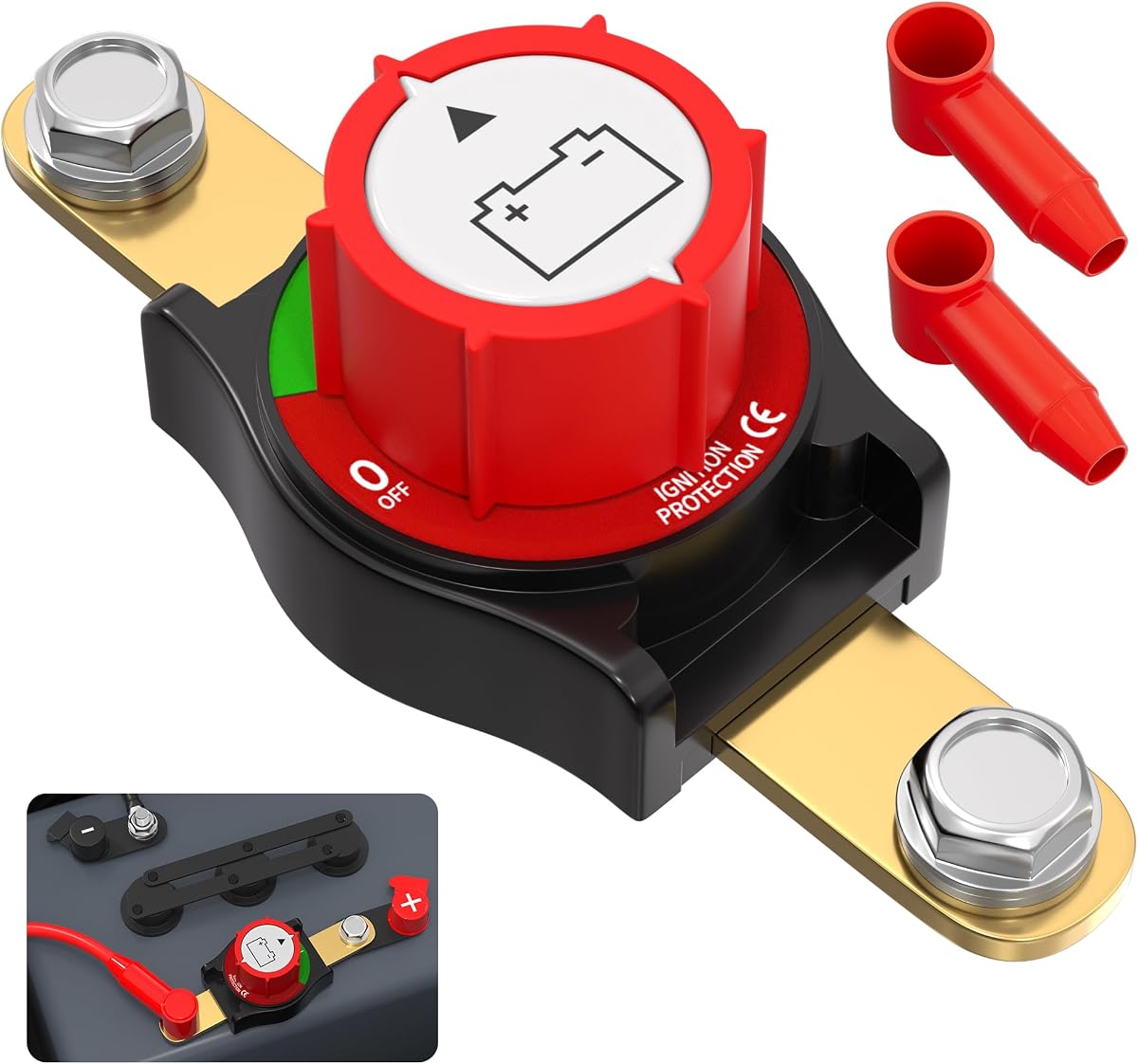

This Joinfworld switch is a conventional top-post battery disconnect designed to sit in the negative side of a vehicle, boat, RV, or other DC electrical system. It is rated for 12–48 volts, with a stated 250A continuous capacity and 1000A cranking capacity. Its core appeal is straightforward isolation: rotate the control to open or close the battery circuit without removing a cable by hand.
We may earn a commission when you buy through this link, at no additional cost to you.
The installation package includes a negative battery clamp and tapered post, allowing the switch to become part of the negative cable connection rather than merely sitting beside the battery. Copper components support dependable conductivity, while the ABS housing is designed for regular electrical-system use. The two-position on-off layout is easy to understand and can be locked with other compatible switches when additional isolation is required.
Its main uncertainty is that the supplied listing does not provide a customer rating, so buyers cannot compare a verified rating history with the more established options in this roundup. The stated current figures also describe the switch rather than an entire starting system, so alternator output, cable size, and engine requirements still deserve attention. Even so, the broad voltage range and extensive application list make it a versatile candidate.
Choose this model if you need a straightforward negative-side top-post switch, work across 12-, 24-, or 48-volt systems, and want a high cranking figure without moving to a remote or dual-terminal design. It is especially appropriate for cars, RVs, campers, boats, trucks, ATVs, UTVs, and battery banks where physical disconnection during inactivity is the main goal.
Keeping the switch on the negative side makes accidental contact with energized metal less likely during installation and servicing. The two-position control also gives a clear visual indication of whether battery power is flowing through the switch.
The stated 1000A cranking capacity is useful for vehicle owners who need more headroom than a basic low-current accessory switch. Confirm that the battery cables and surrounding electrical equipment are appropriately rated for the same load.
We may earn a commission when you buy through this link, at no additional cost to you.
This compact 12-volt top-post switch is designed around a more adjustable installation than a fixed-angle battery switch. It has a 4.4 rating and offers ON, OFF, and removable-knob positions, allowing the user to disconnect power or physically remove the control for added security. Its stated fit range is 15–17 millimeters, making post measurement an essential pre-purchase step.
We may earn a commission when you buy through this link, at no additional cost to you.
The body uses Nylon 66 rather than the ABS material commonly found in comparable switches. According to the supplied description, that material provides more than 30 percent greater strength and improved flame resistance. A solid brass construction supports conductivity and corrosion resistance. The adjustable mounting angle is especially valuable in cramped engine compartments where fixed cable geometry can place unwanted strain on the connection.
The model supports two installation approaches. It can mount directly to a compatible negative battery post using the clamp end, or both ends can accept wire lugs for a custom cable arrangement. That versatility broadens its appeal, although the listed 12-volt designation and narrower terminal range make it less appropriate than 12–48V models for larger commercial or multi-battery systems.
This switch is a strong fit for a 12-volt car or light vehicle owner who values a removable control and adaptable angle. It is less suitable if you have side-post terminals, a post outside the stated range, or a system requiring 24- or 48-volt support. Verify clearance and cable direction before installation, and remember that removing the knob is only one layer of theft deterrence.
The knob can be taken away after the switch is turned off, making it harder for someone to restore power casually. This is useful for long-term parking, but it should not replace normal vehicle security practices.
Rotating or adjusting the switch lets the negative cable approach the battery at a more natural angle. That can reduce tight bends, improve terminal contact, and make installation easier in a crowded compartment.
We may earn a commission when you buy through this link, at no additional cost to you.
This 12–24V switch receives a 4.6 rating and centers on installation flexibility. Both terminal ends rotate through 180 degrees, allowing fixed battery cables to approach from different directions without being forced into an awkward angle. The design targets SAE-style top-post negative terminals measuring 17–19 millimeters in diameter.
We may earn a commission when you buy through this link, at no additional cost to you.
Its thickened high-purity copper contact structure is intended to support stable current flow while limiting resistance and heat associated with poor connections. Installation is straightforward: remove the negative battery cable, position the disconnect, reconnect the cable, and tighten it. The supplied package includes a wrench and two washers, reducing the need for additional specialized tools.
The limitation is compatibility rather than quality. It is explicitly not designed for side-post batteries, positive terminals, or posts below 17 millimeters. The 24-volt ceiling also excludes 48-volt systems, although it covers a useful range of passenger vehicles, trucks, RVs, campers, and boats that use 12 or 24 volts.
This is an appealing choice when cable direction and limited space are the main installation challenges. It has the strongest published rating among the switches with a numeric customer score in this list. Confirm the post diameter before ordering, and inspect the switch and cable ends regularly for tightness, corrosion, or heat discoloration after installation.
A switch that can align with the existing cable direction reduces the need to reposition heavy cables or create sharp bends. It can also make terminal access easier when the battery is positioned low or close to a body panel.
A solid contact structure is important because a loose or corroded connection can create resistance and heat. The supplied design emphasizes thickened copper, while correct tightening and periodic inspection remain essential.
We may earn a commission when you buy through this link, at no additional cost to you.
The Nilight 90015A combines a 4.7 customer rating with a broadly specified 12–48V electrical range. It is rated at 275A continuous, 455A intermittent, and 1250A momentary for cranking at 12 volts. That gives it a credible combination of sustained capacity and starting headroom for cars, trucks, marine systems, RVs, and other DC equipment.
We may earn a commission when you buy through this link, at no additional cost to you.
The ABS housing includes a rear cover intended to insulate terminals against short circuits, while the package contains four sets of bolts. The switch offers two-position on-off operation and can stand alone or be locked together with other switches. Its stated waterproof construction is especially relevant to marine installations, where moisture and corrosion are constant concerns.
It does not offer remote operation, programmable cutoff, or a removable-key security system, so it is a more conventional mechanical solution than the remote models. Its usefulness depends on having reasonable access to the battery and a mounting position where the control cannot be inadvertently moved. The installation also needs to meet local electrical and marine safety requirements.
This is our top overall pick because it balances broad voltage support, strong current figures, protective construction, and the highest numerical rating in the group without introducing complex electronics. It suits users who value direct, dependable mechanical isolation across a wide range of vehicles and equipment rather than app-like convenience or remote access.
The continuous, intermittent, and momentary ratings give you a clearer picture of expected use. Continuous current supports the battery connection during normal operation, while the higher cranking figure is intended for short starting bursts rather than sustained loads.
The covered rear section helps insulate terminals, while the waterproof housing suits exposed marine or outdoor installations. Sealed or covered hardware still requires regular inspection, especially around exposed studs and cable terminations.
We may earn a commission when you buy through this link, at no additional cost to you.
This switch is built around tight-installation flexibility. Its stated height is only 1.5 inches, making it shorter than many top-post battery switches and potentially useful beneath low hoods or inside constrained battery compartments. It supports 12–48V systems and carries stated ratings of 300A continuous and 900A cranking, with an IP66 waterproof rating.
We may earn a commission when you buy through this link, at no additional cost to you.
The package is unusually complete for a compact model. It includes an installation guide, negative SAE female clamp, negative SAE male terminal post, and an adjustable spacer. A large red knob is easy to turn, and it can be removed to discourage unauthorized use. The PA66 housing is rated from minus 40 to 284 degrees Fahrenheit, supporting use across a wide temperature range.
Its obvious trade-off is that disconnecting the battery also removes power from the entire system. The supplied information specifically warns that electronics storing data, such as a radio, may lose memory each time the switch is turned off. The compact geometry and removable control are valuable, but users should expect this consequence when selecting a whole-system mechanical disconnect.
This is a strong choice for owners of cars, trucks, RVs, boats, and other equipment with limited hood clearance who also need a high stated continuous current rating. Measure available space before ordering, and decide in advance whether your aftermarket electronics depend on retained power.
A lower switch profile can make the difference between a clean installation and one that interferes with a hood, cover, brace, or cable route. The included adjustable spacer adds another layer of positioning flexibility.
The red knob is easy to locate and operate while still allowing the user to remove it after isolation. That makes the switch more useful against casual tampering without requiring a complicated lock.
We may earn a commission when you buy through this link, at no additional cost to you.
The RVBOATPAT model brings remote control and automatic protection to a 12-volt battery disconnect. It is rated to handle 240A continuous and 1000A instant current, with a magnetic latching relay designed to consume only 3mA in standby. The remote lets the user isolate power without reaching into a crowded engine compartment or battery tray.
We may earn a commission when you buy through this link, at no additional cost to you.
Its voltage management is the defining feature. The switch cuts power when battery voltage reaches 11.8 volts, which is intended to reduce deep discharge during long parking periods. A driving guard disables the remote while cranking and when voltage is above 13.2 volts, reducing the possibility of an accidental power interruption on the road. The unit also provides manual control for emergency or service use.
Compared with a purely mechanical switch, this design adds electronics, installation connections, and another potential failure point. It also manages battery power rather than modifying a vehicle's original emissions equipment. The user still needs to understand what accessories and control systems will react when the battery is disconnected.
This is the premium selection for owners who want convenient remote access and automatic low-voltage protection. It is especially appealing for an RV, boat, or vehicle stored for long periods where parasitic drain is a recurring concern. Confirm that 12 volts matches the system and review how aftermarket electronics behave during a complete power interruption before installation.
A remote can make routine isolation much easier than reaching a switch under a hood or behind interior trim. It is particularly useful when the battery is installed in a compartment that is inconvenient or difficult to access.
The automatic cutoff at 11.8 volts is intended to intervene before prolonged deep discharge. Driving-related interlocks add another layer of protection against unintended shutdown while the vehicle is in use.
We may earn a commission when you buy through this link, at no additional cost to you.
This remote kill switch is designed for 12-volt cars and trucks, with a 4.3 rating and a very low stated standby current of 0.003A. The control can disconnect the battery remotely, while a manual option provides a fallback for emergencies and electrical work. That combination makes the product accessible to users who want convenience without losing direct control.
We may earn a commission when you buy through this link, at no additional cost to you.
Its automatic behavior is similar to the RVBOATPAT model. When voltage falls below 11.8 volts, the unit cuts power after 120 seconds. Above 13.2 volts, remote operation is disabled to help prevent accidental interruption while driving. The design targets common sources of long-term drain, including aging wiring, electronics left active, and forgotten lights.
The supplied information does not state a continuous or cranking current rating, which makes that specification harder to compare with the high-capacity mechanical models. The lack of a published voltage ceiling means it should not be assumed to support 24- or 48-volt systems. Users with high-output alternators, large battery banks, or heavy accessory loads need to verify electrical suitability before installation.
This switch is most compelling for a 12-volt vehicle owner who wants remote anti-theft control, low standby consumption, and automatic low-voltage isolation. It is a good candidate for a stored daily driver, work truck, or camper, provided the vehicle's load requirements and wiring method are compatible with the product.
A magnetic control with a stated 0.003A standby draw is designed to minimize the burden of leaving a remote switch connected. That makes the product more practical for extended parking than a system that continuously consumes meaningful standby power.
The manual control is valuable when the remote is unavailable or when a technician needs direct isolation. It also provides a familiar physical option for users who do not want to depend entirely on remote electronics.
We may earn a commission when you buy through this link, at no additional cost to you.
This Joinfworld model fills an important gap in the roundup by targeting side-post batteries directly. It supports 12–48V systems and is rated at 275A continuous, 455A intermittent, and 1250A cranking for ten seconds. The terminals use M10 tinned copper studs, and the package includes copper conductive mounting brackets for direct connection without a separate adapter.
We may earn a commission when you buy through this link, at no additional cost to you.
The housing is made from ABS plastic and includes a rear cover intended to insulate terminals against shorts. Its two-position on-off operation keeps the control understandable, while the ability to stand alone or be locked with other switches adds flexibility for more complex battery banks. The waterproof emphasis also suits the marine applications emphasized in the product information.
Because it is tailored to side-post terminals, it will not be a universal answer for every battery. The listing does not provide a customer rating, leaving less direct feedback than several competitors. Users must also ensure the included brackets, cable lugs, and stud dimensions correspond to their battery and cable configuration.
This is a focused choice for a vehicle or boat with side-post terminals where a top-post model would be awkward or incompatible. It combines broad voltage support with a substantial stated continuous rating and compact bracket-based installation, making it particularly relevant for marine and automotive electrical systems that need a direct side-terminal solution.
The included conductive brackets allow the switch to connect directly to compatible side-post batteries without buying a separate top-post adapter. That reduces parts count and can produce a cleaner, more secure cable route.
The rear cover helps insulate the terminal area from accidental contact and short circuits. It is especially useful in crowded engine compartments where tools and clothing may accidentally brush against exposed conductive parts.
We may earn a commission when you buy through this link, at no additional cost to you.
The BURMONG switch delivers a 275A continuous rating across a stated 12–48V range, offering a straightforward mechanical option for many cars, trucks, RVs, boats, ATVs, and battery banks. Its 4.2 rating reflects a practical design centered on easy installation, clear on-off positions, and dependable power isolation rather than remote intelligence.
We may earn a commission when you buy through this link, at no additional cost to you.
The switch rotates through 90 degrees to indicate on and off, which is intuitive for most users. A solid brass or copper clamp and ABS housing are specified for conductivity, corrosion resistance, and electrical safety. The product is typically mounted on the negative terminal, helping reduce the chance of a direct short during servicing.
One detail deserves attention: the clamp is described as brass or copper, which may indicate material variation between production batches. The listing also provides no removable-key feature, remote control, or automatic voltage threshold. Those omissions are reasonable for a basic disconnect, but they mean the switch depends on physical access and deliberate operation for theft deterrence and long-term storage management.
This is the budget pick for buyers who want a high stated continuous rating and wide voltage compatibility without paying for a remote system. It is well suited to straightforward battery isolation on a compatible vehicle or boat, provided you verify the terminal style, cable fit, and included hardware before installation.
A basic rotary switch has fewer electronic components than a remote model. That can translate into fewer operating dependencies, straightforward use, and an installation that is easier to understand and service.
The stated 12–48V range covers many common automotive, recreational, and marine systems. Confirm the actual battery-post type and the continuous current needed by the vehicle before treating the switch as a universal fit.
We may earn a commission when you buy through this link, at no additional cost to you.
This package includes two manual rotary battery disconnect switches designed for 12- and 24-volt systems. It has a 4.0 rating and is built around pure copper contacts, a simple 90-degree operating motion, and a compact form intended to fit common battery-terminal layouts. Including two units gives users more flexibility than a single-switch package.
We may earn a commission when you buy through this link, at no additional cost to you.
The pure copper contact structure is presented as a way to support high conductivity, low resistance, and reduced voltage drop. Operationally, the user rotates the switch upward to cut power and downward to restore it. Because the design contains no electronics, it does not draw standby power and will not interfere with vehicle communication through a powered network.
The product description does not provide a continuous or cranking current rating, which is the biggest specification gap in the roundup. A material label alone cannot establish whether a switch is appropriate for a high-output alternator, large battery bank, or demanding starter. Post dimensions, cable lug fit, and mounting details should be confirmed with the listing and the user's battery before purchase.
This two-piece set is best for someone who values simple mechanical control, copper contacts, and the option to install one switch or distribute two across separate circuits. It may suit cars, trucks, RVs, boats, trailers, and campers, but buyers with high current demands should choose a model with clearly published capacity figures.
A pair can be used for separate positive and negative isolation, multiple battery banks, or a spare kept for another application. The two-unit format is useful when a single-switch package would not provide enough placement options.
A purely mechanical switch has no standby consumption, firmware, pairing process, or remote battery. It isolates power only when the user moves the control, making behavior easy to predict during storage and service.
We may earn a commission when you buy through this link, at no additional cost to you.
The right battery disconnect switch depends on electrical capacity, battery-terminal design, system voltage, available space, and the level of control you need. Comparing those factors before installation is the most reliable way to avoid poor fit, insufficient capacity, or unwanted system interruptions.
Begin by identifying whether your battery uses a top-post or side-post terminal, then measure the relevant post or stud dimensions. Several switches in this guide are specifically designed for SAE-style top posts, while one is tailored to side-post batteries. A switch that looks physically similar can still be unsuitable if its clamp, stud, or post range does not match the battery. Check the cable lugs as well as the battery terminal because a secure battery-side connection does not help if the opposite cable end will not fit the switch.
In short, confirm terminal type, post diameter, stud size, cable clearance, and mounting space before buying.
Continuous current describes the load the switch can carry while remaining engaged, while cranking or momentary ratings cover brief high-current events. Compare the switch with the demands of your alternator, starter, battery bank, inverter, winch, and other high-draw accessories. A higher rating is generally useful, but a real installation also depends on correct cable gauge, clean terminations, adequate fusing, and sound vehicle grounding. Never treat a momentary cranking figure as a continuous rating.
Choose a model with continuous capacity above the expected sustained load and a cranking figure appropriate to the starter.
The voltage rating defines the electrical systems on which the switch may be used. Five of the listed models support a broad 12–48V range, while others are limited to 12 volts or 12–24 volts. Your alternator, battery bank, and accessories must all operate within the selected switch's range. Higher-voltage compatibility is useful for commercial, industrial, and larger RV systems, but it does not eliminate the need to verify current capacity and construction.
Match the labeled voltage range to every part of the system rather than the battery label alone.
Manual rotary switches are direct, simple, and easy to service, but require physical access whenever you want to change the circuit. Remote switches improve convenience, especially in a crowded engine bay or an RV with a hard-to-reach battery, while automatic cutoff models can respond to voltage thresholds. Electronic features introduce additional considerations, including standby consumption, failure modes, and interlock behavior. Decide whether convenience or mechanical simplicity is more important before choosing.
Manual controls favor reliability and directness; remote and automatic controls favor accessibility and active battery management.
Battery compartments can be surprisingly restrictive, with hoods, braces, air intakes, and cable paths limiting available space. The compact top-post model is specifically designed for low-clearance installation, while the dual rotating-terminal switch and adjustable-angle model offer more freedom in cable direction. Consider not only the switch body but also the knob's turning path and the space needed to connect a wrench. Avoid forcing a fixed-angle switch into a position that puts stress on the terminal.
Measure the compartment and plan the cable path before selecting a switch, especially in marine and RV installations.
Marine, RV, and outdoor installations face moisture, salt, temperature changes, and corrosion. Some models explicitly advertise waterproof housings or IP66 protection, while others emphasize covered terminals and corrosion-resistant materials. The enclosure rating does not make exposed studs, bolts, and cable lugs immune to corrosion. Use marine-appropriate cable and terminations, protect vulnerable connections, and inspect them periodically for green staining, heat, looseness, or salt accumulation.
Prioritize sealed construction in wet environments, but also protect and inspect every exposed electrical connection.
A disconnect switch can deter casual tampering because the vehicle will not start if the battery circuit is open, but it is not a substitute for a comprehensive alarm or immobilization system. Removable knobs offer a simple physical deterrent, while remote controls make it easier to isolate power without reaching the battery. Consider who may need access, such as a family member, mechanic, or roadside assistance provider, and keep the control or a clear operating procedure somewhere accessible and secure.
Use removable or remote controls for added deterrence, while ensuring authorized users can restore power safely.
A battery switch usually removes power from the whole vehicle or equipment system. That may reset radio presets, clocks, security codes, window settings, or other stored data, and it can interfere with communication between electronic modules. Remote and automatic switches are especially likely to cause interruptions. Test which functions you can live without restoring or program them after a complete power loss. If essential equipment must remain active, plan a separate auxiliary power arrangement.
Choose the switching method only after considering which electronics and convenience features will lose power or reset.
Before installation, turn off the vehicle or equipment, remove the ignition key, and disconnect the negative battery cable first. Follow the switch instructions, confirm the terminal and cable dimensions, and position the control where it will not interfere with a hood, cover, moving parts, or hot components. Reconnect the negative cable through the disconnect, tighten the fasteners evenly, and check that the switch is firmly supported rather than placing stress on the battery post.
After installation, test both positions with the engine off and confirm that the intended electrical loads respond as expected. If using a remote model, learn the pairing and manual override procedures before relying on automatic cutoff. Never activate a remote disconnect while the engine is cranking or the vehicle is moving. After any full power interruption, restore radio presets, clocks, security functions, and other settings that may have been lost.
For maintenance, disconnect power before touching connections and follow the vehicle manufacturer's battery-isolation procedure. Inspect the switch, cable lugs, and terminals periodically for looseness, corrosion, discoloration, melting, or unusual heat. Clean with appropriate tools and protect exposed metal in marine environments. Recheck tightness after the first several starts, and replace damaged or heat-discolored parts rather than relying on the switch to protect an overloaded circuit.
Most automotive installations place the switch on the negative battery terminal because accidental contact with a positive post can create a direct short. Some marine or multi-battery systems use positive-side isolation for different switching or load-control reasons, following a system-specific wiring plan. Follow the switch instructions and consult the vehicle or equipment wiring diagram rather than assuming either side is always correct.
A purely mechanical switch does not consume standby power because it has no active electronics. Remote models do draw a small amount while connected, although the two remote options here specify very low standby consumption through magnetic latching. Automatic models can also monitor voltage and disconnect at a set threshold. The exact standby draw should be checked in the listing and considered alongside the battery's condition and storage duration.
Only if the manufacturer explicitly rates the switch for 24 volts. Some products in this guide support 12–24V or 12–48V, while others are labeled for 12V only. Voltage rating, continuous current rating, and terminal fit must all be verified. Using a switch outside its rated voltage can cause arcing, overheating, premature failure, or an unsafe installation.
The continuous current rating should comfortably exceed the largest sustained current expected through the connection, while the cranking rating should cover the starter's short-duration demand. Also consider alternators, inverters, winches, and other heavy accessories. Cable size, fusing, terminal condition, and installation quality can limit real-world performance even when the switch itself has a high rating.
It can, because a full battery disconnect removes power from the entire system. Radio presets, clocks, security settings, window memory, and communication between electronic modules may reset or be temporarily unavailable. Remote or automatic models can make interruptions more frequent. Identify the functions you need, restore or reprogram them after power loss, and consider a separate auxiliary-power solution if they must remain active.
Inspect it at least when routine vehicle or equipment service occurs, and more frequently in wet, salty, or heavily used marine environments. Check the knob, mounting hardware, cable lugs, terminals, and housing for looseness, corrosion, cracking, discoloration, or heat. A switch that becomes stiff, intermittent, warm under normal load, or visually damaged should not be relied upon for isolation.
It can deter casual theft because the starter and many electrical accessories will not operate while the battery circuit is open. It is not a complete security system, however, and sophisticated thieves may bypass it or target the battery separately. A removable knob, remote control, alarm, immobilizer, and secure parking strategy provide stronger layered protection.
Not safely without the correct compatible hardware. A top-post clamp will not properly grip a side-post terminal, and an improvised adapter may create a poor connection or inadequate electrical capacity. Choose a switch designed for the actual terminal type, or use manufacturer-approved conversion hardware where permitted. Confirm the post diameter, stud dimensions, cable lug size, and available installation space.
The Nilight 90015A stands out as the best overall option because it combines a strong 4.7 rating with 12–48V support, substantial continuous and cranking figures, and protective construction. The RVBOATPAT remote model is the premium choice for convenient remote operation, automatic low-voltage cutoff, and magnetic latching, while the BURMONG provides the most budget-friendly route to a 275A continuous mechanical disconnect.
Prioritize terminal fit, system voltage, and current capacity before considering convenience features. A remote control or automatic cutoff may be valuable in an RV or boat with a difficult-to-access battery, but a simple mechanical switch can be easier to understand and maintain. Also consider whether a complete power interruption will reset important electronics and whether the switch can be reached safely for routine operation.
Before ordering, confirm the battery-post type, measure the available space, check the cable size, and compare the switch's published voltage and current ratings with your complete electrical system. Product specifications, ratings, and prices can change, so review the current Amazon listing before making a final purchase decision.
